Tuesday, February 25, 2025

Trying to Catch Up/ Loving the Embarrassment

Here it is, the final days of February and the first blog post in over a month. Usually, January finds me pretty energized and prolific here, especially in the wake of Winter Jazz Fest. The entries usually stay fairly consistent until the spring, or even summer. Not this year. You'd think The Man came and took me away.

Not quite, thankfully. The good news is that my lack of blog posts can be attributed to being busy in other places. With JazzTimes back, online only at this point, I've been busy working on assignments for them. In addition to my dispatch on the Manhattan Marathon of Winter Jazz Fest (see previous blog post for a link), I've contributed three pieces this month:

Bassist Joe Sanders, a Milwaukee native who now resides in France and recently released his album Parallels

My Overdue Ovation on bassist Steve Tintweiss, a piece which was overdue itself, having been slated to run in JazzTimes around this time two years ago, right before the magazine was sold and the new owner (who has since sold it) got rid of all of us "gatekeepers."  That piece appeared on this site but the version in the link has been tightened up and updated. 

Trumpeter Ambrose Akinmusire, whose latest album, honey from a winter stone, recently came out on Nonesuch Records. 

It's great being back in the JzzTimes fold, as my first entry into the magazine happened just over 22 years ago, when I profiled Marshall Allen not long after he had taken the helm of the Sun Ra Arkestra. (Marshall recently turned 100 and just released an album as a leader of a smaller group.) Plus, some of the writers from JT's prime are back too - including editor David Adler and contributors like Morgan Enos, Geoffrey Himes and Allen Morrison. Please check it out. David is posting new stuff almost every day and I need to catch up. Don't begrudge the ads that are there. We have to generate some revenue in order to survive. 

Along with those pieces, I also have a review in the February issue of the New York City Jazz Record of the latest album by cellist Christopher Hoffman. This link goes to the whole issue, which can be read and downloaded, which I recommend. There are a lot of good features this month - and a little bit of me. 

*


A few days ago, I finally watched We Were Famous, You Don't Remember: The Embarrassment, a great documentary on the great, unsung Wichita, Kansas band the Embarrassment. (I've very, very slow with getting to films.) They existed from the late '70s into the early '80s, causing quite a stir in their hometown, which created a ripple effect that touched people far beyond in other cities. They did it without releasing more than a couple EPs and a few single, all on their own. They're one of those bands that is not widely known, but the people who do know them are absolutely fanatical about them. With good reason.

Through some stroke of luck, filmmakers Daniel Fetherston and Danny Szlauderbach uncovered a bunch of live footage of the band, much of which had decent-to-good sound quality. The four-piece band was clearly one of those groups that took a smattering of musical knowledge and combined that with youthful enthusiasm to make things up in their own. Watching them tear it up at a basement party, I felt like I was there because I was bopping around on the couch picking up on their energy. 

When you watch a film with the subtitles on (like I do), it gives you an extra perspective on the band's lyrics, since they often flash up on the screen. I knew the band was clever to begin with, but singer John Nichols really slayed me when I caught when he was singing in "Celebrity Art Party." 

The main reason it struck such a chord with me - aside from relating to the band's excitement and the idea of writing songs about wild topics that might have been discussed in a college class right before practice - probably had something to do with that period of time being long gone. Granted it might be easier now for a band like the Embarrassment to get the word out about what they do, to make connections and get to more cities. But at that time, there was no real standards set, especially in literal Middle America. You did what you felt because it felt right. 

And in conjunction with all of that, the end of it bummed me out a little bit. I know that's the basic story arc of these things. They didn't have a tragic ending like some bands. They had just had enough. But the stories from people they knew back then about how crushed they felt - I think that's the part that got me. A small flock of people felt really invested in this band. They believed in them because they had this "thing" that made the hearts beat faster. I'm getting overly poetic about it but it again harkens back to a more innocent time when bands could really felt like something more than just a band. 

Of course, Embarrassment guitarist Bill Goffrier would soon more to Boston and get into Big Dipper, who rocked the next breed of music geeks like me, making the whole life of putting out records on a small label and traveling in a van seem like the greatest life there was. So there is that happy epilogue. (About a year ago, I found out that the Embarrassment played Pittsburgh's fabled Electric Banana once. Bill said he mentioned it the first time they came here which is probably true but I was too wound up that night to remember that.) 

We Were Famous (whose title comes from a song lyrics) is streaming on Tubi, so you should watch it there. Or go to the official site for it and find out how to watch it

Sunday, January 19, 2025

Winter Jazz Fest Hits Brooklyn + Seeing Old Indie Rock Friends

On Saturday, January 11, the Winter Jazz Fest moved over a borough for the second night of multiple acts at nine different venues. The Brooklyn Marathon was a night that the dance card filled up quickly and even tougher choices had to be made about who to see and who would be missed. As my JazzTimes colleague Martin Johnson pointed out in his report on the evening, there were many places where it was a challenge to get through the door. After succeeding in getting in, it felt better to simply park oneself and not move. (Glad it wasn't just me that felt this way.) 

However, before the jazz, I had to check out an indie rock show in the neighborhood. Back in the early '00s, the Naysayer landed in my sphere and stayed there. Anna Padgett fronted the band with a cast of friends that included Cynthia Nelson (also of Ruby Falls, Retsin), Karla Schickele (Ida, Beekeeper) and others. The songs blended dry wit of her lyrics and her semi-stark music that often sounded like mutant country. My band the Mofones opened for the Naysayer on one visit to Pittsburgh and the band stayed at my house. Aside from being social media friends, we hadn't talked since then. 

So I was really excited to see the Naysayer was playing Pete's Candy Shop in Brooklyn, opening for Mascott, another band I fell hard for around that time. The nom de stage of Kendall Jane Meade,  that band played elaborately layered pop songs on albums like Dreamer's Book, which is still pull out every few months. Saturday night was the release show for Mascott's new album.


Anna Padgett of the Naysayer

The back room at Pete's Candy Shop feels about as big as half of a subway car. It's also similar to what I imagine the Cavern felt like when the Beatles were playing there: brick walls, with a slightly raised stage at one end. A glass door sits at the opposite end but it stays shut during performances. One must walk around the hallway to get it. 

When I arrived, the Naysayer were doing their soundcheck. Anna looked at me with a faint sense of recognition. I asked if she remembered staying at my house 20-plus years ago. "Yeah. 'Cat Butler,' right?" she asked, remember a notorious Mofones song. "I love that song!" It took me a moment to realize the bassist was Schickele. When I did, I realized she was playing the same bass that she had back in the day, with a right-hand technique that always impressed me, seeming to barely touch the strings but still delivering a big sound. 

The Naysayer's set was a trip down memory lane. Early faves like the unsettling "Currency," "Ring Ring Ring" and the raunchy but sweet "Pure Beauty" all played into that, with killer harmonies from Schickele. I was hoping to hear my fave of her softer songs, "Kitten Time," but since I felt like I had already crashed someone else's party, I kept quiet. I had to slip out before Mascott's set but I'm hoping to pick up the new album somewhere online. 

Had I known what awaited me down around the corner in Williamsburg, I might have stayed at Pete's a little longer. I figured I'd probably only catch half a set by Vijay Iyer's Trio + 1 but that would still be satisfying enough. Winter Jazz Fest is all about taking in as much as you can in a short time. But when I walked up to National Sawdust, where Iyer was presumably already deep into his set, the line was out the door and around the corner. Only about seven people were in the VIP line so, although it wasn't my night to be an official press guy, I figured I'd play that card. I gave up after hearing someone come up to a person in front of me saying, "We're going someplace else. They won't even let [such-and-such] in, and he's playing!" 

Loove Labs, a sort of gallery and performance space just down the block on N. 6th Street, wasn't turning folks away. The front area was equally crowded with people hoping to get into the back room, where the music was happening. Though it wasn't ideal,  I really wanted to see the sets by both Darius Jones and the Matthew Shipp Trio, so as pianist Paul Cornish played his set, I joined the throng that slowly made their way up to the doorway and into the room. Pianist Cornish (who hails from Los Angeles, again keeping the plight of that city in our hearts) sounded a bit more straightahead than the acts that would follow him, but he had a fleet, sharp skill on the piano which made me want to check out his Blue Note debut when it drops later this year.

Darius Jones

Something happened to me during Darius Jones' set. It was a feeling of elation that one always hopes to experience at a live show, but that occurs only rarely. Alto saxophonist Jones, bassist Chris Lightcap (who hails from Latrobe, PA) and drummer Jason Nazary ended their set with "No More My Lord," a piece based on an Alan Lomax recording of prison workers singing this hymn. The trio took it out of tempo, with Lightcap bowing a heavy drone. After stating the melody, Jones used his huge tone (which is probably similar to Albert Ayler in terms of how he can project volume) to unleash a series of big overtones, honks and growls. Things were building when Nazary took things up a notch, moving from cymbal rolls and taps across his kit, into heavy whacks. 

BANG! It felt like I had reached liftoff. Like I had been pushed off a cliff and could suddenly fly. The last time I remember feeling this elated happened when I heard Television play "Marquee Moon" live and Tom Verlaine's solo opened my third eye. Last week, I was sitting in my chair, swaying back and forth like some church lady feeling the spirit. Part of me wanted to yell my enthusiasm at the band, but the other half of my head still had it together to know that no one wants to hear some yutz making it all about them. After the set, I told Jones what I felt like doing and he assured me that it's okay to scream something like that at his gig. Maybe next time. 

Matthew Shipp

Matthew Shipp's trio - Shipp on piano, Michael Bisio on bass, Newman Taylor Baker on drums - have been playing together for a decade as of this year. Bisio has been with the pianist for another five years prior. That kind of longevity has solidified into a strong rapport that makes the title of their last album, New Concepts in Piano Trio Jazz, not hyperbole or a joke but a strong fact. 

Baker provides a fascinating role in that group because he really doesn't play his kit like one might expect. He provides commentary rather than keeping the tempo or, alternately, playing free. While using brushes, he ran the opposite sides of them over the kit - the wire loops - gentle tapping the skins. There were moments when it seemed like he might be playing a melody while Shipp was providing the rhythm. During a proper solo, he ran his hands over the snare drum, moving the rhythm onto his chest and legs while keeping the movement flowing.
 
Michael Bisio

Bisio also took on the melody tasks at times. An unaccompanied solo seemed to start with a hymn at the foundation, before his bow made a splatter of notes fall over one another. Just when things seemed totally free at different points during the set, you noticed the four-note pattern or a walking line ("The Function") that held things together and liberated his bandmates.

Shipp plays in a manner that seems to be in deep communication with the other two. The set began gently with "Primal Poem" and kept flowing until the end. (I lost track of time so I can't recall how long they actually played.) His personal style includes hitting a staccato chord and moving the damper pedal simultaneously to increase the accent and that popped up a few times during the set. Following Bisio's unaccompanied solo, Shipp knew exactly when to jump back in with a left hand jab. 

Towards the end of their set, Baker finally cut loose with some loud bashes to spur Shipp's playing. I can't recall the exact reason but my notes conclude with the phrase "those Steely Dan 'Josie' chords." The exact memory is a bit fuzzy but it might refer to what's played in that song's intro, which even a non-Dan fan like me can appreciate. Especially when it comes from Shipp.

After chatting with Shipp and a few other writers, it was about midnight. I joked with the pianist about whether he was going to go and sit in with the Sun Ra Arkestra, who were at Brooklyn Bowl, five blocks away. Of course they were probably marching offstage by that time anyway, as Pedro Martins was slated to perform at 12:15.  

Zoh Amba


Back at National Sawdust, the staff was taking in the stanchions that kept the outside hopefuls in line a few hours earlier. Inside, tenor saxophonist Zoh Amba was covered in sweat as she emitted some hair-rising overtones from her horn. The 24-year old saxophonist has drawn comparisons to Albert Ayler for the way she plays, but with her Sun Ensemble that night, her brute force put my ears in mind of another ESP forefather - Frank Lowe. 

Amba definitely plays with loads of energy, but the later portion of her set came off like a rushed indie rock show, especially since it came at the end of a weekend of carefully-staged events. After finishing a blast of energy music with her quartet - Kanoa Mendenhall (bass), Lex Corton (piano), Miguel Marcel Russell (drums) - Amba switched her tenor for an amplified acoustic guitar - which needed to be tuned first. She chatted casually to the audience though she didn't use the microphone which stood close by. Her guitar songs, both built on energetic two-chord riffs, provided a nice respite from the fire though they also kind of seemed at odds to someone who had just stumbled into the high-ceiling space. 

The last tune of the evening was a rollicking version of the Stooges' "I Wanna Be Your Dog." Having been performed by Sonic Youth and the Sun Ra Arkestra once on the great Night Music show, this version was not without precedence. But the song's subtle changes in the chorus were blown off by the band, who stuck with the main riff. (I know this is quibbling, but that twist adds to the song's kick.) When Amba switched back to tenor mid-song, she picked up where she left off earlier. Viscerally, it fit with the mood, but it would have been cool to hear her blow something that used that descending riff as a jumping-off point. 

Winter Jazz Fest continued several days into this past week. Sunday night, as I jostled in a seat on what was supposed to be a Megabus but was really just a Coachways or something similar (Megabus as it was five years ago doesn't seem to exist anymore), Ravi Coltrane was guiding a group of high-profile players in a show that marked the 60th anniversary of the release of his father's album A Love Supreme. A few days later, (Le) Poisson Rouge hosted Strata-East Rising, a tribute to that independent label, which included label founder Charles Tolliver and players who recorded for it such as Cecil McBee. 

As I type this a week later, it occurs to me that, with all the history that was presented last week, and all the camaraderie, love and support felt for those dealing with big losses on the West Coast, the final excursion of my trip - Zoh Amba's Sun Ensemble - also pointed towards the future of this music. Although the set's execution could have been a little tighter, the forthright presentation gives one hope for new music on the horizon. 


Thursday, January 16, 2025

Journeying to Winter Jazz Fest & Thursday Night's Happenings

I haven't been to NYC Winter Jazz Fest since 2020. In 2022, it seemed like it was going to rebound, post-pandemic. Then a surge cancelled in-person performances yet again a few weeks ahead of the date. Last year, with JazzTimes gone and having only contributed a few short album reviews to The New York City Jazz Record, I didn't feel right going. 

This year, things felt different. I'd been away too long, so why not make the journey. On top of that, it was announced in December that JazzTimes was coming back from the grave - for a second time - so it seemed like the moment to immerse myself in the music. If that wasn't enough motivation, a few days before leaving Pittsburgh, I was given the assignment of writing about NYCWJF's Manhattan Marathon, which took place last Friday on stages around town. 

With the California fires raging at the same time, it was hard to fully rejoice in my good fortune. Many musicians were losing everything at that time. But the entire weekend left me a good sense of community - people that care for one another and always have the thoughts of others close at heart, especially while they were playing.

My dispatch on the Manhattan Marathon can be found here. I have included some other photos from those shows below as well. 

But Thursday comes first. 

Another thing I haven't done - in over a decade - is ride the Amtrak train from Pittsburgh to New York. After flying once or twice, I opted for the Megabus for most of my trips to Winter Jazz Fest. It was comfortable - especially if I reserved the front seat on the upper level - and affordable. These days, Megabus is a shell of its former self (details forthcoming in the next post). The only bus leaving Pittsburgh leaves at Christ O'clock in the morning, too early for me to check in at my hotel. So the train it was. It takes all day to get there but the scenery is great. 

Winter Jazz Fest officially began on Thursday, January 9 with four stand-alone shows at three different venues. My stop was (Le) Poisson Rouge, to catch Fay Victor with her Herbie Nichols SUNG project, in which she takes the compositions of unsung Blue Note pianist Nichols and adds lyrics to them. Their album, Life Is Funny That Way, came out on TAO Forms last year. 


Jazz vocalists are often a tough sell for my ears, including ones who dabble more in avant-garde circles, taking sonic ideas from free jazz players and adapting them to voice. But Victor was magnetic onstage, commanding everyone's attention. Her performance plunged into the power of the lyrics and what they meant. "That was a journey, wasn't it," she asked after the band finished "The Culprit is You," an adaptation of Nichols' "2300 Skidoo," after a taking us on such a trek. The observation couldn't have been more accurate, especially in light of the country at this moment. 

Victor's band included Michael Attias (alto and baritone saxophone), Tom Rainey (drums), Ratzo Harris (bass) and Anthony Coleman (piano), all of whom played on the album. Attias was an especially good foil for Victor, in terms of soloing. "Lady Sings The Blues," the Nichols/Billie Holiday co-written song, was played rubato, with everyone stretching out and digging into the space provided by that arrangement. The quintet also provided that they knew how to swing hard, with Victor ending the set with some solid scatting with Attias picking up from there.

I caught a little of Sophye Soliveau's set before heading to my next destination. Brandee Younger isn't the only jazz harpist, as Soliveau commanded the huge instrument, singing while playing. The opening tunes of her set seemed rooted as much in R&B as jazz, which the audience dug.

As I looked around the room, fully feeling like the small town guy in the big city, I recalled that the room once was the Village Gate, where one of my earliest favorite recordings was made: Herbie Mann's "Coming Home Baby." My dad had it on a pre-recorded, coverless cassette that was like an EP (that song on one side, three shorter tunes on the other) and I used to try an imagine what the room looked like where the group was playing. Although when I was three, I didn't fully grasp it was a live recording (the only applause comes after Hagood Hardy's vibes solo), let alone that it was at the Village Gate. Thursday wasn't my first time in the room, but my first time making the connection.


The Village Vanguard was not a venue that took part in the festival, but having only been there once, I made a point, while still at home, to see if I should check it out . As luck would have it, pianist Kris Davis was there all week, so I bought a ticket online to make sure I'd get in. (In 2020, there was quite the line to see Julian Lage, though I did finally get a table.)

When people say there are no bad seats at the Vanguard, they're right. But my stars were lining up that night because the picture below was taken from my seat.


Yes - I was right in front of the piano. I could have touched Kris Davis. But that would be rude. So would the act of trying to take a picture during her set. The Vanguard specifically frowns on such things and I may be a tourist but I'm not an ugly tourist. The phone stayed closed. All I needed was a scoop pad.

Robert Hurst (bass) and Johnathan Blake (drums), who also appeared on Davis' Run the Gauntlet album, joined her for the week's residency. The pianist took the stage with focus and a commanding presence, reaching into her instrument to hold the piano strings as she struck the opening notes of what I believe was "Knotweek." Blake, who sets up his kit with each drum at the same height, astounded with a skill that often took jerky passages and gradually reshaped them into funky 4/4 grooves. Hurst skillfully locked in with Davis' left hand during a version of Steve Lacy's "The Flame." He continued to drone and slide during that tune, while the piano splashed over him. 

This was followed by an interlude with a delicate flow that recalled Paul Motian's compositions. It turns out, it was "Beauty Beneath the Rubble," which was written by Blake. The set ended with "Run the Gauntlet" the title track to the trio's 2024 release. Hurst's wild arco solo led to some hammered left hand chords from Davis, as Blake thundered away on his kit. Interestingly, as loud as Blake was, the set-up of the room insured that he never drowned out the piano or bass. 

Note: The Vanguard has a one drink minimum, but considering the mood that night, and that my signature gin and soda was only $10, I bought two. 


FRIDAY NIGHT PHOTO HIGHLIGHTS


Violinist Jenny Scheinman's All Species Parade kicked off the Friday night Manhattan Marathon. 


Dancer Julianna Cressman joined Scheinman's group, playing up the lyrical qualities of the music with her movement.


Vijay Iyer and Wadada Leo Smith, played a rich, flowing set at Performance Space NY.


Saxophonist Josh Johnson, who played on Saturday with the group SML and has played with Jeff Parker, performed a solo set with electronics that turned his horn into a whole section.


I only caught a few minutes of the Air Legacy Trio - l to r, Marty Ehrlich, Hillard Greene and Pheeroan akLaff. 

Friday, December 27, 2024

The Two Albums of 2024 That Slayed Me


This is the time of year when music scribes around the world wrack their brains to try and remember everything they listened to, and decide what was the Best. An esteemed colleague of mine recently said that there is no such thing as "the best." And he's right. He went on further to say that it's impossible to compile a list, at least in the realm of jazz music (the industry in which he works) because there are too many damn albums out there to hear in a 12-month period. Those are my words, not his. 

But I agree wholeheartedly. You know why I don't post here more often?  One big reason is because I often don't feel ready to sound off on an album without giving it several detailed listens, getting a good idea of what the performer strives to get across. That takes time away from other albums. Which contributes to my neurosis about never being able to catch up. Overthinking? Yeah, sure. But I don't have an editor here to bust my chops if I get something wrong.

Having said all that, I did compile a Year End list for both The New York City Jazz Record (for which I contribute) and for the 19th Annual Jazz Critic's Poll, which was founded by Francis Davis. Those lists can be seen in a few weeks. Right now I have decided to write about two albums that officially knocked my socks off this year. One kinda, sorta has jazz improvisation in its make-up, the other does not. But both albums need to be heard by more people. So, uh, pay attention, please.

(Merge) 

This Melbourne, Australia quartet has released three albums, but Oyster Cuts is their first on the US Merge label. Bella Quinlan (bass), Sam Nicholson (guitar, keys), Michael Panton (guitar) and Holly Thomas (drums) take turns singing, evoking those pre-indie rock days when it was fine for to not have one person fronting the band all the time. The hype sticker on Oyster Cuts made a comparison to Australian forefathers (and - sisters) the Go-Betweens and that was all it took for me to make a blind buy. (I had purchased several of that bands CDs earlier this year in hopes of making up for lost pop time). Little did I know that this would probably be the best blind purchase I made since springing for the Dream Syndicate's The Days of Wine and Roses, based on a review in Creem magazine. 

Quivers occupy a solid corner in the world of dreamy pop, with simple but steady grooves, delicate hooks and guitars that can jangle or wail, depending on the mood. The album opens with the lyric, "All I ever wanted was a true friend/ all I ever wanted was a friend with benefits/ all I ever wanted was transcendence."  From there, the band's take on relationships gets deeper. "There's nothing like a radio when the batteries are dying/ there's nothing like running away from someone/ Just from fear of trying." ("Grief Has Feathers"). 

My personal highpoint comes in the down tempo swell of "Screensaver" where the reverb-heavy three-chord riff never gets tired and all four band members join together on the chorus line, "I'll be yours/ I'll be yours/ I'll be your/ screensaver." It might be the year's best metaphorical take on devotion and some of the most blissful moments to come down the pike since Galaxie 500's second album. Album closer "Reckless" also offers a tutorial on how to play two chords for six minutes and keep it compelling through subtle changes in harmony and dynamics.

Oyster Cuts bowled me over so hard on the first listen that I looked up the band's contact info and sent them a gushing email that night. They were nice enough to reply soon too. Turns out I missed an earlier trip to Pittsburgh and considered driving out to eastern Pennsylvania to catch their fall tour. It didn't happen, but hopefully they'll come back this way again before too long. In the meantime, everyone should get this album. 


(American Dreams)

A disclaimer is probably not necessary  - because it's been explained several times in this space - but Wendy Eisenberg played guitar and banjo on a few tracks on the album by my band, the Harry Von Zells. Bias? One might say that. But Eisenberg's discography offers plenty of explanation.

The guitarist could be considered something of a musical polymath. Their discography includes solo free improvisation guitar (Its Shape Is In Your Touch), compositions played on both guitar and banjo (Bloodletting), several albums of singer-songwriter ideas crossed with a prog-like scope that never goes where it's expected (Auto, just to name one) and two albums with the punk-metal-jazz trio Editrix. Honorable mention should also be made of Eisenberg's cover of Judee Sill's "The Kiss," also released as a single earlier this year.

The beauty of Viewfinder comes from the way that Eisenberg virtually brings all of these influences together in a song cycle that chronicles the experience of getting Lasik surgery on their eyes. After years of enduring virtually every complication from bad eyesight, the procedure literally gave them a new perspective on life and everything around them. 

In lesser hands, this could be a flimsy or heavy-handed concept full of clunky metaphors. But Eisenberg doesn't brings some heft in the blend of the music and the subject matter. "Lasik" opens the album with guitar urgently pedaling a single note while the lyrics candidly discuss getting the procedure, answered by pensive trombone lines. When that tension finally breaks, they strum tense chords, with piano splashing in the background before returning to that single note. 

Four songs in, "Afterimage" presents 22 minutes of improvisation which moves from loosely-structured and calm to free. It could be considered a break from the program but in other ways, the mood fits appropriately. Again, Eisenberg's guitar starts off in the distance, giving trumpeter Chris Williams and trombonist Zekereyya el-Magharbel much of the blowing space, before things open up. It's only on the penultimate track, "Viewfinder," that the guitar locks into a dirty skronk of a riff that feels like a signature Eisenberg sound (one that would be at home with Editrix, for instance). In between, they deliver a compelling blend of strings and vocals that present different nuances with each listen.  

If Viewfinder weren't enough, Eisenberg released two other albums this year - Accept When (Astral Spirits), a collaboration with saxophonist Caroline Davis, and If a Body Meet a Body, a trio album as part of Squanderers with David Grubbs and Kramer. 


Sunday, December 22, 2024

CD Review - Jeff Lederer - Guilty!!!


Jeff Lederer
Guilty!!!
(Little [i] Music) www.littleimusic.com

I hope Jeff Lederer is okay. He released this politically-charged, this-might-cost-me-some-fans-but-if-they-can-t-handle-it-screw-them album on October 7 (my birthday), commenting on the absurdity of the political climate, not limited to the presidential race that was running whole hog at the time. Then a month later, the stupidity of the country reared its ugly head, assuring us the village might be burned in order to save it. What did Lederer think? And now, is he worried that The Man might come after him and this album?

The saxophonist is no stranger to wild concepts. In the past, Lederer has combined Albert Ayler compositions with sea shanties, to a rollicking effect. He also paired up songs from Ayler's infamous New Grass album with Shaker hymns on Heart Love (2018). Last year's Schoenberg On the Beach dug into the music of Arnold Schoenberg. Considering the year that 2024 was turning into, a set of politically-charged jazz tunes isn't out of the question.

Guilty!!! overflows with bold moves. They begin with the cover, an homage to Jackie McLean's 1965 Blue Note album It's Time! which had ten rows of exclamation points following the title. This one has the titular word written 34 times, one for each felony conviction that the current President-elect was handed earlier this year. That number continues in the title track, a composition co-written with trombonist Curtis Hasselbring, who transformed a recording of Adam Schiff reading the word 34 times, turning it into a melody. Unsettling and unnerving at first blush, once the ear knows what to expect, the focus shifts to the melodic introduction of the song and the groovy brass and sax horn tune that follows. The group can't resist repeating the 34 words again at the end, but they deliver it more like a Minor Threat lyric.

Samples of different members of Congress appear throughout the album, creating scenes that might be closer to Kramer's samples on early Bongwater albums than any jazz album. "Buttigieg vs. Sanders" includes both of those men, the tune reflecting on a time when both came close to getting a nomination a few elections ago. "Cheapening the Process" spears George Santos, "Deportation Operation" was inspired by a speech from our new leader and "We The People" draws from Senator Katie Britt's whispery, misleading rebuttal to President Biden's State of the Union. Though the voices play a big part of each track, they don't overshadow the music, which takes the idea of an acoustic brass (and reed) band to places where it rarely ventures. Stewart and Wilson create some steady foundations that give the horns a chance to go wild.

Along with the original musical commentary, Lederer also brings in a few non-originals with related issues. John Carter's "And She Speaks" touches on violence against Black woman, with some free vocals from Mary LaRose which feel a bit unsettling. Charles Mingus's "Fables of Faubus" updates the names of those who were speared in the lyrics, though LaRose, drummer Matt Wilson and the band come off a tad closer to a Wait Wait Don't Tell Me panel than a group of pissed off jazz musicians. (In other words, it's a little too lighthearted.) But the blowing can't be beat. 

The general tone of Guilty!!! places in league with other albums born during times of civil unrest. If it might not be quite as heavy as Max Roach's We Insist! Freedom Now Suite, the closing interpretation of Ayler's "Truth is Marching In," evokes another bold statement - Charlie Haden's Liberation Music Orchestra. That album closed with a one-chorus version of "We Shall Overcome," following a musical recreation of the chaotic Democratic Convention of 1968. The message was clear - at least to these ears: We're beaten down but we're not giving up. We shall overcome in the end. 

With "Truth Is Marching in" Lederer is delivering a similar message. Despite the bullshit out there, the truth will get us through, as long as we're willing to let it march in. Lederer and Knuffke intone the opening melody with Stewart and Hasselbring poking at it, and then Wilson leads the procession. 

Maybe this overstates the idea, but maybe the times call for it. 

Who knows, maybe Lederer could be our next president. I mean, if we learned anything this past November, it's that anyone can be president. 


Wednesday, December 04, 2024

CD Review: Peter Lenz - Breathe: Music for Large Ensembles


Peter Lenz 
Breathe: Music for Large Ensembles

With 21 musicians under his direction, Peter Lenz exploits their sonic potential in the opening seconds of "Between Lines," the first track on Breathe. A broken chord begins in the upper range with trumpets and saxophones, spilling down slowly over a couple octaves to the trombones. Then drummer Jim Black goes into a joust with the ensemble, going wild over the stop-start horns that could accompany an onscreen slugfest (albeit one out of an episode of Batman perhaps), before everyone arrives at the song's theme. 

And that all takes place in the first 21 seconds. 

Lenz, known initially as a drummer who has lead the band Lithium, reveals a great amount of depth in writing for the orchestra (two tracks), chamber ensemble (one track) and big band (two). He makes sure that each section gets used appropriately, bringing distinct color to the composition and the nuances of his writing. The ensemble create a sound that feels both lush and aggressive as "Between Lines" builds to a climax where Keisuke Matsuno's guitar erupts in skronk, again driven by Black. 

The other orchestra piece, "Von Inneren Grenzen" ("of internal boundaries") is inspired by a 2015 refugee crisis in Europe and a Bertold Brecht poem. Lenz wrote original lyrics, sung by Efrat Alony in a manner that works more like another instrument, complementing the chords that the orchestra stacks up before Jacob Garchik (trombone) solos, with more guitar scrapes lurking beneath the surface.  

Of the two big band pieces, "Eleanor" borrows from the Beatles' "Eleanor Rigby" but skillfully avoids the pitfalls of most attempts at dressing up the Beatles in jazz clothes. Traces of the original melody surface early on, and might be missed. But when the song's original chorus comes out at the end, Lenz lets the natural pathos of the melody (and perhaps the memory of the lyrical storyline) carry it. 

The 15-minute title track could arguably be considered the album's centerpiece. A chamber ensemble of four strings, two reeds, trombone, bass and drums play the four-part work that combines Chris Speed's penetrating clarinet tone, ostinatos, bent notes that play up frequency vibrations, along with more tender moments. 

Breathe became a bit of a collaborative project with Lenz's wife Violeta Puerta Cana, who created illustrations for each composition, all included in the package. The album was recorded after Lenz had been diagnosed with cancer. Despite minimal rehearsal and a rush to get everything getting completed within a series of days, the players don't cut any corners. Here's hoping that Lenz will rebound, as he sounds like he's just getting warmed up with this type of work.

Monday, November 25, 2024

CD Review: Darius Jones - Legend of e'Boi (The Hypervigilant Eye)


Darius Jones
Legend of e'Boi (The Hypervigilant Eye)

Legend of e'Boi (The Hypervigilant Eye) represents the seventh chapter in alto saxophonist Darius Jones's Man'ish Boy epic, which began with an album of that name in 2009. (The series will include two more chapters/albums.) The music is inspired by and deals with Black mental health and healing from personal trauma. The booklet with the disc features short essays and poems that deal with the issue. Jones also highlights two organizations dealing with mental health services for musicians and trauma-informed care for queer communities of color: Backline and NYC Affirmative Psychotherapy, respectively. 

While the more intense versions of free jazz (Pharoah Sanders, Albert Ayler) often scare listeners away due to the high intensity levels of the playing, it has always hit my ears as something transcendent, or, if not that, a music that attempts to mow down all forms of adversity in the way in order to help musicians and listeners reach that level of peace that comes after. Legend of e'Boi feels like that type of an album. "No More My Lord," based on a recording Alan Lomax made of singing prison workers, has that kind of feeling. Bassist Chris Lightcap creates a heavy, almost overdriven drone with the bow, allowing Jones to take a spiritual melody and use it as a gateway to some unhinged blowing. Even as he starts a fire, he creates something that feels beautiful.

"Affirmation Needed" climaxes with some altissimo squeals and upper register filigrees, but long before Jones gets to that, the body of his solo unleashes a rapid line of notes that he tongues most of the time, rather than slurring them together. The approach gives it a tough edge and drummer Gerald Cleaver, the third member of the group, seems to spur the saxophonist, motivating him to come to a boil and hold some lines with serious vibrato.

Jones proves himself equally as capable with a ballad as with the wilder moments. "We Inside Now" (a companion piece to the shape-shifting "We Outside") is stark and slow with Cleaver and Lightcap keeping the accompaniment to a bare minimum of quarter notes, while the saxophone lines also move slowly, in a combination of grace and an undercurrent of melancholy. 

It might come as a surprise that the closing track, titled "Motherfuckin [sic] Roosevelt" does not close the album out with some more free blowing. Named for the uncle that gave Jones his first saxophone, the track begins with some beefy lines from the leader, moving into a bass solo full of heavy plucking by Lightcap.

The history of jazz has been informed by a wealth of social issues that have affected artists personally, to an extent that the music serves as a strong document of that aspect of this country's history. When it comes the mental health and wellness, as well as the topic of sexuality, those ideas often get overlooked or swept under the jazz carpet. Legend of e'Boi takes a subtle approach to this subject matter but that results in a strong set that is hard to ignore. Jones's work just keeps getting stronger with each release.

Note: "We Outside" and "Motherfuckin Roosevelt" do not appear on the vinyl edition but the package includes a download card with all six tracks.

Tuesday, November 12, 2024

CD/LP Review: Ingebrigt HÃ¥ker Flaten (Exit) Knarr - Breezy


Ingebrigt HÃ¥ker Flaten (Exit) Knarr
Breezy

Bassist Ingebrigt HÃ¥ker Flaten has declared, "Free the jazz," a turn of phrase so appropriate, it's surprising no one else has used it yet. The members of Flaten's (Exit) Knarr group have taken his rallying cry seriously. In the track "Free The Jazz" the bassist anchors a choppy groove while alto saxophonist Mette Rasmussen erupts in a series of joyful honks and wails. The other members of the sextet hold down the fort while tenor saxophonist Karl Hjalmar Nyberg answers Rasmussen's call with a steady low note. Rasmussen's pitch goes higher and higher as if to test the limits of her alto's range. Her sense of discovery feels infectious.

Like a good deal of Breezy, the music combines free moments without completely forsaking a steady background, stirring up the excitement in the process. Flaten and guitarist  Jonathan F. Horne play a staccato vamp throughout "Dylar," giving the rest of the band the leeway to take off.  Horne gets manic in "Ability" as the horns (which include trumpeter Erik Kimestad Pedersen) play a five-note line behind them and Nyberg eventually begins to joust with the guitarist.

On the other end, "Hilma" begins with tranquil synth wooshes (courtesy of guest Joakim Rainer Petersen). Trumpet calls float down the hillside, answered in a canon by the saxophones. When everything seems to be heading in a Eno-esque direction, the group shifts into a jagged line in which everyone moves together. 

Flaten gives himself one moment to solo in the opening of "Breezy," a piece dedicated to the late trumpeter jaimie branch. Because of its subject matter, Pedersen's trumpet becomes the most prominent voice as the piece continues with a blue theme, almost reminiscent of a Mingus line. With everyone joining in (including Petersen) things skillfully avoid getting busy before they fade naturally into alto wails and synth noise.

Born in Norway, Ingebrigt HÃ¥ker Flaten has recorded extensively in a variety of projects - appearing on 200 albums, including the bands Atomic and the Thing, as well as many Ken Vandermark bands. (Exit) Knarr came together initially as a one-off commission for the 2021 Vossa Jazz Festival, releasing an album under the bassist's name which now serves as the group's moniker.  With his rep as a prolific sideman set, it's high time to catch up on his skills as a leader and composer.


Saturday, November 09, 2024

Pitt Jazz Concert Report


What a week, eh? There is a lot to unpack from the turn of events that occurred on Tuesday and I'm not about to dig into here. I have my opinions on it and felt like slugging at least one person this week ("felt" is different than actually doing it, remember) and don't want to get into a debate about it. Wherever you are and whoever you are, I hope you're doing okay, all things considered. 

I sat down at the laptop this morning, thinking about an album that I wanted to write about, only to remember I never offered a dispatch on last week's Pitt Jazz Concert. So despite that fact that it happened a week ago, it felt like a quickie was in order. 

Chad Taylor, the new head of Jazz Studies at Pitt, understands that Pittsburgh likes its hard bop and isn't too certain about new things, so he programmed an evening that combined the best of both worlds, never playing it too safe or taking it too out. While the more adventurous moments provided the highlights and gave the ensemble the chance to really click, the standards portion also provided a pretty good time.

The evening honored local jazz godfather and drummer Roger Humphries and Philadelphia-born, internationally known bassist Reggie Workman. Along with those musicians, the ensemble included Taylor  (who alternated drum duties with Humphries), Pitt's Dr. Aaron J. Johnson (trombone, conch shells), Sumi Tonooka (piano), Jeff Parker (guitar), Brian Settles (tenor saxophone), Ingrid Jensen (trumpet), Immanuel Wilkins (alto saxophone) and Jessica Boykin Settles (vocals). My far away picture up above features Settles, Parker, Jensen, Workman and Wilkins.

Pitt's Bellefield Hall has a spacious auditorium with nearly 700 seats. Not quite the fancy space of the Jazz Concert's old home down the street, the Carnegie Music Hall, it also doesn't quite have the sound system to accommodate a group like this. The horns and Parker's guitar cut through, but the rhythm section sounded as if they were quite jelling at all times, which seemed less a symptom of the performance and more of the room.

Workman's compositions factored heavily into the two sets and they provided moments when the group really clicked. "Shades of Angola," which started set number two, caught the band in full gear. Taylor kicked it off with an unaccompanied solo, followed by Workman bowing beneath the bridge before kicking into a boppish vamp. Parker's bright tone and Tonooka's two-handed chords kept things exciting. 

His "Conversations" was a highlight in the first set, with Johnson blowing conch shells and Jensen delivering a sprite tone that evoked Out To Lunch-era Freddie Hubbard to these ears. 

With Humphries behind the drum kit and Jessica Boykin Settles on the mic, the first set included a version of Bobby Timmons' "Moanin'," with the lyrics Jon Hendricks penned for his version with Lambert, Hendricks and Ross. She paid tribute to vocalist Shirley Horn with "Here's to Life" but the ballad seemed like it could have been a chorus or two shorter. In the second set, she returned to the stage for a bold version of "Strange Fruit." "What a Little Moonlight Can Do," gave Parker and Wilkins (whose sense of invention was on display all night every time he soloed) some good space and might have been better with the sugary audience participation portion.

"Blues March" might be one of those songs that has become an easy blowing vehicle at jam sessions, but with Humphries leading the march, it served as a fitting way to close the evening, as well as a way to honor Benny Golson, who composed it and recently passed away.

In closing, there is the subject of etiquette. From my perch in the balcony, I didn't notice anyone leaving mid-performance, but friends sitting below said that some of the older patrons didn't have the patience to wait until intermission or the end of the night to leave. While I understand that, after 54 years, some people might expect to hear nothing more adventurous than "Killer Joe" and "Blue Bossa," it would be nice if people opened their minds a little to explore new ideas. After all, the music wasn't foisting Cecil Taylor-style attacks on them.

Closer to my seats, the couple in front of me seemed to be having a deep conversation throughout the evening. That is, they were when they weren't whipping out their devices and watching Pitt get clobbered in a football game. Once again, your reporter's pal on the floor also saw the same lack of social graces going on there. What's next - yelling during "Strange Fruit" if the team makes an interception? I know it was a rough game, but just because technology allows you to explore two Pitt events at once, it doesn't mean you should.

We've all seen or heard stories about the chatty person in the back of the jazz club during the set. DON'T BECOME THAT PERSON. (Please repeat the message to your friends.) 

Friday, November 01, 2024

Jeff Parker - Master Guitarist

Photo by Jeff Newberry
 
The last time I met up with Jeff Parker was 2017, when he came to town with Tortoise, the long-standing Chicago group that had the corner on the term "post-rock," due to their vast, swirling sound. After their soundcheck, Parker and I settled into the group's tour bus for a Before & After listening test and talk for JazzTimes magazine. 

Towards the end of meeting, he casually described himself as a "frustrated bebop guitar," which at the time seemed like a modest, somewhat self-deprecating comment that hinted that some deeper style lurked underneath his own work. The former quality comes to mind because Parker has chops to spare, straddling a strong melodic sense with a knack for effects that expand his sound. But a listen to his work with the New Breed (New Breed, Suite for Max Brown) travels to places far beyond the realm of bebop.

One interesting quality to both albums is the way Parker combines elements that shift around the beat but still work. In addition to jazz and modern rock, he also has an affinity for beat making and loops, as a fan of artists like the late J Dilla. The beat that opens "Executive Life" on The New Breed has a hiccup to it but it still keeps the flow going. "Build a Nest," which kicks of Max Brown, has vocals from his daughter Ruby, also feels a little off-center but in a way that adds to the music. 

Along with those album, the prolific guitarist also released For Folks in 2021, a solo recital that includes lyrical versions of the standard "My Ideal" and Thelonious Monk's deep cut waltz "Ugly Beauty" along with original works. The double LP Mondays at the Enfield Tennis Academy (Eremite, 2022) consists of four side long improvisations in a quartet with drummer Jay Bellerose, bassist Anna Butterss and saxophonist Josh Johnson. Sometimes spare, sometimes repetitive thanks to loops, the mood often creates a trance. 

In thinking about all of these releases and the variety between them, it becomes clear that Parker ought to bring an exciting element to Saturday's Pitt Jazz Concert, which is helmed by his longtime friend drummer Chad Taylor at the University of Pittsburgh (click here to read my talk with Taylor).

Parker and I caught up last week by phone. Still a resident of Los Angeles, he was working in New Orleans at the time.

What's happening in New Orleans?

There was a Tortoise show a couple days ago. I also had a trio gig with bassist James Singleton and Quin Kirchner, the drummer from Chicago. Then I'm playing a duo gig tonight. Kind of a duo show, with a singer named Gabrielle Cavassa. Joshua Redman is going to play a few tunes with us too.

Kind of all over the place!

The way I like it.

The last time you and I talked, about five years ago, when you were here with Tortoise. One of the things you said at the end was you described yourself as a "frustrated bebop guitar player." It's funny because I was listening to Suite for Max Brown and didn't get a sense of that. But I'm just wondering, with albums like that and all that you do, is there a string connecting it to bebop?

Yeah, of course. I mean, I find that whole era of music inspiring. The ideas that those guys were dealing with were so advanced. It was progressive. That's the thing that I really get from it. Not just tangibly what's happening in the music, but what's behind it, in terms of dealing with ideas. And they're advanced. And moving the music forward. I call myself a frustrated bebop player because that music is difficult to play. Well you know, man, what's the point of me presenting myself as an artist, as someone who is in this revisionist role? I'm trying to make my own music. I mean, I'm not like a bebop guitar player. I'm a musician. I'm a composer. I think compositionally. If you analyze some of my music, you can definitely hear that in the harmony and maybe in some of the counterpoint stuff. But I'm not trying to play music that somebody was making 80, 90 years ago at this point.

It's interesting when you think about that music too because back when Charlie Parker or Fats Navarro were playing, it was a risk to play that. But they were playing what they feel. Listening again to the Suite for Max Brown, how much of that was creating in the studio vs. live playing?

Most of it. Almost all of it. Part of it was by the time and also out of necessity. Because just scheduling couldn't work out. So I would have musicians come by my place here and there, and they recorded what they can. The way I even deal with the New Breed music, that's what it is: me, stitching together musical ideas to make it into a tapestry. Conceptually, that's what it is. It's me dealing with samples and beats. My interest is in production, using the studio to make this kind of work that's based more in sonics and how it captures and exploits that space. 

When you're putting stuff together do you have a pretty good idea of what you want, going in, or do you give yourself a clean slate and see where it goes?

Definitely the latter. It's very experimental. A lot of times I might just have an idea that's more of a blueprint and the music might come out of something I want to experiment with, in a general sense. Then the music comes out of that, as opposed to the other way around. 

That can keep it exciting too. It's a discovery for the listener, but you get to be the listener as it takes shape too. How much of a chance do you get to play that stuff live? When the albums came out, did you get to perform those tracks?

Yeah. We toured. That album came out right before lockdown. Luckily we were able to get in about a week or 10 days worth of touring. And when we were touring, the country was closing up behind us. That tour was the last thing a lot of people saw before we were locked down for a year and a half.
We played it some, and still do. The New Breed band played at the Chicago Jazz Festival in late August. And we've been doing sporadic things. We played the Wexler Center in Columbus. We played a show at the University of Iowa.

When we play it live, it's different. That's one of the things I deal with. I'll have us improvising to music that I've recorded, that's on a grid. The improvising makes it sound more organic. When we perform it live, rather than play to a grid, I'll have whoever is in the drum chair triggering drum samples, so they can improvise with the samples material. Whereas in the studio, it's opposite way.

That's what I was wondering: how do you approach it live - recreating it vs. expanding on it.

At the end of the day. it is improvised music. It's an improvised process. that's what I'm doing. You know, most composition - I probably speak for most musicians in all kinds of music - comes from improvising. Wherever musical ideas come from. The composer sits down at their chosen instrument and they start to experiment with ideas until they come up with something that's tangible enough to work its way into being documented. New Breed records are for sure, that's what's behind them. When we play it live, I try to keep that spirit - that, as musicians, we can express ourselves within this constructed framework. 

Another thing I just listened to was the Monday Nights at the Enfield Tennis Academy. How does that group compare to the New Breed?

It's pretty different. But similar, you know? Because I had a residency with that group on most Mondays for a few years, until people got crazy busy. Now we hardly play at all. But for a while we started out just playing standards. Then we settled into this way of improvising. After we'd been playing almost every week for a few years, the improvising was very deliberate. It involved us introducing new ideas and sticking with them. Over a long period of time, these improvisations would develop. 

I was just talking to someone about this yesterday. It's not random. We're improvising but it's very deliberate in what we're doing. I can tie it directly with my other work. It's based in stagnant movement like looped drums and stagnant activity. Then, kind of using that concept to improvise with. And it's deliberate. It took us [time in] developing this musical relationship. We never talk about it. But it's an area that everyone in the band was interested in exploring.  

You mean, the loops are steady and you use that as a foundation to improvise off of that?

Yeah. Off of the idea. It doesn't have to be like that. We don't talk about it. But you can tell by what everybody is, how we're communicating with one another, that's the thing that everyone is thinking about. 

A couple things stuck out to me. It shows that you don't have to play a lot to be effective. Sometimes the bass and the drums might be kind of spare but it works. It's what the situation calls for. 

Yeah. Exactly.

The other thing is, with the loops going, it creates kind of a trance that carries it too. Personally, sometimes the loops can be a bit too much, but after awhile when you get used to  them, you realize it's not about what you think. Just let it take you somewhere.

That's what it's like to make beats. That's where a lot of the concept came from. I don't know if you heard the first New Breed album. That one came more directly out of my making beats - me being inspired by [J] Dilla and DJ Premiere, Pete Rock and my heroes [like] Mad Lib. My heroes in hip hop, producers and experimenting in that medium. And adding that to whatever musical ideas I was having. 

When you're making beats - dealing with samples and then the production mode - you just listen to a loop. Man, you can listen to it for hours. You're tweaking it and making little changes. You get into this zone. It's very solitary and it's very much about the way music sounds. You get into this repetition thing. It's a unique way to compose music. A lot of the New Breed music, and you know, the way we do the improvising with the ETA quartet ... and my solo guitar stuff. It's all very much based in, I don't know. trying to invite people into my world. And have them feel what that feels like. Get into the space of this music, which puts you in this meditative space. 

Any thing you wanted to talk about? New releases?

I have a new album coming out on International Anthem/Nonesuch of the ETA quartet. They just announced it. The release date is November 22. It's called The Way Out of Easy. It's that ETA quartet, another live recording. I think it was January 2, 2023. It's a double album, four long tunes. There's one composition that I wrote, the rest are improvisations. 

In addition to the concert on Saturday, Nov. 2 at Bellefield Hall, the afternoon will feature three free seminars. 1 p.m. - trumpeter Ingrid Jensen; 2 pm. - bassist Reggie Workman; 3 p.m. - Chad Taylor. These seminars take place in the Frick Fine Arts Building, 650 Schenley Drive.
At 3 p.m. tenor saxophonist Brian Settles and vocalist Jessica Boykin-Settles will be at the Afro-American Music Institute, 7131 Hamilton Ave., Homewood.

The concert takes place at 8 p.m. $20.


Tuesday, October 29, 2024

Chad Taylor & the 54th Pitt Jazz Seminar & Concert

The Pitt Jazz Seminar and Concert is synonymous with the turning of the leaves. Created by the late Dr. Nathan Davis in 1970, the annual event brought seasoned jazz musicians to town for a series of free seminars, culminating in a concert that harkened back to the days of blowing sessions, where everyone took part. 

When Geri Allen and, later, Nicole Mitchell succeeded Davis, things began to evolve, pushing the music out of its hard bop comfort zone. Mitchell's 2019 concert ruffled some feathers but last year's event, under the direction of Dr. Aaron Johnson, got things back on track.

The 54th annual event will honor bassist Reggie Workman and hometown drummer Roger Humphries. It coincides with the recent arrival of drummer Chad Taylor, who now serves as Director of Jazz Studies at Pitt. Taylor's musical c.v., is vast and fascinating. He and Rob Mazurek have helmed various Chicago Underground units (often Duos, with some Trios in there too). He has also played with Fred Anderson, Marc Ribot and James Brandon Lewis, to name just a few. As a leader, Taylor also released several albums, one of which - The Daily Biological  - was this writer's favorite album of 2020. 

Taylor and I caught up last week, right as he was boarding a train on the way to a rehearsal, and we discussed Pitt, music and teaching. (A link to info on the concert appears at the bottom of this entry.)


Mike: Are you in town now? Are you hopping between cities? 

Chad: Yeah, I'm doing a lot of back and forth. Right now, I'm on my way to New York for a rehearsal. But thing will get more settled in Pittsburgh next semester. I bought a house near the South Side slopes. I'm getting that all set up now. I'm excited.
One of the things going on is that I got this fellowship, the Pew Fellowship. One of the stipulations is you have to be a residence in Philly. So I can't sell my house in Philly until that fellowship is over. So that's why I have been doing a lot of back and forth. It's a two-year fellowship.
So right now I see myself as living in Pittsburgh and I'm also living in Philly. I'm sort of living in two cities at the same time!

Is this typical for a jazz educator these days - bouncing around between cities anywhere?

For a lot of people. One thing that has changed about the position at Pittsburgh, is that, until I came along, the position was being Director of Jazz Studies. Now the position is Artistic Director of Jazz Studies, which means I don't have all the day-to-day administrative stuff, the committee meetings and other things that a director would normally have. And I can concentrate more on the shape of the program and the direction the program is going in. That differs from what Nicole [Mitchell] and Geri [Allen] were doing.

Is Aaron Johnson handling some of that day to day stuff?

He is. He's also the Chair of the Music Department. But in addition, we're getting ready to hire somebody next year who going to have a role....Did you know Michael Heller?

Yeah. Did he write the book about the loft scene [Loft Jazz: Improvising New York in the 1970s]?

Exactly. He's left and went to Brandeis. So we're getting ready to take his place. And the person who gets that position is going to have more role of being administrative stuff and being on committee meetings.

How did [your appointment at Pitt] come about? Did Pitt come to you, or did you hear about it and jump at the opportunity?

Well, I knew about the position. I knew when Nikki left that the position was going to open up and I let Nikki know that I was interested in doing that position. I had been looking for an academic position for quite awhile now. Maybe seven or eight years. 
I started working with Nicole in 1997, when I moved back from New York. So we have some history. She told me that she thought I'd be great for the position. And that's when I started pursuing it.
There was some back and forth. It took about two years. I did a residency that NIcole helped set up. I had a chance to work with the students and i had a chance to do some teaching and really have some insight into the program. Then I applied for the position. And it worked out. 
I'm excited about being at Pitt. And I'm excited about the direction that I want to take the program. 

In jazz academia, things are getting smaller and smaller... I really think jazz is getting bigger. It's just how we're looking at it. Because it's not just a genre of music. It's a process. It's a way of people coming together and taking these different elements of music and  putting them in a new way to create something different.

Pittsburgh is known for its past contributions to jazz. But when it comes to modern music that pushes the edge, the kind of stuff that you often play, that doesn't get talked about a lot. As you're getting set up, how do you approach that?

That's a good question. That's one thing I'm super excited about. First off, Pittsburgh is a hard bop town. You got Art Blakey, Stanley Turrentine, Ahmad Jamal, all these great musicians. That's what I grew up playing. I grew up in Chicago. I grew up playing organ jazz and hard bop. One of the first bands I was in, I was playing with .... you know, back then Rob Mazurek [Taylor's long-standing partner in the Chicago Underground Duo] was a hard bop trumpet player. He had a band with Eric Alexander. Those were some of the first gigs I did. I love that music. I grew up with that music and that music is still very much a part of me. I still do gigs like that.

I also, as you know, do a lot of progressive music, creative music as well. I love doing that, Now one of my goals with this position is to embrace all of jazz, the whole shebang. One of the ways I'm going to do that is by having musicians who have all these broad range of styles that they can play. 
If you look at the programming this year, you have someone like [bassist] Reggie Workman. He has the hard bop credentials. If anybody has hard bop credentials, it's Reggie Workman. He played with Art Blakey for years. But he also played with Coltrane and he also has his own music which has more open structures and is more adventurous. He's somebody that can go between both those worlds.
 
So can somebody like [alto saxophonist] Immanuel Wilkins. Which I didn't even realize until recently. I did a gig with him a couple years ago in Philadelphia with [tenor saxophonist] Odean Pope, just the three of us. We didn't play any compositions. We didn't rehearse. We just played for two hours straight, improvised music. I was just so blown away with what Immanuel -  and Odean - were doing.  Immanuel, I think he's 26, 27. He really knows the history of the music. He can play hard bop but he also has his own thing. 

Someone like [guitarist] Jeff Parker is someone else who can go between both those worlds. Sumi [Tonooka, piano], who I've known for a while now, also goes between places. But she's done a lot of work as a composer, working with string ensembles, orchestras. And really an incredible pianist who I think is going to bring a lot to this ensemble.

The whole idea with having people who love jazz and are able to go between these different areas. Because one thing I see that's happening in jazz academia, things are getting smaller and smaller. Less people are applying. Less people are interested in becoming a jazz musician. Jazz record sales are declining. It's always, 'Okay, jazz music is getting smaller.' I really think jazz is getting bigger. It's just how we're looking at it. Because it's not just a genre of music. It's a process. It's a way of people coming together and taking these different elements of music and  putting them in a new way to create something different. When you look at jazz like that, it keeps getting bigger and bigger. 

So my idea is really to expand this idea of what jazz is. And basically have people understand that jazz is for everybody. So when people say to me they don't like jazz, I always get confused. What do you mean you don't like jazz? What is jazz to you? Usually what I find out is that they have a really narrow idea of what jazz music really is.


I hear jazz in everything. You think about it like this, Mike. The drum set was an invention that was made in America to play jazz music. So if you hear a drum set in any sort of music, you are hearing something that was created for jazz. There's a connection there. I hear jazz in all sorts of things. I don't see it as something that's old fashioned. I think it's really relevant today. One thing I have in an agenda at Pitt is to really broaden the idea of what jazz is. 

It's true. When you're talking artistically it's branching out into so many styles, whether your're talking abouit Robert Glasper or Tim Berne, there's something going on there. 

And it's for all generations. It's not for old people, it's just your grandparents' music. It's not noise or this hipster thing. It's a whole spectrum. It's for everybody. 

Now we've just got to get more people to listen and pay attention.

Exactly! And not be afraid of it. You know what's interesting is, I went to Salvador, in Bahia, Brazil, a couple years ago. I was at a nightclub. In this club, they had a DJ spinning all this great Brazilian music. And everybody was dancing. You had grandmothers dancing with their grandchildren - in the nightclub! You had all ages. It wasn't like a big pickup scene, though I'm sure there's some of that. The point is that, they were playing this music and you had people that were five years old and people that were eighty years old. They were all getting down, dancing, appreciating it. And jazz has that potential too. It should be like that. It's for everybody. 

What is like teaching jazz in 2024?

People want to know how it relates to them. They don't want to have it be just a historical perspective, like this is something that happened a long time ago, and this is just a history course. They want to know, how does jazz relate to me now? 

The course that I'm teaching is one that Nicole Mitchell was teaching before. It's called Creative Arts Ensemble. For this class, it's a multi-disciplinarian class, meaning, it's open to all the arts - dancers, people into theater, people into photography, people in visual arts. We talk about ways of collaborating, different artistic practices, as well as collaborating as a class. It's been a lot of fun to teach. Something about Pitt - the number one elective course at Pitt is Jazz History. 

I took that class when Nathan Davis was there.

Oh! I think it has to do with the fact that Nathan had built this thing up. I taught the class when I was in my residency. Some people think it's an easy A, which it shouldn't be. I don't think it is. I think that once they get there, they realize, "Oh, I'm going to have to learn something." But I bring that up to say there is so much amazing talent at Pitt. In this class I'm teaching now, it's not a big course. It's small.. We have a couple students who are political science majors and they're incredible musicians, incredible vocalists. You see that in the big band too. You have all these non-music majors who are incredibly talented.

The challenge though, is the undergraduate program needs some work. We don't have many people who are majoring in jazz in the undergraduate program. So that's one of my goals - to create demand for people to become a jazz major.

The graduate program is going strong. There's a lot of history there. Geri and Nicole both focused on that. But we are at a point now where, in order to make the program relevant, we have to have demand for the undergraduate jazz program. That's one of the biggest challenges I have, and Pitt has. Because right now, the students who want to major in jazz, aren't going to Pitt. They're going to Duquesne. 

Maybe your name can draw some of the more adventurous types.

What's great about Pitt is it's a huge school that has all these different schools within the school. They're all willing and able to collaborate. You have this incredible amount of resources. One of the ways I plan on drawing more students into the undergraduate program is to create avenues for them to combine jazz with other arts - not even other arts -  with other fields that they could be interested in. So in other words to have - I don't know what you would call it - like a jazz major/minor kind of thing. You could major in jazz but also have access to these other areas, and maybe have a dual degree.

Are you thinking of combining it with marketing or media?

Absolutely. There are a lot of areas that could be explored in creating some really innovative types of programs. And I get the feeling the school is open to that. The other thing is we have an amazing [recording] studio. It needs a little bit of work but we're getting it in shape. We can offer students access to the studio and also courses in learning how to use the studio as a part of their degree.  

What's great is I got the dean to put a significant amount of money every year into the studio, keeping it up to date and for hiring people to work in the studio. That's something that can really be used as an incentive to pull in more students. 

With all the groups that you're involved in, are you going to try and present some of your bands while you're here?

Yeah, one thing that's great about my academic program is that I can focus on my own bands. I don't have to rely on being a sideman and doing all this touring for income. I'd like to have my ensemble play at Pitt, maybe not necessarily on campus but you know, doing gigs at Con Alma or other venues. 

Anything else that you wanted to mention?

I think we touched on a lot. I'll be interested to see how the Pitt concert is received. We're going to be doing some weird stuff. I shouldn't say "weird," but we are going to be doing some adventurous things. Overall, we'll be playing standards as well. We're going to be mixing them in. So we're going to be bringing both of those flows together. We'll see what happens. 
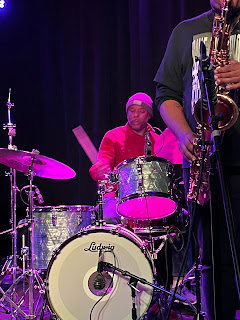
Taylor, with James Brandon Lewis, at Club Café, March 2023


A complete schedule of events can be found here.