Wednesday, April 08, 2015

Mary Halvorson & Stephan Crump - aka Secret Keeper - Slay Pittsburgh


Funny how these things work. Sometimes top-notch, adventurous jazz types come to Pittsburgh and a baker's dozen of listeners show up. Then last night, a guitarist who is arguably one of the most innovative in her field (definitely the most unique voice) and a dynamic, prolific bassist  - whose regular gigs include a spot in the Vijay Iyer Trio - come to town, totally flying under the p.r. radar, and they pack a loft, essentially selling it out, at least a week in advance. It's a tad ironic that the duo goes by the name Secret Keeper. But I'm here to celebrate, not castigate.

I found out that Mary Halvorson (guitar) and Stephan Crump (bass)  - aka Secret Keeper - were coming here almost by accident, told by a friend/publicist a while ago. The evening after I interviewed Mary for a Pittsburgh City Paper article, I heard that it was sold out. Luckily, Mary ensured that I got in. Which is good because if I hadn't, I would have had a five-alarm meltdown. ("Standing in the rain/ with his head hung low/ couldn't get a ticket/ it was a sold-out show...")

The only reason I'm editorializing is because it would have been cool if the folks who attend things like the Sound Exchange weekly events at the Thunderbird Cafe had known about it, so audiences could cross-pollinate. Mary is coming back for a residency in June/July with the band Thumbscrew. Hopefully everyone can come in contact then. We can be a welcoming people, us Pittsburghers.

So, yeah, I suppose I was sort of geeking out at the show. I really like Mary's music with her own bands, and love Stephan's many projects. But getting to see Secret Keeper in person, just a few feet away from me, was awesome. Halvorson's big, hollow body Guild guitar has a distinct, crisp tone to begin with, but she has a signature sound, built on a skillful use of pitch-bending pedals, delay and the occasional stomp of the Rat distortion box. Crump plays his bass viscerally, hugging it, singing along with it, generally working up a sweat as he did last night. (It got pretty warm in the room as the set proceeded.)

Emerge, Secret Keeper's second album, isn't officially out yet, but the duo has been touring in support of it for the past week, and last night's set was predominantly drawn from that album's tracks. It was fascinating to watch Halvorson play long, extended melody lines that kept flowing. In the coda of "Bridge Loss Sequence, she switched to chords that almost sounded like Freddie Green's riffing in a Count Basie piece - although the context was way different, and this was only a passing moment. But it shows how much contour can be found in their work.

Crump often sounding like he was operating on a different rhythmic plain than his partner, but it was easy to see that they were moving together even if they were playing parallel melodies (or to extend that metaphor, maybe it was more perpendicular). He bowed some deep harmonics and some rich double (and possibly triple) stops. Then the climax to a piece like "Disproportionate Endings" both of them pulled out some outer space harmonics. "Mirrors," originally an improvisation on their Super 8 album, had Crump playing his bass's frame percussively before Halvorson looped a bunch of guitar effects that sounded like sped-up piano noodlings.

The audience seemed to stay with the duo through the whole set, sitting in quiet, rapt attention (from what little I could pick up in the second row) and showing their enthusiasm with applause. Here's hoping we'll all see each other again soon at another show.

Tuesday, April 07, 2015

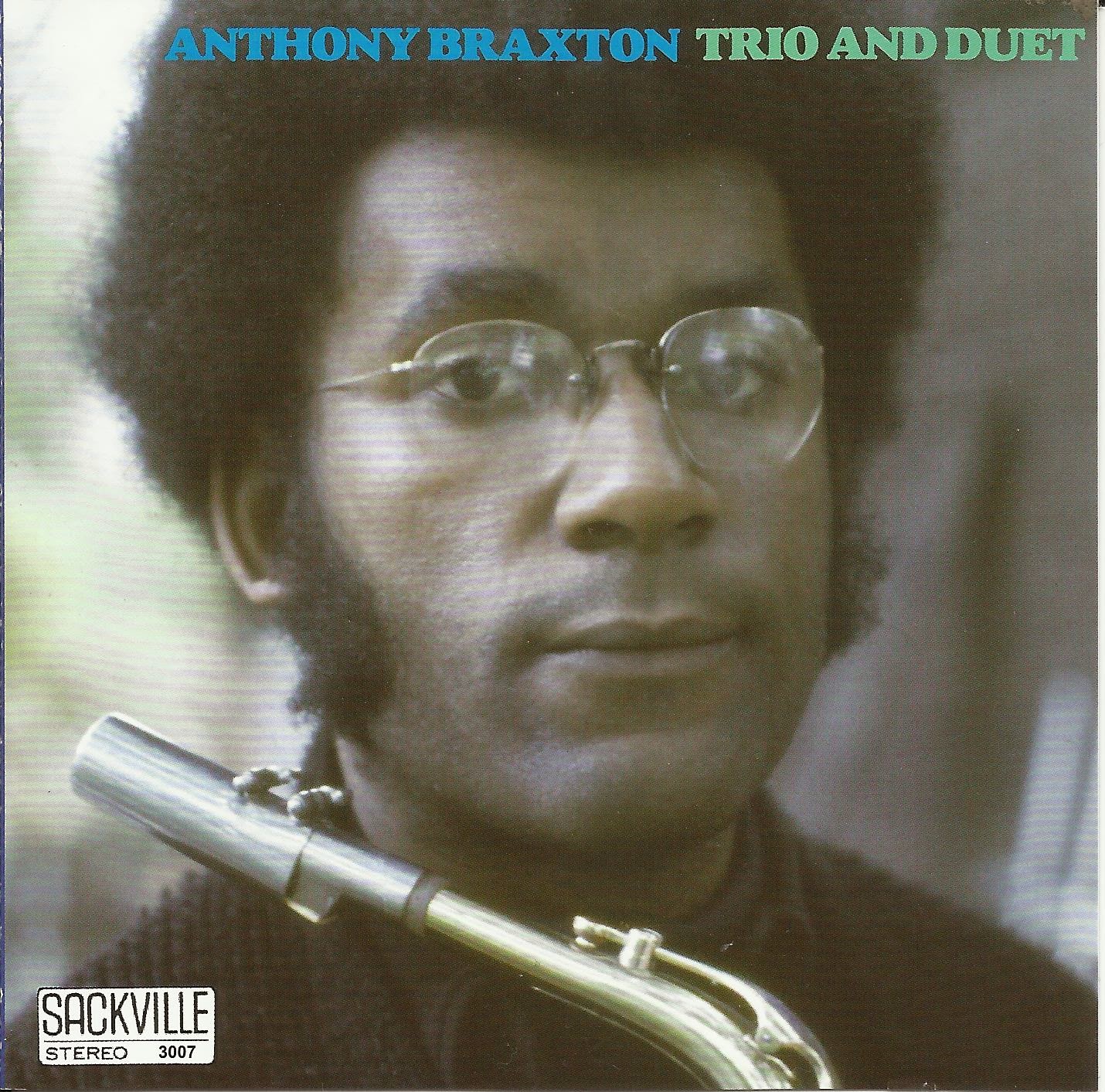
CD Review: Anthony Braxton - Trio and Duet


Anthony Braxton
Trio and  Duet
(Sackville) www.delmark.com

Delmark continues their reissue series of albums on the Sackville label with a 1974 session that could have just as easily been called Two Sides of Anthony Braxton, due to the contrast between what appeared on Side One and Side Two. The side-length "Composition 36" finds him with his Creative Construction Company partner (Wadada) Leo Smith (trumpet, pocket trumpet, flugelhorn, percussion, small instruments) and Richard Teitelbaum (Moog synthesizer, percussion). Conversely, Side Two consists of Braxton and bassist Dave Holland tearing through standards like "The Song Is You" and "Embraceable You," never forsaking the chord changes but also maintaining their own musical identities.

"Composition 36" also blends elements of abstract, sometimes pointillistic playing with recurring melodic elements. It begins with Teitelbaum oozing out some metallic drones from his keyboard before a muted Smith and Braxton (playing only B-flat, and later bass, clarinet) state a long-toned theme that will reappear a few more times. The 18-minute piece never really falls into a full group improvisation nor do the players take typical solo spots. Overlap and support are key. Smith wrings life out from upper register squeals, the clarinet squeaks and grumbles through different registers. Teitelbaum creates noisy soundscapes but he also turns them into pedal notes that sound like a melodic vacuum cleaner, and he also unleashes some fast keyboard runs in a more conventional voice.

After hearing this on vinyl, one has the chance to ruminate on the contours of "Composition 36" while flipping the record over. With the reissue, we're propelled right into an upbeat, nearly 12-minute version of "The Song Is You" without much more than a chance to exhale. Holland's steady walking bassline keeps the structure in place, still leaving him time to solo. Braxton's alto has a delightfully gruff tone to it that treats the standards well. "You Go To My Head" is played a little more uptempo than normal, and not quite as legato; "Embraceable You" also sounds a little wilder and not quite as much like a ballad. "I Remember You" - one of two bonus tracks - takes liberties with the melody from the first measure, perhaps in homage to Lennie Tristano and his acolytes. As he continues, Braxton adds a few squonks to the tune, which might explain why this track was left off the original album (though length was also probably a major factor). In total, Trio and Duet offers a vast picture of the complexities that fueled Braxton's work.

Tuesday, March 31, 2015

Matthew Shipp & Michael Bisio Are Coming To Town


Pianist Matthew Shipp (left) and bassist Michael Bisio (right) are coming to Pittsburgh tomorrow night (that's Wednesday, April 1) and performing at the First Unitarian Church at Ellsworth and Morewood Avenues. I talked to Matthew a couple weeks ago, and parts of the conversation are appearing tomorrow in Pittsburgh City Paper as part of a bigger article about shows happening here this month. Considering how the show is tomorrow, and how Matt only gets a few good quotes in, I figured I'd run the whole interview here. Matt has a bit of a reputation as being a firebrand but he's always been nothing but nice to me. Plus, his performances are amazing. He and Michael came to town last fall as a duo and it was astounding. So if a few more people are motivated to check them out based on this, that will be a good thing.


Q: So did I read that you have an album coming out on ESP-Disk?

It’s the sax player’s CD [Polish tenor saxophonist Mat Walerian] but they put my name on it because it’s his first cd. And I have an Ellington album [To Duke] out too on a French label, Rogue Art.

Q: But didn’t you say I’ve Been to Many Places might be your last album.

I know what I said. Don’t listen to what I say when it comes to recording. [Laughs} I meant it. But I’m still in this vortex of recording. I just can’t seem to get out of it.

Q: Is it still fun?
Yeah. I love the process but I would rather….

Q: Why’d you say it?

I’ve been with [the label] Thirsty Ear for a long time. And I’m not going to keep doing it forever where I keep putting out Thirsty Ear albums now. And probably, when I end my relationship with Thirsty Ear, unless something sweet comes along, where it’s involved with some patronage type of thing, I’m not gonna keep generating albums on other labels too. It’ll be obvious when it’s time.  And I thought it was, but it wasn’t quite.

Q: How long you and Michael [Bisio, bass] been playing together?

The first gig with the trio was probably 5 to 6 years ago. We have a real feel for each other and a real friendship apart from the music. And a real feeling of destiny for this part of our life as far as being a team. We have a real sense of purpose with this. I feel it does show in the music.

Q: How does playing in a duo setting differ from the trio [which had included drummer Whit Dickey]?

It’s more intimate. The trio – this might sound weird – it’s more of a commercial jazz setting and people are more used to that format. You can kind of do it with the veneer that it’s a regular jazz trio no matter how modern the music is. And with the duo, you do away with that pretense altogether, just doing pure communication.

Q: How does playing with Michael compare with playing with William Parker?

It’s two different structures altogether. They both are utter monsters and they both are strong personalities. And they both are great bassists and they both are totally different also. i’ve been blessed to have both of them in my life. I feel very lucky.

Q: Do you still get to play with William?

I have breakfast with him most every day. I do stuff with him occasionally. I’ve done a couple different things that he’s been involved in, in the last year. I mean he’s so busy with his own stuff.

Q: So, the new album [The Gospel According to Matthew & Michael (Relative Pitch) with Bisio and violist Mat Maneri] – how spontaneous was that?

I want that to be the mystery. I’m not going to say. There are definitely some composed parts but it’s also a lot of improv. The percentage – I want to sit back and see what everyeone guesses with that….there’s definitely some compositions in there. This is an experiment for me. I want to see what people project on it. So I’m not going to answer that.

Q: Tell me about the Robert D. Bielecki grant.
In my case, he gives out different grants for different things but he just gave me a certain amount of money ($15,000) and told me to do whatever I want with it. I used some of this for this project. He’s a foundation and he gives away money to people he thinks will do something with it. And he happens to be a fan of my music. So that worked out well.

Q: How did it come together? Did you have to apply for it?
I knew he was doing a foundation and I put out feelers. I had seen him sneaking around at a couple of my concerts in the past. I started talking to him and he asked, If I gave this amount of money, what would you do with it? And I said, I don’t know… pay off credit card debts? [Laughs] But I used that money to fund this project. I haven’t done anything with Mat Maneri for a while, and I wanted to get back with him and do something with him also.

Q: How is touring going? Is your audience growing?
Every gig’s different in every place. We’ve had some really good turnouts for some things recently. I actually played at Jazz at Lincoln Center. It was the Ellington project. We had two sold out sets. I recently played in Washington DC and the organization we played had the biggest audience they ever had. But on any given night, you can have an off night. Nothing is a straight line in this. But we’ve been doing pretty well on the road.

Q: How are shows in Europe?

I’m not going to say it’s dried up. But it’s not as rich as it once was.  But yeah it’s cool.

Q: A few days ago, you started a debate on Facebook at the San Francisco Jazz Festival.

Oh, that’s still going on. [Shipp’s issue was that a large number of performances during the festival were tributes to older artists or albums, like A Love Supreme, at the expense of current artists playing their own music]

Q: Well, here’s your chance to expound on it.

I would just say, ah… all jazz needs to be organic. And by organic I mean, just let people do what they do, whether it’s straight ahead, avant-garde…I would say there’s an over- degree of conceptualization going on in programming at major festivals that’s not conducive to having a beautiful organic evening. A lot of it seems to be very calculated – calculated for tourists. And in that way, it’s doesn’t seem to be a vibrant music. The way a lot of major festivals are presenting it, they got corporate sponsorships and it seems like they almost program things in ways that they think mirror the corporate sponsorship. There’s something so plastic about so much of it.

Q: That’s everything I wanted to ask. Is there anything you wanted to add?


I’m just trying to play some music. I’m trying to really be organic these days and try to do my thing. 

Tuesday, March 17, 2015

Will Butler, Hypercolor in Pittsburgh

But first, before I get to the titular subjects, I have to do a what-I've-been-up-to introduction, because it's been a handful. I'm not one of those bloggers who can give immediate updates at the drop of a hat.

Yesterday was the first Monday in a few weeks where I didn't have a story to work on or an interview to conduct. Or both, which I think might have been the case recently. Last week, I returned to Blurt after a long hiatus of writing for them. I reviewed the new album by Australia's Dick Diver which you can find here. It has yet to run, but I also interviewed Mark Stein, organist for Vanilla Fudge. With SXSW coming up this week, Blurt will probably go on hold for a spell. But as soon as I can say, "here comes the Fudge," I will let you know when that article drops.

Mr. Stein was a good egg too. Turns out the band is still loathe to talk about the sophomore slump LP The Beat Goes On, but like a trooper, he did anyhow. We also discussed the start of the band, as well as the making of their new album - yes, they're still at it - Spirit of '67.

Last week Arcade Fire's Will Butler played a sold-out show at Brillobox, which I believe I was the only person to preview in the local press.  Maybe it was clear it was going to sell out, so no hype was necessary. But, dang, was anyone curious what it was going to sound like?

Butler put on a good show, with a four-piece band of himself on guitar and keyboards, drummer, second keyboardist and back-up vocalist. His album (if you can call it that because it only has eight songs, most of them under four minutes apiece) Policy runs the gamut, stylistically, as did the show. "What I Want" had the power chord attack of the Buzzcocks while, one song later, "Anna" sounded like Suicide, with an unrelenting keyboard riff. The album had only been released two days prior, but the audience - which probably numbered in the high 100s, whatever the capacity is at Brillo' - seemed familiar enough with it and ate it up.

The UK newspaper The Guardian struck a deal with Butler a couple weeks ago where he wrote a song a day for five days, based on articles he read on their masthead. Results were then posted on Soundcloud. The idea might sound dubious, but the results are actually pretty strong. Among the ones he played at the show, "Madonna Won't Save You," is one of the most memorable, if nothing else for its opening line of "You can spend all day/ breaking hearts with a/ sledgehammer and a glass of milk." Weird lyrical non-sequiturs like that also show up on the album too and act as some of the more memorable aspects of the release.

Even though he might only have scant material available now, Butler and the crew weren't lacking for a set. They plowed from one song into another, with little time left for banter, though Butler gave a shout-out to former Pirate Andy Van Slyke later in the set. The back-up vocalist and keyboardist had some dance moves going later in the evening. The fact that they weren't quite synchronized added to the charm, making it seem more like the inspiration of the moment got them moving.

Two nights prior to that show, avant/prog-rock/noise/experimental jazz trio Hypercolor played at Howler's. They were touring behind a new self-titled release on Tzadik. Drummer Lukas Ligeti, guitarist Eyal Maoz and bassist James Ilgenfritz play music that gets heavy at times but never bombastic. Ligeti's drumming sounded especially propulsive early in the set, getting things off to a strong start. Maoz, who sits while playing, worked a bunch of pedals to keep the textures evolving, while Ilgenfritz used the six-string bass in a manner that you don't see very often. He jammed econo on it, to put it one way.

All three of these cats have numerous projects going on, so there was a plethora of CDs to peruse after the show. Ilgenfritz, who has released a solo-bass disc of Anthony Braxton compositions, had a disc that came out that day of an opera he wrote based on William S. Burroughs' The Ticket That Exploded. I also picked up a disc of a project called Colonic Youth, which includes drummer Kevin Shea on it.

Hypercolor's showkicks off a pretty intense six-week slew of jazz performances in Pittsburgh. To be self-serving for a moment, I'll only list one - Hearing Things, a trio of Matt Bauder/Vinnie Sperrazza/JP Schlegelmilch, who play something closer to '60s instrumental. They're playing at Howlers on Sunday, March 22 with my band, the Love Letters.


Tuesday, March 03, 2015

Yesterday's Errands & the weekend of the Westerlies

Monday is typically a day where I can blog about the weekend's events since it's usually a day off. But yesterday was so action-packed that I didn't get a chance. In the morning, the city was a sheet of ice (and it still is in front of my house because there's no rock salt to be had in all of the Pittsburgh; apologies to my neighbors) so there was a two-hour delay for the kid's school. The weather also killed a coffee date I had with a friend of mine. 

Later that afternoon, I went to Donny's school for Read Across America Day, armed with Ezra Jack Keats' John Henry. I chose that book because, when I was a second grade, the Arrow Book Club (from whom we ordered books at school) had a record of James Earl Jones reading the story, which I ordered. His voice still resonates in my head when looking at the words on the page. I'm no James Earl Jones when it comes to orating, but I did a pretty convincing read for the class.

At 4:30, the phone rang and on the other end was Mark Stein, organist extraordinaire of Vanilla Fudge. We talked for about half an hour and I felt like it could've gone on longer. Much of what he told me is probably subject matter he has to rehash over and over, so it was nice of him to do that. He said upfront that he doesn't like talking about The Beat Goes On, their second album and a failed concept album. Still, he spoke his mind about it, and about the new stuff the band is doing. The results of that interview will appear on the Blurt website hopefully sooner rather than later, because Vanilla Fudge's new album comes out this week. 

Finally, yesterday, Ma Shanley got back into town and I had to meet her at the train station at 8:00 to get her home. She had a good time with brother and his family outside of Philadelphia. 

Rewinding back to Sunday afternoon, the Westerlies performed at Carnegie Library, essentially kicking off what I consider to be two months of serious jazz shows. Below is a picture of the band, left to right - Zubin Hensler, Riley Mulkerkar, Andy Clausen and Willem de Koch. (Remember that thing that's in the background? A good, old fashioned card catalog. Not sure if it's still in use or if it's just moved to this room to be dealt with at a later time.)


Last year the Westerlies released an album titled Wish the Children Would Come On Home, on which they played a whole set of compositions by Wayne Horvitz. He might be known to many as "the guy who played keyboards in John Zorn's Naked City" or as a former downtown New Yorker. But he taught the guys when they were living in Seattle, before they all ended up moving to New York for college.

Horvitz's writing starts with a bunch of musical strains and winds up being something pretty unique. Jazz, Americana, modern classical - it also seems to factor into it, but you can't lay a finger on one particular element. (A few years ago, an article in JazzTimes mentioned that there was some particular descriptor that sent him through the roof. I think it was "iconoclast." It's easy to see why it could be affixed to him, but also why he didn't approve.)

As rapturous as the Westerlies album is, seeing them in person was even more exciting. The way the four of them blend together creates a full sound that goes beyond what could be expected from a quartet. Not only are their harmonies really tightly voiced (especially with the trombones, who handle harmony and a lot of rhythmic stuff in de Koch's parts), but the pitches catch your ear in a way that seems to get between the notes. Thoughts of the Microtonal Festival (which had also been going on all weekend) might have been influencing my thoughts during the set.

When the group invited up a former teacher and the head of the concert series to sing with them, things sounded even richer, the voices blending with the horns, occasionally getting overpowered by the brass but still sounding strong. Donovan, my seven-year-old companion, who seemed pretty interested throughout the one-hour set, said he liked this part best. Because he was with me, and because we needed to get a book before the library closed, there wasn't time to hang out and chat too much with the group. But hopefully they'll be back again.

Friday, February 27, 2015

Here Comes da Fudge, and a few other assignments

Playing right now: Vanilla Fudge - Rock & Roll

I bought this Vanilla Fudge album about a month ago, along with their debut album. I wanted to get back to it in part because this Monday, I'm interviewing Fudge organist/vocalist Mark Stein for an article on the band. Yes, they're still together and in fact they have a new album out.

Around the beginning of the year, I told myself that I should be a little more ambitious about writing, like I haven't been in a long time. The combination of getting the Love Letters record together and my dad passing away left me feeling like I wasn't into doing much more than the basics. (In case any of my editors read this, the previous comment should not be confused with the idea of "phoning it in." I merely didn't feel like trying to go above and beyond the journalistic path.) Hell, I haven't written anything for Blurt in months. Now I'm doing this Vanilla Fudge piece for them, along with a couple record reviews.

Yesterday, I also did an interview with Arcade Fire's Will Butler, who has a solo album coming out in a couple weeks, and who is also coming here around the same time. The timing of the interview got a little screwed up but it all shook out okay, and Will was a pretty nice bloke. I managed to squeeze that in between dinner and band practice, not to mention picking up the kid from his friend's house in the meantime.

Plus the deluge of live music in Pittsburgh starts this Sunday with the Westerlies at Carnegie Library. I'll blot about that, and offer a list of upcoming shows in the next entry.

Tuesday, February 24, 2015

CD Reviews: Andrew Drury - Content Provider & The Drum


Andrew Drury
Content Provider
(S&S)

Andrew Drury
The Drum
(S&S) www.andrewdrury.com

Drummer Andrew Drury's two self-released albums display vastly different sides to his approach to the kit. Content Provider features a quartet of two saxophones, guitar and drums playing Drury's compositions (and a completely reimagined Clifford Brown tune). The Drum is just how it sounds: Drury and a floor tom, with a few accessories. But both of those descriptions barely scratch the surface of what appears on each disc.

It helps to know that Drury studied with the late Ed Blackwell, leaving his home in Seattle at 18 and heading to Connecticut to meet the one-time Ornette Coleman sideman. Blackwell's liberated approach to the kit affected Drury, opening him up to infinite possibilities. He went on to play with Wadada Leo Smith, John Tchicai and Brad Mehldau, to name just a few. His current projects include 10³²K, a sort of repertory group who pay homage to people like Albert Ayler, Charles Mingus and Roswell Rudd. They released the solid That Which Is Planted last year, and they're about to perform a commissioned suite at the Lincoln Center Rubenstein Atrium.

The jagged riff under pinning "Keep the Fool" makes a great opening for Content Provider, and sounds like a drum line transcribed to guitar. Hearing it delivered by skronk-and-burn guitarist Brandon Seabrook only adds to the execution. On top of him, tenor saxophonist Ingrid Laubrock and alto saxophonist Briggan Krauss alternate between countermelodies and combining with Seabrook.

The title track, after a red herring intro that could have been "Also Sprach Zarathustra," introduces a brief long-toned theme that connects passages of free blowing from the quartet, resulting in 14 minutes that fly by quickly. Drury's fills and rolls, not only on this track but throughout the whole album, bolster the theme and offer foundation that his companions use as a springboard for their own furious solo work. Seabrook reinforces why he keeps showing up in rock and jazz situations, since he balances melody and noise (in "The Commune of Brooklyn" he sounds like he's imitating a truck's back-up warning). If the six Drury originals weren't enough, they take Clifford Brown's upbeat bop classic "Daahoud" and slow it down, turning it into something closer to "Harlem Nocturne," making the chord changes more prominent in the process. Much like Ches Smith's These Arches, this band highlights a drummer with a personal approach to the kit, an engaging melodic mind and skill at band leading. If this album doesn't start getting a buzz soon, something's wrong.


And speaking of buzz, that's part of what can be found on The Drum.

Albums devoted to one instrument are nothing new in creative music. In fact Count Basie drummer Papa Jo Jones even made a solo album (The Drums) as far back as 1973. That album had an impact on Drury, but what he creates with just a floor tom, abetted by an aluminum sheet, bell and faucet escutcheon, frequently doesn't even sound percussive.

The Drum is not for the faint of heart. While Drury could have parlayed his teachings from Blackwell into rhythmic excursions on the skin, he instead employs the ol' artillery of extended techniques: scraping textures on the drum head that sometimes squeal, sometimes rumble and often do both. "Hidden Voices" could be mistaken for wild brass notes that Peter Evans or Wadada Leo Smith might emit. "Aluminum Donkey Dance" sounds like his Content Provider compadre Seabrook, or Jimi Hendrix, imitating UFOs in "EXP."

Once the mind is freed from any preconceived ideas about this performance, parts of The Drum sounds pretty fascinating.  "Control and Let Go" sounds like a squeal sustained for four minutes, and gets a little old. And the whole disc might appeal more to fans of Merzbow than to jazz. But the ways in which Drury produces these noises - both the abrasive and the hypnotic - give this album staying power.

Sunday, February 22, 2015

Clark Terry - a salute

It takes the wind out of your sails when you go on Facebook to link a post, and you see a bunch of posts about Clark Terry passing away. I probably can't say anything that hasn't already been said, but I owe it to this great artist to say something anyway.

Clark Terry was one of those musicians who seemed to always be around. My dad had an eight-track tape of him when I was a kid. I'd see his records in stores all the time. Buck Bryce probably played him regularly on WYEP back in the day. I knew he was in the Count Basie band for awhile too. So I kind of took him for granted.

When I saw him play at the University of Pittsburgh Jazz Concert one year, within one chorus of a solo, I thought, "Yeah, now I see why he's so omnipresent. He's incredible. Talk about playing at the top of your game."

There have been several pieces I've written over the years for JazzTimes about jazz education, and Clark's name popped up a lot in them. You want to see the personification of the word "tireless," look at him. The guy was 94 years old, and even when he was confined to a wheelchair, he was still active.

Are there any people left that can measure up like that?

Bless you, Clark Terry. RIP.

CD Review: Red Garland Trio - Swingin' on the Korner


Red Garland Trio
Swingin' on the Korner
(Elemental) www.elemental-music.com

In discovering this double-set of live recordings by pianist Red Garland, it's interesting to parallel the state of his career with that of his former "boss, " Miles Davis. By 1977, the trumpeter had pioneered electric jazz, added funk to it and had retreated from the performance sector. Garland too, had disappeared from the stage for a few years, but when he returned, his approach to the piano sounded virtually the same as it did nearly two decades prior when he anchored the Davis quintet that included John Coltrane. The set list could have come from the late '50s/early '60s period, with his take on "Billly Boy" (borrowed from Ahmad Jamal), "On Green Dolphin Street" and "Dear Old Stockholm," all of which he recorded with Davis.

Yet none of the music sounds out of date, either from a 1970s perspective or a 2015 perspective. It has an air of authority to it. This is how these songs should be played if you want to affect listeners. Not only that, since there are no horns sharing the spotlight with Garland, Swingin' at the Korner reveals what an influential pianist he was.  He could move from heavy blues to light ballad, all of it containing some serious weight. Garland was occasionally dismissed as a "cocktail pianist" playing little more than background music, but even lighter fare like "It's Impossible" or "On a Clear Day" never sounds mawkish in his block-chord-playing hands. This style still fuels budding pianists to this day.

The title refers to San Francisco's Keystone Korner, where these performances were recorded in early December 1977. It reunites Garland with his fellow Davis bandmate Philly Joe Jones, who also plays with plenty of swing and fire. In fact, the drummer gets plenty of solo space, even in tunes like "Autumn Leaves" (taken at a brisk pace after a gentle opening), indicating the rapport and fun that both players we're having onstage. Bassist Leroy Vinegar had never joined forces with but of these guys - and never would again - but his solid walking, always enthralling and never cliched, makes a perfect piece to this puzzle.

Being an Elemental release, Swingin' on the Korner comes with a deluxe booklet, not only with appreciations from Keystone Korner owner Todd Barkan and Nat Hentoff, but interviews with Don Schlitten (who worked with Garland at Prestige and later MPS Records), drummer Kenny Washington and Ira Gitler. Pianist Benny Green reminisces too, and an informative 1979 article by Doug Ramsey that appeared in Texas Monthly also offers great insight into the pianist. In addition to being a great listen, albums like this make you want to go back and rediscover Garland's past glories, with a better perspective on them.

Sunday, February 15, 2015

The Punk Meets the (New) Pornographer

Playing right now: Prism Quartet - Heritage/Evolution Volume 1 (Innova)
Note: Since this was posted originally, it's been edited to include the set list

Okay, so I suppose I was wrong. A few weeks ago I stated that everything I've done with the Love Letters culminated on the night of our record release show on January 31. But really, I felt like the moment of truth came this past Friday when the New Pornographers played at Mr. Small's Theatre. 


I felt that way largely because throughout the time that we were making the record, and prior, I never met John Collins in person. There were phone calls, emails, even an interview (where the whole scheme for the record germinated in my head). But that night we were going to meet face to face.


Yes, he's just a guy. A guy who plays bass (and a million other instruments too, if you check his credits on several NPs albums) and just happens to have a recording studio and a good ear. So I shouldn't act all star-struck. But throughout all the time that I dealt with him, I was pretty tenacious, not wanting to let this opportunity slip through. With that in mind, who knew what he'd have to say. Maybe he'd tell me how much of a pest I was. Maybe he was doing this out of obligation. 


Turns out it was neither. After staring at another guy, wondering if it was John (it wasn't), a few minutes later, a soft-spoken guy slid up and casually said, "Hey." And he was soft-spoken to the point that my damaged ears sometimes had trouble hearing what he was saying. Erin (Love Letters drummer) and I chatted with him for a few minutes, gave him a record and gave him the band update. He was interested in all of it. 


Jaill was the opening act, and they were playing while we talked. Their set was pretty good: Guitar-driven pop with keyboards and a singer that sounded a little like Arcade Fire's Win Butler or Clap Your Hands Say Yeah's Alec Ounsworth, albeit not quite as whiny, just in terms of register. I later picked up their album There is No Sky (Oh My My) which is even better than their set indicated.


While Jaill was playing, Erin and I made our way back to the bar, where the sound was really good and visibility was good enough. So we decided to stay put instead of eventually going to the front of the room. Plus there was something to lean on, rather than having to stand in a sea of people. (The show was sold-out.) If I felt like having a drink, I didn't have to go anywhere either. 


They hit the stage with "Brill Bruisers" and the energy didn't waver the whole time. It's been almost six years since I've seen the band live, so naturally I built up the excitement in my head about what it should be. And I wasn't disappointed.

Neko Case wasn't with the band. (Don't dwell on this, people. Yes, she's great but it might hurt Carl's feelings.) But Dan Bejar was - something that's NEVER happened when they've come to Pittsburgh before. We finally got to hear "Jackie's Dressed in Cobras," "Testament to Youth in Verse" and several others. He didn't play the whole set, coming and going, strapping an acoustic guitar on and off. 


The set dipped as far back as album #1, with title track "Mass Romantic" inspiring some frenzied pogoing and yelling from me. The Brill Bruisers songs all sounded really strong too, recreating the layers of the album (it helps having two keyboard players) with lots of guitars on top. In addition to Carl Newman's steady rhythm work, and Bejar's coming and going, mainstay Todd Fancey was there in the corner of stage right. At least I think it was him, from where I was standing. 


Erin wondered if they'd play "The Bleeding Heart" show, to which I replied, "They have to." It reminds me of an interview with one of the original Temptations who said they once tried to do a show without singing "My Girl" and took some serious heat for it afterwards. That song became the final one of the evening during the encore. ("Bleeding Heart" not "My Girl.") I was a little surprised they didn't do ELO's "Don't Bring Me Down" as they have in the past. But it's a good idea to keep us guessing. 


I told John earlier that I would like to say hi to Kathryn Calder, their one keyboardist and vocalist. When she put out her second album, I did a so-so email interview with her that became a small feature in Blurt. But I really love her albums, including a new self-titled one that's coming out in a couple months. (I heard an advance of it this week.) He texted me before their set and said to hang around after and he'd introduce us.


After they were done, John came out and took me backstage where Kathryn was waiting. Much like John, she too was totally laidback and friendly. We talked about loosing parents and the effect it can have on writing and recording. I'm hoping to do a real interview with her for the album in a few months. The only downside is that she said her solo tour probably won't come to Pittsburgh because it's too expensive. I didn't ask if that meant the distance or our city's entertainment tax or what. I just let it slide, even though it burst my bubble a little. 


Then I went home. No pictures. It never entered my mind to get some while we were talking. Guess you'll have to just take my word for it. 


Here's the setlist:
Brill Bruisers
Myriad Harbor
Moves
Slow Descent into Alcoholism
War on the East Coast
Dancehall Domine
Use It
Jackie Dressed in Cobras
Another Drug Deal of the Heart
The Laws Have Changed
You Tell Me Where
All the Old Show Stoppers
Adventures in Solitude
Sweet Talk, Sweet Talk
Backstairs
Champions of Red Wine
Born with a Sound
Mass Romantic

Encores:
[something by Dan Bejar; can't read my writing]
Sing Me Spanish Techno
The Bleeding Heart Show

Thursday, February 12, 2015

New Release!

Playing right now: Kathryn Calder - s/t album

If it wasn't enough that the New Pornographers are coming to town this Friday, their keyboardist/vocalist Kathryn Calder has a new album coming out in a few months. I love her previous two LPs and so far, this one is really great too. So excited. I must convince her to come to Pittsburgh on her solo tour.


Wednesday, February 04, 2015

Two Years in the Making


It was more than two years ago that the Love Letters first went into to studio to lay down the basic tracks for four songs. We wouldn't finish recording, adding the last overdub, until the following summer. Before we even went in, I had been in contact with John Collins about producing us. That came about for a few reasons.

For starters, I don't exactly trust my own ears to get the mix/production I really like. For as long as I have been recording, I'm still not sure how to pinpoint what should be done. During this time, I was listening to the first New Pornographers album, Mass Romantic, and thought, That is what we should sound like. Male/female harmonies, keyboards blending with raw guitars, hooks galore. There was also the story Mr. Collins told me during a phone interview several years ago, about mixing one of the NPs' songs for a commercial and emailing the finished product to the people making the ad. I figured if he could do that by mail, maybe he could take raw tracks and polish them up.

He said he'd be willing to do it, but once we finally got things done, he was in the midst of traveling from Vancouver to New York to mix what would become the New Pornographers' latest Brill Bruisers album. This just happened to coincide with Aimee's departure from the Love Letters. Oh, the times that try men's souls. (And women's too.)

Well, tenacity paid off and over this past weekend, the Love Letters FINALLY had a record release show for a double 7" record. There are 4 songs, one on each side. Two of them were produced by Collins. Two were painstakingly mixed by the band and studio whiz Dave Cerminara to make sure they didn't completely pale in comparison. After awhile I just wanted to get it out so I resigned myself to the idea of revamping the record "label" of my previous band, Igor Records.

The show took place at Club Cafe, a nice as place as any to have such a shindig. (I should also add that the weather held up really nicely.) In honor of the special occasion, Aimee rejoined the band for the night and we became a quintet. My ears were clogged, as a result of walking pneumonia that I think I had for about two weeks prior. So it was hard to tell exactly how loud I was (really freaking loud, apparently), but things held together really well. There were people there taking pictures, though the only time I showed up in one was in a group shot. I guess I'm not that interesting to shoot as a performer.

Great Silence, a band made of up co-workers past and present, also played. I think it might've been their second (maybe third) show. Their one singer didn't have any pipes that night so they did mostly instrumental stuff, which sounded like My Bloody Valentine or Bowery Electric: droney riffs with a lot of spacey guitar textures. Though things sounded tentative, it was a good time. Can't wait to hear more from these cats.

The picture at the top of this entry is our record cover inside Sound Cat Records. They have copies of it, as does the Attic Record Store and Desolation Row (which is inside Caliban Books). If you're in Pittsburgh, check out the records there. If not, email me and I can get you a copy.

I realized earlier in the day, that everything I've done with the band over the past two years was building up to that evening. It kind of freaked me out. Now - what's next?

Tuesday, January 27, 2015

Ken Vandermark & Nate Wooley at the Warhol

I thought the wax in my ears was playing tricks on me. When Nate Wooley and Ken Vandermark started playing together at the Andy Warhol Museum's theater, their first piece placed both of them in the high, upper register, and my ears responded by hearing a lower note beneath theirs. Talking to a few people in the days following the show, I deduced that it wasn't me, but the room creating that extra note as the high pitches bounced off the walls. Further, Vandermark does this with a performance, "checking the room" to see how possible it is.

It's been eight years since saxophonist/clarinetist Vandermark dropped into Pittsburgh. I remember it well because it was a wintry night when the Vandermark 5 played the same stage, and I was still a few months away from parenthood.

While that 2007 show featured a full band, last Wednesday (January 21) was an evening of solo and duo sets. Wooley came on first, armed with a trumpet, mute and narrow piece of sheet metal. When he emitted his first super-soft long tone, it threatened to turn into one of those minimal performances where the note is less important than how it gets manipulated. But it shifted into high gear quickly. Wooley created two tones by getting the metal to vibrate against the mute. He also scraped the metal on the bell of the horn (if you hate the sound of metal on metal, cover your ears). After squirting around his horn's upper register, he easily shifted into the warm, middle register, finally ending with a relaxed tune.

Wooley was quiet and rather serious during his set, compared to Vandermark who spoke to the sizeable crowd between pieces. "It's alright if you want to go," he said towards the door as one patron apparently had enough after a clarinet piece dedicated to filmmaker Michael Snow, marked by slap tonguing and long tones. Switching to tenor, he kept a rhythm going by hitting the pads so precisely that it almost sounded like a digital loop. Strapping on his mighty baritone, he explored the whole register of the horn, concluding with a rhythmic groove that evoked Sun Ra.

After an intermission, Wooley and Vandermark returned to the stage together for a series of duets. They paid tribute to the trumpet-reed duo of John Carter and Bobby Bradford by playing a few of that pair's compositions among their own. Carter's "And She Speaks" started the set and gave the first ear-harmonic twist.

There's value in seeing a group like this on the final night of their tour because they've had numerous sets to grow as a unit, and Vandermark and Wooley were in sync with each other. Wooley's "Best Coast" (hopefully that's right; it was an homage to the Pacific Northwest) featured trumpet smears and growls against clarinet slap tonguing. His trumpet imitated an analog synthesizer during Vandermark's avant "Call the Numbers."

Despite a healthy amount of squonk and squealing (which, admittedly, made me hold my ears at times) the duo also delivered many delicate moments too. "Killtown" started off almost like a Gerry Mulligan tune and "General Sherman" ended the evening with a brief ballad.

Seated in front of me in the Warhol theater were two women with a girl who seemed to be about tween age, playing one of those candy games on the phone prior to the start of the show. Throughout the night, one or both of the women looked at the girl with expressions that said, "what do you think of that," in response to the music. Some cynical people might expect the response to be eye-rolling and fidgeting in the seat. But actually, the girl responded with wonder and amazement. She might have thought the sounds were crazy, but she clearly dug them. The three of them stayed for the whole show as well. Hopefully they'll make it to other performances like this and who knows maybe the young lady will be part of tomorrow's experimental music scene.

Monday, January 19, 2015

LP Review: Áine O'Dwyer - Music for Church Cleaners, Vol. I and II


Áine O'Dwyer
Music for Church Cleaners, Vols. 1 and II

If you had unlimited access to a church's pipe organ, what would you play? Scary movie music? "Baby Elephant Walk" and "Alley Cat"? An imitation of Keith Emerson or Jimmy Smith? 

It might be tempting to simply hold down a chord or two and bask in the rich swell of the sound emanating from the pipes, pulling drawbars in and out to see how the tone changes and reverberates around the room.

Áine O'Dwyer, who normally plays improvised music on the harp, had this golden opportunity at St. Mark's Church in Islington (United Kingdom). The pipe organ was being cleaned so she was able to sit down and the keyboard and basically tinker with it. She recorded everything and originally released on a cassette, presenting a personal field recording. Vacuum cleaners whir in the background as she plays, as do children's voices. Most entertaining is an exchange between O'Dwyer and a church employee on "An Unkindness of Ravens," the seventh track.

Woman: A request from the ladies...
O'Dwyer: Oh. Stop playing?
W: (warmly) No, no, no. When you hold it on one note for a long time, can you keep it quiet? Or can you just not... stay on one note for a long time? 
O: Okay, yes.
W: Okay? Sorry.

O'Dwyer does enjoy pedal point drones (the first track in fact is titled "Pedal Danse") and the lady quoted above returns later in the album to again remind her that her sustained notes can be felt throughout the building. But most often, her choice of tempo is slow, akin to the hymns that might be played normally on the organ,, with the same kind of harmonic framework. This isn't noisy, free improvisation by any means. The combination of background sounds and drones make it more like meditation music.

The sound of the organ is rich and beautiful, and O'Dwyer does get takes the sounds of Bach into the realm of post rock and occasional psychedelia. But 91 minutes of these drones can be hard to take all at once. (The original cassette release was half this size.) After awhile, the conversations and ambient sounds become almost more interesting that the music itself. 

Yet that was O'Dwyer's goal - to document it with the approach of John Cage, letting all found sounds become part of the music. Further, the reissued, expanded version is coming out on vinyl (limited edition of 500), so it comes with three built-in breaks during the program. (My advance copy came as a download of the whole set.) Hearing it that way, or in its original cassette form, can make all the difference. In bite size pieces, it sounds enthralling.

Sunday, January 18, 2015

Willie's Country Roadhouse and me

When I finally heard "Green Green Grass of Home" all the way through, listening to all the lyrics and not just thinking of it as some cornball song delivering by someone like Tom Jones, I started to think of it like an O. Henry story After it gets to the spoken part about "I was only dreaming," it becomes clear that it isn't just some "I want to go back home" song. Then there's the double metaphor about how he'll touch that green green grass again - from beneath it. It's great writing.

I've been thinking of that a lot lately. At the end of November, I bought a new car and it came with a three-month trial of Sirius XM radio. A few weeks ago, my son was fiddling with the Sirius dial and came across Willie's Country Roadhouse, a station "hosted" by Willie Nelson that plays nothing but "Classic Country." And they're right about that. I've heard folks that I know and others that I've only seen in print: Kitty Wells, Del Reeves, Buck Owens, Stonewall Jackson, a whole lotta Waylon Jennings (I think they play him once every hour), Hank Thompson, Charley Pride.

The thing that I love about this music is that these people know how to spin a yarn. They sing about the same topics: lovin', drinkin', loneliness, the Good Book, cheatin'. But they manage to put original spins on it each time. Charley Pride has a song called "Does My Ring Hurt Your Finger" and it's not until the end of the first verse - which follows an opening chorus - that you get the whole plot line, as it were: His wife is going out to the shows without him, which is cool, but she's leaving her wedding band at home. Rather than asking, why are you cheating on me, he asks the title question, saying he can get it adjusted at the jewelry store.

When was the last time it took a whole paragraph to outline a Kenny Chesney song?

Another great aspect of this station is they have a really vast playlist. I'm still hearing new songs and when they play songs that I've already heard, there is usually a period of several days in between the overlap. While the djs probably record their breakers in advance, it has a live feel. Plus their downhome delivery is infectious.

There's also a lack of pretense in the music. The arrangements are often similar, with a meowing pedal steel playing in the intro, but everything works towards the message of the song, not sounding slick. The only time I felt like things started to sound bland was during an Oak Ridge Boys song that I heard a few nights ago. "Y'all Come Back Saloon" sounded like it was focused more on the group's voices to the exclusion of the storyline itself, which got a little muddled. When the chorus repeats that much, you're going more for crowd-pleasing singalongs than storytelling, and showing a line to more "modern country."

I'm sure I won't subscribe to XM radio once the free trial is up, but it's almost tempting.

But music like this is what's keeping me from listening to, and writing about, more music here.

Saturday, January 10, 2015

CD Review: Lennie Tristano - Chicago April 1951


Lennie Tristano
Chicago April 1951
(Uptown) www.uptownrecords.net

During his piano solo on the uptempo "Palo Alto," Lennie Tristano plays a chorus that rolls on for at least 12 bars without a break in the melodic development. It's the equivalent to a horn player blowing for that long without stopping to take a breath. Tristano rattles off a rather even set of eighth notes, perhaps a little straid compared to what his pianistic peers were doing at the time, but the ideas at the foundation of it are startling, in length and continuity.

Tristano's legacy has its fair share of followers, who rabidly champion his teachings. (He was one of the first serious teachers of post-war jazz.) Lee Konitz and Warne Marsh were two of his most famous students, but pianist Connie Carothers also carries the Tristano flag in her solid work.

Yet he isn't always talked about in the same pantheon of other post-war jazz pianists, due in part perhaps to his reluctance to take the usual jazz musician track of playing nightclubs to the often less-than-appreciative audience. (This disc includes one such example of Tristano giving a snarky-yet-professional rejoinder to someone wanting to hear "Tennessee Waltz.") While the music was rich in melodic extrapolations, there are times when it could come across as a bit academic, with the rewritten themes to standards coming off a bit like complex practice routines. (See Warne Marsh's Intuition album.) Tristano also liked his rhythm sections to play it pretty straight, leaving the heavy lifting to him and the horns.

Having said that, this album presents all the strong points of Tristano's legacy, and then some. Recorded fairly well at Chicago's Blue Note Jazz Club, the pianist leads a group not only with Konitz and Marsh but trombonist Willie Dennis, perhaps best known for his appearance of Charles Mingus's Mingus Ah Um, and another student of the maestro. Buddy Jones and Mickey Simonetta round out the group on bass and drums, respectively.

Though Tristano calls the tunes, acts the leader and clearly presides over the music, many of the songs come from Konitz and Marsh, who write their own heads for jazz standards. What comes across most significantly is the way the horns handle this rocky terrain so gracefully. While the saxophonists were brothers at arms, Dennis fits in tightly with them, the resulting harmonies recalling the Miles Davis Birth of the Cool sessions, in which Konitz participated a few years prior.

The depth of the rhythm section doesn't always come across in the recordings, so it's often hard to try and follow the harmonic cues the musicians are using. Jones plays steady walking bass lines virtually throughout the whole package and Simonetta is solid but restrained.  When the chord changes get a little blurry, the focus moves to the solos themselves. It's easy to get lost in them, so expansive are these guys. The two-disc set includes many of the major works that Konitz had recorded for Prestige and New Jazz at the time: "Sound-Lee" (a rework of "Too Marvelous for Words"), "Palo Alto" ("Strike Up the Band"), "Tautology" ("Indiana," the basis for Tristano's "No Figs" as well). Marsh contributes "Background Music" (based on "All of Me") and gets credit for two versions of "I Can't Believe That You're In Love With Me Variations." Both horn men penned "Sax of a Kind," which is based on "Fine and Dandy."

Chicago April 1951 can arguably be placed with those original studio recordings considering there are few documents of the group playing them live, and none with Dennis in the fold.


Monday, December 22, 2014

CD Review: Phil Haynes-No Fast Food - In Concert


Phil Haynes - No Fast Food
In Concert
(CornerStoreJazz) www.philhaynes.com

Drummer Phil Haynes drew inspiration for the No Fast Food trio from Elvin Jones' post-Coltrane trios, which featured bassist Jimmy Garrison and saxophonist Joe Farrell. On two albums, that trio kept one foot on the ground while pushing the limits of piano-less, horn driven jazz. 

The name No Fast Food implies that these guys aren't going to settle for mass producing something lacking in quality ingredients or nutrition, which would be easy to consume and forget about once that moment is over. Quite the contrary. If names alone establish credibility, saxophonist David Leibman (who played with Elvin Jones a few years after said albums) and bassist Drew Gress (a leader as well as one-time bandmate to Tim Berne, Fred Hersch and Ravi Coltrane) take the cake. Together with Haynes  - himself a 30-year vet who has worked with Anthony Braxton, Dave Douglas and others - these guys operate on the same plain, with the ability to shift from pensive to wild, ballad to free squonk. 

Most of the two-disc set was recorded at Rochester, New York's Bop Shop, with a few tracks coming from Elk Creek Cafe & Aleworks in Millheim, PA. (It's good to know that a place like that caters to this kind of adventurous music. The audience seems to agree.) Haynes receives credit for all the compositions, but many could very easily have been spontaneous group efforts. "Zen Lieb" opens the second disc with a bowed bass and wooden flutes, making it one of the more esoteric pieces of the set. Haynes sounds content to keep his efforts to the cymbals, rolling and bowing as needed, making the whole thing a unique tone poem. 

The leader's unique approach to his kit factors into the music's impact. In "West Virginia Blues," his mix of kick drum accents and stick work almost sounds like two drummers intertwined. Liebman, who projects authority from the first note he plays, whether on disc or in person, begins the track with an unaccompanied tenor solo. The jagged melody that cues in the group recalls Tim Berne's Bloodcount, establishing order out of limitless freedom. 

Gress is one of those musicians who shows up on numerous albums by an array of leaders, and In Concert offers plenty of reasons why. "Together," which probably comes the closest to those early Elvin Jones trio sides, has a bass solo marked by some fine double-stops. On his own in "Out of the Bowels," Gress produces some wonderfully jarring harmonies, that shift into fast runs and bits of disjointed melodies that actually convergence into a richer picture. 

Despite coming from two different sources, the music on In Concert was recorded only two days apart and the whole thing has the feeling of two complete sets. From the moment the trio hits on the first track, the engagement of a live performance comes across.


Saturday, December 20, 2014

Me and the 2014 NPR Music Jazz Critics Poll

For about the past five years, I've been polled as part of a national survey of jazz critics for the best albums of the year. The results have run on a few different websites, and this year, it's on NPR. The results were posted this past Friday, and can be found here.

Often times, I feel like the odd man out. The albums that top the charts are ones that I either haven't heard yet or that fly under my radar. Not so this year. Four of the Top 10 albums were things that I picked, including #1 and #2! Does it mean that I'm keeping up with the big guys, or that my tastes are finally gaining wider acceptance? I'll let you answer that.

Tuesday, December 09, 2014

I'll Have a Bland Christmas...

I've never really cared either way for the holiday perennial "Santa Baby." Eartha Kitt's original version was fine, complete with male "ba-boom" vocals in the background and Henri Rene's sly swinging bachelor pad accompaniment. Recorded in 1953, when Ms. Kitt's shopping list ('54 convertible, yacht, a big fancy ring) was mildly amusing, as few gals really expected to get that. Still as far as Christmas songs about riches go, I prefer Pearl Bailey's "Five Pound Box of Money," for its sheer audacity, not to mention the singer's easygoing honesty, as opposed to Ms. Kitt's iciness.

When Madonna covered "Santa Baby," it came as no surprise. After all she was known as the Material Girl, and who better to make like she was entitled to the fancy wish list (or should that be "demand" list.). From what I recall, her version is pretty much a carbon copy of the original, which begs the question, what's the point?

But, it's all in the delivery, right?

Now, granted I'm behind the times by about seven years on this. But I was forced to hear Taylor Swift's version of "Santa Baby" recently, not knowing it was her or that it'sold news. Yes, everyone does a Christmas album these days, because it practically guarantees that no matter how bad your career goes, you at least get some airplay one month out of the year. (I"m talking about you, Wilson Phillips)
.
The thing that's so annoying about Ms. Swift's "Santa Baby," is that the modern country arrangement of the song was done completely by the numbers. They got the chord changes right. But there's no feeling. There's no camp to this song. There's not even any, um, sexy quality to it. Swift was 18 when the song came out, so she can be excused for not giving it that quality.

So all we're left with is a big-voiced gal belting out a shopping list for Santa, which in post-millennial years doesn't sound as outrageous because we expect to see pop stars with all sorts of bling, like a fancy ring and a convertible. And Taylor already has the deed that gets mentioned in the song. Which is probably why she doesn't sound any more believable singing this song than some 7-year old big voiced kid who you'd find on America's Got Talent. But she really doesn't (or didn't) have the credibiliy to pull it off. She would have been better off singing "I Want a Hippopotamus for Christmas."

But then again, what do I know? I never get tired of the Singing Dogs doing "Jingle Bells."

Friday, December 05, 2014

CD Review: Bud Powell - Live at the Blue Note Cafe Paris 1961


Bud Powell
Live at the Blue Note Cafe, Paris 1961
(ESP-Disk') www.espdisk.com

This album marks the second reissue by ESP of live Bud Powell recordings this year, following the three-disc Birdland 1953 set of radio recordings that appeared earlier. While the pianist's output after 1954 is considered inconsistent, thanks in part to his mental instability, here he shows no signs on weakness, playing with sympathetic musicians (French bassist Pierre Michelot and American expatriate Kenny Clarke) who know how to lock in with him. Additionally, several tracks capture him stretching out, which is exciting to anyone used to hearing Powell in the three- to five-minute format.

The same year as these performances, Cannonball Adderley produced a Powell session for Columbia Records called A Portrait of Thelonious that featured four compositions by his good friend. Monk was clearly on his mind and in his set that year. "Thelonious" sounds particularly compelling because of the way Clarke accents the melody so tightly, right in the pocket with Powell, who adds the appropriate spark to the simple melody. While the composer recorded that tune several times, it rarely possessed this kind of interaction in tandem with his musical personality.

"Monk's Mood," a lesser known ballad with an equally lush and deceptive line, sounds strong too. "Round Midnight" was well on its way to becoming a jazz standard, but Powell keeps it fresh by attacking the chords with gravity.

The first three tracks on the album augment the trio with tenor saxophonist Zoot Sims. They stretch out on "Groovin' High," which includes two separate solos by Powell. "Taking a Chance on Love" gives everyone blowing time, with the pianist's melodic ideas sounding especially crisp and concise. Sims' subdued, somewhat smoky tone fits right in with the trio, most notably on the "Bud Blues," a mid-tempo 12-bar workout that segues into the set-closer "52nd Street Theme," another Monk tune. Bebop vehicle "Shaw Nuff" was the rapid tune that proved the mettle of players during this time, and Powell definitely flies here.

The sound quality is strong throughout the set, which is a good part of the reason this session sounds so rewarding: Michelot's strong walking line is heard clearly in a track like "Bud Blues," Clarke's bomb drops put Powell's creativity in high relief and, overall, the leader seems to have an unending, focused well of ideas. More than simply another collection of jazz evergreens, this album provides another worthy addition to the Powell canon from a time when he was still firing on all cylinders.