Monday, March 13, 2023

Requiem for Jazz Journalist, Who Gets Resurrected By Live Shows

I do plan on finishing my long, drawn out deep dive into Ivo Perelman's Reed Rapture In Brooklyn. In fact, I'm almost done and I'm thinking about wrapping up the last two sessions in one entry within the next couple of days. (Presumably, Vinny Golia and Dave Liebman won't be hurt if they don't separate entries for each of their sessions with Ivo.) 

But since it's been a month since I last posted here, and due to some dour news that hit the street last week, I needed to go off-track a bit, ending with a more upbeat note with a little bit of musical activity I witnessed this week.

First the bad news. Word had quietly gone out on social media a few weeks ago that JazzTimes, the monthly magazine for which I've written for two decades now, had been sold. Rather, it's parent company, Madavor Media, had been sold. No email announcement had been made to the magazine's writers as of yet, so, as ominous as that news could be, I kept plugging away. Around that time, I filed a feature for the magazine, which was the first one in several months that had been assigned to me. And I had my usual two CD reviews to do for the new issue. (I usually get two a month, which is cool with me.) 

Last weekend, a rather alarming post appeared on the Jazz Journalist Association's Facebook page announcing not only the sale, but that all staff, freelancers and all, were being let go. It was hard to tell exactly how to take it. Speculation? Fact? My feature story had already been filed and the reviews were due on Tuesday. Having just received the music about a week prior, I planned to listen to the music more, take notes and file by Monday night. Early that morning, I got confirmation that the reviews were still expected.

Then by mid-afternoon on Monday, an email came through saying that assignments for the May issue had been cancelled. So that was it. My longest freelance gig ever. Gone. 

For a couple hours, I sat at my laptop and my mind wandered. 

Should I still write the reviews? 

Maybe they do still want them. 

Maybe I should just write them for the blog. 

Yeah, that's a good idea. I think.

I haven't finished the Ivo set.

But this is current. Write the two things you were going to do for JazzTimes. At least you'll have them done. 

Should I really still write the reviews? .Repeat series of questions and answers.

This is how I mourn. I stay in one place and walk in circles. 

But that's not the end of a story. Not at all.

The news about JazzTimes came within days of the death of saxophonist Wayne Shorter. The tradition has always been for the magazine to publish an obituary as soon as possible. (I once heard a former editor say his greatest fear was that some Christmas Eve, amidst holiday revelry, the news would hit that some colossal jazz legend had died, meaning the ED. would have to spring into action.) 

The magazine did indeed publish a piece about Mr. Shorter, but an obit it was not. It was written by someone who had never written for the magazine previously, though the person was listed as a senior editor. Rather than go through Shorter's life either chronologically or touch upon his artistic high points (time with the Jazz Messengers, the Second Great Miles Davis Quintet, Weather Report, his unique later period productivity) and temper that with the late saxophonist's sage-like thoughts, the writer instead brushed over just a few of these accomplishments, resorted to cliched descriptions of jazz musicians smoking cigarettes and wearing berets and - worst of all - the excessive use of unnecessary quotation marks around words that don't need them ("pace-setting") and unnecessary capitalizations. Last time I checked bebop was one word, with a lower case B. Unless of course it appears at the start of a sentence. It reminds me of the story another former editor told me about when a trippy (literally) writer submitted an article full of words used incorrectly. "That doesn't make sense," he told her. "I know," she said,  "but I liked the way it looked." 

It did not provide any hope for the future of the magazine, nor did the JT tweet that padded the magazine and the writer on the back - describing the Shorter piece as "very beautiful" - do anything to improve things.

I haven't written a freelance article for a Pittsburgh paper in about two years. Now I don't have any freelance writing gigs at all. Oh well, I have a record coming out next month so there will be no time for me to talk about other people's music anymore. (That's sarcasm, to clarify, though the record is coming out.)


On a more positive note, after such dark news, I caught an early set by guitarist Mila Shadel last Friday at Con Alma, at their Shadyside location. Shadel first popped up on my radar a few months ago after she played one of the Experimental Guitar Nights that my friend/bandmate Erik Cirelli helps to curate. Her set that night was really just a sample and I wanted to hear Shadel stretch out, but kept missing shows. I couldn't spend the whole night at Con Alma but at least I'd catch a set. 

Her trio was rounded out by bassist Anton DeFade (above, with Shadel) and drummer Jason Washington, Jr. I had just seen DeFade recently, playing with pianist Deanna Witkowski a few weeks ago at Kingfly Spirits. Last Friday gave a chance to check out the trio up close, with only a small bit of audience conversation going on mid-set this time.

The trio kicked off the evening with Horace Silver's "Strollin'" which, in going back to the original, is a bold choice for a trio since the melody relies a lot on the horn harmonies, and a response from the piano. But these three dug into it. I regretted the seat I chose because I couldn't see Shadel's left hand, and it would have been cool to check out how she was doing what she did. 

After another number to warm up, Shadel announced Emily Remler's "Firefly" as the next tune. By this point, the trio was  ready to move into high gear. Shadel in particular was really flying. That was followed by a tune whose name I missed but which had a groove that was a little Latin and funky. DeFade left a strong impression in the next selection, understated but really coming across with some solid lines, both as an anchor and a solo instrument. Washington did the same in "Sonnymoon For Two," ramping up the energy in one chorus. Watching him play, he added a lot of complex accents but made it look simple.

I wish I could have stayed but I had dinner plans. Hopefully I'll see these three again soon.


I must have been crazy, having a couple drinks at Con Alma, going home and having pizza, filling the coffee travel mug and heading out to Government Center for another show, but I did it.

St. Dude was playing on a bill with two other acts. That band includes two-thirds of Action Camp - guitarist/vocalist Bengt Alexsander and drummer Joe Tarowsky. They're pictured above, with bassist Aaron Crothers. (I think they prefer more anonymous stage names but oh well.) It was heavy stuff, with low tunings, baritone guitars and a solid attack. Maybe a bit much for my ears after Mila Shadel but a good time nonetheless. 

From there, things get foggier. There was a reception for photo exhibition in the coffee shop and/or bar attached to Government Center so there were plenty of people milling around. I tried to have some conversations with people and succeeded for the most part, but I felt like I was missing a lot of it. So there was a lot of "What was that?" going on. 

Bitter Coast played some jagged guitar rock that sounded cool but I was having trouble keeping focus by then. Probably should have packed a bottle of water to go with the coffee. Ceiling Stares, the solo moniker for Steve Patchan, began with a blaring recording of "The Good, The Bad and the Ugly" playing at high volume, drowning out his voice. The volume and the early day I would have the next morning were pointing me towards the door so I slipped out. 

One byproduct of not having the local writing gig is that I'm really out of the loop regarding the local indie rock scene. While I didn't get to check everyone out to the extent that I'd like, at least it put more folks on my radar, for future explorations.

And I'm still a member of....

Monday, February 13, 2023

DL Review Part 10: Ivo Perelman - Reed Rapture In Brooklyn, With Colin Stetson


Ivo Perelman
Reed Rapture In Brooklyn 

Part Ten - With Colin Stetson

Think fast - you have the chance to play a contrabass saxophone. What do you do? Imitate Adrian Rollini's style of '20s jazz, or the version of it that was recreated, was some surrealism, by Roger Ruskin Spear and Rodney Slater in the Bonzo Dog (Doo Dah) Band? 

No. You go for the low HONNNNNNNNNNNK and see how many people are blown across the room. You want to be Anthony Braxton. Or Roscoe Mitchell. Or - God help us all - Borbetomagus.

Or you're Colin Stetson.

To clarify (meaning, the placate any quibblers), most of the gentleman mentioned above played the Bass Saxophone. Mr. Stetson plays the contrabass saxophone. He also plays the tubax, a slightly more portable version of the contra- version, which was invented at the end of the 20th century. 

Another thing to clarify is that anyone thinking they can immediately create a thunderous honk on the big horn better have a lot of wind power of their own. I have a feeling that the act of making that monster wail isn't easy too easy.

Which is why Stetson's performance with Ivo Perelman is so fascinating. His technique is such that he seems to let sounds ricochet through the inside of his bell as they make their way out. He also unleashes a flurry of rapid finger flutters over the keys, making his instrument sound downright lithe. This all comes after both saxophonists open the track ("2") with two high pitched wails that will knock you across the room, and Stetson immediately pulls back to create waves of sound that imitate guitar feedback.

A low-bottom instrument like Stetson's could easily take on the role of a bass guitar and set up a riff that adds some foundation to a free improvisation. That happens in "1" but Stetson also sounds like he's trying to catch up with Perelman's tenor, which is blowing rapidly in the other channel, like he's several steps ahead of the bigger horn. Riffs surface in a few other tracks and Stetson even sounds a bit like some icy synth noises ("5") as well. This particular track sounds pretty free, with both players blowing for keeps, but the way they play has a clear, forward motion to it. 

All that analysis of Stetson does not mean that he overshadows Perelman's tenor. True, there are moments where our host acts like the straight man, playing at a low volume, waiting for something big to come along. But he rides his partner's waves of sound, never staying in one place long enough to get predictable. If his tenor gets hysterical, it quickly calms back down. After the session's wild ride, "6" closes on a slow, pensive note, which still includes moments that are almost bluesy and rather dark. But the subdued tone impresses, especially after what precedes it.


Saturday, February 11, 2023

DL Review: Ivo Perelman - Reed Rapture In Brooklyn, Part Nine - With Joe McPhee


Ivo Perelman
Reed Rapture In Brooklyn

Part Nine - With Joe McPhee

One thing that hasn't been heard on any of the sessions of Reed Rapture up to this point is the human voice. That all changes when Ivo Perelman teams up with Joe McPhee. Along with their two tenors, both of them add some vocalizing on a few tracks. 

While McPhee begins "2" by alternating deep breaths and soft moans through his horn, Perelman evokes Patty Waters. The impressive part of it comes when he seamlessly shifts from voice to tenor. (It sounded like he didn't have the horn in his mouth initially, if the hard consonant noises were any indication.) McPhee alternates some throaty growls with rootsy blowing here, but his big vocal moment comes in "5," where he also recreates some horn wails with his human voice, full of heavy vibrato. Previous to that, in "4," Perelman seems torn between blowing and verbally expressing his enthusiasm for the rugged meeting of the minds. For McPhee, the feeling is mutual. These moments are brief sections of the whole session but they add a distinct wrinkle to the tracks. 

The seven tracks have plenty of free blowing going on, but that's balanced out by moments of restraint and riffs.  "6" with a lick that's downright boppish. In a few cases, McPhee is the one setting up a groove. He plays a slow, two-note riff in "3" that comes across like a funeral ballad, which Perelman uses as a foundation for a mix of high shrieks, low chants and exploration in the middle range. It might be ominous but it's soulful too.

After Perelman plays solo for nearly two minutes, McPhee takes that as a cue to join him in "7.". Both begin with a low down sound that's closer to Ben Webster than their Albert Ayler. McPhee sticks close to a spiritual or bluesy idea - at one point moaning through his horn -  but Perelman runs all over the place. They could have competed for wildest growls but they already did that in "4." Here, they seem interested in contrasts. The results make a strong ending to this summit meeting.


Wednesday, February 01, 2023

DL Review: Ivo Perelman - Reed Rapture In Brooklyn, Part Eight - Jon Irabagon

Yes, I'm going to do it. I'm going to get through all 12 sessions of Reed Rapture in Brooklyn. I realize there's been too much time off between entries. Winter Jazz Fest had nothing to do with that. I didn't go this year, partially because of the idea of being around a crap ton of people in a big city after having COVID a month earlier; the other half having to do with holding onto funds to pay for the pressing of my album. Here we go again.


Ivo Perelman
Reed Rapture In Brooklyn

Part Eight - With Jon Irabagon

What a difference a session makes. When we last left our hero, Ivo Perelman was in a deep conversation with James Carter and the duo often sounded like they were playing composed pieces instead of spontaneous works. For this installment, Perelman teams up with that talented scalawag with the artillery of rare and unusual saxophones, Jon Irabagon. Together, their collective ideas move in a different direction, running loose and free instead of looking for form. I refer to him as a scalawag because once he gets going on some pee-wee horn, he really goes for the gusto, even if it means blowing static. His technique does indeed extend, and his chops are right there to deliver something substantial. 

Irabagon is credited with sopranino and slide soprano saxophones, the latter of which sounds like yet another rare horn that he has uncovered, following the mezzo-soprano saxophone. While "sliding" isn't exactly the first word that describes his playing here, he does spend a lot of time in the upper register of his horns, which inspires Perelman to employ some high harmonics on his tenor to meet his comrade somewhere close. This happens in the first track, when Irababon locks into a series of high-pitched repetitive figures, and Perelman follows suit.

All seven tracks move along amorphously, never sticking to a particular shape but living in the moment before veering off. While one track nearly hits the 10-minute mark, most are closer to five, with the wildest blasts of freedom coming in the climax of "6," which is a compact 2:47. "4" begins with Perelman entering in a low growl while Irabagon simply blows air thorough his horn. Things get whiney but they also briefly hit upon a melody that feels inspired by both the blues and a synagogue cantor.  In a different track, Irabagon approximates a feeling of pain, a flute and, a few minutes later, a fleet of angry gosling falling out of his horn. 
 
It feels significant to note that throughout all of this, Perelman sticks with just one saxophone, his tried and true tenor. The choice always acts as a proud indicator that anything all of these other guys can do with a couple horns, he can match on one. And he's right. 


Thursday, January 19, 2023

DL Review: Ivo Perelman - Reed Rapture In Brooklyn, Part Seven - With James Carter


Ivo Perelman
Reed Rapture In Brooklyn

Part Seven - With James Carter

James Carter has often strikes me as a saxophonist with a whole lot of ideas who wants to get them all out there in record time. He plays has a gifted sense of melody and speed, and he often straddles a rich line with some manic honks and wails, alternating between straightforward and overcharged. So he seems like a great partner for Ivo Perelman.

So it might sound contradictory that part seven of Reed Rapture In Brooklyn feels in some ways like the most composed of the two-reed sessions so far. In the track "7," it almost sounds like Perelman and Carter (who plays baritone sax on all nine duets) are playing variations on "It Ain't Necessarily So." If not that, it sounds like some testifying blues, where Carter plays a line and Perelman's tenor echoes his sentiment.

The duo loves moving through dynamic shifts rapidly. "2" alone runs all over the place, beginning with Perelman blowing air through his horn and unwrapping a dreamy melody with some old-time vibrato as Carter builds a foundation. Before long, the two of them are honking with enthusiasm, but that dies down quickly too. Carter's baritone sustains some rich tones and when Perelman follows suit, the effect is almost Ellingtonian. One track later, they getting wrapped up in Bach-like counterpoint. 

But the moments that imply structure most often come when Carter gets some funk going on his horn. Throughout the session, he pulls out some fat riffs that sound right at home in the baritone's low register. Sometimes he might be going through changes in his mind as he takes a six-note riff and modulates with it ("5"). When he goes into some rapid arpeggios, Perelman opts for a restrained bit of vibrato action that eventually goes wild. The tenor man seems like he's surrendering the floor to Carter in "4," adding just a few peeps, but before long they're in close formation, trading lines together.

There are many tea kettle moments, where they both unleash some vicious squeals that could tear down walls. Like a lot of what they duo does here, moments like this are fleeting, acting as a bridge to another sonic twist. But even the more intense moments are enough to make you sit up, listen and realize how quickly these two line up together.

Sunday, January 15, 2023

DL Review: Ivo Perelman - Reed Rapture in Brooklyn, Part Six - With Roscoe Mitchell

This marks the half-way point, through Ivo Perelman's set of 12 duets. 


Ivo Perelman
Reed Rapture In Brooklyn

Part Six - With Roscoe Mitchell

Roscoe Mitchell had recently retired from teaching at Mills College when he spoke to me in 2019, in anticipation of his appearance at the Pitt Jazz Seminar and Concert. Once his post-retirement life had settled down, he said, I want to get to the point where I can practice one note the whole all day." Saxophonists and longtime Mitchell fans can understand such focus; non-musicians might be left scratching the head. 

But the value of this discipline comes across around 18 minutes into "2," his duet with Ivo Perelman. As Perelman's tenor bobs around, peeling off an especially ecstatic line just moments prior, Mitchell locks into one note on his bass saxophone and holds it for 60 seconds. Relatively speaking, it's a low note, though it's probably mid-range on the big horn. The impact of the drone (and a few overtones early on) feels electrifying. It takes us to the core of the music, setting a path for what follows. Who knows if Mitchell did have the time to devote a day to a note in the few years between our talk and this session, but the energizing value of this discipline can be felt. 

Mitchell and Perelman's session yielded just three tracks but "2" alone lasts nearly 40 minutes. The other two add an additional 20 minutes, providing about the same amount of music that have come in the other Reed Rapture sessions. Mitchell, who has been playing a lot of soprano and sopranino with the Art Ensemble of Chicago recently, sticks exclusively to bass sax here. It gives the music a foundation by virtue of its range, providing something of a tonal center at various times. In "1," he almost gets a groove going after notes popped to the surface in a somewhat spare, pointillistic duet with Perelman's tenor. Perelman pulls back to a whisper during "3" giving Mitchell a chance to ruminate on the horn. 

"2" is really the centerpiece, where the duo get to know each other. They take their time deciding where they wants to go and how they'll get there, without any lag time. As they gradually move towards a climax in the final five minutes, Mitchell's horn almost sounds like he's plugged into a fuzz box. When Perelman joins him, they buzz like a hornet's nest. From there, they engage in a cat-and-mouse chase, with Perelman jumping into the upper register. 

Roscoe Mitchell's work often deals with open space and how that can be as meaningful as the moments where everyone joins in. Some of the former approach is on display here. He often prefers single, lengthy notes to extended lines. (That could be the nature of the bass sax again, but Mitchell does kick it up at times too.) His partner strikes a good balance between going with that flow and riding the top wave created by the low horn. 


Friday, January 13, 2023

DL Review: Ivo Perelman - Reed Rapture in Brooklyn, Part Five - With Ken Vandermark


Ivo Perelman
Reed Rapture In Brooklyn

Part Five - With Ken Vandermark

Calling Reed Rapture In Brooklyn a series of duets by Ivo Perelman with 12 different saxophonists is turning out to be a tad inaccurate. Although all the guests have spent time with Adolphe Sax's brilliant invention, some of them don't use it here. Two reviews ago, David Murray stuck to his bass clarinet rather than his tenor. And on this section of the album, Chicago multi-reedist Ken Vandermark is content to spend 40+ minutes on the old licorice stick, the B-flat clarinet, rather than his tenor or baritone saxophone. (Looking ahead, I have no idea what Joe McPhee will be playing and I might just wait to find out when I spin their tracks.)

The dozen tracks capture Perelman (on tenor as always) and Vandermark sounding like they're having a blast. They begin by exploring the space between each other, throwing short bursts of sound into the air, playing clipped notes before laying into longer tones. Moreso than any of the previous pairings, the duo frequently sounds so in tune with each other that they could be working from compositions. Vandermark lays down a foundation in "2," stating whole notes that feel a little lonely. Perelman answers in a tone that feels a little majestic (more proof that he has roots that go back to straightahead players) and a little playful as he delivers some mid-range lines.  

They move along parallel lines in "5" but their paths recall the way Joseph Jarman and Roscoe Mitchell made disparate lines blend together in the Art Ensemble of Chicago. When they land on the same pitch simultaneously, you have to wonder if it was intuition, good ears or a pre-destined plan. Regardless, the spark can be felt between them.

Vandermark and Perelman cut loose often during the set too, blowing wild, but in tandem. Clarinet spurts combine with runs all over the tenor. Sometimes they move at a rapid pace, knowing the right moment to go from mid-range pirouettes to upper register shrieks. 

One of the more fascinating elements to this duo is the way both of them seem to know how long each performance should be. A few of the tracks last between four and six minutes, but several come in around the two-minute mark. In many, Vandermark and Perelman reach a climax together, ending  on a sharp cluster here and a gentle, lower pitch there. Both of them seem interested in playing in a manner that works to best serve the project. That description sounds obvious - and it probably is - but that is not always so blatant while listening to free improvisation. 

Tuesday, January 10, 2023

DL Review: Ivo Perelman - Reed Rapture In Brooklyn, Part Four - With Lotte Anker

While I'm not sticking to a set time schedule, I'm continuing my listening journey through Ivo Perelman's set of 12 duets with different saxophonists. 


Ivo Perelman
Reed Rapture In Brooklyn

Part Four - With Lotte Anker 

The first three duet sessions in Reed Rapture In Brooklyn paired the Brazilian tenor man up with some players who frequent different jazz scenes, so to speak, than Perelman. Tim Berne is no stranger to pure improvisation, but Joe Lovano and David Murray, perhaps in terms of their longevity and output, represented some wild card pairings. The performances that feature alto and soprano saxophonist Lotte Anker feels more like a meeting of kindred spirits, two players coming together more as avant peers. 

Whether or not it's the case, Anker and Perelman play like longtime friends with similar ideas. This example comes in the first track (again, there are no titles, only numbers) when Anker hints at a particularly frenzied pitch and Perelman jumps right onto that same pitch seconds later. It galvanizes both of them, lifting the energy of the performance. On this track, Anker's alto tone recalls the pungent attack of Anthony Braxton: she's gravelly and scrappy, forcing notes from her horn in a deep breath, turning them into feedback when they crash to the surface. 

When the duo dips into the upper registers of their respective horns, they aren't content to merely hold onto a long tone for dear life. "2" is marked by a flurry of fast-moving notes that sound like birds. As they accelerate, it sounds like more birds have joined the flock. One track later, Anker's soft squeaks on soprano feel almost soothing, leading to a section where Perelman echoes her notes almost like a canon.

Moments of wild shrieks pop up throughout the session, but the duo also has a fondness for ending several improvisations with a natural decrescendo. Sometimes it must be hard to tell whether an improv should keep going or stuff. These two appear to have an instinctual ability to sense when the time is right to stop, and how to do it. 

After concluding "5" that way, they begin the next track in the same mood. Perelman reveals the scope of his musical knowledge by playing low and smoky at first, almost like a swing player or, to be more accurate, a disgruntled balladeer who fights a battle between angst and sentimentality as he blows. During this 11-minute track - the longest of their set - Anker appears to echo him in a way that makes the music sound like a close conversation. 

All of this could be incorrect conjecture about Perelman and Anker. Maybe they are old friends. Maybe they talked extensively before the session about their musical philosophies. Regardless of how much preparation they made, it yielded some great saxophone discussions here. 

Monday, January 02, 2023

DL Review - Ivo Perelman - Reed Rapture In Brooklyn, Part 3 - With David Murray

Yes, I know it's upside down. 
This way you won't see the same exact image 12 times


Ivo Perelman
Reed Rapture In Brooklyn

Part Three - With David Murray

The combination of Ivo Perelman and David Murray feels like one of the most anticipated sections of this 12-duet set. Murray has really made a career out of never staying in the same musical place for too long. He is just as likely to play in a more traditional setting - tearing it up in the process - as he is playing in a freer situation, having worked with trios, octets, big bands, not to forget an organ quartet, the Gwo Ka Masters and the World Saxophone Quartet. 

Murray is also a master improvisor who can pile on chorus after chorus, building each time from what he has already played. Years before saxophonist James Brandon Lewis came up with his Molecular Systematic Music idea, I sat transfixed at a David Murray show, imagining the path of his solo looking like one of those DNA models that twists around as it moves upward. The base of it always connected but it evolved at it stretched up. Too bad Lewis went public with his idea first. The only people who ever heard my theory were friends at the bar. Though it was funny to hear one friend, who understood what I implied, suggesting that you could direct your bandmates's solos by yelling, "Use the DNA approach."

Anyway, the idea of Murray getting together for a purely spontaneous meeting with this Brazilian raconteur feels intriguing, with myriad possibilities.

For openers, Murray throws a curveball. He left his tenor saxophone in the case, or at home, and plays nothing but bass clarinet during his ten improvisations with Perelman. This proves to be a positive though, due to Murray's skill on the instrument. Along with his harmonic chops, his slap-tonguing technique makes it double as a percussive instrument, virtually making him alternating parts of a rhythm section, in addition to harmony. Sometimes he approximates a bass marimba, which gingerly switches between the role of an accompanist to Perelman's relatively grounded improvisation and a leader, bouncing ideas off the accompanying tenor.

Things get playful in "3," where Murray sticks closely to an arpeggio melody, with Perelman adding color as it moves forward, making it proceed like a soundtrack piece to a suspenseful scene. When Murray launches "4" with a guttural wail, Perelman takes that cue to slide off and back on to the rails, having stayed rather calm until then. "5" builds off a groovy, descending blues riff from Murray (which, to be really obscure, also resembles the David Bowie instrumental "Sense of Doubt"). Of course, before they're done, they both take turns hitting the upper register from some shrieks of joie de vivre. 

Hopefully, this won't be the only documented meeting of these two masters. 
 

Friday, December 30, 2022

When They Play Donald Byrd In the Courtroom

Before we jump into another set from the Ivo Perelman album, a story...

On Wednesday of this week, I had a hearing in Traffic Court. I was pulled over back in early October because I hadn't renewed the registration on my car. I've heard The Man has special technology now where they can check your license to see if you're unregistered or not. My registration expired back in February. 

Despite my slang up above, the cop that pulled me over didn't come off like The Man. He was actually pretty laid back about it, perhaps because I was too. Hey, I goofed so, why get defensive? Since it had been several months, he said he had to write me up, but made it seem like no big deal. Plead not guilty, go to court and it would get straightened out. 

Wednesday morning, I took the bus downtown (why pay a big parking fee or risk getting a ticket) and walked the long walk down the courthouse. (It's waaay down on First Avenue, near the jail.) The last time I was there (where I got off!), there were several people in front of me at the information window, before the 9:00 a.m. opening and I had to wait awhile to plead my case. On this day, arriving around the same time, there were only four people ahead in line. 

Once I checked it and headed to the courtroom, I saw that the judge at the bench was Gene Ricciardi. This was interesting to me for a few reasons. First of all, the judge I had at my last hearing was a gruff guy who busted people's chops for doing dumb stuff but also seemed to understand the difference between that and a simple mistake. He was a wiseguy who seemed to like his authority, but if you could role with his jokes, you were okay. Not so for the woman who didn't understand something he said and responded with a very casual "What?!" He had to remind her that it's better to address such questions to as "Excuse me, your honor?" (He also cut her a break for doing something stupid and she kept getting argumentative.)

Judge Gene Ricciardi wouldn't remember it, but 30 years ago when he was on City Council, an Intro to Journalism student called his office to get clarification on a measure that was passed on the day that this kid was covering the Council meeting for his class. I was the kid. The future judge was very nice on the phone, though the details of that measure were still pretty puzzling. 

Little did I know, the Judge was also a swinging cat.

As he was plugging in his microphone on Wednesday, he said something casually that seemed to address us defendants. I thought he mentioned Donald Byrd. Then told his assistant, "They're probably all too young to know Donald Byrd." A few seconds later, it became clear he was talking about the late trumpet player. One of Donald Byrd's '70s crossover songs started playing through the courtroom sound system. I couldn't resist raising my hand and saying I knew who he was. "Oh, that guy must be older," the judge quipped. 

The song played for less than a minute before the pile of cases was brought before the judge. He looked at the first one. "Shanley." 

As I made my way to the bench, I started wondering if I should say something further about Donald Byrd and when. "You know, there was a tribute to him at the Pittsburgh International...." No, no, no, Too many syllables. Take it easy.

The judge asked if I had taken care of my registration, which I had, immediately after getting home back in October. The case was dismissed and I was directed to see the person at the window out in the hallway. 

"Thanks. By the way, I saw Donald Byrd at Pitt back in 1989." I think he responded with an amused, "Really?!" I can't quite remember, but I did get a positive reaction. By then I wanted to get out of there.

If you ever have to go to Traffic Court, just take it in stride. A few people I talked to grumbled beforehand :Yeah you'll probably get dismissed but it sucks that you have to go Downtown and go through all of that. Yeah, but my case was dismissed. And the judge played Donald Byrd in the courtroom!

Wednesday, December 28, 2022

DL Review: Ivo Perelman - Reed Rapture In Brooklyn, Part Two - With Tim Berne


Ivo Perelman
Reed Rapture In Brooklyn

Part Two - With Tim Berne

This is the second passage in what I hope will be a 12-entry write up that focuses on the sessions on Perelman's digital album, on which he duets with a dozen different reed players.

Unlike the tenor saxophonist's session with Joe Lovano - 14 tracks that didn't last longer than eight minutes, with most coming in well below the five-minute mark - this hour-and-change session with Tim Berne is devoted to longer conversations. Of the five of them, one goes on for 22 minutes, two for about 13 minutes each and another two for seven. 

Neither saxophonist is out of place in longer tracks. Perelman's Live at Nuremberg album with Matthew Shipp consisted of a continuous performance full of ripples and nuances. Alto saxophonist Berne is probably the musician who really made me appreciate extended compositions. His albums with the quartet Bloodcount included works that went on upwards of 40 minutes, taking all kinds of turns, detours and regenerative passages, which often seemed to come out of nowhere. The way "What Are the Odds" on the Unwound disc goes from solo to composition stands out as particularly memorable.

While Berne's compositions are engrossing, he hasn't always had the same impact when working in a purely improvisational situation. Granted, his recent work with guitarist David Torn and drummer Ches Smith has been an exception to that. Albums and live performances have been pretty fiery. But his Paraphrase trio seemed to wander. The Veil - a CD by the trio of Berne, guitarist Nels Cline and drummer Jim Black - was a strong set overall, but there were many times where Berne seemed to stick to raw growls and overtones when one of his flowing lines could have added more to the music.

So I'm breaking my own rule again. Originally I said I'd listen to each Reed Rapture session just once, treating it like a live performance and then writing about it. This piece is being composed while the music is playing again because I think I was doing a few things while listening to the first time, not giving it total attention.

My takeaway from the first listen was that Perelman and Berne spent a lot of time imitating whistling tea kettles, squealing in that upper register. In fact they hit that shrill spot at about the time in the first two tracks, right around 2:30.  Altissimo wails are fine but a little can go a long way. 

But Perelman and Berne seem to realize that. As often as they go high, they don't ever reside in that space for too long. They're ready to jump onto something else after making their point. In addition to that, their duets really sound like involved conversations. They listen closely to each other, leading Perelman to echo phrases from Berne, replicating dynamics and lines. In "2," a moment comes three-quarters in where it sounds like they're playing a Berne composition; Perelman joins in and it works, with Berne even bending his line to meet the tenor saxophonist's melody. At one point, their quick exchanges almost sound like, 
"S'alright?"
"S'alright!"

The final track, "5," even finds them delving into some musical drama. Berne blows low while Perelman seems to coo in response. It might be too much to call it a ballad, but it has a pensive quality to it. In the end, while the duo might have given into their wilder instincts a few times, they likely came away knowing a great deal about each other as players. 


Monday, December 26, 2022

DL Review: Ivo Perelman- Reed Rapture In Brooklyn Part 1 - With Joe Lovano


Ivo Perelman
Reed Rapture In Brooklyn

Part One - With Joe Lovano

One way to force yourself to see an idea through to fruition is to talk about it in the space online where it should appear. That way, an expectation is created for the follow-through. Otherwise, you look like you can't keep your word. And nobody wants to do that. At least I don't. 

So here we are. In my last post, I mused about doing entries for Ivo Perelman's Reed Rapture in Brooklyn, with separate posts for each of the twelve saxophonists who appear with his tenor. It seemed like the best way to explore such a lengthy project and a way to dig into each duet without getting bogged down somewhere along the way and reducing certain sessions to a phrase or two. That being said, I'm going to start writing about Reed Rapture and see where it takes me. Maybe I'll do it in 12 days, taking inspiration from my friend Steve Michener's Album A Day Facebook group or Pittsburgh saxophonist Ben Opie's entries about Ennio Morricone. 

First, some background. Tenor saxophonist Ivo Perelman is one prolific player. He releases a lot of albums. In fact, by the time I reach the end of this project, it's likely that he'll have a few more sessions in the can or on the street. Within months of Reed Rapture being released (digitally only, at this point), he also released another set of duets with pianist Matthew Shipp on ESP-Disk', Fruition. 

All of Perelman's work in completely spontaneous, never working from pre-conceived compositions. While he can be a pretty intense performer, spending a lot of time in the upper register of his horn, he doesn't merely blow to fill up space. He's also not one to get locked into one ugly sound, which he repeats until all life is wrung from it. The saxophonist can use the altissimo range to create some challenging melodies. Plus, he's also likely to dive into some rich, smoky tones from the his horn's lower register, as this set proves.

Because of his approach to performance, which in a way makes each album somewhat akin to a live set, I want to consider these sessions as if they were 12 different live sets, trying to listen to them closely just once and describe them that way. That being said, I'm starting by breaking that rule and giving the session with Joe Lovano a second examination. I first listened to it about a month ago and didn't write down any notes about it, so a second view is needed. 

Rather than tenor, Lovano plays the C Melody and F Soprano saxophones here. The former is pitched a whole tone above the tenor, which makes it a bit easy to mistake for his typical horn. Like the other guests on this set, Lovano resides in the right channel while Perelman plays in the left. 

Of all the combinations on Reed Rapture, the meeting with Joe Lovano might seem like the one least likely to succeed. Lovano is a strong improviser though not someone known for eschewing chord changes and structure for all-out blowing. But he and Perelman had some interesting exchanges. Like the whole album, their 14 tracks are identified by numbers rather than song titles. Many of them end with the two players landing together on the same low note, concluding with a smoky, subdued feeling. That husky blend occurs frequently here, but they never stay with any mood for two long.  Perelman seems to challenge his guest to an altissimo shriek-off in "11" but Lovano jumps between the high register and more grounded lines. When he does wail away in "1," it elevates the melody that is Perelman playing. 

Throughout, they simultaneously bend the same pitch in different ways, imitate birds in quick two-beat/one-note exchanges and, in two tracks, even touch on a ballad or torch song mood. All but three tracks last less than five minutes, making brevity a key factor. When things clock in around seven or eight minutes, it still feels like time well spent. When they sound like they're playing on parallel lines, both saxophonists still manage to complement each other. It's easy to imagine that, after the tape stopped running, the two of them looked at each other and let out a laugh of excitement over what they created. 

Tuesday, December 20, 2022

Just Keep Doing It. Eh, Why? No One Cares

As long as I hit "Send" after this post is completed (which I must have done if you're reading this now), this will be post #43 for 2022. That means I've posted exactly as many times as I did in 2021. But I'm not bragging about that. Last year's totals were a poor showing. In previous years, I've at least gotten into the 50 and 60-post range. 2019 was the exception but I think that was because I had a massive record collection that I was dealing with. Not an excuse. Just sayin'. 

This year has been a crazy one. I recorded an album with my band, though the band itself doesn't really exist outside the studio now. The album got mastered recently and soon I will be sending it off to a pressing plant to have it turned into shiny pieces of plastic. I ordered a split single, each side devoted to the basement projects of two friends of mine. (That's right - I'm not on the record at all.) If all goes well with the universe, both of these records will be out in the spring. 

While all that was going on, I came into another pile of records and I'm still working through the last one, which can take time. My place of work takes a lot out of me too, though much of that might be due to my headspace. 

All of that doesn't leave much time for writing. Sure there's the occasional, pretty much monthly reviews for JazzTimes but that's really all there is. I think it dawned on me this year, though it's been the case for longer, that I don't have a local outlet to cover music in Pittsburgh. Besides this blog. When you combine that realization with the low numbers of people who check out the blog, add a sprinkle of mental exhaustion after a day of work, and the siren call of records that would like to be sold online so they don't take up space anymore... is there motivation to write? Can I even think critically? Can I listen critically to music? Can I listen without nodding off, not as a reflection of the music but of me?

As I leave those rhetorical questions hanging in the air for the moment, there was another thing that prevented me from posting anything in the last few weeks. I finally caught the big C. 

Yes, I wear a mask at work 40 hours a week, pledging that I will keep doing that until the number of COVID cases in Allegheny County drops to 100 in a week (last week's report had 880 cases, down from the week before from the total of 914. Yay, Pittsburgh).  But the day after Thanksgiving I attended the reunion show of first-wave punks Carsickness and the Cynics. By Monday I was feeling like two miles of bad road. Tuesday, I figured out why when I took a home test. 

Thankfully, the lousy feeling didn't last too long. By Thursday, I had some energy back and was up and around in the house, though still being careful to keep my distance from the family. But in the thick of it, with all the fever dreams going on, there was a thin layer of depression on top of that. Wondering why I was dumb enough to get myself into that mess. Pissed that I was going to have to cancel a car inspection that was almost overdue. Panicked at the prospect of having to do that because who knows when I would be able to get it taken care of? (Answer- this week.) Car inspection has always been a source of great anxiety.

It was also giving me second thoughts about attending Winter Jazz Fest in New York next month. That was usually my big blow-out trip for the year (I don't really travel much otherwise.) I haven't been to a Winter Fest since 2020, when we were on the eve of the pandemic. Early this year, I was all set to go WJF '22, with passes purchased, bus tickets and hotel rooms booked, only to hear that it wasn't happening. Now, I'm kind of apprehensive about being around that many people and risking getting sick again. More significantly, I don't feel the drive that I once had to get to NYC and immerse myself in the shows, seeing everyone I know and would like to know. That part really feels sad. 

We go through periods of our life where things that we used to do aren't as fun as they used to be. Sometimes that's for the better. I never had a taste for recreational substances so that passed me by. One day a few months ago, I had a thought: Drinking just makes me sleepy. I haven't stopped drinking altogether but I don't do it as much. When I do, it's almost always at home, so I feel like I'm being responsible. Coffee, on the other hand, has become part of my routine at several points of the day. I have a feeling that when co-workers see me at work, I almost always have my travel mug close by. 

Hopefully writing about music won't be the next thing that gets cast by the wayside. Smaller freelancing opportunities, low blog readership and - most significantly - having to be both the writer and the one who imposes the deadline when something should be submitted to this blog, all tend to feel overwhelming and zap the energy these days. Listen to an album? Closely? Okay, which album? This one looks g-....no wait, how about this one? Wait - that's one I have been meaning to listen to. Along with those others. This one came out five months ago? Dammit. (In case any of my JT associates are reading this, I still relish any chance I get to write for them and the assignments still recharge my enthusiasm.)

In conclusion, this post might be more of a way for me to blow off the cobwebs and get back on the horse, so to speak. I had it in my head to do almost daily posts, going through Ivo Perelman's massive Reed Rapture In Brooklyn set, where he duets with a dozen reed players. I started listening to it, thought about smaller posts and then.....

Well, part of what happened was that two Sundays ago, there was a record fair in town. I had been hoping and waiting for the event for quite awhile. Pricing records for the show took several weeks. In order for me to release two records, I have to unload some too, which is what I did. I tested negative a few days prior, so I was in the clear, though my mask was on my face most of the time. 

Now that the event is over, maybe I could focus on some writing. 

Then again, Christmas is only five days away now. So we'll see. 

In closing, here are photos of Karl Mullen of Carsickness (who also came down with COVID following the show) and Gregg Kostelich from the Cynics. 


Thursday, November 17, 2022

CD Review: Chris Pitsiokos - Art of the Alto


Chris Pitsiokos
Art of the Alto

Relative Pitch is a New York-based label that specializes in a wide array of avant garde jazz and free improvisation. Their extensive catalog includes groups that swing while they break new ground, as well as skin-searing recitals in which "extended technique" barely scratches the surface of what comes in the recording. The label posts videos frequently on Instagram of the latter style of playing too.

A while back, I took a dive into some new releases on the label and, at the time, I couldn't hack them. Normally raucous free improv like that yanks me right in, especially if I'm seeing it live. It might have been around this time in 2020, when my sensibilities seemed a little vulnerable. But the sound of two trumpets creating some visceral un-trumpet like sounds was so far beyond extended that the technique seemed to split down the middle and become something else entirely. I wasn't feeling it. I was reminded of an experimental musician once talking about how music like that is fun to play but not always fun to listen to.

Chris Pitsiokos' solo alto saxophone album seemed like a good place to dive back into to this kind of music. I have a fondness for solo instrument albums and what better instrument than my former horn of choice. "Dolomite" begins the album with a blast - a harsh metallic blast that last about three seconds and repeats after a two-second pause. This continues for several minutes, evolving from a sound that doesn't resemble an alto to a pattern where Pitsiokos alternates altissimo squeals and low honks, while his circular breathing sustains the sound. Eight minutes in, he's blowing a tart line that gets picks up speed, eventually moving faster than Anthony Braxton did in a similar setting, without forsaking his melody line for wails. What started brutally ends with some soft multiphonics and some semblance of music order, rather than cathartic wailing.

That might be a lot of insight into one track, but "Dolomite" does last 14 minutes, and it sets the tone for the rest of the album. In fact "Obsidian," which appears later in the album, begins almost the same way as "Dolomite," to the point where it eventually sounds like Pitsiokos is playing along with the earlier track. "Basalt" and "Sandstone" find the saxophonist delivering one high shriek for their duration of each track, which last one- and two-minutes respectively. 

As often as Pitsiokos seems to lock into a cluster of notes, he also displays the chops to expand on the line, often incorporating another pitch from the bottom range of his horn. Yet again he does it all without taking a breath, but making it all flow. This happens in "Shale" which also includes a moment that sounds authentically like a skipping CD. (I was listening to a download so it was clearly him.) 

"Anthracite" ends the album like a ballad, compared to what preceded it. Pitsiokos blows long tones at a hushed volume, and although things get a little tense, it ends with a growl floating to the surface over a wave of sustained notes. 

Art of the Alto is a challenging listen. But anyone who comes in contact with the album probably already knows that. When given the time, it becomes more than merely feral technique on parade. Pitsiokos uses that technique to creates some unique sonic sculptures.

Tuesday, November 15, 2022

LP/DL Review: Jackson/Hoogland/Abrams/Avery - These Things Happen / Slow Bell Trio - When the Circle Was Closed

Keefe Jackson/ Oscar Jan Hoogland/Joshua Abrams/ Mikel Patrick Avery
These Things Happen

Slow Bell Trio
When the Circle Was Closed

Saxophonist/clarinetist Keefe Jackson often turns up in a variety of different musical projects, not only in his Chicago home area but abroad as well. These two releases from the past few months reveal the opposite ends of the spectrum with Jackson and his collaborators, each with its own brand of sonic lure.


These Things Happen features Jackson's tenor saxophone together with Chicago comrades Joshua Abrams (bass) and Mikel Patrick Avery (drums), as well as Dutch pianist Oscar Jan Hoogland. The quartet interprets two Thelonious Monk compositions, one by Dewey Redman, one by Herbie Nichols and two by Hoogland. 

The zeal displayed on this all-too-short release can bring to mind the ICP Orchestra, a group that seems to be at the crossroads of the hardest swinging jazz ever and a desire to blow it all into sonic smithereens - while still keeping some semblance of order in the music. Hoogland's "Wimpel" begins several times like a rich tenor ballad, but the rubato set up keeps splattering into little blasts of freedom. Then it starts over again for another go at it. A two-chorus version of Monk's "Bemsha Swing" comes with stuttered notes that make it almost unidentifiable to those who don't already know the source. "Epistrophy" by contrast, swings with reckless abandon, with Avery's crashes stoking the fire. "Aanhanghuis," the other Hoogland original, pits a 30s style piano vamp against some icy sopranino sax lines. 

Along with a devoted reading of Nichols' "The Happenings," These Things Too only has one flaw - its brevity. The entire album (their term, not mine) lasts a measly 22 minutes. That's not an album. It's a tease. Where's the rest, gentlemen?


This would be a good place to point out that here I am, in less than a month, covering a new release on cassette. But since the Slow Bell Trio released When the Circle Was Closed this past summer, the cassette has sold out, at least on their Bandcamp site. If that's where you're looking, it's download city.

This trio presents Jackson in a setting far removed from Monk or Herbie Nichols. His clarinets (bass and contrabass) and sopranino team up this time with the drums and electronics of both Steven Hess and Mike Weis. Each of them has an extensive c.v. playing in more rock-centric bands as well as ambient and electronic settings, at their sensitivities come into play here.

When the Circle Was Closed is the sound of understatement combined with unspoken communication between players. Much of the six tracks feels like they could be attempts to recreate the blend of disparate sounds heard on a Chicago street in the wee hours of the morning. "Abandoned by language" evokes the sound on a subway platform. Drums echo in the background but they sound heavily processed, almost dreamlike. Jackson's bass clarinet imitates water flowing down a drain. 

Although each piece is spare, all six contains elements that keep a flow going, like a droning electronic tone, metallic or wooden percussion, or a percussive hit on a drum that sets a pulse, if not a steady beat. Ghost sounds lurk in the background, sometimes sounding like another bass clarinet track ("Without face, without name, without saying I have come"). Sometimes it hard to discern one of the lower reeds from the electronics. The sound of static in "On their long boats" starts to feel more like rain, adding more of a visual feeling the music.

At times, it feels like the trio could build into something. After all the gentle drones and bass clarinet squeals, it would be great to hear the two drummers and Jackson kick into a wild free improvisation, with some drones adding to it. But it never happens. For that reason, the 37-minute set resides in the same dynamic range for its entirety. That in itself feels impressive, since Jackson, Hess and Weis really interact with each other with the textures they develop. But it would be nice to have some storm along with the calm that precedes it. 
 

Friday, November 04, 2022

A Few Nights of the 52nd Pitt Jazz Seminar and Concert

I begin today with a tangential rant.

Around the end of September, I was hanging out with a friend of mine who I knew from my college radio days. He remarked that the evening that we were together was the 31st anniversary of Nirvana's Pittsburgh show at Graffiti. (This, of course, is the one that Nirvana fans and native Pittsburghers all remember as the night when the band set the couch in the dressing room on fire, quite possibly in retaliation to the booking agent who wanted a cut of their merchandise sales. You can't mention that show in Pittsburgh without that adjacent story.)

That show has gone down in history because, of course, it happened right as Nirvana was hitting it big - really big. Big enough for punk rock to "break" as a film about several bands from that period would later opine. I know many people who were there but I was not one of them. I had just played a show with my long time favorite band Trotsky Icepick and in a few weeks would see Sebadoh, who unexpectedly blew my mind in a way that hasn't been the same since. (I was also dealing with relationship issues, but that's irrelevant right now.)

Besides, at that time no one would have predicted that a band who was part of the grunge scene - which was still pretty much a catch-all term for Pacific Northwest bands - would take their major label debut and knock it out of the stratosphere, unlike anyone else up to that point. In September 1991, Nirvana was just another band on their way up. People who liked them were ready to check them out but no one had any idea that they were witnessing legends in the making. . 

And that's the reason why it's important to go out to shows and check out live music. You never know where an artist is going to be in a few months. You never know how moved you might be by someone's set. Sure, the specter of COVID-19 still lurks in every corner, but people and venues are playing it safe. If you bring your mask, you should be in a good shape. There's no guarantee you walk out of a show feeling like you're reached nirvana (pun intended), but you have a greater chance of witnessing some legend in the making just be being out and about. And as many people have said, you've got to dig it to dig it.

Which brings us to the 52nd Annual Pitt Jazz Seminar and Concert, which started this week and continues for the next few days. In years past, the seminar welcomed jazz musicians to the University of Pittsburgh, where they gave free lectures on topics ranging from their careers to the industry to the music itself. It would culminate in a Saturday evening concert that was reminiscent of the Jazz at the Philharmonic shows: a blowing session that put together musicians that may or may not have ever been on the same stage at the same time.

The whole thing was spearheaded by the late Dr. Nathan Davis in 1970, who brought in a pretty high caliber group of friends, some of which who showed up fairly regularly over the years. When Geri Allen took over the position in 2013, the template remained, though the shows started to think outside the box a bit more. Then in 2019, Nicole Mitchell became director of Jazz Studies and presented a concert that included more grounded players like Rufus Reid (bass) and Jason Moran (piano) together with outliers Roscoe Mitchell (saxophones) and Moor Mother (spoken word). Some friends described the evening as a train wreck and audience members expecting to hear a group blow on something like "Killer Joe" left en masse before things were done. (My take on the night can be found here.) 

Post-pandemic, things are a little different for Year 52 of the event, which has the title "We Are All Jazz Messengers." First of all, IT'S ALL TOTALLY FREE! Not in style, but in dollar amount. None of the performances cost anything! Anyone curious to see a pianist who's played with Archie Shepp and Pharoah Sanders and David Murray? Well, you could have seen him this week, without even touching your wallet. 

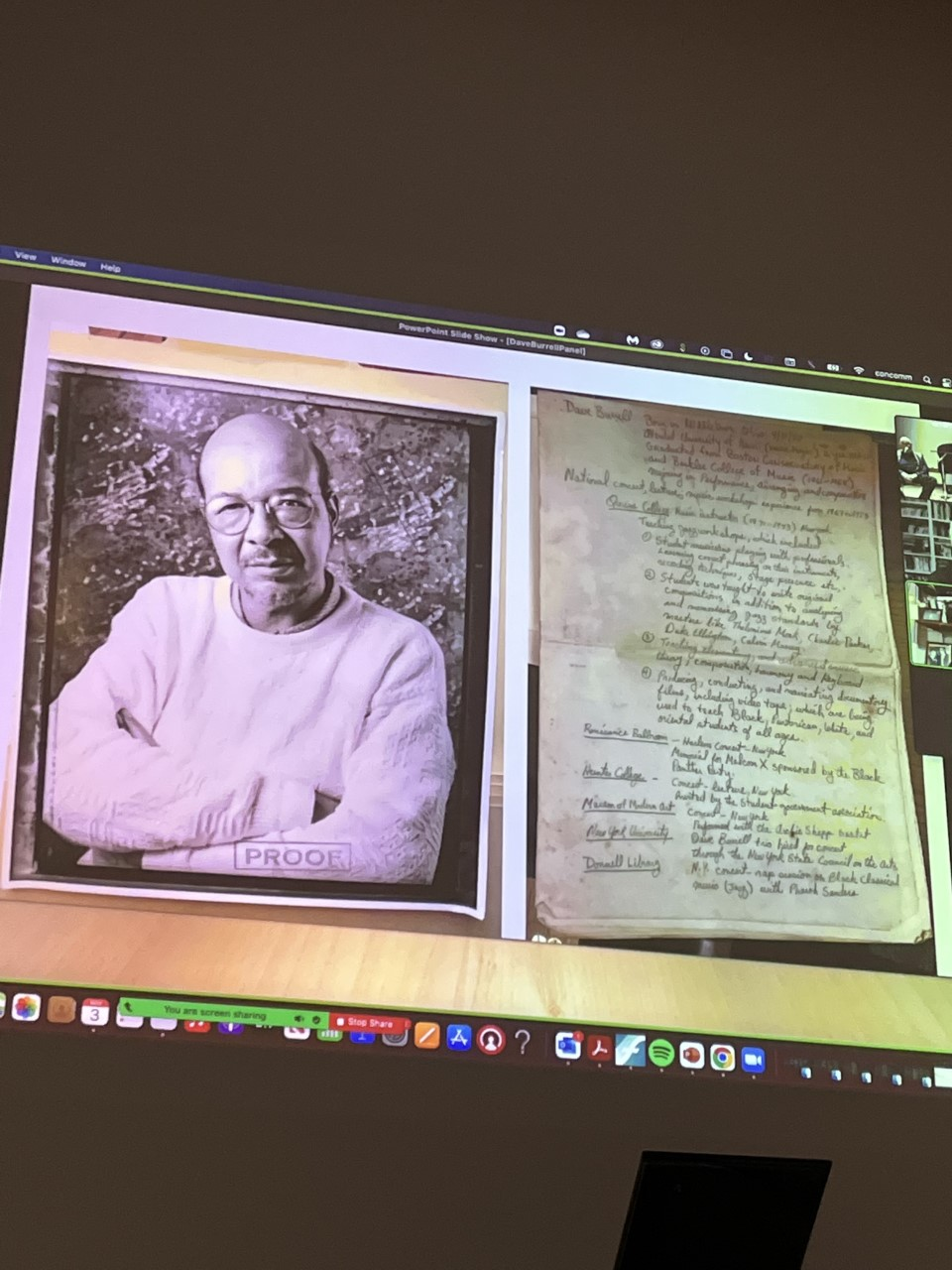
Dave Burrell, the pianist in question, played at the Bellefield Hall at the University of Pittsburgh on Tuesday, November 1. His appearance coincides with the donation of his archives to the Center for American Music, part of the University of Pittsburgh Library System, which also houses Errol Garner's archives. To kick off the Tuesday night show, Ed Galloway, Associate University Librarian for Archives and Special Collections, presented Burrell with a plaque commemorating his career and donation to the university (below). 


The evening featured Burrell in a trio with bassist Joshua Abrams and drummer Hamid Drake, with flutist Nicole Mitchell joining them. (Mitchell just announced her departure from Pitt for the University of Virginia about a month ago. Aaron J. Johnson is now the Acting Director of Jazz Studies at Pitt). But before the whole group played, Burrell sat down at the piano for a long, flowing medley. While he has played with the fiery intensity of someone like Cecil Taylor - reaching his left hand over his right to literally stab the upper register of the keyboard during a solo - the pianist can also reveal a delicate, if no less deep, side by exploring some standards. For about 15 minutes, my ears heard traces of "Autumn Leaves," "Here's that Rainy Day," "How Deep Is the Ocean" and "My Melancholy Baby."  The latter two featured some solid stride work in the left hand, pushing the music forward.


The evening had a pretty casual feel to it, as if the band might have been coming up with ideas on the fly. The whole group came out onstage but Burrell announced that he and drummer Drake would begin with a duet, which sent Mitchell and Abrams backstage again. The two players dug into a tune with a boogie groove to it, with Drake emphasizing the offbeats at one point and playing double-time the next. After a few minutes, Burrell decided it was time for Drake to go it alone, and the pianist himself left the stage.

This move was something that Thelonious Monk used to pull on drummers that got on his bad side, but Drake hadn't done anything to offend the evening's honoree, as far as we could tell. Besides, Drake had more than enough ideas to keep the audience eyes glued to the stage, with a brilliant range of press rolls. hi-hat whacks and more use of offbeats.  


Mitchell and Abrams had their duo time next with the flutist vocalizing as she blew and Abrams producing a series of thick double stops, alternating between bowing and plucking. Despite the casual feeling of the show, the rapport between the players was on display. Drake, Mitchell and Abrams all know each other from their time in Chicago in and around the AACM so that kept things flowing.


With Burrell back with them, a free, open section eventually morphed into "Come Rain Or Come Shine" which the group took their time digging into, exploring it to a great degree. That song especially is one that's been performed thousands of times, but the quartet approached it with that understanding. They weren't there to simply get a rise from the audience by playing something familiar, nor did they turn it inside-out. They presented in a way that proved why it's such a lasting classic.


Last night (Thursday, 11/3), Burrell appeared in a panel discussing his career, along with his wife, the poet/author Monika Larsson and Pitt Associate Professor of Jazz Studies and author Michael Heller (the latter whom kept pronouncing the pianist's surname "BYOR-ell" rather than "BOOR-ell" as everyone else seems to have said it; maybe he's on to something we don't know?). Via Zoom, the discussion also included trumpeter Ted Daniel (seen below), saxophonist David Murray and jazz author John Szwed. 

Heller presented a few shots of items from the Burrell archive, as seen above here in the one shot I got of the overhead projection. The image on the right is actually an early resume that Burrell put together. 


Though the Zoom connection sometimes make things a little hard to hear or contextualize, it provided some fun insight into Burrell's wide-reaching connection with the different players. Daniel (seen above) recalled meeting him at the Berklee School of Music in the early '60s, where Burrell showed "determination and consistency with practicing," and introduced the young trumpet player to the Thesaurus of Scales and Melodic Patterns by Nicholas Slonimsky, a book which he said he still owns to this day. The two players also reminisced about a trip to Europe that took them to a festival "in a cow pasture in Belgium" where they shared a bill with not only the Art Ensemble of Chicago but also Pink Floyd, the Mothers of Invention and Cream.

Larsson talked about writing a libretto for Burrell's music and how a midnight cup of coffee lured her away from her then-husband to the pianist. Murray discusses the duo shows he and the pianist performed, along with the latter's tenure in Murray's octet. Burrell chuckled as he remembered what he would say to drummer Ralph Peterson before a performance: "Time to make the donuts!" 

After the panel discussion, members of the Pitt Chamber Ensemble performed some of Burrell's work for strings and piano, followed by trumpet and piano. After Tuesday night's performance, these modern pieces with flowing melodies offered another take of what the pianist has created. 

If you read this in time, the Pitt Jazz Faculty will present the final on-campus concert on Saturday, November 5. The show will consist of music by Art Blakey. 7:30 pm at Bellefield Hall. It's free! Be there to dig it!


Tuesday, October 25, 2022

CD Reviews: Max Johnson - Hermit Music / Max Johnson Trio - Orbit of Sound

Max Johnson
Hermit Music

Max Johnson Trio
Orbit of Sound


The story has been told over and over during the past two years. The pandemic set in and everything halted - any kind of live performances, not to mention tours. Recording sessions were limited too. This was especially hard for creative improvising (also known as "jazz") musicians, who depend on such things for their livelihood and mental well being. In response, a lot of these players became resourceful, posting live shows online or doing them on porches of their houses or under bridges. These creative types became even more creative to deal with the times. 

That was all well and good but it overlooks a more vulnerable group of musicians - those of us who felt depressed throughout 2020. It can be hard to roll with those punches if you don't have a strong will.

New York-based bassist Max Johnson felt that way. "...When New York shut down in March of 2020, I became deeply depressed and couldn't bear to play my instrument for months," he frankly states in the liner notes to Hermit Music. "While I watched musicians talk about how great it was to take time off, or how productive they were being, I struggled to get out of bed each day and found it hard to put on my positive face."

The five improvised tracks of solo bass on Hermit Music feel cathartic. Rapid plucking launches the title track, sounding in part like a wake-up call and a CD that's stuck. (It's not, but it's impressive that Johnson can evoke that frenetic sound with his instrument). It continues with a drive and focus, stopping to pluck all four strings midway through, sounding more composed than spontaneous. Of course, Johnson had a lot of time to consider what to pull out of his instrument so he's making up for lost time.

A similar sense of direction continues through the other four tracks. Wide open spaces during "Ghost Whistle," where Johnson stops to reflect on his next move, bridge the gap between heavy bowed passages and a plucked section that feels like a theme coming out of the fog. The low rumbles of all four strings returns at the start of "Haystacks," making it less like a visceral gesture and more like a continuation of a theme between tracks. 

Like other solo bass albums, Hermit Music might take a little effort to get into, but the payoff is there, such as when Johnson's bowed overtones reach a cathartic level in "Glass Lungs," moving into more thematic areas. He concludes his notes by saying the music "symbolizes my struggle with self, reality, purpose and mental health." While it might not have been an easy session, what comes across in his playing is a renewed sense of purpose. 


Johnson released Orbit of Sound during this past summer. This session features him in a trio with tenor saxophonist/flutist Anna Webber and drummer Michael Sarin,  working through five detailed pieces. The album title feels appropriate because the group comes up with new ways of utilizing the sax/bass/drums format, with the focal point of the music orbiting around the different players. 

This struck me most significantly during "The Professor." The 16-minute track begins with some free flowing sounds, with everyone in close contact. But somewhere around six minutes, as things unravel, Webber gets fixated on long, plaintive multiphonics. This could get tedious at first, but after awhile it becomes apparent that the action is happening with the bass and drums. She's more of an accompanist while Sarin and Johnson build up a torrent of arco lines and rolling cymbals. It never gets to a chaotic level either, which make the nuances of the flowing music stand out.

Earlier in the album, "Over/Under" takes ample to stretch out too, building from bowed bass noise into carefully delivered plucked notes, peppered by bird sounds and what sounds like shortwave radio static (both from Webber). A pedaled bass note leads to a choppy theme over a 4/4 beat, with Sarin playing the melody as much as he drives it. The drummer gets more animated and lifts off as Webber begins to solo but before long all three reconvene for a closing melody.

Hopefully Johnson will have a chance to get this trio out in the public again. (His Facebook page has a performance from last year at Conveyer in Brooklyn.) He also played recently at Downtown Music Gallery with saxophonist Erin Rogers (a clip appears on Instagram), so it's good to know he's back at it again.