Sunday, July 12, 2015

The Day After Deutschtown

Coming down off of the Deutschtown Music Festival, which happened all day yesterday in the Deutschtown neighborhood on the North Side. Before I go any further, I want to make sure that folks know that I am appreciative that the Love Letters were able to play the event. There were about 125 bands that performed yesterday, and it was cool to be part of that. It was also nice that there was a "green room" set up in one of the venues where the bands were fed. And fed mighty well.

That being said, it feels frustrating when the band that immediately precedes you draws such a big crowd that you can't even see them (in a tiny venue) and as soon as they're done, the majority of those people standing there are gone, gone, gone like roaches in the light. I mean, sure some of them are going to leave. But don't a handful of them want to see what the next band is like? Catch a few of their songs?

We had just 15 minutes between bands for the last group to break down and for us to set up. Grand Piano - the group that played the great set before us - was off stage in record time and we were ready to jump on and hit the downbeat right at 3:00 pm. The set went pretty well, although Mike broke a string in the middle of his song that has a pretty significant guitar showcase. Then he accidentally restrung it with the wrong string and had to redo it. But things flowed pretty well.

There were a few who hung around to see us. A few of Erin's Timbeleza bandmates showed up too. And the owner of the James Street Gastropub, where we played, complimented me after our set, and seemed genuine about it. But it would have been cool to have a person or two from the audience ask about the record or when we were playing next.

It's hard with a festival set-up like this. All these bands, all these venues, spread throughout the neighborhood. There were a few outdoor stages but most of the shows were inside, in our case on the bottom floor of the venue, which was actually a great idea because it felt in a way like playing a basement party, to me tha'ts sort of the ideal setting in which to see a band.

The band took off in different directions after our set. We kind of hung around to see the next band, the John Tremaine Show, who were pretty cool. But then we had to get our equipment out of there and it only made sense to take it back home.

Later that night, I returned to the North Side to check out City Steps, who had Pam Hanlin from Dumplings as a guest bassist filling in for regular guy, Ross.


The Modern Cafe (or was it Cafe Modern) wasn't  really built for live music. Tile floors, high ceilings for the sound to bounce off of. And three big screen tvs to flank the band, on those walls alone. But they played a spirited set, Pam playing like she's been in the band for months. Michael was animated too. Apparently, Weird Paul's set earlier in the evening didn't go over well. He was told he was too loud, which was surprising because the band right before City Steps was REALLY LOUD. Thank God for my earplugs.

Today it's back to reality. And work.

Thursday, July 09, 2015

Mudhoney in Pittsburgh


I didn't expect Mudhoney to play all the songs that I knew and loved from 25 years ago, but they did. Well they didn't play "This Gift," but about three times they played something that sounded a helluva lot like it. So between that, and getting to hear "Touch Me I'm Sick," "Sweet Young Thing Ain't Sweet No More" and the favorite of my household in 1989/1990, "You Got It," it was a great night. The band came to Mr. Small's Theatre last night, with locals the Cynics and the Nox Boys opening for them.

Personally, Mudhoney always personified all that was good and wild about music coming out of the Pacific Northwest. Most of it came down to Mark Arm's off-the-rails vocals, which were always at the brink of hysteria, without sounding like a metal screamer. Then there were those power chords, which the blending with hot riffs, like the lick to "You Got It" or the tremolo in "This Gift." After all these years, one can't expect most bands from a quarter-century ago to maintain a wild-eyed visage without looking like either a bunch of screw-ups or dudes who don't realize the Peter Pan frame of mind isn't fooling any of us. Just age, and then rock.

I mention all this because Arm and guitarist Steve Turner looked relatively clean cut from where I was standing. In fact, they looked they could've been in Big Star, circa 1973. Shorter hair, white guy 'fro. They had it. It was strange to see, but I think there was something in the gin last night.

Their set stretched on to about 90 minutes, encores included, and when you consider most of their songs last about three minutes, that makes for a dense set. They hit the stage with the same fury they put out back in the day, kicking off with "Suck You Dry" and it stayed at a high level.

The Cynics played right before them, getting kudos from the headliners, who reminisced about seeing our hometown garage heroes back in their hometown way back when. Our locals also took us way back, opening the set with "Blue Train Station" the title track to their 1986 album. They went on to kick out "No Way" and another number of two from the '80s. But unlike memories of days gone by, they rocked these oldies to prove they were still relevant. After falling off the stage at a show in another city, vocalist Michael Kastelic looked fine and played as if nothing had happened.

The evening began with young Get Hip labelmates the Nox Boys opening the show. Vocalist Zack Keim's guitar was pretty buried in the mix, so it was hard to fully get into the hooks of their songs. But Bob Powers' slide guitar added a lot to the music, and the band sounded really tight. Things sounded catchy.

Monday, July 06, 2015

Thumbscrew was here. Did you know?

Last night Thumbscrew played a show to cap off their two-week residency in Pittsburgh. The group consists of Michael Formanek (bass), Tomas Fujiwara (drums) and Mary Halvorson (guitar). It's a cooperative group where all three of them bring in compositions. They put out an album on Cuneiform, which I reviewed in JazzTimes last year. As part of their residency here, they wrote music for a new album and recorded it at Smalls studio (which is not located in the same building as Mr. Small's Theatre anymore, but in the former site of Audiomation on the North Side.)

If you're a Pittsburgher who didn't know about the show, I'm guessing you're not alone. I suppose, as the main voice of jazz for Pittsburgh City Paper (I'm not trying to brag; I don't know if anyone else picks up the slack), maybe it was partially my fault. I knew they were coming to town, but forgot exactly when it was happening. Coming off about three weeks of Monday deadlines for CP and JT, not to mention some new work for Blurt, I felt like I needed a day where I wasn't either working the dayjob or scrambling for a deadline or hustling a story. So I didn't start chasing the info right away. Nor had anyone contacted me in advance.

By the time I reached out to Halvorson via email they were already here, scouting studios and trying to get on with the business. As it turns out, they were also doing seminars while they were here. That I didn't know about. A few days later I heard from City of Asylum, who was sponsoring the event, along with BNY Mellon. But by then, the deadline to preview the concert had pretty much passed.

The FREE SHOW happened last night on Sampsonia Way, just down the street from the Mattress Factory and from City of Asylum HQ. That's right, free free free. How much do you have to pay to see Michael Formanek - he who has received not one but TWO five-star album reviews in downbeat for his last two albums as a leader? Tomas Fujiwara is also a mother of a drummer, attacking back beats and freedom with the same level of enthusiasm. And anyone who has read anything on this blog knows how I feel about Mary Halvorson. (For you first-time visitors, I think she's extremely inventive as a musician and composer.)

I was getting back into town after visiting family yesterday, so I missed the first 30 minutes of the set. The good news is, I saw the remaining 90 minutes.

Formanek introduced a new piece which he called "Danse en Sense," (I think) asking for any French-speaking audience members to help with the correct pronunciation, having taken it from Google translate. The idea he was going for meant "nonsense dance," and true to the title, the trio played independent lines that were wild yet still worked together, especially Fujiwara's woodblocks, strategically placed on his snare and floor tom. I had half a mind to ask him if his part was written out or if he was just following an idea. But I never got around to it.

Having listened to their debut, it was more exciting seeing them in action, watching the various parts intersect in the music, from more rock-oriented foundations to freedom. The audience seemed to dig it too, giving them a standing ovation. It was great to see so many people out for an adventurous show. I wish they would intersect with the jazz audience at shows when Lina Allemano or William Parker come to town. Or even at the weekly Tuesday night Space Exchange shows at the Thunderbird. The latter events are free shows too.

I'd be curious to know what got people out to this particular event. The 6pm start time? The lack of a cover charge? Getting email blasts about it? This inquiring mind would like to know.

How many people read this blog and thought, wow, I would've gone had I know about it.

Saturday, July 04, 2015

It's the Fourth of July

Playing right now: the new Exploding Star Orchestra album
I've been asked to write about Rob Mazurek, the leader of ESO, so I'm digging into this mammoth new release by them.

It's the Fourth of July and I'm working today. Just for a few hours, though. First time I've ever done that. And I figure since my dayjob involves retail, and I like the people I work with, I should help out. Then it's off to Ohio for a day.

In other news, the band Thumbscrew (Michael Formanek, Mary Halvorson, Tomas Fujiwara) have been in Pittsburgh for over a week, doing a residency at City of Asylum and tomorrow evening is their free show over on the North Side. Here's info on it, for the benefit of anyone who is in town tomorrow and wants to go.  I'm hoping to make it back in time.

So much music going on around here. Of course there was Ginger Baker a few weeks ago. I took copious notes but never got to report on the show. Here's the feature. I found out a few days before the show that no one else in Pittsburgh got to interview him, and I got a bit of a head rush. Then at the show, Ginger mentioned he had been sidelined two weeks prior to the show with pneumonia, and was in the hospital. I did the math quickly and figure it must have happened right after we talked. That might also explain why no one else did.

Considering his frail state, it was impressive that he made it to the show at all. It was a good night. Not spellbinding, but definitely tight. He and percusssionist Abass Dodoo definitely have a strong rapport and are locked in tight together. Ironically, while Ginger was swinging hard with his band, just about a mile across the river, his mate Charlie Watts was playing with the Rolling Stones, who by all accounts really rose to the occasion that night.

The incessant rain and, again, work kept me from checking out more of the Pittsburgh JazzLive Festival which went on all weekend downtown. But as I walked to Penn Avenue from the parking garage to the Byham Theater, Joey DeFrancesco was tearing it up on the B3 on one of the stages. A little rain will never slow down a B3.


Tuesday, June 16, 2015

Will Ornette Get to Hang with Bird?

I should have written about Ornette Coleman's passing, but in the blogosphere, that's probably yesterday's news by now. Besides, what can I possibly say about Ornette that a million people haven't said already? I haven't even read the myriad links to NPR articles on him. I saw one that included a pic of the saxophonist with a mischievous smile on his face, and it kind of broke my heart. Talk about leaving an empty space in this world!

Being raised Catholic, but now being Unitarian Universalist - well, at least I attend the latter church - I spend a lot of time contemplating the afterlife, whether it exists and what's there. OK, I'll just say it: Heaven. I think about Heaven. Especially since my dad died last fall. It made me wonder if Pop met up with Charlie Haden and if they got into a deep discussion of the bass. Charlie kind of reminded me a little of Pop, or vice versa. Although Pop was never one to say, "Solid!" on a regular basis. But they seem like two guys who could talk about deeper things.

So now, I couldn't help wondering if Ornette finally got to sit down with Charlie Parker and talk music. What would that be like? It could be a play, maybe. It should be: Bird's down home demeanor meets Ornette's obtuse but deep philosophy.

You can read all you want about musicians but you never really know what they were like. With all the hangers-on and the worshippers and the naysayers, a lot of people cultivated a personality out of the need to survive. Factor in some baser instincts that take over when you really do know better, and maybe you really do care about a person's feelings.... how many layers does that put on top of person's true personality? Will we ever know the real Bird, or the real Ornette? The latter, probably. I'm sure his son Denardo know what he was like.

The other reason I didn't get to all this last week was there was a lot of music going on. TWO LOVE LETTERS SHOWS IN ONE WEEK! We played the Arts Festival last Wednesday, which was a blast. Beautiful weather. An hour-long set. Great sound. Great sound people. Plus my sister got into town less than an hour before it started, and got to see the whole thing, along with my mom, wife and son. Plus various friends filtered in. And a stranger took photos of us and blogged about it. Thanks!

Then we played at Howler's on Friday night. It started out as kind of a slow night, but by the time we started playing, things felt really electric. Buck, who normally looks restrained, was on fire, using chopsticks a la early Sonic Youth, and jumping around the stage. Erin was pounding hard. Mike (Prosser, not me) was exquisite. I think we turned a major corner. Or hit a new plateau. Or something.

It was so much of a blast that, the next day, after working, I didn't have it in me to see Neko Case at the Arts Festival. Or check out my old high school buddy Sean "Spike" Slawson at the 31st Street Pub. 


Sunday, May 31, 2015

How to Interview Ginger Baker and How Not to Interview Wire

It's been a crazy couple of weeks with a lot of activity geared toward writing. First and foremost, I suppose, was that last week I got to interview Ginger Baker by phone. He's coming to town for the Pittsburgh JazzLive Festival in mid-June, so if there was any chance of talking to him, I was going to take it. 

Last year, when John Lydon was scheduled to come here as part of a production of Jesus Christ Superstar, I was determined to interview him. And at the time I thought the two hardest people to interview in music are probably Lydon and Ginger (who, not surprisingly, worked together). So I pipe dreamed about talking to both. Of course, JCS was cancelled, so no Lydon. Then, at the time, I thought, Well there's no chance I'll talk to Ginger because where would the opportunity be? It's not like he'd come to Pittsburgh....

I guess the universe called my bluff. 

It came together quickly too. I had been thinking about it, and when I emailed the JazzLive organizer, I got an email hours later from Ginger's English publicist trying to figure out a time for an interview. We settled on a Friday morning at 7 a.m. EST (in England, that's noon). Fine with me because my work schedule prevents me from doing interviews during normal business hours. I'm typically up at that time anyway.

The Love Letters had a show the night before, but no problem. I was up at 6:30 putting questions together, and kind of panicking. One thing: I WASN'T going to ask him  - Cream questions. I really believe that one of the reasons Ginger is such a rough interview is that people ask him freeze-dried, dumb questions. Plus, these people never seem to have taken Journalism 101, wherein it is taught that you don't ask Yes/No questions if you want your subject to open up. I went to pains to phrase questions with "How" and "Why" at the start. On top of all that, he's coming here with a jazz group. He's not coming to play some permutation of Cream music.

At 7, I dialed up the number and heard that unique British ring. Then I heard a voicemail. With a woman's voice on it. Did I dial the right number? Am I being stood up?

I waited five minutes and called back. Same thing. Quick - email the publicist. A few exchanges and we're rescheduled for 9 a.m. This time he does pick up. His voice is low, a bit gruff. At this point I should mention the big thing the publicist mentioned that really had me worried about the call: Ginger is hard of hearing. Like many 70+-year old men, he also had the tv going in the background. 

But it went.... smoothly. He didn't yell at me. He spoke. Not a whole lot. He even mentioned towards the end, with a chuckle, that he's not much of a conversationalist. "I just play," was repeated a lot too. I haven't transcribed the interview yet, but I'll need to get on that soon. Then I'll see how much I really have to work with. 

After that call, I felt like I could climb Mt. Everest. But that was shot down a few days later. While I was trying to get the Ginger interview set up, I also needed to land an interview with somebody in Wire, who are also coming to town. It finally came together on a Sunday night at 9 pm. I know their first three albums really well and I received a copy of their most recent album, Wire, which is pretty good. I'm set, right?

Not exactly. Ten minutes into the conversation, what started out with some career-spanning, over-arching questions had narrowed down into a talk just about the old days. Then Colin Newman asked if I only knew the '70s Wire albums. The real answer is that's what I know best. Working knowledge of their '80s ones, plus a few spins on the new one.

I wasn't trying to sound like one of the "boring" people that, as Newman mentioned, dismiss everything but Pink Flag. Hell, I was surprised that the band even revisits that stuff, or talks about it at all. I thought they didn't look back. But he told me I was the first interviewer on this tour that only really knew the early stuff. He doesn't mind talking about it, but he doesn't want someone to read the article and think they're going to just hear greatest hits. Apparently there are a lot of books about it to use as reference. Though, as a reporter, who's going to quote from a book when you have the real thing?

It made for a few uncomfortable moments, but it just so happened that I was about to go into some questions about new guitarist Matthew Simms and the making of the new album. By the end we made peace. Not that there was really a war there. It's just that I'm rarely in the situation and when it does, it feels quite uncomfortable. (I didn't know a whole lot of David Torn's career and we had a great conversation a few weeks ago.) 

By the end, we were on good terms, though. He spoke at length about the Drill Festival that they've done in various cities, including one coming up in Chicago on this tour. It was unfortunate that I only had 500 words to devote to the article, so the scope was narrowed. They're here next Sunday and I'm looking forward to it. Stay tuned for a link to it.

While I'm here, I might as well link the article about David Torn - who's playing Club Cafe tonight - and William Parker, who played this past Thursday at the Thunderbird. Click here. 

Monday, May 25, 2015

CD Review: Myra Melford - Snowy Egret


Myra Melford
Snowy Egret
(enja/Yellowbird) www.jazzrecords.com/enja

Myra Melford took inspiration from the Persian poet Rumi in her previous quintet, Be Bread, using the words and subject matter to shape the music. Snowy Egret, made with an entirely different band, draws on another literary source, that of Uruguayan author Eduardo Galeano and his Memory of Fire trilogy, which tells a history of the Americas through indigenous myths. Galeano's way of writing was idiosyncratic - with some chapters being only a paragraph long - was as much an inspiration as the text itself. As a result, pianist Melford has come up with another set of highly unique, intriguing material that rewards repeated listens.

Snowy Egret draws on melodic ideas that aren't merely sourced from jazz (free or grounded) nor do they attempt to fuse jazz with music that might be connected to Galeano's writing. Although the references to both of these elements can be felt in the pianist's writing, Ron Miles (cornet), Liberty Ellman (guitar), Stomu Takeishi (bass) and Tyshawn Sorey (drums) are equally responsible for what happens in the music.

At times the structure is more minimal, like "Language" which is built largely on one suspended chord.  The piano, guitar, bass and cornet play it together, sounding like an even more angular version of Monk's "Thelonious" riff, before switching to a B section that still involves parallel movement. Variations on the structure come during solos by Ellman and an especially warm passage by Miles.

"The Kitchen," by contrast goes through various permutations. After Sorey (one of the most melodic and rhythmically inventive drummers around) unleashes a tidal wave of tom thunder and snare rolls, the quintet plays a brief stop-start melody, interrupted by free statements by Miles and Ellman. They finally lock in on an off-centered bluesy vamp that allows Melford to pound chords and fire off rapid melody lines, pushing the group away from structure until the finally return home to the staccato theme.

Free excursions also happen in "Little Pockets/Everybody Pays Taxes," in which Takeishi holds things together while everyone around him goes wild. But Melford also writes with sensitive lyricism: "Times of Sleep and Fate" follows "The Kitchen" with a rubato melody brought to life by guitar, piano and muted cornet. "The Virgin of Guadalupe" also begins as a gently as a ballad, with the rhythm section gradually rising in the background behind Miles. The opening bars of album closer "The Strawberry" has gospel voicings in the piano, though it doesn't sound like Melford is trying to take us to church, as it switches to something a little more Latin based after less than 60 seconds.

Writing about Melford's albums tends to be a challenge. They often have so much happening that the risk is wanting to dissect every song or to try to offer a simple overview of the album. The latter never seems to get the ideas out directly. Suffice to say, mere words can't describe the depth of Snowy Egret. Find it and use your own ears make the decision.

Monday, May 18, 2015

Seeing Lina Allemano's Titanium Riot & ATS' 30th Anniversary


Lina Allemano came to town about a year and a half ago, playing one of the Space Exchange shows, the Tuesday night jazz/experimental/what-not night that's normally hosted by a few different local musicians at the Thunderbird Cafe. At the time, she was with her quartet (trumpet, sax, bass, drums), who played it straight but solid. Last week, her return was a little different. Known as Lina Allemano's Titanium Riot, the group includes drummer Nick Fraser (who was also in the quartet), bass guitarist Rob Clutton and keyboardist Ryan Driver.

The group was free all the way (so was the admission charge, so if you missed it, shame on ya). Allemano was blowing rapid clusters of lines, never really digressing into guttural smears or high splats, but definitely locking into flurries of notes. Fraser was a study in restraint, rarely looking at his kit straight on. He seemed to have his eyes closed most of the time, with an expression that meant he was listening attentively to where the music was going.

Clutton was sometimes hard to hear, plunking on a classic Fender but often getting lost in a wave of sounds from Allemano and Driver. The latter was the wild card of the night. He was playing a Realistic keyboard. Yes, Realistic as in the kind that Radio Shack used to sell. I can recall noodling around on one of those (and getting yelled at) in a Radio Shack about 35 years ago. It might not be the same exact model, because Driver seemed to be hitting more than one note at a time, while I think my version was monophonic. But he was doing a lot of knob twisting too.

For the second set, saxophonist Ben Opie (who helped bring Allemano back) sat in with the group. The addition added another level of excitement to the music. Things were still free but the conversation seemed to deepen a bit. If, by some chance, you're reading this entry because you googled Lina Allemano's Titanium Riot since they're coming to your town, be sure to check them out. And buy some CDs too. Their Kiss the Brain disc is really solid.


Around this time 30 years ago, I was going through some sort of existential crisis (although I didn't know it at the time because I had no idea what that meant) because I was a senior in high school and not sure what I was doing once I graduated. At that same time, Pittsburgh newcomer Josh Arnson was teaming up with local underground music stalwarts Evan Knauer, Mike Marcinko and Steve Heineman, and formed a band they dubbed ATS. This was the age of initial bands: DRI, GBH, NSFU, TSOL; though none of those bands have anything to do with ATS' music. That was also the age of cow-punk which ATS was somewhat-incorrectly described as, at the time. Jazz, Minutemen-style punk, real country and anything else they were listening to - it all got thrown in to the blend at some point.

The band marked their 30th anniversary this past Saturday, by playing a characteristically loooooooooong set at Howler's. Arnson and Heineman, if you don't know, left the band 25-28 years ago. Kip Ruefle replaced Heineman, and once guitarist Arnson left, they soldiered on as a trio, save for the occasional auxiliary horn player or extra guitarist that just showed up.

I've seen ATS umpteen times in all those years. Hell, the Love Letters played the band's 25th and 27th anniversary shows at the same venue. But I felt like I had to check this one out again too. The Full Counts opened the night, playing LOUD garage rock, fueled by a lot of power chords. Bassist Eric Vermillion (once of Gumball nationally and locally part of the Steel Miners, FOOD and a few others) fronts the band. While Mr. V has a gift for a raspy garage-band scream, the songs I caught proved that he can sing just as well. Mark Urbano, who played with Heineman decades ago in White Wreackage (and several others) also plays in the band, along with drummer Mike Quinlan (another scene vet who played in Da Shunts with Knauer; as well as FOOD). (Apologies to guitarist #1, whose name I didn't get.)

The core ATS trio of Knauer, Marcinko and Ruefle was expanded with Heineman on keys (that guy can play anything and do it well), saxophonist Tim Pollock and trumpeter Downtown Steve Brown. The joke about ATS' early days is that all of the sets were the same. You could set your watch to the cymbal introduction to "Helsinki Town" as the evening got started, never letting up until "Song for Alice" at the end.

A lot has changed in 30 years. The first two-thirds of the set were new songs, relatively speaking. Knauer even made some quips about "new" meaning they were written in the past six years. Time has done nothing to slow these guys down in terms of songwriting or performance. In fact the noodling that was part and parcel of some of those early shows has really been streamlined in recent years. And by the time they got around to riff-based "classics" like "Sepco and "Louise" at the end of the set, I was kind of craving them. Prior to that, the newer ones sounded as strong as the oldies.

Of course, by the end, I was nearly falling asleep on my feet. I stayed until the end, but it was trying, after that third drink.

Thursday, April 30, 2015

CD Review: Chris Potter Underground Orchestra - Imaginary Cities


Chris Potter Underground Orchestra
Imaginary Cities
(ECM) www.ecmrecords.com

Chris Potter didn't set out to do a concept album about the state of the urban landscape. But in some ways the music on Imaginary Cities does come off like a musical assessment of it. Any given piece of real estate, be it rural or urban, comes with many layers to it, geologically and historically speaking. The suburban sprawl that we see while driving, crammed to the gills with billboards, fast food establishments and the occasional Mom and Pop store - what did it look like half a century ago? Inner city communities still have buildings that was constructed in a period prior,  with storefronts commingling with houses, in various states of repair, still echoing a time when neighborhoods were self-sufficient and there was no need to hop on a bus or get in a car to go and do your shopping.

Where does it go from here? Was it better back then, or is it better to keep move forward? Maybe it's neither of the above, and better to just stare out at the vast sky and soak in the scope of it.

These visuals spring to mind on the tenor saxophonist's new album, which takes his Underground quartet (pianist Craig Taborn, guitarist Adam Rogers, drummer Nate Smith) and adds two bassists (upright player Scott Colley and bass guitarist Fima Ephron), a string quartet and vibraphonist/marimbaist Steve Nelson to it. They create a rich sound, especially during the different sections of the four-part "Imaginary Cities" suite, "Compassion," "Dualities," "Disintegration" and "Rebuilding."

The names, when taken together with the music, conjure up images of various aspects of city life.  "Dualities" seems to depict the contrast between the minor strings and the bright sounding marimba. "Distintegration" is especially telling, where Potter's soprano and the strings move rather freely over a mix of acoustic guitar and basses, creating some eerie tension. Some of it sounds completely composed, while other sections give everyone space to move freely. Finally, to read more into the whole concept, Potter aptly ends by proposing solutions, not merely bringing up issues. "Rebulding" begins with Smith laying down a odd-time groove that Potter (back on tenor) and Nelson use to great advantage. The 11-minute piece goes through various shapes, holding down the groove before switching in the final quarter into a more midtempo section.

But that's only half of the album. "Lament," which precedes the title suite, features Potter's tenor playing over a yearning two-chord vamp towards the end which still has plenty of fire brewing, the strings giving the music a more expansive sound, never acting as a sweetener. The quartet gets as much frontline room as Potter on "Shadow Self," which is inspired by Bela Bartok. The closing "Sky" acts something like a final statement to the whole city concept of the album. The music is vast and expansive, as if trying to encompass the surroundings, again bolstered by the arrangement of 11-piece group.

Strings and jazz can make strange bedfellows. Even the way the strings are recorded can impact the impact of the music. Potter uses them in his music to alternately create tension and reinforce the beauty of his music. In doing so, new things are discovered with each listen, from the shape of melodies to subtle colors that Craig Taborn uses to add drama. It's a work that gets more meaningful with time.

Tuesday, April 21, 2015

RIP Bernard Stollman, ESP-Disk's founder

One of the most dramatic scenes in It's a Wonderful Life comes in the part where George Bailey has no identity and he sees his widowed mother running a boarding house. Frank Capra really plays up the pathos, filming half of Jimmy Stewart's shocked face at close view. Behind him, Clarence the angel says, "Strange, isn't it? Each man's life touches so many other lives. When he isn't around, he leaves an awful hole, doesn't he?"

I thought about Clarence's observation when I heard that Bernard Stollman, the eccentric found of ESP-Disk records passed away yesterday at the age of 85. He lost a battle with colon cancer that had spread to his spine.

ESP was the first American label to give Albert Ayler due recognition. Even though Broadside initially issued the Fugs' debut album, ESP later reissued it and brought it to more people, and released their self-titled second album (which is arguably their best one). Pearls Before Swine. The Godz. Paul Bley. Patty Waters. The list goes on and on. And on. And it includes albums that maybe should not have been released. But they were. The world is a little stranger for it, in a good way. Who knows how many outsider artists were motivated to make music based on what they heard on that label?

It all comes back to Stollman's eccentric vision. He started the label because of his commitment to promoting the Esperanto language. (That's what the label's name represented.) The first album was Ni Kantu en Esperanto, an album of insipid traditional songs sung in Esperanto. I once talked to an ESP act and expressed a desire to hear it. He responded, "No, you don't."

It could have stopped there. But Stollman heard Ayler and put his support behind him, thus providing the first serious platform for what would be called free jazz. He released what was Henry Grimes' only solo album for decades. Giuseppi Logan. Marion Brown. Sunny Murray. Oh wait - I'm getting carried away again.

Stollman might not have been the best businessman, but I'm not here to discuss that. I'm here to give thanks to one man's crazy idea that inspired countless others in its wake. And to encourage others to do the same. You never know how many people you're going to reach when you put a piece of art out there. No, that's not the point, but it can be a significant side effect. So, thanks, Bernard, wherever you are. Ripozi en paco.

Tuesday, April 14, 2015

Rob Mazurek, Geri Allen, Kathryn Calder, Vanilla Fudge

Right now I'm listening to music that I have to review so I can't post anything new. But I have written things in other places to let you know what I've been up to.

Here's a review of both the Rob Mazurek & Black Cube SP show at the Andy Warhol Museum, and Geri Allen & TimeLine at the Kelly Strayhorn Theater. You might need to scroll down through a few stories to read it.

Today, Kathryn Calder - keyboardist and vocalist of the New Pornographers - releases her third solo album under her own name. It's self-titled too. My review of it appears on the Blurt website right here.

Finally, weeks after the fact, here's my Vanilla Fudge piece, also on Blurt.

Wednesday, April 08, 2015

Mary Halvorson & Stephan Crump - aka Secret Keeper - Slay Pittsburgh


Funny how these things work. Sometimes top-notch, adventurous jazz types come to Pittsburgh and a baker's dozen of listeners show up. Then last night, a guitarist who is arguably one of the most innovative in her field (definitely the most unique voice) and a dynamic, prolific bassist  - whose regular gigs include a spot in the Vijay Iyer Trio - come to town, totally flying under the p.r. radar, and they pack a loft, essentially selling it out, at least a week in advance. It's a tad ironic that the duo goes by the name Secret Keeper. But I'm here to celebrate, not castigate.

I found out that Mary Halvorson (guitar) and Stephan Crump (bass)  - aka Secret Keeper - were coming here almost by accident, told by a friend/publicist a while ago. The evening after I interviewed Mary for a Pittsburgh City Paper article, I heard that it was sold out. Luckily, Mary ensured that I got in. Which is good because if I hadn't, I would have had a five-alarm meltdown. ("Standing in the rain/ with his head hung low/ couldn't get a ticket/ it was a sold-out show...")

The only reason I'm editorializing is because it would have been cool if the folks who attend things like the Sound Exchange weekly events at the Thunderbird Cafe had known about it, so audiences could cross-pollinate. Mary is coming back for a residency in June/July with the band Thumbscrew. Hopefully everyone can come in contact then. We can be a welcoming people, us Pittsburghers.

So, yeah, I suppose I was sort of geeking out at the show. I really like Mary's music with her own bands, and love Stephan's many projects. But getting to see Secret Keeper in person, just a few feet away from me, was awesome. Halvorson's big, hollow body Guild guitar has a distinct, crisp tone to begin with, but she has a signature sound, built on a skillful use of pitch-bending pedals, delay and the occasional stomp of the Rat distortion box. Crump plays his bass viscerally, hugging it, singing along with it, generally working up a sweat as he did last night. (It got pretty warm in the room as the set proceeded.)

Emerge, Secret Keeper's second album, isn't officially out yet, but the duo has been touring in support of it for the past week, and last night's set was predominantly drawn from that album's tracks. It was fascinating to watch Halvorson play long, extended melody lines that kept flowing. In the coda of "Bridge Loss Sequence, she switched to chords that almost sounded like Freddie Green's riffing in a Count Basie piece - although the context was way different, and this was only a passing moment. But it shows how much contour can be found in their work.

Crump often sounding like he was operating on a different rhythmic plain than his partner, but it was easy to see that they were moving together even if they were playing parallel melodies (or to extend that metaphor, maybe it was more perpendicular). He bowed some deep harmonics and some rich double (and possibly triple) stops. Then the climax to a piece like "Disproportionate Endings" both of them pulled out some outer space harmonics. "Mirrors," originally an improvisation on their Super 8 album, had Crump playing his bass's frame percussively before Halvorson looped a bunch of guitar effects that sounded like sped-up piano noodlings.

The audience seemed to stay with the duo through the whole set, sitting in quiet, rapt attention (from what little I could pick up in the second row) and showing their enthusiasm with applause. Here's hoping we'll all see each other again soon at another show.

Tuesday, April 07, 2015

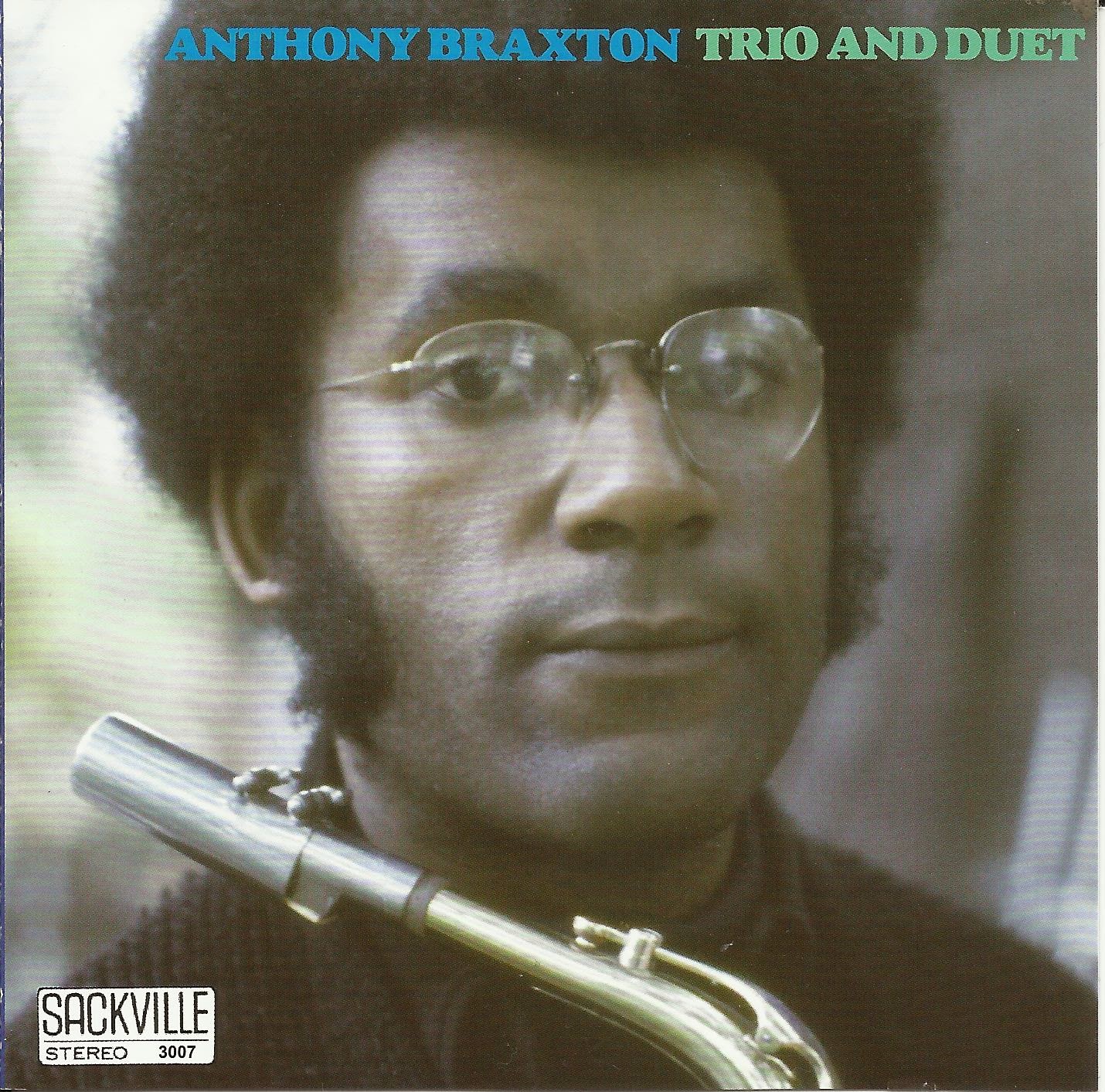
CD Review: Anthony Braxton - Trio and Duet


Anthony Braxton
Trio and  Duet
(Sackville) www.delmark.com

Delmark continues their reissue series of albums on the Sackville label with a 1974 session that could have just as easily been called Two Sides of Anthony Braxton, due to the contrast between what appeared on Side One and Side Two. The side-length "Composition 36" finds him with his Creative Construction Company partner (Wadada) Leo Smith (trumpet, pocket trumpet, flugelhorn, percussion, small instruments) and Richard Teitelbaum (Moog synthesizer, percussion). Conversely, Side Two consists of Braxton and bassist Dave Holland tearing through standards like "The Song Is You" and "Embraceable You," never forsaking the chord changes but also maintaining their own musical identities.

"Composition 36" also blends elements of abstract, sometimes pointillistic playing with recurring melodic elements. It begins with Teitelbaum oozing out some metallic drones from his keyboard before a muted Smith and Braxton (playing only B-flat, and later bass, clarinet) state a long-toned theme that will reappear a few more times. The 18-minute piece never really falls into a full group improvisation nor do the players take typical solo spots. Overlap and support are key. Smith wrings life out from upper register squeals, the clarinet squeaks and grumbles through different registers. Teitelbaum creates noisy soundscapes but he also turns them into pedal notes that sound like a melodic vacuum cleaner, and he also unleashes some fast keyboard runs in a more conventional voice.

After hearing this on vinyl, one has the chance to ruminate on the contours of "Composition 36" while flipping the record over. With the reissue, we're propelled right into an upbeat, nearly 12-minute version of "The Song Is You" without much more than a chance to exhale. Holland's steady walking bassline keeps the structure in place, still leaving him time to solo. Braxton's alto has a delightfully gruff tone to it that treats the standards well. "You Go To My Head" is played a little more uptempo than normal, and not quite as legato; "Embraceable You" also sounds a little wilder and not quite as much like a ballad. "I Remember You" - one of two bonus tracks - takes liberties with the melody from the first measure, perhaps in homage to Lennie Tristano and his acolytes. As he continues, Braxton adds a few squonks to the tune, which might explain why this track was left off the original album (though length was also probably a major factor). In total, Trio and Duet offers a vast picture of the complexities that fueled Braxton's work.

Tuesday, March 31, 2015

Matthew Shipp & Michael Bisio Are Coming To Town


Pianist Matthew Shipp (left) and bassist Michael Bisio (right) are coming to Pittsburgh tomorrow night (that's Wednesday, April 1) and performing at the First Unitarian Church at Ellsworth and Morewood Avenues. I talked to Matthew a couple weeks ago, and parts of the conversation are appearing tomorrow in Pittsburgh City Paper as part of a bigger article about shows happening here this month. Considering how the show is tomorrow, and how Matt only gets a few good quotes in, I figured I'd run the whole interview here. Matt has a bit of a reputation as being a firebrand but he's always been nothing but nice to me. Plus, his performances are amazing. He and Michael came to town last fall as a duo and it was astounding. So if a few more people are motivated to check them out based on this, that will be a good thing.


Q: So did I read that you have an album coming out on ESP-Disk?

It’s the sax player’s CD [Polish tenor saxophonist Mat Walerian] but they put my name on it because it’s his first cd. And I have an Ellington album [To Duke] out too on a French label, Rogue Art.

Q: But didn’t you say I’ve Been to Many Places might be your last album.

I know what I said. Don’t listen to what I say when it comes to recording. [Laughs} I meant it. But I’m still in this vortex of recording. I just can’t seem to get out of it.

Q: Is it still fun?
Yeah. I love the process but I would rather….

Q: Why’d you say it?

I’ve been with [the label] Thirsty Ear for a long time. And I’m not going to keep doing it forever where I keep putting out Thirsty Ear albums now. And probably, when I end my relationship with Thirsty Ear, unless something sweet comes along, where it’s involved with some patronage type of thing, I’m not gonna keep generating albums on other labels too. It’ll be obvious when it’s time.  And I thought it was, but it wasn’t quite.

Q: How long you and Michael [Bisio, bass] been playing together?

The first gig with the trio was probably 5 to 6 years ago. We have a real feel for each other and a real friendship apart from the music. And a real feeling of destiny for this part of our life as far as being a team. We have a real sense of purpose with this. I feel it does show in the music.

Q: How does playing in a duo setting differ from the trio [which had included drummer Whit Dickey]?

It’s more intimate. The trio – this might sound weird – it’s more of a commercial jazz setting and people are more used to that format. You can kind of do it with the veneer that it’s a regular jazz trio no matter how modern the music is. And with the duo, you do away with that pretense altogether, just doing pure communication.

Q: How does playing with Michael compare with playing with William Parker?

It’s two different structures altogether. They both are utter monsters and they both are strong personalities. And they both are great bassists and they both are totally different also. i’ve been blessed to have both of them in my life. I feel very lucky.

Q: Do you still get to play with William?

I have breakfast with him most every day. I do stuff with him occasionally. I’ve done a couple different things that he’s been involved in, in the last year. I mean he’s so busy with his own stuff.

Q: So, the new album [The Gospel According to Matthew & Michael (Relative Pitch) with Bisio and violist Mat Maneri] – how spontaneous was that?

I want that to be the mystery. I’m not going to say. There are definitely some composed parts but it’s also a lot of improv. The percentage – I want to sit back and see what everyeone guesses with that….there’s definitely some compositions in there. This is an experiment for me. I want to see what people project on it. So I’m not going to answer that.

Q: Tell me about the Robert D. Bielecki grant.
In my case, he gives out different grants for different things but he just gave me a certain amount of money ($15,000) and told me to do whatever I want with it. I used some of this for this project. He’s a foundation and he gives away money to people he thinks will do something with it. And he happens to be a fan of my music. So that worked out well.

Q: How did it come together? Did you have to apply for it?
I knew he was doing a foundation and I put out feelers. I had seen him sneaking around at a couple of my concerts in the past. I started talking to him and he asked, If I gave this amount of money, what would you do with it? And I said, I don’t know… pay off credit card debts? [Laughs] But I used that money to fund this project. I haven’t done anything with Mat Maneri for a while, and I wanted to get back with him and do something with him also.

Q: How is touring going? Is your audience growing?
Every gig’s different in every place. We’ve had some really good turnouts for some things recently. I actually played at Jazz at Lincoln Center. It was the Ellington project. We had two sold out sets. I recently played in Washington DC and the organization we played had the biggest audience they ever had. But on any given night, you can have an off night. Nothing is a straight line in this. But we’ve been doing pretty well on the road.

Q: How are shows in Europe?

I’m not going to say it’s dried up. But it’s not as rich as it once was.  But yeah it’s cool.

Q: A few days ago, you started a debate on Facebook at the San Francisco Jazz Festival.

Oh, that’s still going on. [Shipp’s issue was that a large number of performances during the festival were tributes to older artists or albums, like A Love Supreme, at the expense of current artists playing their own music]

Q: Well, here’s your chance to expound on it.

I would just say, ah… all jazz needs to be organic. And by organic I mean, just let people do what they do, whether it’s straight ahead, avant-garde…I would say there’s an over- degree of conceptualization going on in programming at major festivals that’s not conducive to having a beautiful organic evening. A lot of it seems to be very calculated – calculated for tourists. And in that way, it’s doesn’t seem to be a vibrant music. The way a lot of major festivals are presenting it, they got corporate sponsorships and it seems like they almost program things in ways that they think mirror the corporate sponsorship. There’s something so plastic about so much of it.

Q: That’s everything I wanted to ask. Is there anything you wanted to add?


I’m just trying to play some music. I’m trying to really be organic these days and try to do my thing. 

Tuesday, March 17, 2015

Will Butler, Hypercolor in Pittsburgh

But first, before I get to the titular subjects, I have to do a what-I've-been-up-to introduction, because it's been a handful. I'm not one of those bloggers who can give immediate updates at the drop of a hat.

Yesterday was the first Monday in a few weeks where I didn't have a story to work on or an interview to conduct. Or both, which I think might have been the case recently. Last week, I returned to Blurt after a long hiatus of writing for them. I reviewed the new album by Australia's Dick Diver which you can find here. It has yet to run, but I also interviewed Mark Stein, organist for Vanilla Fudge. With SXSW coming up this week, Blurt will probably go on hold for a spell. But as soon as I can say, "here comes the Fudge," I will let you know when that article drops.

Mr. Stein was a good egg too. Turns out the band is still loathe to talk about the sophomore slump LP The Beat Goes On, but like a trooper, he did anyhow. We also discussed the start of the band, as well as the making of their new album - yes, they're still at it - Spirit of '67.

Last week Arcade Fire's Will Butler played a sold-out show at Brillobox, which I believe I was the only person to preview in the local press.  Maybe it was clear it was going to sell out, so no hype was necessary. But, dang, was anyone curious what it was going to sound like?

Butler put on a good show, with a four-piece band of himself on guitar and keyboards, drummer, second keyboardist and back-up vocalist. His album (if you can call it that because it only has eight songs, most of them under four minutes apiece) Policy runs the gamut, stylistically, as did the show. "What I Want" had the power chord attack of the Buzzcocks while, one song later, "Anna" sounded like Suicide, with an unrelenting keyboard riff. The album had only been released two days prior, but the audience - which probably numbered in the high 100s, whatever the capacity is at Brillo' - seemed familiar enough with it and ate it up.

The UK newspaper The Guardian struck a deal with Butler a couple weeks ago where he wrote a song a day for five days, based on articles he read on their masthead. Results were then posted on Soundcloud. The idea might sound dubious, but the results are actually pretty strong. Among the ones he played at the show, "Madonna Won't Save You," is one of the most memorable, if nothing else for its opening line of "You can spend all day/ breaking hearts with a/ sledgehammer and a glass of milk." Weird lyrical non-sequiturs like that also show up on the album too and act as some of the more memorable aspects of the release.

Even though he might only have scant material available now, Butler and the crew weren't lacking for a set. They plowed from one song into another, with little time left for banter, though Butler gave a shout-out to former Pirate Andy Van Slyke later in the set. The back-up vocalist and keyboardist had some dance moves going later in the evening. The fact that they weren't quite synchronized added to the charm, making it seem more like the inspiration of the moment got them moving.

Two nights prior to that show, avant/prog-rock/noise/experimental jazz trio Hypercolor played at Howler's. They were touring behind a new self-titled release on Tzadik. Drummer Lukas Ligeti, guitarist Eyal Maoz and bassist James Ilgenfritz play music that gets heavy at times but never bombastic. Ligeti's drumming sounded especially propulsive early in the set, getting things off to a strong start. Maoz, who sits while playing, worked a bunch of pedals to keep the textures evolving, while Ilgenfritz used the six-string bass in a manner that you don't see very often. He jammed econo on it, to put it one way.

All three of these cats have numerous projects going on, so there was a plethora of CDs to peruse after the show. Ilgenfritz, who has released a solo-bass disc of Anthony Braxton compositions, had a disc that came out that day of an opera he wrote based on William S. Burroughs' The Ticket That Exploded. I also picked up a disc of a project called Colonic Youth, which includes drummer Kevin Shea on it.

Hypercolor's showkicks off a pretty intense six-week slew of jazz performances in Pittsburgh. To be self-serving for a moment, I'll only list one - Hearing Things, a trio of Matt Bauder/Vinnie Sperrazza/JP Schlegelmilch, who play something closer to '60s instrumental. They're playing at Howlers on Sunday, March 22 with my band, the Love Letters.


Tuesday, March 03, 2015

Yesterday's Errands & the weekend of the Westerlies

Monday is typically a day where I can blog about the weekend's events since it's usually a day off. But yesterday was so action-packed that I didn't get a chance. In the morning, the city was a sheet of ice (and it still is in front of my house because there's no rock salt to be had in all of the Pittsburgh; apologies to my neighbors) so there was a two-hour delay for the kid's school. The weather also killed a coffee date I had with a friend of mine. 

Later that afternoon, I went to Donny's school for Read Across America Day, armed with Ezra Jack Keats' John Henry. I chose that book because, when I was a second grade, the Arrow Book Club (from whom we ordered books at school) had a record of James Earl Jones reading the story, which I ordered. His voice still resonates in my head when looking at the words on the page. I'm no James Earl Jones when it comes to orating, but I did a pretty convincing read for the class.

At 4:30, the phone rang and on the other end was Mark Stein, organist extraordinaire of Vanilla Fudge. We talked for about half an hour and I felt like it could've gone on longer. Much of what he told me is probably subject matter he has to rehash over and over, so it was nice of him to do that. He said upfront that he doesn't like talking about The Beat Goes On, their second album and a failed concept album. Still, he spoke his mind about it, and about the new stuff the band is doing. The results of that interview will appear on the Blurt website hopefully sooner rather than later, because Vanilla Fudge's new album comes out this week. 

Finally, yesterday, Ma Shanley got back into town and I had to meet her at the train station at 8:00 to get her home. She had a good time with brother and his family outside of Philadelphia. 

Rewinding back to Sunday afternoon, the Westerlies performed at Carnegie Library, essentially kicking off what I consider to be two months of serious jazz shows. Below is a picture of the band, left to right - Zubin Hensler, Riley Mulkerkar, Andy Clausen and Willem de Koch. (Remember that thing that's in the background? A good, old fashioned card catalog. Not sure if it's still in use or if it's just moved to this room to be dealt with at a later time.)


Last year the Westerlies released an album titled Wish the Children Would Come On Home, on which they played a whole set of compositions by Wayne Horvitz. He might be known to many as "the guy who played keyboards in John Zorn's Naked City" or as a former downtown New Yorker. But he taught the guys when they were living in Seattle, before they all ended up moving to New York for college.

Horvitz's writing starts with a bunch of musical strains and winds up being something pretty unique. Jazz, Americana, modern classical - it also seems to factor into it, but you can't lay a finger on one particular element. (A few years ago, an article in JazzTimes mentioned that there was some particular descriptor that sent him through the roof. I think it was "iconoclast." It's easy to see why it could be affixed to him, but also why he didn't approve.)

As rapturous as the Westerlies album is, seeing them in person was even more exciting. The way the four of them blend together creates a full sound that goes beyond what could be expected from a quartet. Not only are their harmonies really tightly voiced (especially with the trombones, who handle harmony and a lot of rhythmic stuff in de Koch's parts), but the pitches catch your ear in a way that seems to get between the notes. Thoughts of the Microtonal Festival (which had also been going on all weekend) might have been influencing my thoughts during the set.

When the group invited up a former teacher and the head of the concert series to sing with them, things sounded even richer, the voices blending with the horns, occasionally getting overpowered by the brass but still sounding strong. Donovan, my seven-year-old companion, who seemed pretty interested throughout the one-hour set, said he liked this part best. Because he was with me, and because we needed to get a book before the library closed, there wasn't time to hang out and chat too much with the group. But hopefully they'll be back again.

Friday, February 27, 2015

Here Comes da Fudge, and a few other assignments

Playing right now: Vanilla Fudge - Rock & Roll

I bought this Vanilla Fudge album about a month ago, along with their debut album. I wanted to get back to it in part because this Monday, I'm interviewing Fudge organist/vocalist Mark Stein for an article on the band. Yes, they're still together and in fact they have a new album out.

Around the beginning of the year, I told myself that I should be a little more ambitious about writing, like I haven't been in a long time. The combination of getting the Love Letters record together and my dad passing away left me feeling like I wasn't into doing much more than the basics. (In case any of my editors read this, the previous comment should not be confused with the idea of "phoning it in." I merely didn't feel like trying to go above and beyond the journalistic path.) Hell, I haven't written anything for Blurt in months. Now I'm doing this Vanilla Fudge piece for them, along with a couple record reviews.

Yesterday, I also did an interview with Arcade Fire's Will Butler, who has a solo album coming out in a couple weeks, and who is also coming here around the same time. The timing of the interview got a little screwed up but it all shook out okay, and Will was a pretty nice bloke. I managed to squeeze that in between dinner and band practice, not to mention picking up the kid from his friend's house in the meantime.

Plus the deluge of live music in Pittsburgh starts this Sunday with the Westerlies at Carnegie Library. I'll blot about that, and offer a list of upcoming shows in the next entry.

Tuesday, February 24, 2015

CD Reviews: Andrew Drury - Content Provider & The Drum


Andrew Drury
Content Provider
(S&S)

Andrew Drury
The Drum
(S&S) www.andrewdrury.com

Drummer Andrew Drury's two self-released albums display vastly different sides to his approach to the kit. Content Provider features a quartet of two saxophones, guitar and drums playing Drury's compositions (and a completely reimagined Clifford Brown tune). The Drum is just how it sounds: Drury and a floor tom, with a few accessories. But both of those descriptions barely scratch the surface of what appears on each disc.

It helps to know that Drury studied with the late Ed Blackwell, leaving his home in Seattle at 18 and heading to Connecticut to meet the one-time Ornette Coleman sideman. Blackwell's liberated approach to the kit affected Drury, opening him up to infinite possibilities. He went on to play with Wadada Leo Smith, John Tchicai and Brad Mehldau, to name just a few. His current projects include 10³²K, a sort of repertory group who pay homage to people like Albert Ayler, Charles Mingus and Roswell Rudd. They released the solid That Which Is Planted last year, and they're about to perform a commissioned suite at the Lincoln Center Rubenstein Atrium.

The jagged riff under pinning "Keep the Fool" makes a great opening for Content Provider, and sounds like a drum line transcribed to guitar. Hearing it delivered by skronk-and-burn guitarist Brandon Seabrook only adds to the execution. On top of him, tenor saxophonist Ingrid Laubrock and alto saxophonist Briggan Krauss alternate between countermelodies and combining with Seabrook.

The title track, after a red herring intro that could have been "Also Sprach Zarathustra," introduces a brief long-toned theme that connects passages of free blowing from the quartet, resulting in 14 minutes that fly by quickly. Drury's fills and rolls, not only on this track but throughout the whole album, bolster the theme and offer foundation that his companions use as a springboard for their own furious solo work. Seabrook reinforces why he keeps showing up in rock and jazz situations, since he balances melody and noise (in "The Commune of Brooklyn" he sounds like he's imitating a truck's back-up warning). If the six Drury originals weren't enough, they take Clifford Brown's upbeat bop classic "Daahoud" and slow it down, turning it into something closer to "Harlem Nocturne," making the chord changes more prominent in the process. Much like Ches Smith's These Arches, this band highlights a drummer with a personal approach to the kit, an engaging melodic mind and skill at band leading. If this album doesn't start getting a buzz soon, something's wrong.


And speaking of buzz, that's part of what can be found on The Drum.

Albums devoted to one instrument are nothing new in creative music. In fact Count Basie drummer Papa Jo Jones even made a solo album (The Drums) as far back as 1973. That album had an impact on Drury, but what he creates with just a floor tom, abetted by an aluminum sheet, bell and faucet escutcheon, frequently doesn't even sound percussive.

The Drum is not for the faint of heart. While Drury could have parlayed his teachings from Blackwell into rhythmic excursions on the skin, he instead employs the ol' artillery of extended techniques: scraping textures on the drum head that sometimes squeal, sometimes rumble and often do both. "Hidden Voices" could be mistaken for wild brass notes that Peter Evans or Wadada Leo Smith might emit. "Aluminum Donkey Dance" sounds like his Content Provider compadre Seabrook, or Jimi Hendrix, imitating UFOs in "EXP."

Once the mind is freed from any preconceived ideas about this performance, parts of The Drum sounds pretty fascinating.  "Control and Let Go" sounds like a squeal sustained for four minutes, and gets a little old. And the whole disc might appeal more to fans of Merzbow than to jazz. But the ways in which Drury produces these noises - both the abrasive and the hypnotic - give this album staying power.

Sunday, February 22, 2015

Clark Terry - a salute

It takes the wind out of your sails when you go on Facebook to link a post, and you see a bunch of posts about Clark Terry passing away. I probably can't say anything that hasn't already been said, but I owe it to this great artist to say something anyway.

Clark Terry was one of those musicians who seemed to always be around. My dad had an eight-track tape of him when I was a kid. I'd see his records in stores all the time. Buck Bryce probably played him regularly on WYEP back in the day. I knew he was in the Count Basie band for awhile too. So I kind of took him for granted.

When I saw him play at the University of Pittsburgh Jazz Concert one year, within one chorus of a solo, I thought, "Yeah, now I see why he's so omnipresent. He's incredible. Talk about playing at the top of your game."

There have been several pieces I've written over the years for JazzTimes about jazz education, and Clark's name popped up a lot in them. You want to see the personification of the word "tireless," look at him. The guy was 94 years old, and even when he was confined to a wheelchair, he was still active.

Are there any people left that can measure up like that?

Bless you, Clark Terry. RIP.

CD Review: Red Garland Trio - Swingin' on the Korner


Red Garland Trio
Swingin' on the Korner
(Elemental) www.elemental-music.com

In discovering this double-set of live recordings by pianist Red Garland, it's interesting to parallel the state of his career with that of his former "boss, " Miles Davis. By 1977, the trumpeter had pioneered electric jazz, added funk to it and had retreated from the performance sector. Garland too, had disappeared from the stage for a few years, but when he returned, his approach to the piano sounded virtually the same as it did nearly two decades prior when he anchored the Davis quintet that included John Coltrane. The set list could have come from the late '50s/early '60s period, with his take on "Billly Boy" (borrowed from Ahmad Jamal), "On Green Dolphin Street" and "Dear Old Stockholm," all of which he recorded with Davis.

Yet none of the music sounds out of date, either from a 1970s perspective or a 2015 perspective. It has an air of authority to it. This is how these songs should be played if you want to affect listeners. Not only that, since there are no horns sharing the spotlight with Garland, Swingin' at the Korner reveals what an influential pianist he was.  He could move from heavy blues to light ballad, all of it containing some serious weight. Garland was occasionally dismissed as a "cocktail pianist" playing little more than background music, but even lighter fare like "It's Impossible" or "On a Clear Day" never sounds mawkish in his block-chord-playing hands. This style still fuels budding pianists to this day.

The title refers to San Francisco's Keystone Korner, where these performances were recorded in early December 1977. It reunites Garland with his fellow Davis bandmate Philly Joe Jones, who also plays with plenty of swing and fire. In fact, the drummer gets plenty of solo space, even in tunes like "Autumn Leaves" (taken at a brisk pace after a gentle opening), indicating the rapport and fun that both players we're having onstage. Bassist Leroy Vinegar had never joined forces with but of these guys - and never would again - but his solid walking, always enthralling and never cliched, makes a perfect piece to this puzzle.

Being an Elemental release, Swingin' on the Korner comes with a deluxe booklet, not only with appreciations from Keystone Korner owner Todd Barkan and Nat Hentoff, but interviews with Don Schlitten (who worked with Garland at Prestige and later MPS Records), drummer Kenny Washington and Ira Gitler. Pianist Benny Green reminisces too, and an informative 1979 article by Doug Ramsey that appeared in Texas Monthly also offers great insight into the pianist. In addition to being a great listen, albums like this make you want to go back and rediscover Garland's past glories, with a better perspective on them.

Sunday, February 15, 2015

The Punk Meets the (New) Pornographer

Playing right now: Prism Quartet - Heritage/Evolution Volume 1 (Innova)
Note: Since this was posted originally, it's been edited to include the set list

Okay, so I suppose I was wrong. A few weeks ago I stated that everything I've done with the Love Letters culminated on the night of our record release show on January 31. But really, I felt like the moment of truth came this past Friday when the New Pornographers played at Mr. Small's Theatre. 


I felt that way largely because throughout the time that we were making the record, and prior, I never met John Collins in person. There were phone calls, emails, even an interview (where the whole scheme for the record germinated in my head). But that night we were going to meet face to face.


Yes, he's just a guy. A guy who plays bass (and a million other instruments too, if you check his credits on several NPs albums) and just happens to have a recording studio and a good ear. So I shouldn't act all star-struck. But throughout all the time that I dealt with him, I was pretty tenacious, not wanting to let this opportunity slip through. With that in mind, who knew what he'd have to say. Maybe he'd tell me how much of a pest I was. Maybe he was doing this out of obligation. 


Turns out it was neither. After staring at another guy, wondering if it was John (it wasn't), a few minutes later, a soft-spoken guy slid up and casually said, "Hey." And he was soft-spoken to the point that my damaged ears sometimes had trouble hearing what he was saying. Erin (Love Letters drummer) and I chatted with him for a few minutes, gave him a record and gave him the band update. He was interested in all of it. 


Jaill was the opening act, and they were playing while we talked. Their set was pretty good: Guitar-driven pop with keyboards and a singer that sounded a little like Arcade Fire's Win Butler or Clap Your Hands Say Yeah's Alec Ounsworth, albeit not quite as whiny, just in terms of register. I later picked up their album There is No Sky (Oh My My) which is even better than their set indicated.


While Jaill was playing, Erin and I made our way back to the bar, where the sound was really good and visibility was good enough. So we decided to stay put instead of eventually going to the front of the room. Plus there was something to lean on, rather than having to stand in a sea of people. (The show was sold-out.) If I felt like having a drink, I didn't have to go anywhere either. 


They hit the stage with "Brill Bruisers" and the energy didn't waver the whole time. It's been almost six years since I've seen the band live, so naturally I built up the excitement in my head about what it should be. And I wasn't disappointed.

Neko Case wasn't with the band. (Don't dwell on this, people. Yes, she's great but it might hurt Carl's feelings.) But Dan Bejar was - something that's NEVER happened when they've come to Pittsburgh before. We finally got to hear "Jackie's Dressed in Cobras," "Testament to Youth in Verse" and several others. He didn't play the whole set, coming and going, strapping an acoustic guitar on and off. 


The set dipped as far back as album #1, with title track "Mass Romantic" inspiring some frenzied pogoing and yelling from me. The Brill Bruisers songs all sounded really strong too, recreating the layers of the album (it helps having two keyboard players) with lots of guitars on top. In addition to Carl Newman's steady rhythm work, and Bejar's coming and going, mainstay Todd Fancey was there in the corner of stage right. At least I think it was him, from where I was standing. 


Erin wondered if they'd play "The Bleeding Heart" show, to which I replied, "They have to." It reminds me of an interview with one of the original Temptations who said they once tried to do a show without singing "My Girl" and took some serious heat for it afterwards. That song became the final one of the evening during the encore. ("Bleeding Heart" not "My Girl.") I was a little surprised they didn't do ELO's "Don't Bring Me Down" as they have in the past. But it's a good idea to keep us guessing. 


I told John earlier that I would like to say hi to Kathryn Calder, their one keyboardist and vocalist. When she put out her second album, I did a so-so email interview with her that became a small feature in Blurt. But I really love her albums, including a new self-titled one that's coming out in a couple months. (I heard an advance of it this week.) He texted me before their set and said to hang around after and he'd introduce us.


After they were done, John came out and took me backstage where Kathryn was waiting. Much like John, she too was totally laidback and friendly. We talked about loosing parents and the effect it can have on writing and recording. I'm hoping to do a real interview with her for the album in a few months. The only downside is that she said her solo tour probably won't come to Pittsburgh because it's too expensive. I didn't ask if that meant the distance or our city's entertainment tax or what. I just let it slide, even though it burst my bubble a little. 


Then I went home. No pictures. It never entered my mind to get some while we were talking. Guess you'll have to just take my word for it. 


Here's the setlist:
Brill Bruisers
Myriad Harbor
Moves
Slow Descent into Alcoholism
War on the East Coast
Dancehall Domine
Use It
Jackie Dressed in Cobras
Another Drug Deal of the Heart
The Laws Have Changed
You Tell Me Where
All the Old Show Stoppers
Adventures in Solitude
Sweet Talk, Sweet Talk
Backstairs
Champions of Red Wine
Born with a Sound
Mass Romantic

Encores:
[something by Dan Bejar; can't read my writing]
Sing Me Spanish Techno
The Bleeding Heart Show

Thursday, February 12, 2015

New Release!

Playing right now: Kathryn Calder - s/t album

If it wasn't enough that the New Pornographers are coming to town this Friday, their keyboardist/vocalist Kathryn Calder has a new album coming out in a few months. I love her previous two LPs and so far, this one is really great too. So excited. I must convince her to come to Pittsburgh on her solo tour.


Wednesday, February 04, 2015

Two Years in the Making


It was more than two years ago that the Love Letters first went into to studio to lay down the basic tracks for four songs. We wouldn't finish recording, adding the last overdub, until the following summer. Before we even went in, I had been in contact with John Collins about producing us. That came about for a few reasons.

For starters, I don't exactly trust my own ears to get the mix/production I really like. For as long as I have been recording, I'm still not sure how to pinpoint what should be done. During this time, I was listening to the first New Pornographers album, Mass Romantic, and thought, That is what we should sound like. Male/female harmonies, keyboards blending with raw guitars, hooks galore. There was also the story Mr. Collins told me during a phone interview several years ago, about mixing one of the NPs' songs for a commercial and emailing the finished product to the people making the ad. I figured if he could do that by mail, maybe he could take raw tracks and polish them up.

He said he'd be willing to do it, but once we finally got things done, he was in the midst of traveling from Vancouver to New York to mix what would become the New Pornographers' latest Brill Bruisers album. This just happened to coincide with Aimee's departure from the Love Letters. Oh, the times that try men's souls. (And women's too.)

Well, tenacity paid off and over this past weekend, the Love Letters FINALLY had a record release show for a double 7" record. There are 4 songs, one on each side. Two of them were produced by Collins. Two were painstakingly mixed by the band and studio whiz Dave Cerminara to make sure they didn't completely pale in comparison. After awhile I just wanted to get it out so I resigned myself to the idea of revamping the record "label" of my previous band, Igor Records.

The show took place at Club Cafe, a nice as place as any to have such a shindig. (I should also add that the weather held up really nicely.) In honor of the special occasion, Aimee rejoined the band for the night and we became a quintet. My ears were clogged, as a result of walking pneumonia that I think I had for about two weeks prior. So it was hard to tell exactly how loud I was (really freaking loud, apparently), but things held together really well. There were people there taking pictures, though the only time I showed up in one was in a group shot. I guess I'm not that interesting to shoot as a performer.

Great Silence, a band made of up co-workers past and present, also played. I think it might've been their second (maybe third) show. Their one singer didn't have any pipes that night so they did mostly instrumental stuff, which sounded like My Bloody Valentine or Bowery Electric: droney riffs with a lot of spacey guitar textures. Though things sounded tentative, it was a good time. Can't wait to hear more from these cats.

The picture at the top of this entry is our record cover inside Sound Cat Records. They have copies of it, as does the Attic Record Store and Desolation Row (which is inside Caliban Books). If you're in Pittsburgh, check out the records there. If not, email me and I can get you a copy.

I realized earlier in the day, that everything I've done with the band over the past two years was building up to that evening. It kind of freaked me out. Now - what's next?