Showing posts sorted by date for query Pitt Jazz. Sort by relevance Show all posts

Wednesday, November 12, 2025

Pitt Jazz Seminar Concert 2025

One thing I didn't clarify in my preview post about the Pitt Jazz Seminar Concert was the one person who was not part of the performance that night - Chad Taylor, the head of Jazz Studies at Pitt and the person who put the event together. Considering the event was titled Percussion Discussion, with that instrument featured prominently, and that one of Taylor's former teachers (Joe Chambers) was a featured guest that evening, it was a bit of a surprise. (Though the internet indicates that he was just returning from a European tour with James Brandon Lewis a few days earlier.) Taylor was on hand to help emcee the event, but that was it. One can't help but admire someone who prefers to put the spotlight on other people during an event like this. 

Sasha Berliner

The first half of the show feature two separate sets. Vibraphonist Sasha Berliner started the night with a solo performance on her instrument, where she created and played along with some loops. She covered some wide ground, beginning with György Ligeti's "Musica Ricercata #7" and a version of "My Funny Valentine" that was long and dreamy and nothing like the chestnut that has been done umpteen times. When she set up some low bass loops and started playing with four mallets, it was a exciting surprise to hear the voicings that came up on top of the foundation. It was even cooler when it turned out to be Thelonious Monk's "Light Blue," which is a challenge to pull off in any context, especially as a solo. In lesser hands, it can feel lugubrious but Berliner gave it some spark.

One personal frustration throughout the evening stemmed from the on-the-fly stage direction. Over 55 years, there has always been a little of that (announcers mispronouncing artists' names or admitting "I've never heard of this guy") and there was a little of that going on. The evening's official host, Mike Canton (host of The Soul Show on WZUM-The Jazz Channel) provided a warm welcome and introduced the acts, but he could've provided more details on how the order of the show would proceed. He had introduced Berliner quickly, when she seemed to need a moment to set up shop. He also talked up the tap dancing that would be part of the Joel Ross Trio's set, but never introduced dancer Melissa Almaguer by name. 

Tap has been highlighted in previous seminar concerts as well as concerts staged by the Kente Arts Alliance. The late Jack DeJohnette also performed in an evening with Savion Glover in 2016 at the Manchester Craftsmen's Guild. So it's not unusual to see it here in town. Yet the Ross trio's flowing sound didn't seem like the best pairing with Almaguer. The group and the dancer are clearly inventive artists, but it took a while for both parties to sound like interaction was happening. This could have been due in part to a mix that didn't carry the dancer's work up to our seats.  


Left to right: Aaron J. Johnson, Reggie Watkins, trombones
Yoko Suzuki, Ben Opie, Kenny Powell: saxophones (seated). Erik Lawrence, alto, flute.
Bobby Sanabria, drums. Howie Alexander, piano. Lee Smith, bass.
Warren Smith, tympani. Joe Chambers, vibes.


The second half of the show saluted the percussion ensemble M'Boom with a band that featured the last living members of that group, rounded out by Bobby Sanabria on drums and a crew of local musicians filling out the horn section. The ensemble came out of the gate blazing, starting with Bobby Hutcherson's "Pomponio." Joe Chambers and horn section leader Erik Lawrence (on alto) both took fiery solos that hinted at the excitment that was coming. 

They continued saluting the late vibraphonist Hutcherson by following with his "Ballade Die Ravel," which Chambers arranged. Sanabria had already started to kick some serious ass in the previous tune. During this one, he dextrously played congas and cymbals, in addition to traps and became one of the rhythm section's driving forces.

Pittsburgh pianist Howie Alexander was a last minute addition to the band, filling in for Aaron Graves, who was listed in the program. Chambers seemed to fascinated with our hometown whiz, giving him multiple solo space, on which he delivered. It was as much of surprise to Alexander as to everyone else, but his solo on Duke Ellington's "Midnight Sun" put his authority on full display. Vocalist Mavis SWAN Poole joined the group for a few songs, including the Max Roach/Abbey Lincoln piece "Mendacity," another song that has not lost is relevance in current times.

Mavis SWAN Poole


Chambers, Warren Smith (who spent most of the set behind four tympani) and Sanabria all began patting their chests towards the end of the set, setting a pulse that most of the band picked up on. After they made their way to center stage, they eventually headed back to their respective spots and things shifted into a big roar from the wealth of percussion instruments. Smith never got much in the way of space to stretch out but he made his presence known. And at 92, we're lucky that he made the trip. He and Chambers were bestowed with Lifetime Achievement Awards during the performance too.

Although the performance lasted over two hours (including intermission) it felt like it wrapped up a little too suddenly. The marimba towards the front of the stage was never used. (For a moment, we were hoping that Ross and Berliner might come out onstage to join in for a closing tune.) Nevertheless, a good time was had by all. 

The evening program even offered some "Save the Date" info for next year's seminar and concert - The Jazz Organ Summit, November 1-8, 2026. You've been reminded.

Wednesday, November 05, 2025

Preview of the 55th Annual Pitt Jazz Seminar & Concert

2025 marks the 55th year that the University of Pittsburgh has hosted a weeklong series of seminars on jazz music, its players and the industry, culminating in a concert of internationally recognized jazz musicians gathering onstage. The template for the concert has shifted since the late Dr. Nathan Davis started it during his years at Pitt (1969-2013), bringing in a number of heavyweight friends (which included Art Blakey, Donald Byrd and Johnny Griffin at one time or another) for a program that harkened back to the large ensemble Jazz at the Philharmonic template of getting everyone onstage to play together. The work of his successors on at least one occasional drew ire from attendees who expected the events to remain the same. (See here for reports on years past.) But Chad Taylor, the Director of Jazz Studies, has put together a unique program this season, which has been called "Percussion Discussion" that can bring in everyone. 

The Pitt Jazz Ensemble kicked off
 Jazz Week this past Monday with a lunchtime
set in the William Pitt Union.

The same year that Davis launched what would become the annual Seminar/Concert event, Max Roach joined forces with several other jazz percussionists in New York to create the band M'Boom. Two of the surviving members of the group, Joe Chambers and Warren Smith, will be in Pittsburgh to talk about their work and to perform.


Joe Chambers (above) has an astouding discography as both a leader and sideman. He appeared on numerous albums in the late '60s, supporting players such as vibist Bobby Hutcherson, pianists Andrew Hill and Chick Corea and trumpeter Freddie Hubbard. He recorded with Miles Davis during the In Silent Way sessions, which weren't released until the complete sessions appeared in 2001. His work on the 26-minute "Ghetto Walk" had an understated swing to it that sustained the lengthy track and predicted Davis' future work.

In addition to playing drums, Chambers is also skilled on vibraphone and piano. His 2016 album Landscapes put all of his talents together: he played drums and overdubbed vibes as the lead instrument, as well as extra percussion and solo piano, each on one track respectively.

M'Boom impressively made their instrument sound melodic and delicate. One of my favorite moments came on their 1992 Live at S.O.B.'s  album where Chambers' vibes accompanied the late Roy Brooks, who played "Body and Soul" on the saw. (This might be a good topic to bring up during the discussion "Cross Rhythms: the Life and Musicality of Joe Chambers" which Taylor will host on Thursday, November 6 in Room 205 at Bellefield Hall, 3 p.m. 


If Joe Chambers' c.v. seems impression, 92-year old Warren Smith (above) is a national treasure, with forays into all styles of music. The drummer worked as a leader and a session player, showing up in places as unlikely as the first Pearls Before Swine album on ESP-Disk', at a time when he was also playing with Sam Rivers, Nina Simone and Janis Joplin. On the aforementioned M'Boom album, Smith played the melody to Thelonious Monk's "Blue Monk" on tympani, with a skill that made it more than a novelty.

Along with M'Boom, Smith also created the Composers Workshop Ensemble. Old News Borrowed Blues, a 2009 CD on the independent Engine label, featured Smith with 14 other musicians, playing original works with the fire and passion akin to the Sun Ra Arkestra. He also was a member of the late tenor saxophonist David S. Ware's final quartet. Friday, November 7, Pitt's Aaron J. Johnson will host a seminar "Warren Smith: A Life in Music" at 3 p.m. in the same room as above in Bellefield Hall.


Saturday's seminars kick off with a presentation with a vibraphonist who has quickly risen up as one of jazz's most significant performers on the instrument. Sasha Berliner (above) is only 27 years old and has already released three albums as a leader, including this year's Fantȏme. She has also worked as a supporting member in bassist Ben William's group Between Church and State. 

Berliner brings a significant voice to the seminar and concert, with an astute grasp on the music's history while still creating work that is modern with her own voice. Earlier this year, she told JazzTimes, “I think there are some people who are in fear of the origins and traditions of jazz going obsolete. And I think that it’s not a zero-sum game. It’s not like because modern jazz exists, that stuff goes away.” Her "Speaking With Mallets" talk happens on Saturday, November 8 in Bellefield Hall Auditorium at 2 p.m. 


No talk about the evolution of jazz rhythm would be complete without a discussion of the Afro-Cuban hybrids that lay at the base of the music. Bobby Sanabria (above), a South Bronx native who has played and written extensively on the topic, will host Afro-Cuban Workshop on Saturday at 3 p.m. in Bellefied Auditorium. Sanabria has played with virtually all the heavy hitters in that musical genre (Tito Puente, Dizzy Gillespie, Mongo Santamaria) as well as working with Joe Chambers and equally unique artists like Henry Threadgill. 

Everything comes together on Saturday, November 8 at 8 p.m. for the Pitt Jazz Concert, which salutes the music of M'Boom with a cast of national musicians (and tap dancers) and local players filling out the band's horn section. A detailed list of all the musicians and ticket info can be found here. There are also a few talks that I didn't mention, and a screening of a documentary about Art Blakey, so check that link. 


Tuesday, October 21, 2025

Artifacts, Live at the Manchester Craftsmen's Guild


Photo by Liina Raud

Last Thursday, the Manchester Craftsmen's Guild presented a performance that swung a bit to the left of the nearly 40-year old musical institution's usual programming. Artifacts, the trio of Nicole Mitchell (flute), Tomeka Reid (cello) and Mike Reed (drums), was on tour and needed a spot to play. Mitchell, who ran Pitt's Jazz Studies program from 2019 to 2022, reached out to MCG Jazz executive producer Marty Ashby, who welcomed the trio to the space. Although all three musicians have played in situations where the music moves in an outward direction, their sound combined a sense of adventure with a hard-swinging mood.

Reid avoided the bow in the early part of the set and plucked her instrument like a bass. It set up a vamp in some of the tunes, like "Pleasure Palace" to which Mitchell added a throaty solo. One of the microphones on the flute ran the instrument through a set of effects which often gave it a theremin-style sound, which Reed and Reid abetted during "Giddy Giddy" with stops that alternated on every two and three beats. Reed got some drones going on his drum heads in "Torps," with his cymbals eventually blending into long tones from his bandmates before things broke into a solid 4/4 backdrop for the flute and cello. 

Throughout their set, the rapport between all three players was clearly on display, with an ability to move from jerky stop-start parts to a steady groove in a new, untitled piece. In Mitchell piece "B.K.,"  the composer's flute and electronics were really lifted by the drums and cello, raising the excitement of the set. 


MCG doesn't allow photography during the performances, but my friend Wayne was quick to snap the above photo at the end of the set when Artifacts posed for another photographer. I was too busy hoping to br a fanboy with Reed, expressing my fondness for his Flesh and Bone album, which can be found here. (Read it and find a copy of it, pronto.) Reid's 3+ 3 album from last year was also a great find. And of course, Mitchell's discography continues to grow as we speak. 

Hopefully these three won't be strangers in the Steel City. When Mitchell gave the city a shout as things were setting up, the response indicated we were glad to see her again.


Saturday, November 09, 2024

Pitt Jazz Concert Report


What a week, eh? There is a lot to unpack from the turn of events that occurred on Tuesday and I'm not about to dig into here. I have my opinions on it and felt like slugging at least one person this week ("felt" is different than actually doing it, remember) and don't want to get into a debate about it. Wherever you are and whoever you are, I hope you're doing okay, all things considered. 

I sat down at the laptop this morning, thinking about an album that I wanted to write about, only to remember I never offered a dispatch on last week's Pitt Jazz Concert. So despite that fact that it happened a week ago, it felt like a quickie was in order. 

Chad Taylor, the new head of Jazz Studies at Pitt, understands that Pittsburgh likes its hard bop and isn't too certain about new things, so he programmed an evening that combined the best of both worlds, never playing it too safe or taking it too out. While the more adventurous moments provided the highlights and gave the ensemble the chance to really click, the standards portion also provided a pretty good time.

The evening honored local jazz godfather and drummer Roger Humphries and Philadelphia-born, internationally known bassist Reggie Workman. Along with those musicians, the ensemble included Taylor  (who alternated drum duties with Humphries), Pitt's Dr. Aaron J. Johnson (trombone, conch shells), Sumi Tonooka (piano), Jeff Parker (guitar), Brian Settles (tenor saxophone), Ingrid Jensen (trumpet), Immanuel Wilkins (alto saxophone) and Jessica Boykin Settles (vocals). My far away picture up above features Settles, Parker, Jensen, Workman and Wilkins.

Pitt's Bellefield Hall has a spacious auditorium with nearly 700 seats. Not quite the fancy space of the Jazz Concert's old home down the street, the Carnegie Music Hall, it also doesn't quite have the sound system to accommodate a group like this. The horns and Parker's guitar cut through, but the rhythm section sounded as if they were quite jelling at all times, which seemed less a symptom of the performance and more of the room.

Workman's compositions factored heavily into the two sets and they provided moments when the group really clicked. "Shades of Angola," which started set number two, caught the band in full gear. Taylor kicked it off with an unaccompanied solo, followed by Workman bowing beneath the bridge before kicking into a boppish vamp. Parker's bright tone and Tonooka's two-handed chords kept things exciting. 

His "Conversations" was a highlight in the first set, with Johnson blowing conch shells and Jensen delivering a sprite tone that evoked Out To Lunch-era Freddie Hubbard to these ears. 

With Humphries behind the drum kit and Jessica Boykin Settles on the mic, the first set included a version of Bobby Timmons' "Moanin'," with the lyrics Jon Hendricks penned for his version with Lambert, Hendricks and Ross. She paid tribute to vocalist Shirley Horn with "Here's to Life" but the ballad seemed like it could have been a chorus or two shorter. In the second set, she returned to the stage for a bold version of "Strange Fruit." "What a Little Moonlight Can Do," gave Parker and Wilkins (whose sense of invention was on display all night every time he soloed) some good space and might have been better with the sugary audience participation portion.

"Blues March" might be one of those songs that has become an easy blowing vehicle at jam sessions, but with Humphries leading the march, it served as a fitting way to close the evening, as well as a way to honor Benny Golson, who composed it and recently passed away.

In closing, there is the subject of etiquette. From my perch in the balcony, I didn't notice anyone leaving mid-performance, but friends sitting below said that some of the older patrons didn't have the patience to wait until intermission or the end of the night to leave. While I understand that, after 54 years, some people might expect to hear nothing more adventurous than "Killer Joe" and "Blue Bossa," it would be nice if people opened their minds a little to explore new ideas. After all, the music wasn't foisting Cecil Taylor-style attacks on them.

Closer to my seats, the couple in front of me seemed to be having a deep conversation throughout the evening. That is, they were when they weren't whipping out their devices and watching Pitt get clobbered in a football game. Once again, your reporter's pal on the floor also saw the same lack of social graces going on there. What's next - yelling during "Strange Fruit" if the team makes an interception? I know it was a rough game, but just because technology allows you to explore two Pitt events at once, it doesn't mean you should.

We've all seen or heard stories about the chatty person in the back of the jazz club during the set. DON'T BECOME THAT PERSON. (Please repeat the message to your friends.) 

Friday, November 01, 2024

Jeff Parker - Master Guitarist

Photo by Jeff Newberry
 
The last time I met up with Jeff Parker was 2017, when he came to town with Tortoise, the long-standing Chicago group that had the corner on the term "post-rock," due to their vast, swirling sound. After their soundcheck, Parker and I settled into the group's tour bus for a Before & After listening test and talk for JazzTimes magazine. 

Towards the end of meeting, he casually described himself as a "frustrated bebop guitar," which at the time seemed like a modest, somewhat self-deprecating comment that hinted that some deeper style lurked underneath his own work. The former quality comes to mind because Parker has chops to spare, straddling a strong melodic sense with a knack for effects that expand his sound. But a listen to his work with the New Breed (New Breed, Suite for Max Brown) travels to places far beyond the realm of bebop.

One interesting quality to both albums is the way Parker combines elements that shift around the beat but still work. In addition to jazz and modern rock, he also has an affinity for beat making and loops, as a fan of artists like the late J Dilla. The beat that opens "Executive Life" on The New Breed has a hiccup to it but it still keeps the flow going. "Build a Nest," which kicks of Max Brown, has vocals from his daughter Ruby, also feels a little off-center but in a way that adds to the music. 

Along with those album, the prolific guitarist also released For Folks in 2021, a solo recital that includes lyrical versions of the standard "My Ideal" and Thelonious Monk's deep cut waltz "Ugly Beauty" along with original works. The double LP Mondays at the Enfield Tennis Academy (Eremite, 2022) consists of four side long improvisations in a quartet with drummer Jay Bellerose, bassist Anna Butterss and saxophonist Josh Johnson. Sometimes spare, sometimes repetitive thanks to loops, the mood often creates a trance. 

In thinking about all of these releases and the variety between them, it becomes clear that Parker ought to bring an exciting element to Saturday's Pitt Jazz Concert, which is helmed by his longtime friend drummer Chad Taylor at the University of Pittsburgh (click here to read my talk with Taylor).

Parker and I caught up last week by phone. Still a resident of Los Angeles, he was working in New Orleans at the time.

What's happening in New Orleans?

There was a Tortoise show a couple days ago. I also had a trio gig with bassist James Singleton and Quin Kirchner, the drummer from Chicago. Then I'm playing a duo gig tonight. Kind of a duo show, with a singer named Gabrielle Cavassa. Joshua Redman is going to play a few tunes with us too.

Kind of all over the place!

The way I like it.

The last time you and I talked, about five years ago, when you were here with Tortoise. One of the things you said at the end was you described yourself as a "frustrated bebop guitar player." It's funny because I was listening to Suite for Max Brown and didn't get a sense of that. But I'm just wondering, with albums like that and all that you do, is there a string connecting it to bebop?

Yeah, of course. I mean, I find that whole era of music inspiring. The ideas that those guys were dealing with were so advanced. It was progressive. That's the thing that I really get from it. Not just tangibly what's happening in the music, but what's behind it, in terms of dealing with ideas. And they're advanced. And moving the music forward. I call myself a frustrated bebop player because that music is difficult to play. Well you know, man, what's the point of me presenting myself as an artist, as someone who is in this revisionist role? I'm trying to make my own music. I mean, I'm not like a bebop guitar player. I'm a musician. I'm a composer. I think compositionally. If you analyze some of my music, you can definitely hear that in the harmony and maybe in some of the counterpoint stuff. But I'm not trying to play music that somebody was making 80, 90 years ago at this point.

It's interesting when you think about that music too because back when Charlie Parker or Fats Navarro were playing, it was a risk to play that. But they were playing what they feel. Listening again to the Suite for Max Brown, how much of that was creating in the studio vs. live playing?

Most of it. Almost all of it. Part of it was by the time and also out of necessity. Because just scheduling couldn't work out. So I would have musicians come by my place here and there, and they recorded what they can. The way I even deal with the New Breed music, that's what it is: me, stitching together musical ideas to make it into a tapestry. Conceptually, that's what it is. It's me dealing with samples and beats. My interest is in production, using the studio to make this kind of work that's based more in sonics and how it captures and exploits that space. 

When you're putting stuff together do you have a pretty good idea of what you want, going in, or do you give yourself a clean slate and see where it goes?

Definitely the latter. It's very experimental. A lot of times I might just have an idea that's more of a blueprint and the music might come out of something I want to experiment with, in a general sense. Then the music comes out of that, as opposed to the other way around. 

That can keep it exciting too. It's a discovery for the listener, but you get to be the listener as it takes shape too. How much of a chance do you get to play that stuff live? When the albums came out, did you get to perform those tracks?

Yeah. We toured. That album came out right before lockdown. Luckily we were able to get in about a week or 10 days worth of touring. And when we were touring, the country was closing up behind us. That tour was the last thing a lot of people saw before we were locked down for a year and a half.
We played it some, and still do. The New Breed band played at the Chicago Jazz Festival in late August. And we've been doing sporadic things. We played the Wexler Center in Columbus. We played a show at the University of Iowa.

When we play it live, it's different. That's one of the things I deal with. I'll have us improvising to music that I've recorded, that's on a grid. The improvising makes it sound more organic. When we perform it live, rather than play to a grid, I'll have whoever is in the drum chair triggering drum samples, so they can improvise with the samples material. Whereas in the studio, it's opposite way.

That's what I was wondering: how do you approach it live - recreating it vs. expanding on it.

At the end of the day. it is improvised music. It's an improvised process. that's what I'm doing. You know, most composition - I probably speak for most musicians in all kinds of music - comes from improvising. Wherever musical ideas come from. The composer sits down at their chosen instrument and they start to experiment with ideas until they come up with something that's tangible enough to work its way into being documented. New Breed records are for sure, that's what's behind them. When we play it live, I try to keep that spirit - that, as musicians, we can express ourselves within this constructed framework. 

Another thing I just listened to was the Monday Nights at the Enfield Tennis Academy. How does that group compare to the New Breed?

It's pretty different. But similar, you know? Because I had a residency with that group on most Mondays for a few years, until people got crazy busy. Now we hardly play at all. But for a while we started out just playing standards. Then we settled into this way of improvising. After we'd been playing almost every week for a few years, the improvising was very deliberate. It involved us introducing new ideas and sticking with them. Over a long period of time, these improvisations would develop. 

I was just talking to someone about this yesterday. It's not random. We're improvising but it's very deliberate in what we're doing. I can tie it directly with my other work. It's based in stagnant movement like looped drums and stagnant activity. Then, kind of using that concept to improvise with. And it's deliberate. It took us [time in] developing this musical relationship. We never talk about it. But it's an area that everyone in the band was interested in exploring.  

You mean, the loops are steady and you use that as a foundation to improvise off of that?

Yeah. Off of the idea. It doesn't have to be like that. We don't talk about it. But you can tell by what everybody is, how we're communicating with one another, that's the thing that everyone is thinking about. 

A couple things stuck out to me. It shows that you don't have to play a lot to be effective. Sometimes the bass and the drums might be kind of spare but it works. It's what the situation calls for. 

Yeah. Exactly.

The other thing is, with the loops going, it creates kind of a trance that carries it too. Personally, sometimes the loops can be a bit too much, but after awhile when you get used to  them, you realize it's not about what you think. Just let it take you somewhere.

That's what it's like to make beats. That's where a lot of the concept came from. I don't know if you heard the first New Breed album. That one came more directly out of my making beats - me being inspired by [J] Dilla and DJ Premiere, Pete Rock and my heroes [like] Mad Lib. My heroes in hip hop, producers and experimenting in that medium. And adding that to whatever musical ideas I was having. 

When you're making beats - dealing with samples and then the production mode - you just listen to a loop. Man, you can listen to it for hours. You're tweaking it and making little changes. You get into this zone. It's very solitary and it's very much about the way music sounds. You get into this repetition thing. It's a unique way to compose music. A lot of the New Breed music, and you know, the way we do the improvising with the ETA quartet ... and my solo guitar stuff. It's all very much based in, I don't know. trying to invite people into my world. And have them feel what that feels like. Get into the space of this music, which puts you in this meditative space. 

Any thing you wanted to talk about? New releases?

I have a new album coming out on International Anthem/Nonesuch of the ETA quartet. They just announced it. The release date is November 22. It's called The Way Out of Easy. It's that ETA quartet, another live recording. I think it was January 2, 2023. It's a double album, four long tunes. There's one composition that I wrote, the rest are improvisations. 

In addition to the concert on Saturday, Nov. 2 at Bellefield Hall, the afternoon will feature three free seminars. 1 p.m. - trumpeter Ingrid Jensen; 2 pm. - bassist Reggie Workman; 3 p.m. - Chad Taylor. These seminars take place in the Frick Fine Arts Building, 650 Schenley Drive.
At 3 p.m. tenor saxophonist Brian Settles and vocalist Jessica Boykin-Settles will be at the Afro-American Music Institute, 7131 Hamilton Ave., Homewood.

The concert takes place at 8 p.m. $20.


Tuesday, October 29, 2024

Chad Taylor & the 54th Pitt Jazz Seminar & Concert

The Pitt Jazz Seminar and Concert is synonymous with the turning of the leaves. Created by the late Dr. Nathan Davis in 1970, the annual event brought seasoned jazz musicians to town for a series of free seminars, culminating in a concert that harkened back to the days of blowing sessions, where everyone took part. 

When Geri Allen and, later, Nicole Mitchell succeeded Davis, things began to evolve, pushing the music out of its hard bop comfort zone. Mitchell's 2019 concert ruffled some feathers but last year's event, under the direction of Dr. Aaron Johnson, got things back on track.

The 54th annual event will honor bassist Reggie Workman and hometown drummer Roger Humphries. It coincides with the recent arrival of drummer Chad Taylor, who now serves as Director of Jazz Studies at Pitt. Taylor's musical c.v., is vast and fascinating. He and Rob Mazurek have helmed various Chicago Underground units (often Duos, with some Trios in there too). He has also played with Fred Anderson, Marc Ribot and James Brandon Lewis, to name just a few. As a leader, Taylor also released several albums, one of which - The Daily Biological  - was this writer's favorite album of 2020. 

Taylor and I caught up last week, right as he was boarding a train on the way to a rehearsal, and we discussed Pitt, music and teaching. (A link to info on the concert appears at the bottom of this entry.)


Mike: Are you in town now? Are you hopping between cities? 

Chad: Yeah, I'm doing a lot of back and forth. Right now, I'm on my way to New York for a rehearsal. But thing will get more settled in Pittsburgh next semester. I bought a house near the South Side slopes. I'm getting that all set up now. I'm excited.
One of the things going on is that I got this fellowship, the Pew Fellowship. One of the stipulations is you have to be a residence in Philly. So I can't sell my house in Philly until that fellowship is over. So that's why I have been doing a lot of back and forth. It's a two-year fellowship.
So right now I see myself as living in Pittsburgh and I'm also living in Philly. I'm sort of living in two cities at the same time!

Is this typical for a jazz educator these days - bouncing around between cities anywhere?

For a lot of people. One thing that has changed about the position at Pittsburgh, is that, until I came along, the position was being Director of Jazz Studies. Now the position is Artistic Director of Jazz Studies, which means I don't have all the day-to-day administrative stuff, the committee meetings and other things that a director would normally have. And I can concentrate more on the shape of the program and the direction the program is going in. That differs from what Nicole [Mitchell] and Geri [Allen] were doing.

Is Aaron Johnson handling some of that day to day stuff?

He is. He's also the Chair of the Music Department. But in addition, we're getting ready to hire somebody next year who going to have a role....Did you know Michael Heller?

Yeah. Did he write the book about the loft scene [Loft Jazz: Improvising New York in the 1970s]?

Exactly. He's left and went to Brandeis. So we're getting ready to take his place. And the person who gets that position is going to have more role of being administrative stuff and being on committee meetings.

How did [your appointment at Pitt] come about? Did Pitt come to you, or did you hear about it and jump at the opportunity?

Well, I knew about the position. I knew when Nikki left that the position was going to open up and I let Nikki know that I was interested in doing that position. I had been looking for an academic position for quite awhile now. Maybe seven or eight years. 
I started working with Nicole in 1997, when I moved back from New York. So we have some history. She told me that she thought I'd be great for the position. And that's when I started pursuing it.
There was some back and forth. It took about two years. I did a residency that NIcole helped set up. I had a chance to work with the students and i had a chance to do some teaching and really have some insight into the program. Then I applied for the position. And it worked out. 
I'm excited about being at Pitt. And I'm excited about the direction that I want to take the program. 

In jazz academia, things are getting smaller and smaller... I really think jazz is getting bigger. It's just how we're looking at it. Because it's not just a genre of music. It's a process. It's a way of people coming together and taking these different elements of music and  putting them in a new way to create something different.

Pittsburgh is known for its past contributions to jazz. But when it comes to modern music that pushes the edge, the kind of stuff that you often play, that doesn't get talked about a lot. As you're getting set up, how do you approach that?

That's a good question. That's one thing I'm super excited about. First off, Pittsburgh is a hard bop town. You got Art Blakey, Stanley Turrentine, Ahmad Jamal, all these great musicians. That's what I grew up playing. I grew up in Chicago. I grew up playing organ jazz and hard bop. One of the first bands I was in, I was playing with .... you know, back then Rob Mazurek [Taylor's long-standing partner in the Chicago Underground Duo] was a hard bop trumpet player. He had a band with Eric Alexander. Those were some of the first gigs I did. I love that music. I grew up with that music and that music is still very much a part of me. I still do gigs like that.

I also, as you know, do a lot of progressive music, creative music as well. I love doing that, Now one of my goals with this position is to embrace all of jazz, the whole shebang. One of the ways I'm going to do that is by having musicians who have all these broad range of styles that they can play. 
If you look at the programming this year, you have someone like [bassist] Reggie Workman. He has the hard bop credentials. If anybody has hard bop credentials, it's Reggie Workman. He played with Art Blakey for years. But he also played with Coltrane and he also has his own music which has more open structures and is more adventurous. He's somebody that can go between both those worlds.
 
So can somebody like [alto saxophonist] Immanuel Wilkins. Which I didn't even realize until recently. I did a gig with him a couple years ago in Philadelphia with [tenor saxophonist] Odean Pope, just the three of us. We didn't play any compositions. We didn't rehearse. We just played for two hours straight, improvised music. I was just so blown away with what Immanuel -  and Odean - were doing.  Immanuel, I think he's 26, 27. He really knows the history of the music. He can play hard bop but he also has his own thing. 

Someone like [guitarist] Jeff Parker is someone else who can go between both those worlds. Sumi [Tonooka, piano], who I've known for a while now, also goes between places. But she's done a lot of work as a composer, working with string ensembles, orchestras. And really an incredible pianist who I think is going to bring a lot to this ensemble.

The whole idea with having people who love jazz and are able to go between these different areas. Because one thing I see that's happening in jazz academia, things are getting smaller and smaller. Less people are applying. Less people are interested in becoming a jazz musician. Jazz record sales are declining. It's always, 'Okay, jazz music is getting smaller.' I really think jazz is getting bigger. It's just how we're looking at it. Because it's not just a genre of music. It's a process. It's a way of people coming together and taking these different elements of music and  putting them in a new way to create something different. When you look at jazz like that, it keeps getting bigger and bigger. 

So my idea is really to expand this idea of what jazz is. And basically have people understand that jazz is for everybody. So when people say to me they don't like jazz, I always get confused. What do you mean you don't like jazz? What is jazz to you? Usually what I find out is that they have a really narrow idea of what jazz music really is.


I hear jazz in everything. You think about it like this, Mike. The drum set was an invention that was made in America to play jazz music. So if you hear a drum set in any sort of music, you are hearing something that was created for jazz. There's a connection there. I hear jazz in all sorts of things. I don't see it as something that's old fashioned. I think it's really relevant today. One thing I have in an agenda at Pitt is to really broaden the idea of what jazz is. 

It's true. When you're talking artistically it's branching out into so many styles, whether your're talking abouit Robert Glasper or Tim Berne, there's something going on there. 

And it's for all generations. It's not for old people, it's just your grandparents' music. It's not noise or this hipster thing. It's a whole spectrum. It's for everybody. 

Now we've just got to get more people to listen and pay attention.

Exactly! And not be afraid of it. You know what's interesting is, I went to Salvador, in Bahia, Brazil, a couple years ago. I was at a nightclub. In this club, they had a DJ spinning all this great Brazilian music. And everybody was dancing. You had grandmothers dancing with their grandchildren - in the nightclub! You had all ages. It wasn't like a big pickup scene, though I'm sure there's some of that. The point is that, they were playing this music and you had people that were five years old and people that were eighty years old. They were all getting down, dancing, appreciating it. And jazz has that potential too. It should be like that. It's for everybody. 

What is like teaching jazz in 2024?

People want to know how it relates to them. They don't want to have it be just a historical perspective, like this is something that happened a long time ago, and this is just a history course. They want to know, how does jazz relate to me now? 

The course that I'm teaching is one that Nicole Mitchell was teaching before. It's called Creative Arts Ensemble. For this class, it's a multi-disciplinarian class, meaning, it's open to all the arts - dancers, people into theater, people into photography, people in visual arts. We talk about ways of collaborating, different artistic practices, as well as collaborating as a class. It's been a lot of fun to teach. Something about Pitt - the number one elective course at Pitt is Jazz History. 

I took that class when Nathan Davis was there.

Oh! I think it has to do with the fact that Nathan had built this thing up. I taught the class when I was in my residency. Some people think it's an easy A, which it shouldn't be. I don't think it is. I think that once they get there, they realize, "Oh, I'm going to have to learn something." But I bring that up to say there is so much amazing talent at Pitt. In this class I'm teaching now, it's not a big course. It's small.. We have a couple students who are political science majors and they're incredible musicians, incredible vocalists. You see that in the big band too. You have all these non-music majors who are incredibly talented.

The challenge though, is the undergraduate program needs some work. We don't have many people who are majoring in jazz in the undergraduate program. So that's one of my goals - to create demand for people to become a jazz major.

The graduate program is going strong. There's a lot of history there. Geri and Nicole both focused on that. But we are at a point now where, in order to make the program relevant, we have to have demand for the undergraduate jazz program. That's one of the biggest challenges I have, and Pitt has. Because right now, the students who want to major in jazz, aren't going to Pitt. They're going to Duquesne. 

Maybe your name can draw some of the more adventurous types.

What's great about Pitt is it's a huge school that has all these different schools within the school. They're all willing and able to collaborate. You have this incredible amount of resources. One of the ways I plan on drawing more students into the undergraduate program is to create avenues for them to combine jazz with other arts - not even other arts -  with other fields that they could be interested in. So in other words to have - I don't know what you would call it - like a jazz major/minor kind of thing. You could major in jazz but also have access to these other areas, and maybe have a dual degree.

Are you thinking of combining it with marketing or media?

Absolutely. There are a lot of areas that could be explored in creating some really innovative types of programs. And I get the feeling the school is open to that. The other thing is we have an amazing [recording] studio. It needs a little bit of work but we're getting it in shape. We can offer students access to the studio and also courses in learning how to use the studio as a part of their degree.  

What's great is I got the dean to put a significant amount of money every year into the studio, keeping it up to date and for hiring people to work in the studio. That's something that can really be used as an incentive to pull in more students. 

With all the groups that you're involved in, are you going to try and present some of your bands while you're here?

Yeah, one thing that's great about my academic program is that I can focus on my own bands. I don't have to rely on being a sideman and doing all this touring for income. I'd like to have my ensemble play at Pitt, maybe not necessarily on campus but you know, doing gigs at Con Alma or other venues. 

Anything else that you wanted to mention?

I think we touched on a lot. I'll be interested to see how the Pitt concert is received. We're going to be doing some weird stuff. I shouldn't say "weird," but we are going to be doing some adventurous things. Overall, we'll be playing standards as well. We're going to be mixing them in. So we're going to be bringing both of those flows together. We'll see what happens. 
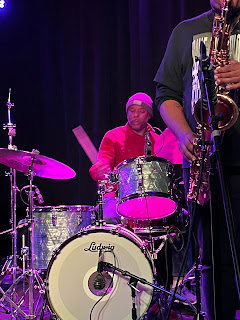
Taylor, with James Brandon Lewis, at Club Café, March 2023


A complete schedule of events can be found here. 

Friday, April 26, 2024

An Appreciation of Michael Cuscuna


I've told this story numerous times, but it seems like it's never appeared on this blog, and the timing is right. It was a chilly almost wintery morning in either November or December 1984. Like every weekday morning, I was up early to deliver the Post-Gazette before heading to school, where I was a senior. My morning routine usually involved bringing the papers into our living room, counting them, putting them in my delivery sack, grabbing rubber bands ("gum bands" to us Pittsburghers) and heading out on my route. 

On this morning, before I could get to the papers, I found a thick square box between our two front doors. The box had my name on it. IT had arrived - The Complete Blue Note Recordings of Thelonious Monk, a four-record set that was only available by mail order from the label that put it together: Mosaic. This was a major expense for a teenager, even one with a lucrative paper route. I think it might have cost about $8 per record. (Insert rimshot here.) 

There was barely any time to skim the set's detailed booklet over breakfast, let alone listen to any of the records. But when I got home that afternoon, I starting poring over both the music and detailed notes about each session, stopping to even follow along in a book of transcribed Monk piano solos. I had just gotten into Monk over the last few months. Hal Willner's tribute album was my gateway; I wanted to hear it because John Zorn was on it. 

After playing That's the Way I Feel Now and scratching my head several times, I purchased a few of Monk's OJC reissues. The compilation's inner sleeve mentioned Mosaic's Monk set and my dad had probably received a catalog from them with details. This almost secret/extra effort way of hearing the music seemed like an important step I needed to take.

I don't think my sentimentality is getting in the way when I say that purchasing that album was a defining moment for me, as both a musician (I still believed I was going to be a saxophonist) and as a writer (that would come later). And this is all due to the efforts of Michael Cuscuna, who started Mosaic with the late Charlie Lourie. Michael passed away last weekend and the world has lost a champion for music preservation and elevation.

Reading through those Mosaic catalogs from the '80s and '90s, it felt like Cuscuna and Lourie were as excited about these releases as listeners would be. If there was a little bit of back-patting going on, they were also quick to expound about the lengths that they would go to find the best sounding master of a session for one of their sets. That devotion made each set feel like a Big Deal. Back in the late '80s, the boxset boom had yet to really catch fire. These guys were ahead of the game and they showed how to do it right.

When CD reissues kicked into full gear in the following decade, Cuscuna became synonymous with jazz rereleases. He had already been instrumental in getting Blue Note back in business around the same time he launched Mosaic. Now he was the one rummaging through old warehouses and storage facilities (perhaps not literally, but they were similar), unearthing those gems again, discovering alternate takes or lost songs and, most importantly, figuring out what they were and from where they came. Most people might have overlooked the fact that Blue Note listed a Tina Brooks album on their inner sleeves that was never released. Cuscuna noticed it, and found the tenor saxophonist's missing session. If you unearthed something like that, you'd be clucking about it in a slick catalog too.

Cuscuna wasn't devoted to just one period of jazz music either. In one of Mosaic's most tremendous releases, he and Lourie curated the entire output of the early jazz label Commodore. Records in three volumes; each box has between 20 and 23 records. He also released Cecil Taylor's complete output for Candid Records. (If the word "complete" sounds repetitive, that's because these guys wanted each set to be comprehensive. When doing a set for the prolific organist Jimmy Smith, they had to limit it to one month.)

I didn't realize it at the time but Cuscuna also shaped my musical scope in another way. When I told my brother that my first encounter with Albert Ayler annoyed me more than moved me, he recommended buying an Ayler album, listening closely and reading what the liner notes said about this wild saxophonist. When I took his advice, the album I found was Vibrations, which had extremely insightful notes about Ayler's background and music - penned by Cuscuna. This cat had a handle on everything.

And he was not jaded or arrogant about it. He was enthusiastic. The University of Pittsburgh brought Cuscuna to town in 2011 for a lecture at the Pitt Jazz Seminar and Concert. In a phone interview prior to his arrival, he was gregarious and very open when speaking to this fanboy about his work. It was quite a confidence boost to hear that a quote from my article wound up in the Washington Post's obituary for Cuscuna. (For the record, here's the quote: "If I put out music that is really unworthy or would embarrass the artist or make an artist unhappy, then I think that’s the worst sin I could commit.")

Another quote from him appeared on the Mosaic website earlier this week, which really hit home too: "It’s the stuff that gets to you between about [ages] 12 and 25 that stays with you for life. You never absorb music in quite the same way after that.” It explains why both Monk piano solos and, heaven forbid, the lyrics to some REO Speedwagon songs are still easily accessible in my head. 

Personally, Mosaic always represented the highest level of jazz collecting. Along with the alternate takes, the label made sure you knew all you wanted to know about the artists and the sessions they made. When I became a staff writer at InPgh, I felt like I had really arrived when I was able to snag some promos and write about them for the paper. It took a few years but I even got to review a couple for JazzTimes. (Several other jazz scribes were clamoring for those reviews.)

As the above picture shows, I've been able to amass many of the sets over the years. Having enough Christmas money to afford the Larry Young set made it feel extra special. Getting the Clifford Brown set from my parents for my birthday takes me back to that time. Two years ago, I found the one set I never thought I could afford - the Complete Capitol Recordings of the Nat King Cole Trio, a mind-numbing 18-disc set (the vinyl counterpoint was 27 records!). It was being sold at a chain store for less than half of what it's worth. 

In my interview with Cuscuna, he mentioned that the Cole set (which was originally offered to buyers on an installment plan!) was one of the few projects where he never burned out on the artist. Listening to it, it's easy to see why. Nat was that good. Sure it's all about the music, but the presentation certainly adds to the listening pleasure.

If this piece has been more about me than the late, great Michael Cuscuna, that can be attributed to the fact that Michael really shaped the way I approach music, largely as a listener but probably to some degree as a writer. Not just jazz, he opened my ears with everything. Collecting is fun, but it's more rewarding when you can share these discoveries with people, opening them up to new sounds and new ideas that they can explore on their own.

Michael was all about that. And I'm doing my damnedest to pay it forward. 

Thank you, Michael.


Friday, November 03, 2023

The Pitt Jazz Seminar and Concert - Still Kicking in Year 53

The last time the University of Pittsburgh's Music Department presented the Pitt Jazz Seminar and Concert in the tradition established by the late Dr. Nathan Davis,  the world was pre-pandemic and people flocked to the Carnegie Music Hall in Oakland without fear of becoming ill. That was November 2, 2019. Nicole Mitchell was spending her first school year as the new head of Jazz Studies at the university. The one-time president of Chicago's heralded Association for the Advancement of Creative Musicians (AACM), Mitchell had told this writer a few months earlier during an interview that the concert would "shake things up" this year.

That description turned out to be a bit of an understatement, as my post from a few days later would indicate. The avant-garde had finally found an academic home in Oakland, and the locals were not happy. Suffice to say, jazz can be like that. 

The pandemic threw a monkey wrench into the annual event after that, though last year featured a series of talks and a concert honoring pianist Dave Burrell, which simultaneously served as a farewell to Nicole Mitchell, who had left the city for the University of Virginia. 

But after a few years of suspense - and rumbles that we might not ever see a big concert event like it again - the Pitt Jazz Concert is back for its 53rd year, with an all star lineup of veteran players and newer, equally cutting edge players sharing the stage. The show takes place Saturday, November 4. The venue has changed this time, apparently due to construction happening at the Carnegie Music Hall. The music is moving Downtown to the Point Park University's Pittsburgh Playhouse, 350 Forbes Avenue. Things kick off at 8 p.m.  Like years past, there are also free seminars on the afternoon of the show, which I'll get to in a minute.

First the lineup.

Dr. A. J. Johnson (trombone) has been the interim head of Jazz Studies at Pitt since Mitchell left and in addition to his work at the school, he has also been active on the local jazz scene, crossing a line that previous leaders didn't do as often as they could have. Among other things, Johnson staged four separate recitals of Charles Mingus compositions at Alphabet City. The lineup he has assembled for the Pitt Jazz Concert includes some exciting players, some of whom might be widely known, others who might be under the radar, waiting to bring listeners to their feet. 


Drummer Lenny White might be one of the most visible members of this year's lineup. At the young age of 20, he made an auspicious debut as one of the drummers of Miles Davis' Bitches Brew, playing on the title track. That album ushered in the blend of jazz and rock that became known as fusion, and White became one of the foremost drummers in that style. 

Most significantly, he held the drum seat in Return To Forever, one of the most successful groups in that style, if not overall during the '70s. White has since gone on to have a successful solo career, in addition to sideman work with artists ranging from Geri Allen to Ron Carter and Andrew Hill.  The drummer has also worked with bassist Buster Williams - a prolific artist and sideman in his own right, who also appears in the Pitt Jazz concert this weekend.


There always seems to be one guest at the Pitt Jazz concert who can make an attendee stop in their tracks, put aside any second thoughts about going and proclaim, "I'm there." My selection this year is trumpeter Charles Tolliver. He might not be well-known to the casual jazz listener but over the last half-century, he has made great strides for the both the music and the artists playing it. As a performer, he first showed up on albums like It's Time and Action by saxophonist Jackie McLean. The fire power in his playing paired perfectly with the leader's tart alto tone. Tolliver contributed some strong composition on those albums too.  

The trumpet player started a group in the early '70s with pianist Stanley Cowell, but the duo also launched the independent label Strata-East together. It might not have been the first label launched by jazz musicians, but it quickly garnered a reputation that continues to this day with listeners and collectors. Among the releases, the label had a hit with Gil Scott-Heron's "The Bottle."

Tolliver continues to play and record. In the '00s, Blue Note released With Love, a live big band album which revealed that time had not mellowed his musical outlook. When Gary Bartz performed his entire Another Earth album at the 2019 Winter Jazz Fest,  Tolliver joined him onstage, blowing in a manner that rivaled the late Pharoah Sanders, who was onstage that night as well. Connect, Tolliver's most recent album (2020) was a small group setting that also featured strong writing and playing. 

The concert's lineup also includes Keyon Harrold (trumpet), who came to town in 2019 during the Pittsburgh International Jazz Festival, playing an emotionally-charged set Downtown on Liberty Avenue. In addition to his own work, Harrold played the trumpet parts in the Miles Davis film Miles Ahead and has worked with a number of pop and hip-hop artists ranging from Beyoncé to Mac Miller. Once called a "mugician" by filmmaker Don Cheadle, ("musician" + "magician") during the filming of Miles Ahead, Harrold considers Tolliver a mentor, so the combination of the two should set off some sparks.

Pianist Victor Gould, saxophonist/vocalist Camille Thurman as well as host Dr. Johnson complete the lineup.

As part of the weekend's events, three free seminars will take place on Saturday at the Frick Fine Arts building in Oakland. Nicole Mitchell will return to speak at 1 pm, followed by Gould at 2 p.m., and Harrold at 3 p.m. Thurman will host a seminar at the Afro American Music Institute (7131 Hamilton Avenue) at 2 p.m. 

For those who read this article in a timely manner, pianist Benito Gonzalez will perform a solo concert at Bellefield Auditorium in Oakland (315 S. Bellefield Avenue). 

Information and tickets to Saturday night's concert can be found at https://www.jazz.pitt.edu/jazzseminar.


Wednesday, March 22, 2023

Pitt Jazz Composers Concert - A Recap

If last Friday night's double bill of the James Brandon Lewis Trio and the Messthetics (see previous post) wasn't enough to satiate people for a few days, the weekend offered a wealth of other shows in town too. Terri Lyne Carrington and Social Science came to town on Saturday to the Pittsburgh Playhouse. Guitarist/vocalist Camila Meza performed the following evening at City of Asylum.

Sandwiched between both of those shows were two matinee performances within a few blocks of each other. Pianist Deanna Witkowski appeared at the Carnegie Library in Oakland and the 2023 Pitt Jazz Composers Concert took place at Bellefield Hall. If I was ambitious, I might have been able to check out a little of both shows. As much as I wanted to see Deanna Witkowski again, having caught a set at Kingfly Spirits a few weeks ago, I opted to check out the afternoon of works by alumni, students and faculty at Pitt's music school.


Dr. Aaron Johnson, seen above holding a conch shell, serves as Interim Director of Jazz Studies at Pitt as well as Assistant Professor of Music. He acted as emcee of the afternoon, and contributed one of the event's strongest pieces.

The band performing each work consisted of many established Pittsburgh musicians, including Paul Thompson (bass), Rick Matt (alto saxophone), Reggie Watkins (trombone) and James Johnson III (drums). 

The music covered a wide range, starting with: a straightforward blend of bop-flavored blues and funk (Rick Nowlin's "Blue Funk"); reworked Charlie Parker (John Lagnese's "Donna Lee In Indiana"); as well as "Thieves" a piece by PhD Candidate Samuel Boateng, which blended music from Ghana with the swing of the ensemble, adding vocals in two languages. 

Departed Jazz Department head Nicole Mitchell was saluted in an arrangement of her "Africa Rising." The piece's 6/4 ostinato led to a solo by tenor saxophonist Eric DeFade (below) that almost featured a Mingus-style vamp. Trumpeter Alex Perez also helped build on the feel of the piece. The late Geri Allen, who preceded Mitchell in the department, was also recognized with a version of her "Unconditional Love," arranged by Pitt's Ralph Guzzi.  


Of the more modern-sounding compositions, Johnson said that Juwon Adenuga's "Water" proved a bit too challenging for students in a jazz arrangement class, hence this ensemble was given the piece, inspired by Fela Kuti and combining a steady rhythm with shifting harmonies. Jason Belcher's "Moderniity" got its "somewhat mindless title" from a Modernism class he took during his undergraduate years. Equally inspired by George Russell's Lydian Chromatic Concept while maintaining a focused structure, it was involving in ways that I'm still trying to unwrap. (Sometimes it's hard to figure out pieces like this after one live listen.)

The reason Dr. Johnson held a conch onstage is due to a two-note phrase he blew on the shell, which inspired a line in "Red Summer," from his "1919 Suite." A meditation on the racial attacks experienced by African-Americans following the end of World War I, the piece was one of the strongest works of the afternoon, shifting from melodies driven by vibes and baritone sax to a driving canon section and a slow bump and grind groove with a bass break by Thompson. Johnson also lead the group through "Cannonball" a piece that "starts and ends with [church] and in between there's some sinning going on," according to the composer.

Mark Micchelli's "Stop Requested" closed the set. Although it was inspired by a bus ride, it avoided any novelty that might come with that type of muse, save for the use of two or three trick endings before the final blast. Prior to that, it created tension with minor chords and something of a four-on-the-floor beat from drummer Johnson. In that regard, it accurately evoked the feeling a Pittsburgher might have when waiting for a bus that's long overdue.

As I finish typing these words, alto saxophonist Caroline Davis, whose music I've followed for a few years (and have written about on this blog) is performing at Pitt, supposedly with some of the people who played at the Composers Concert. I would have loved to see her in town but alas, I only heard about the show yesterday, through an email from a friend who stumbled across it by accident. 

In looking through Davis' Instagram account, which I followed but hadn't seen in my feed for awhile, there was mention of Pittsburgh about a month ago. But would it have killed anyone at the Sunday show to mention, "Oh by the way, Caroline Davis is going to be here on Wednesday"? I can think of at least four people who would like to see her. And I know one who might have changed their schedule around to check it out. (I'm a fanatic that way.) 

Point is: Let people about shows IN ADVANCE. 


Sunday, January 15, 2023

DL Review: Ivo Perelman - Reed Rapture in Brooklyn, Part Six - With Roscoe Mitchell

This marks the half-way point, through Ivo Perelman's set of 12 duets. 


Ivo Perelman
Reed Rapture In Brooklyn

Part Six - With Roscoe Mitchell

Roscoe Mitchell had recently retired from teaching at Mills College when he spoke to me in 2019, in anticipation of his appearance at the Pitt Jazz Seminar and Concert. Once his post-retirement life had settled down, he said, I want to get to the point where I can practice one note the whole all day." Saxophonists and longtime Mitchell fans can understand such focus; non-musicians might be left scratching the head. 

But the value of this discipline comes across around 18 minutes into "2," his duet with Ivo Perelman. As Perelman's tenor bobs around, peeling off an especially ecstatic line just moments prior, Mitchell locks into one note on his bass saxophone and holds it for 60 seconds. Relatively speaking, it's a low note, though it's probably mid-range on the big horn. The impact of the drone (and a few overtones early on) feels electrifying. It takes us to the core of the music, setting a path for what follows. Who knows if Mitchell did have the time to devote a day to a note in the few years between our talk and this session, but the energizing value of this discipline can be felt. 

Mitchell and Perelman's session yielded just three tracks but "2" alone lasts nearly 40 minutes. The other two add an additional 20 minutes, providing about the same amount of music that have come in the other Reed Rapture sessions. Mitchell, who has been playing a lot of soprano and sopranino with the Art Ensemble of Chicago recently, sticks exclusively to bass sax here. It gives the music a foundation by virtue of its range, providing something of a tonal center at various times. In "1," he almost gets a groove going after notes popped to the surface in a somewhat spare, pointillistic duet with Perelman's tenor. Perelman pulls back to a whisper during "3" giving Mitchell a chance to ruminate on the horn. 

"2" is really the centerpiece, where the duo get to know each other. They take their time deciding where they wants to go and how they'll get there, without any lag time. As they gradually move towards a climax in the final five minutes, Mitchell's horn almost sounds like he's plugged into a fuzz box. When Perelman joins him, they buzz like a hornet's nest. From there, they engage in a cat-and-mouse chase, with Perelman jumping into the upper register. 

Roscoe Mitchell's work often deals with open space and how that can be as meaningful as the moments where everyone joins in. Some of the former approach is on display here. He often prefers single, lengthy notes to extended lines. (That could be the nature of the bass sax again, but Mitchell does kick it up at times too.) His partner strikes a good balance between going with that flow and riding the top wave created by the low horn. 


Friday, November 04, 2022

A Few Nights of the 52nd Pitt Jazz Seminar and Concert

I begin today with a tangential rant.

Around the end of September, I was hanging out with a friend of mine who I knew from my college radio days. He remarked that the evening that we were together was the 31st anniversary of Nirvana's Pittsburgh show at Graffiti. (This, of course, is the one that Nirvana fans and native Pittsburghers all remember as the night when the band set the couch in the dressing room on fire, quite possibly in retaliation to the booking agent who wanted a cut of their merchandise sales. You can't mention that show in Pittsburgh without that adjacent story.)

That show has gone down in history because, of course, it happened right as Nirvana was hitting it big - really big. Big enough for punk rock to "break" as a film about several bands from that period would later opine. I know many people who were there but I was not one of them. I had just played a show with my long time favorite band Trotsky Icepick and in a few weeks would see Sebadoh, who unexpectedly blew my mind in a way that hasn't been the same since. (I was also dealing with relationship issues, but that's irrelevant right now.)

Besides, at that time no one would have predicted that a band who was part of the grunge scene - which was still pretty much a catch-all term for Pacific Northwest bands - would take their major label debut and knock it out of the stratosphere, unlike anyone else up to that point. In September 1991, Nirvana was just another band on their way up. People who liked them were ready to check them out but no one had any idea that they were witnessing legends in the making. . 

And that's the reason why it's important to go out to shows and check out live music. You never know where an artist is going to be in a few months. You never know how moved you might be by someone's set. Sure, the specter of COVID-19 still lurks in every corner, but people and venues are playing it safe. If you bring your mask, you should be in a good shape. There's no guarantee you walk out of a show feeling like you're reached nirvana (pun intended), but you have a greater chance of witnessing some legend in the making just be being out and about. And as many people have said, you've got to dig it to dig it.

Which brings us to the 52nd Annual Pitt Jazz Seminar and Concert, which started this week and continues for the next few days. In years past, the seminar welcomed jazz musicians to the University of Pittsburgh, where they gave free lectures on topics ranging from their careers to the industry to the music itself. It would culminate in a Saturday evening concert that was reminiscent of the Jazz at the Philharmonic shows: a blowing session that put together musicians that may or may not have ever been on the same stage at the same time.

The whole thing was spearheaded by the late Dr. Nathan Davis in 1970, who brought in a pretty high caliber group of friends, some of which who showed up fairly regularly over the years. When Geri Allen took over the position in 2013, the template remained, though the shows started to think outside the box a bit more. Then in 2019, Nicole Mitchell became director of Jazz Studies and presented a concert that included more grounded players like Rufus Reid (bass) and Jason Moran (piano) together with outliers Roscoe Mitchell (saxophones) and Moor Mother (spoken word). Some friends described the evening as a train wreck and audience members expecting to hear a group blow on something like "Killer Joe" left en masse before things were done. (My take on the night can be found here.

Post-pandemic, things are a little different for Year 52 of the event, which has the title "We Are All Jazz Messengers." First of all, IT'S ALL TOTALLY FREE! Not in style, but in dollar amount. None of the performances cost anything! Anyone curious to see a pianist who's played with Archie Shepp and Pharoah Sanders and David Murray? Well, you could have seen him this week, without even touching your wallet. 

Dave Burrell, the pianist in question, played at the Bellefield Hall at the University of Pittsburgh on Tuesday, November 1. His appearance coincides with the donation of his archives to the Center for American Music, part of the University of Pittsburgh Library System, which also houses Errol Garner's archives. To kick off the Tuesday night show, Ed Galloway, Associate University Librarian for Archives and Special Collections, presented Burrell with a plaque commemorating his career and donation to the university (below). 


The evening featured Burrell in a trio with bassist Joshua Abrams and drummer Hamid Drake, with flutist Nicole Mitchell joining them. (Mitchell just announced her departure from Pitt for the University of Virginia about a month ago. Aaron J. Johnson is now the Acting Director of Jazz Studies at Pitt). But before the whole group played, Burrell sat down at the piano for a long, flowing medley. While he has played with the fiery intensity of someone like Cecil Taylor - reaching his left hand over his right to literally stab the upper register of the keyboard during a solo - the pianist can also reveal a delicate, if no less deep, side by exploring some standards. For about 15 minutes, my ears heard traces of "Autumn Leaves," "Here's that Rainy Day," "How Deep Is the Ocean" and "My Melancholy Baby."  The latter two featured some solid stride work in the left hand, pushing the music forward.


The evening had a pretty casual feel to it, as if the band might have been coming up with ideas on the fly. The whole group came out onstage but Burrell announced that he and drummer Drake would begin with a duet, which sent Mitchell and Abrams backstage again. The two players dug into a tune with a boogie groove to it, with Drake emphasizing the offbeats at one point and playing double-time the next. After a few minutes, Burrell decided it was time for Drake to go it alone, and the pianist himself left the stage.

This move was something that Thelonious Monk used to pull on drummers that got on his bad side, but Drake hadn't done anything to offend the evening's honoree, as far as we could tell. Besides, Drake had more than enough ideas to keep the audience eyes glued to the stage, with a brilliant range of press rolls. hi-hat whacks and more use of offbeats.  


Mitchell and Abrams had their duo time next with the flutist vocalizing as she blew and Abrams producing a series of thick double stops, alternating between bowing and plucking. Despite the casual feeling of the show, the rapport between the players was on display. Drake, Mitchell and Abrams all know each other from their time in Chicago in and around the AACM so that kept things flowing.


With Burrell back with them, a free, open section eventually morphed into "Come Rain Or Come Shine" which the group took their time digging into, exploring it to a great degree. That song especially is one that's been performed thousands of times, but the quartet approached it with that understanding. They weren't there to simply get a rise from the audience by playing something familiar, nor did they turn it inside-out. They presented in a way that proved why it's such a lasting classic.


Last night (Thursday, 11/3), Burrell appeared in a panel discussing his career, along with his wife, the poet/author Monika Larsson and Pitt Associate Professor of Jazz Studies and author Michael Heller (the latter whom kept pronouncing the pianist's surname "BYOR-ell" rather than "BOOR-ell" as everyone else seems to have said it; maybe he's on to something we don't know?). Via Zoom, the discussion also included trumpeter Ted Daniel (seen below), saxophonist David Murray and jazz author John Szwed. 

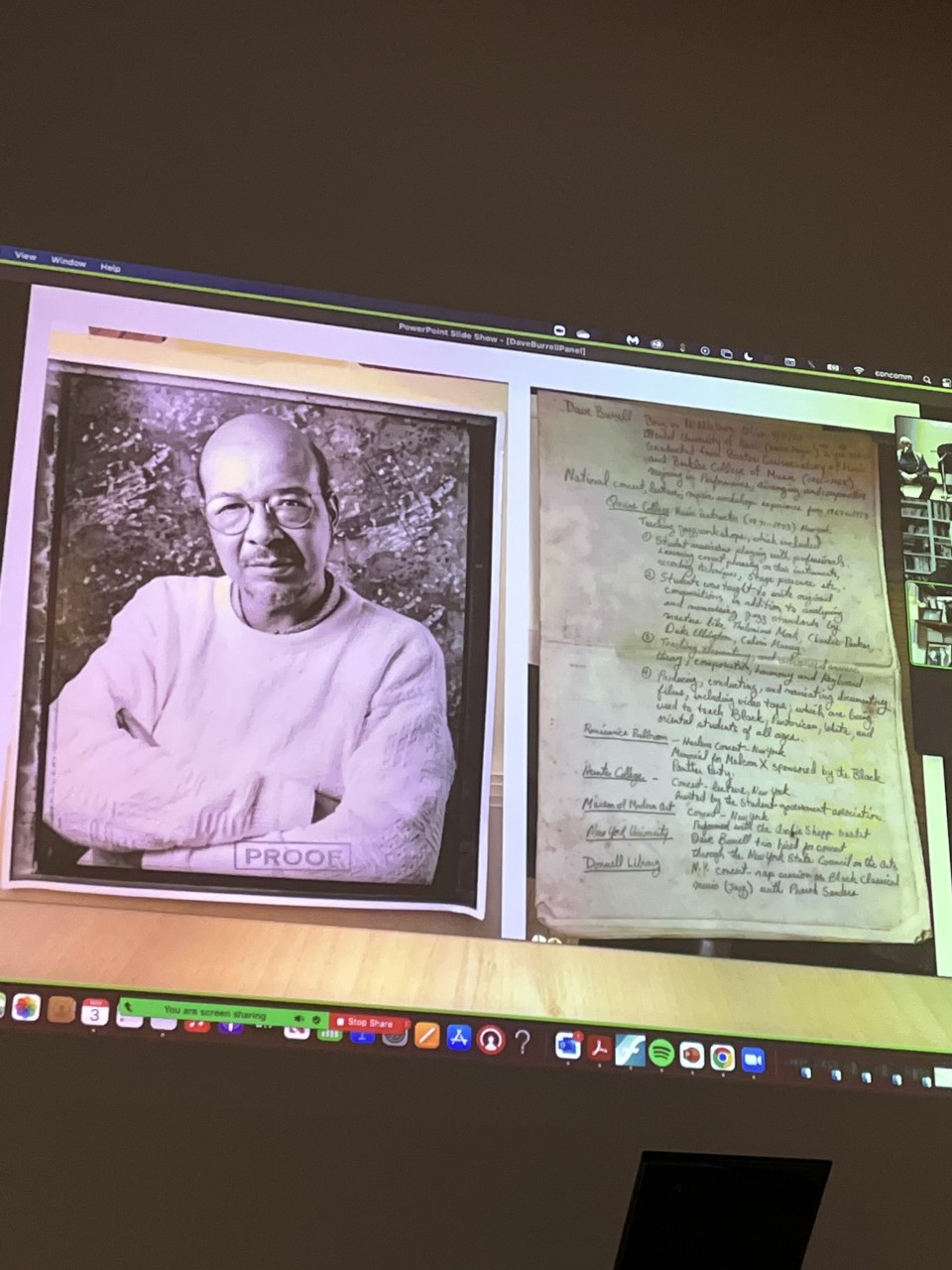
Heller presented a few shots of items from the Burrell archive, as seen above here in the one shot I got of the overhead projection. The image on the right is actually an early resume that Burrell put together. 


Though the Zoom connection sometimes make things a little hard to hear or contextualize, it provided some fun insight into Burrell's wide-reaching connection with the different players. Daniel (seen above) recalled meeting him at the Berklee School of Music in the early '60s, where Burrell showed "determination and consistency with practicing," and introduced the young trumpet player to the Thesaurus of Scales and Melodic Patterns by Nicholas Slonimsky, a book which he said he still owns to this day. The two players also reminisced about a trip to Europe that took them to a festival "in a cow pasture in Belgium" where they shared a bill with not only the Art Ensemble of Chicago but also Pink Floyd, the Mothers of Invention and Cream.

Larsson talked about writing a libretto for Burrell's music and how a midnight cup of coffee lured her away from her then-husband to the pianist. Murray discusses the duo shows he and the pianist performed, along with the latter's tenure in Murray's octet. Burrell chuckled as he remembered what he would say to drummer Ralph Peterson before a performance: "Time to make the donuts!" 

After the panel discussion, members of the Pitt Chamber Ensemble performed some of Burrell's work for strings and piano, followed by trumpet and piano. After Tuesday night's performance, these modern pieces with flowing melodies offered another take of what the pianist has created. 

If you read this in time, the Pitt Jazz Faculty will present the final on-campus concert on Saturday, November 5. The show will consist of music by Art Blakey. 7:30 pm at Bellefield Hall. It's free! Be there to dig it!