Friday, November 03, 2023
The Pitt Jazz Seminar and Concert - Still Kicking in Year 53
Tuesday, October 29, 2024
Chad Taylor & the 54th Pitt Jazz Seminar & Concert
The Pitt Jazz Seminar and Concert is synonymous with the turning of the leaves. Created by the late Dr. Nathan Davis in 1970, the annual event brought seasoned jazz musicians to town for a series of free seminars, culminating in a concert that harkened back to the days of blowing sessions, where everyone took part.
When Geri Allen and, later, Nicole Mitchell succeeded Davis, things began to evolve, pushing the music out of its hard bop comfort zone. Mitchell's 2019 concert ruffled some feathers but last year's event, under the direction of Dr. Aaron Johnson, got things back on track.
The 54th annual event will honor bassist Reggie Workman and hometown drummer Roger Humphries. It coincides with the recent arrival of drummer Chad Taylor, who now serves as Director of Jazz Studies at Pitt. Taylor's musical c.v., is vast and fascinating. He and Rob Mazurek have helmed various Chicago Underground units (often Duos, with some Trios in there too). He has also played with Fred Anderson, Marc Ribot and James Brandon Lewis, to name just a few. As a leader, Taylor also released several albums, one of which - The Daily Biological - was this writer's favorite album of 2020.
Taylor and I caught up last week, right as he was boarding a train on the way to a rehearsal, and we discussed Pitt, music and teaching. (A link to info on the concert appears at the bottom of this entry.)
Mike: Are you in town now? Are you hopping between cities?
One of the things going on is that I got this fellowship, the Pew Fellowship. One of the stipulations is you have to be a residence in Philly. So I can't sell my house in Philly until that fellowship is over. So that's why I have been doing a lot of back and forth. It's a two-year fellowship.
So right now I see myself as living in Pittsburgh and I'm also living in Philly. I'm sort of living in two cities at the same time!
Is this typical for a jazz educator these days - bouncing around between cities anywhere?
For a lot of people. One thing that has changed about the position at Pittsburgh, is that, until I came along, the position was being Director of Jazz Studies. Now the position is Artistic Director of Jazz Studies, which means I don't have all the day-to-day administrative stuff, the committee meetings and other things that a director would normally have. And I can concentrate more on the shape of the program and the direction the program is going in. That differs from what Nicole [Mitchell] and Geri [Allen] were doing.
Is Aaron Johnson handling some of that day to day stuff?
He is. He's also the Chair of the Music Department. But in addition, we're getting ready to hire somebody next year who going to have a role....Did you know Michael Heller?
Yeah. Did he write the book about the loft scene [Loft Jazz: Improvising New York in the 1970s]?
Exactly. He's left and went to Brandeis. So we're getting ready to take his place. And the person who gets that position is going to have more role of being administrative stuff and being on committee meetings.
How did [your appointment at Pitt] come about? Did Pitt come to you, or did you hear about it and jump at the opportunity?
There was some back and forth. It took about two years. I did a residency that NIcole helped set up. I had a chance to work with the students and i had a chance to do some teaching and really have some insight into the program. Then I applied for the position. And it worked out.
I'm excited about being at Pitt. And I'm excited about the direction that I want to take the program.
Pittsburgh is known for its past contributions to jazz. But when it comes to modern music that pushes the edge, the kind of stuff that you often play, that doesn't get talked about a lot. As you're getting set up, how do you approach that?
I also, as you know, do a lot of progressive music, creative music as well. I love doing that, Now one of my goals with this position is to embrace all of jazz, the whole shebang. One of the ways I'm going to do that is by having musicians who have all these broad range of styles that they can play.
So can somebody like [alto saxophonist] Immanuel Wilkins. Which I didn't even realize until recently. I did a gig with him a couple years ago in Philadelphia with [tenor saxophonist] Odean Pope, just the three of us. We didn't play any compositions. We didn't rehearse. We just played for two hours straight, improvised music. I was just so blown away with what Immanuel - and Odean - were doing. Immanuel, I think he's 26, 27. He really knows the history of the music. He can play hard bop but he also has his own thing.
Someone like [guitarist] Jeff Parker is someone else who can go between both those worlds. Sumi [Tonooka, piano], who I've known for a while now, also goes between places. But she's done a lot of work as a composer, working with string ensembles, orchestras. And really an incredible pianist who I think is going to bring a lot to this ensemble.
The whole idea with having people who love jazz and are able to go between these different areas. Because one thing I see that's happening in jazz academia, things are getting smaller and smaller. Less people are applying. Less people are interested in becoming a jazz musician. Jazz record sales are declining. It's always, 'Okay, jazz music is getting smaller.' I really think jazz is getting bigger. It's just how we're looking at it. Because it's not just a genre of music. It's a process. It's a way of people coming together and taking these different elements of music and putting them in a new way to create something different. When you look at jazz like that, it keeps getting bigger and bigger.
So my idea is really to expand this idea of what jazz is. And basically have people understand that jazz is for everybody. So when people say to me they don't like jazz, I always get confused. What do you mean you don't like jazz? What is jazz to you? Usually what I find out is that they have a really narrow idea of what jazz music really is.
I hear jazz in everything. You think about it like this, Mike. The drum set was an invention that was made in America to play jazz music. So if you hear a drum set in any sort of music, you are hearing something that was created for jazz. There's a connection there. I hear jazz in all sorts of things. I don't see it as something that's old fashioned. I think it's really relevant today. One thing I have in an agenda at Pitt is to really broaden the idea of what jazz is.
It's true. When you're talking artistically it's branching out into so many styles, whether your're talking abouit Robert Glasper or Tim Berne, there's something going on there.
And it's for all generations. It's not for old people, it's just your grandparents' music. It's not noise or this hipster thing. It's a whole spectrum. It's for everybody.
Now we've just got to get more people to listen and pay attention.
Exactly! And not be afraid of it. You know what's interesting is, I went to Salvador, in Bahia, Brazil, a couple years ago. I was at a nightclub. In this club, they had a DJ spinning all this great Brazilian music. And everybody was dancing. You had grandmothers dancing with their grandchildren - in the nightclub! You had all ages. It wasn't like a big pickup scene, though I'm sure there's some of that. The point is that, they were playing this music and you had people that were five years old and people that were eighty years old. They were all getting down, dancing, appreciating it. And jazz has that potential too. It should be like that. It's for everybody.
What is like teaching jazz in 2024?
People want to know how it relates to them. They don't want to have it be just a historical perspective, like this is something that happened a long time ago, and this is just a history course. They want to know, how does jazz relate to me now?
The course that I'm teaching is one that Nicole Mitchell was teaching before. It's called Creative Arts Ensemble. For this class, it's a multi-disciplinarian class, meaning, it's open to all the arts - dancers, people into theater, people into photography, people in visual arts. We talk about ways of collaborating, different artistic practices, as well as collaborating as a class. It's been a lot of fun to teach. Something about Pitt - the number one elective course at Pitt is Jazz History.
I took that class when Nathan Davis was there.
Oh! I think it has to do with the fact that Nathan had built this thing up. I taught the class when I was in my residency. Some people think it's an easy A, which it shouldn't be. I don't think it is. I think that once they get there, they realize, "Oh, I'm going to have to learn something." But I bring that up to say there is so much amazing talent at Pitt. In this class I'm teaching now, it's not a big course. It's small.. We have a couple students who are political science majors and they're incredible musicians, incredible vocalists. You see that in the big band too. You have all these non-music majors who are incredibly talented.
The challenge though, is the undergraduate program needs some work. We don't have many people who are majoring in jazz in the undergraduate program. So that's one of my goals - to create demand for people to become a jazz major.
The graduate program is going strong. There's a lot of history there. Geri and Nicole both focused on that. But we are at a point now where, in order to make the program relevant, we have to have demand for the undergraduate jazz program. That's one of the biggest challenges I have, and Pitt has. Because right now, the students who want to major in jazz, aren't going to Pitt. They're going to Duquesne.
Maybe your name can draw some of the more adventurous types.
What's great about Pitt is it's a huge school that has all these different schools within the school. They're all willing and able to collaborate. You have this incredible amount of resources. One of the ways I plan on drawing more students into the undergraduate program is to create avenues for them to combine jazz with other arts - not even other arts - with other fields that they could be interested in. So in other words to have - I don't know what you would call it - like a jazz major/minor kind of thing. You could major in jazz but also have access to these other areas, and maybe have a dual degree.
Are you thinking of combining it with marketing or media?
Absolutely. There are a lot of areas that could be explored in creating some really innovative types of programs. And I get the feeling the school is open to that. The other thing is we have an amazing [recording] studio. It needs a little bit of work but we're getting it in shape. We can offer students access to the studio and also courses in learning how to use the studio as a part of their degree.
What's great is I got the dean to put a significant amount of money every year into the studio, keeping it up to date and for hiring people to work in the studio. That's something that can really be used as an incentive to pull in more students.
With all the groups that you're involved in, are you going to try and present some of your bands while you're here?
Yeah, one thing that's great about my academic program is that I can focus on my own bands. I don't have to rely on being a sideman and doing all this touring for income. I'd like to have my ensemble play at Pitt, maybe not necessarily on campus but you know, doing gigs at Con Alma or other venues.
Anything else that you wanted to mention?
I think we touched on a lot. I'll be interested to see how the Pitt concert is received. We're going to be doing some weird stuff. I shouldn't say "weird," but we are going to be doing some adventurous things. Overall, we'll be playing standards as well. We're going to be mixing them in. So we're going to be bringing both of those flows together. We'll see what happens.
![]() |
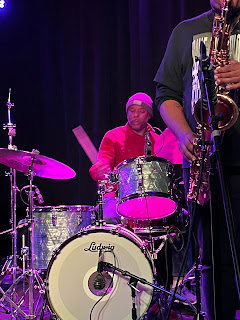
| Taylor, with James Brandon Lewis, at Club Café, March 2023 |
Wednesday, November 05, 2025
Preview of the 55th Annual Pitt Jazz Seminar & Concert
![]() |
| The Pitt Jazz Ensemble kicked off Jazz Week this past Monday with a lunchtime set in the William Pitt Union. |
No talk about the evolution of jazz rhythm would be complete without a discussion of the Afro-Cuban hybrids that lay at the base of the music. Bobby Sanabria (above), a South Bronx native who has played and written extensively on the topic, will host Afro-Cuban Workshop on Saturday at 3 p.m. in Bellefied Auditorium. Sanabria has played with virtually all the heavy hitters in that musical genre (Tito Puente, Dizzy Gillespie, Mongo Santamaria) as well as working with Joe Chambers and equally unique artists like Henry Threadgill.
Saturday, November 09, 2024
Pitt Jazz Concert Report
Friday, November 04, 2022
A Few Nights of the 52nd Pitt Jazz Seminar and Concert
With Burrell back with them, a free, open section eventually morphed into "Come Rain Or Come Shine" which the group took their time digging into, exploring it to a great degree. That song especially is one that's been performed thousands of times, but the quartet approached it with that understanding. They weren't there to simply get a rise from the audience by playing something familiar, nor did they turn it inside-out. They presented in a way that proved why it's such a lasting classic.
Tuesday, November 07, 2017
Review of the 47th Pitt Jazz Seminar Concert - Remembering Geri Allen
![]() |
| Kurt Rosenwinkel, Tia Fuller, Kenny Davis, Nicholas Payton |
That sentiment was repeated many times during the concert this past Saturday, although Coltrane was absent, having cancelled due to an illness. The eight remaining musicians and emcee S. Epatha Merkerson each recounted anecdotes about Allen as a performer and an educator. A brief video was also shown, which included comments from musicians like Coltrane, Teri Lyne Carrington and Esperanza Spalding as well as Pitt faculty.
For the first time in 47 years, the evening wasn't directed, passively or otherwise, by the university head of jazz studies. Under Dr. Nathan Davis, the concert (which usually concluded a week of seminars, talks and films on campus) operated like a jam session, with a wealth of A-list jazz musicians coming to town, blowing a few tunes together and breaking off into smaller groups that would spotlight individuals. Allen continued the basic template when she took the reins in 2013, but mixed new elements in with some of the well-trodden standards. (The most memorable moment was the opening tune in her first year, Nathan Davis' "If" which was a 20-minute, swampy, Bitches-Brew-style arrangement that heralded Allen's arrival.)
Saturday's performance, consisting predominantly of works by Allen, had a loose quality and felt somewhat more casual that the usual organization of these events. After the video, Nicholas Payton sat down at the piano and, without a word, began playing a riff. As he played, a recording of Allen's voice came over the sound system, as it did several times throughout the night. The rest of the musicians took the stage as Payton (who played trumpet later in the set) vamped: guitarist Kurt Rosenwinkel, bassist Kenny Davis, vibraphonist Stefon Harris, alto/soprano saxophonist Tia Fuller and drummers Kassa Overall and Victor Lewis. Written by Payton, "Geri" was a mid-tempo meditation that set the mood appropriately, though his chanting of the late pianist's name and the call for the audience to join him, felt a little cloying.
Between every couple songs, one of the musicians stepped up to the microphone to back-announce or introduce song titles (which is a good way to explore Allen's work further) and to share a story about their time with her. Tap dancer Maurice Chestnut talked Allen's group Timeline, which put his talent on equal ground with Davis and Overall. Harris recalled meeting Allen on the bandstand, where he had to immediately jump into a take on "I Got Rhythm" changes in B-flat - in which no B-flats were played. That unspoken message of "You better swim" has stayed with him, as his solos were some of the most dynamic of the evening, in terms of complex melody and rhythm.
Harris also created an arresting sonic blend with Fuller's alto and Payton's trumpet on Lewis' "Hey It's Me You're Talkin' To" and Billy Taylor's "I Wish I Knew How It Would Feel To Be Free," the latter recreating the joyful snap of a group like Cannonball Adderley's band, augmented by vibes and tap dancing. Chestnut, lest anyone doubt it, moved like percussionist, reacting to the band, doubling and tripling the beat with a performance that added to the music.
With Pitt Ph.D. student Irene Monteverde on piano (alto saxophonist Yoku Suzuki, another Pitt student, also sat in earlier), the group ended the evening with another Allen piece, "In Appreciation." Its hard bop drive, and solos that included Harris attack on his marimba with reckless abandon, turned the room into revival meeting. But Fuller, who had already conjured a bright-toned, bluesy solo earlier in the song, wasn't done yet. As the rhythm section played a descending riff, she read what could only be called an invocation, beginning as a call to women, repeating with intensity, "This space is a sacred space." She made the audience join with the closing credo that came from Allen: "Jazz is a way of life, a way to be in the world but not of the world - walking, seeing and feeling time." This call for audience participation felt necessary, a way to carry Allen's vision with us, after the last notes had evaporated.
Wednesday, March 22, 2023
Pitt Jazz Composers Concert - A Recap

Of the more modern-sounding compositions, Johnson said that Juwon Adenuga's "Water" proved a bit too challenging for students in a jazz arrangement class, hence this ensemble was given the piece, inspired by Fela Kuti and combining a steady rhythm with shifting harmonies. Jason Belcher's "Moderniity" got its "somewhat mindless title" from a Modernism class he took during his undergraduate years. Equally inspired by George Russell's Lydian Chromatic Concept while maintaining a focused structure, it was involving in ways that I'm still trying to unwrap. (Sometimes it's hard to figure out pieces like this after one live listen.)
Wednesday, November 12, 2025
Pitt Jazz Seminar Concert 2025
![]() |
| Sasha Berliner |
![]() |
| Mavis SWAN Poole |
Tuesday, November 05, 2019
Looking Back at the 49th Pitt Jazz Seminar
Nicole Mitchell said, during the summer, that the Pitt Jazz Seminar and Concert would be shaken up this year. After Saturday night's performance at the Carnegie Music Hall in Oakland, one might say she understated things. The flutist, who now heads the Jazz Studies program at the University of Pittsburgh, gave a shout-out to the late Dr. Nathan Davis, who began the musical tradition in 1970. But from there, she took things in a direction that was miles from the blowing sessions and myriad soloists that was a standard fare.
The evening featured one group with Mitchell on flutes and Moog, Jason Moran on piano, Rufus Reid on bass, Marcus Gilmore on drums and sampler, Roscoe Mitchell on soprano and sopranino saxophones and percussion and Moor Mother doing spoken word. Everyone stayed on stage during the whole show, which lasted just over 90 minutes. Although the performance was bookended by pieces that had a definite groove to them, the group itself took sometime to really get into their own groove for the evening. In a way, that feeling seemed to click after Roscoe Mitchell unleashed some vicious call to arms on his soprano sax.
The theme of the evening was "At the Edge of Beauty: Performing Creative Resistance." Mitchell kicked off the set with "Jumping in the Sugar Bowl," a tune by Amina Claudine Myers, the pianist/organist who had performed the previous evening and also received an Outstanding Lifetime Achievement Award from Pitt at the start of the concert. The spry piece, with Mitchell and Moor Mother singing, got the evening off to a festive start. From there, things moved into freer territory. Gilmore and Mitchell engaged in a dialogue of press rolls and flute wails. Mitchell switched to bass flute for added intensity.
After a while it felt like Gilmore was doing most of the heavy lifting during the night, coaxing and directing from his kit. Roscoe Mitchell blew a variety of intense sounds on his horns, which were occasionally hard to hear fully when he sitting away from his microphone. He switched to percussion regularly. At the other end of the stage, Jason Moran sat listening intently, almost as often as he played. Rufus Reid also showed restrain, resting when he wasn't bowing a foundation.
Moor Mother, on the other hand, participated perhaps a little too much when it might have been better to give these A-list musicians some room. A dynamic performer and clearly a strong writer, her work often consisted of a litany of phrases ("The feeling....the gathering...the way to it..") repeated with no conclusion or one that lost listeners by the time it arrived. In a piece dedicated to Toni Morrison, she kept repeating the statement "I remember" over and over and over.
Roscoe Mitchell put much effort into his sound production, gesticulating with saxophones, all the while blowing some otherworldly sounds. In a piece that began with Nicole Mitchell playing Moog synthesizer (or sampler), the elder Mitchell unleashed a pack of barbed squonks, eventually cuing in the rhythm section one by one. Reid bowed a pedal point, sounding more like the Necks' Lloyd Swanton than the decorated jazz veteran that he is. Nearly 70 minutes into the performance, Mitchell's wake up call got the group on the same page, though Moor Mother still could have given the group a little more space.
Ten minutes later, as that piece concluded, the first two rows in the center section had enough and left. A friend sitting in one of the upper balconies also saw several people depart throughout the evening. A couple seated behind had no qualms with talking the whole night throughout the set. I can only imagine how many people were thinking, "That's not jazz." Oh well.
But the ones that stayed showed their appreciation by giving the group a standing ovation. Afterwards, I heard a mix of opinions. "Sometimes you need to keep your mind open while listening." "That was rough." One friend greeted me with a scream of joy and enthusiasm, in large part because the concert looked toward the future rather than simply reveling in the past. Sure it was a little dicey at times, and some players could have flexed their personalities a little more. But it was great to see Mitchell begin her time in Pittsburgh with such a bold move.
Speaking of bold, Amina Claudine Myers kicked off the concert weekend the night before with a solo set at Bellefield Hall, just around the corner from the Carnegie Music Hall. She began on piano, singing and playing "Down On Me," a blues that might - for better or worse- be best known for the version that Janis Joplin adapted when she was in Big Brother and the Holding Company. Myers delivered it much like Nina Simone might have done, with a rich, emotional voice and style that made musical categorization useless. This delivery set the standard for what followed.
The first half of the set featured Myers playing rippling piano chords, swaying back and forth on the bench, singing in tongues, playing a two-chord riff in the left hand while her right moved over the keys. Then she sat down at the B3 organ, firing up the Leslie speaker. From my seat, I could see the horn in the cabinet rotating and could see Myers' left foot working the bass pedals. If she had stopped after the first organ chord, I would have been satiated. But she went on to play some blues, the dark broken-hearted classic "Angel Eyes" and the original "Have Mercy Upon Us." The latter included some outer space melodies in her right hand, while the bass pedals held it together.
All this for $10. Ten freaking dollars. When was the last time you had that much excitement for $10?
On Saturday morning, I also attended the free seminars of Jason Moran and Roscoe Mitchell. While Mitchell talked at length about the history of the Association for the Advancement of Creative Musicians (AACM), Moran talked about his discovery of Thelonious Monk and how it affected his young, piano-playing mind.
Focusing on Monk's 1959 Town Hall Concert, the real surprises were the excerpts Moran played of Monk's rehearsals at W. Eugene Smith's loft where, though the sound quality was rough, we got to hear the pianist talking with arranger Hall Overton about the music Plus, when Moran played the section of "Little Rootie Tootie" where the Orchestra plays Monk's transcribed piano solo, Moran leaned over the piano onstage and joined in. If that wasn't worth getting out of bed early on a Saturday morning, nothing is.
Wednesday, November 13, 2013
Pitt Jazz Seminar Concert - a week later
The banner on the back of the stage called the evening "A Tribute to Nathan Davis." This founder of the concert was lauded numerous times throughout the evening, not the least of which was a short film chronicling his career in Paris and the work he did to keep this seminar and concert going each year once he came to the University of Pittsburgh. The man himself, though, was nowhere to be found in the Carnegie Music Hall that night. Which felt odd.
When the music finally started nearly after the film, pianist Geri Allen (soon to be Davis' successor at Pitt and organizer of the seminar this year) announced that the band would begin the evening with one of Davis' compositions, "If." After years of seminar concerts that began with uptempo hardbop classics like "Killer Joe," things started with a low-down swampy groove that was closer to Bitches Brew. Bassist Kenny Davis played a spare double-stop riff with the two drummers building on the groove together. Kassa Overall played on the toms while Jeff "Tain" Watts stayed on the snare side of his kit. With Allen on Fender Rhodes, all the evening needed was a bass clarinet and would've sounded like the classic Miles album. Instead there was Vincent Chandler - doing some rapid lines, all tongued - and vocalist Carmen Lundy - who would sing later but worked her voice like another instrument here, in a manner that worked. Even when the band broke into a steady 4/4 funk groove, it was clear that even though they were playing Davis' music, the Seminar had a new leader at the controls.
Jazz Seminar concerts typically had break-out groups following the first tune, with a ballad medley with various players each getting a solo song. Aside from tap percussionist Brinae Ali, who didn't come out until the second set, everyone stayed onstage the whole time (this is one of the first times I remember seeing chairs for all the musicians). Ernie Watts got a solo spot in "Invitation" where his unaccompanied intro and outro had fast lines (like Eddie Van Halen's "Eruption" transposed to tenor) and some upper register squeaks that could've come from an Albert Ayler solo. They nevertheless drew cheers from the crowd. Next, trumpeter Marcus Belgrave sat down center stage for a rich version of "Violets for Your Furs," which epitomized the overused description lyrical. The trumpeter moved slowly but played with the strength of a young player, tempered of course by the lyrical wisdom of a veteran.
Lundy sang two songs, neither of them standards, that weren't identified by name. The first began with her conducting the ensemble, who built up a wave of wildness before the tune kicked in. The second had a spoken word section that worked. Ravi Coltrane finally got a solo spot, with his rendition of Monk's "Epistrophy." It was similar to the version he recorded on Changing Times a few years ago, taking the A part of the song in a slightly non-4/4 time signature and going straight in the bridge. It seemed to confuse bassist Davis and drummer Overall during the head but they eventually locked in for his solo. (More often than not, Overall and Watts didn't play together for most of the evening.)
One of the reasons I was hoping to see a review of the concert was that in years past, the music typically veered towards the familiar. Granted, it was usually quality blowing, with a bit of showboating mixed in from some flashy soloists, but you always knew where you were. Plus, the set of tunes would be announced before they began. That wasn't the case on this night and further, the first tune of the second set didn't go into the theme until Watts opened up with some heavy rolls. It was easy to wonder what the traditionalists thought of the new format. Coltrane got complex, playing over a funky riff and then heading into double-time, while Allen's solo had some impressive voicings in the chords.
Ali came out and tapped on a square of wood that was miked to capture all the nuances of her shoes. She had an amazing feel for tempo, keeping it steady with Overall's brush work, in what sounded "Lover Man." Brecker also got a spotlight tune, playing his own "There's a Mingus A Monk Us," an idea of what would've happened if Charles Mingus and Thelonious Monk had collaborated. He recorded the song in the '80s, which makes it a relative newbie in this case. Guitarist Russell Malone, who worked as support player through most of the evening, got a chance to stretch out with a fluid show piece during the second set too.
The evening closed with another Nathan Davis tune, "I Want to Be Free." Kenny Davis lead the proceedings again, soloing over funk before shaping things into a 4/4 groove with blues changes. Belgrave let fly with some serious blowing, Lundy freestyled a couple choruses impressively and Watts testified again in the upper register. The whole evening ran late, but no one was complaining. It seemed like the audience for the most part was happy to see what the future of the Seminar sounded like.