Monday, February 15, 2021

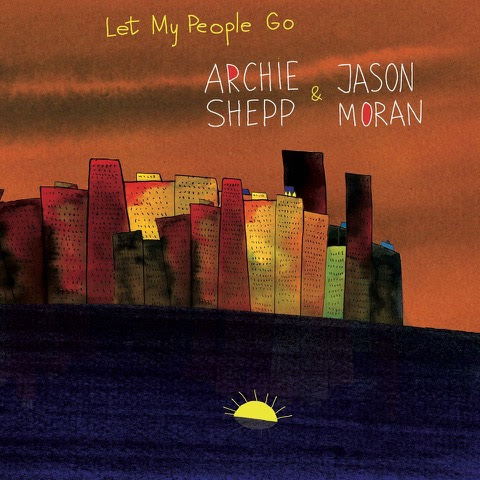
CD Review: Archie Shepp & Jason Moran - Let My People Go


Archie Shepp & Jason Moran
Let My People Go

Archie Shepp's duets with the late pianist Horace Parlan, found on albums that include Goin' Home and Trouble In Mind, arguably contain performances that rank with the tenor saxophonist's best-known early work for the Impulse! label. When recording some of the spirituals on the former album, Shepp told this writer, he was overcome with emotion. "The history, the suffering that those songs connoted was very much part of the performance itself," Shepp said in 2017. "I think we both knew and felt …it’s like two ex-slaves getting together. We didn’t have to discuss our experiences because we were deeply and profoundly aware of the implication. When [Parlan] touched the piano, I could feel history."

Let My People Go finds the 83-year old saxophonist teaming up with pianist Jason Moran for a series of live performances, some reprising the music Shepp made with Parlan, with takes on a few classics jazz compositions by John Coltrane and Thelonious Monk. 

Shepp plays soprano saxophone on three of the album's seven tracks. Although his work on the smaller horn might not be as compelling as the gruff, rugged tenor tone, his reflective approach can be felt on both horns. At the end of both "Wise One" and "Round Midnight," he replicates the soprano by flying into the altissimo register of the tenor. He moves at a more measured pace with this music, never erupting in the manner that he did in his early days. But the way he ends some phrases with dissonant passages in the high register indicates that he could breathe more fire if he felt the need. A highlight comes in "Lush Life" as he cues the in-tempo section with some low honks from the tenor. It sets up a groove that Moran runs with, going into a slightly Latin rhythm.

A few tracks feature the saxophonist adding vocals in the final chorus. His baritone voice also has an understated quality, which might come across as a little ragged. But to my ears, he adds to the music, giving the lyrics to "Sometimes I Feel Like a Motherless Child" some extra credibility. In "Lush Life" he scales the song's unique melody with ease, adding vibrato to his voice, making this contribution a key element to the whole arrangement.

Moran shows a strong rapport with the elder statesmen, playing spare when Shepp needs room to open up and adding heavy blues accents and upper register flourishes to "Motherless Child." His solo in "Wise One" - essentially the album's centerpiece at 13 minutes - relies heavily on chords rather than single line melodies and the energy is contagious. 

"Round Midnight" has been played umpteen times by umpteen jazz musicians. Shepp and Moran clearly realize that and make sure to give it their own collective stamp. A few later tracks  in the album feature audience applause from two European jazz festivals where these recordings were made. "Round Midnight" on the other hand, closes this album tightly with no room or need for the audience to respond. After all that, the applause would really be superfluous. 

Shepp and Moran seem to have a kindred connection that might be similar to what the former had with the late Horace Parlan. Things might move slowly and deliberately on this album, but sometimes deeper conversations work that way. 

Tuesday, February 09, 2021

Barbie Likes To Die...again

Sometimes I forget to toot my own horn on all forums. Two weeks ago, the first vinyl album I ever was ever part of (come to think of it, the only vinyl album I've been part of) was remastered and re-released digitally on Bandcamp - exactly 31 years to the day after its original release. 

Bone of Contention was my first band. Playing in a band was a lifelong dream, at least from the time I was about six, but it didn't happen until I was 18. The recording took a little bit longer, We recorded 48 Points of View when I was 21 and it finally came out a few months after my 22nd birthday. It was a self-released album, on Igor Records, the name coming from guitarist Lila Shaara's ornery but loveable cat. When you're in charge of releasing your own music, you can make crazy decisions like that. 

When you're in charge of your musical fate like that, you can also determine whose ears come in contact with the music. We did send copies to radio stations around the country and a few publications, who had some pretty complimentary things to say about it. Some radio stations latched onto a song called "Barbie Likes to Die," a spoken-word-and-music tale about the hapless Mattel character. The Bone - as we called ourselves - weren't a joke band, but we did swing widely between wry humor and dead serious subjects. "Barbie" did have a small but enthusiastic group of fans. I know because some of them have tracked me down through this blog, looking for a copy of the song. Now that the song - along with the other 12 from the album - are up on Bandcamp, maybe we can make a connection with them. Probably not, because that's the way the internet works (anonymity), but you never know. Here's where you can find it. 


I don't want to ramble on at length about why I think the album is wonderful. But it was the first time I had been involved in something like this (notwithstanding a made-in-the-basement 4-track cassette from two years prior). For that reason it occupies a special place in my life. The band was kind of unique too because there weren't many bands around then where everyone wrote and sang. If you need anymore thoughts on it, there are a few on the Bandcamp set. Check it out and give a listen. 

Thursday, January 28, 2021

CD Review: The Warriors of the Wonderful Sound - Soundpath


The Warriors of the Wonderful Sound
Soundpath
(Clean Feed/Ars Nova Workshop) cleanfeedrecords.bandcamp.com/album/soundpath

Muhal Richard Abrams literally became the founding father of the Association for the Advancement of Creative Musicians, a musical institution in Chicago that lives on even after the pianist/composer's death in 2017. The AACM might immediately evoke thoughts of abstract music or the blends of various artistic disciplines, but this album serves as a reminder that the AACM grew out of  rehearsals that Abrams hosted for his orchestra.

Soundpath was composed by Abrams on a commission by alto saxophonist Bobby Zankel, who leads the Philadelphia ensemble known as Warriors of the Wonderful Sound. With the composer conducting, the Warriors premiered it in 2012 in a performance where the piece lasted 90 minutes. This recording came together in 2018, with saxophonist Marty Ehrlich conducting the group. It lasts a "mere" 40 minutes, and reveals how Abrams' writing, even in his later years, still sounds unique and hard to summarize easily as it references various approaches to music.

Although "Soundpath" has composed passages, the music depends just as much - if not more - on its soloists to shape the sound of the piece. This version of Warriors of the Wonderful Sound includes 17 musicians and everyone gets a solo, many of them concise and direct. In an effort to make sure listeners pay close attention, each player's solo is designated by letters A through I under personnel listing, though that guide doesn't appear anywhere else on the disc or the package, leaving it unclear exactly where one section ends and another begins.

Among the highlights, pianist Tom Lawton does an admirable job of filling the seat of the composer, leading early on into an intriguing alto saxophone trio of Zankel, Ehrlich and Julian Pressley. The latter gets his solo later in the piece, with a mix of squeaks and reed biting that touches on AACM adventure. The opening ensemble passage begin with a fanfare that combines two harmonic directions and later they feature the horns creating harmonies that can't be found on the piano. The tempo moves from free to loosely rhythmic throughout the piece, climaxing with a drum solo by Chad Taylor.

Like much of Abrams' work, the music deepens with each listening and it certainly encourages repeated, close examinations. That says as much about Abrams as it does the whole ensemble, which in addition to the aforementioned players, includes: Robert Debillis (soprano and tenor saxophones); Hafez Modirzadeh (tenor saxophone); Mark Allen (baritone saxophone); Dave Ballou, Duane Eubanks, Josh Evans (trumpet); Graham Haynes (cornet); Steve Swell, Michael Dessen, Alfred Patterson (trombone); Jose Davila (bass trombone); and Michael Formanek (bass). 

Saturday, January 16, 2021

CD Review: Ingrid Laubrock - Dreamt Twice, Twice Dreamt

First things first: I mentioned that the NPR Jazz Critics Poll for 2020 wasn't up in my last post and, sure enough, it popped up a few hours later. Here is the list of albums of the year. More significantly, check out what Francis Davis has to say (his personal story is a hoot, and a little tragic) and look at what your favorite jazz scribe has to say. Or just follow this link and scroll down a bit to see what Mike "He Only Likes Stuff that No One Else Knows" Shanley said.

The following album already made its way onto the list which probably means it's "old" but now, but this is about the time of year that I catch up on albums anyway, So without further tangential yammering...


Ingrid Laubrock
Dreamt Twice, Twice Dreamt

Dreams have provided inspiration for music probably since the beginning of time. Saxophonist/composer Ingrid Laubrock has been keeping a dream journal (at the behest of friend and collaborator Mary Halvorson) for over a decade, having become very fascinated with the things she recalls from her subconscious state. The five compositions on this album were inspired by entries from the journal, as an attempt to "re-enter the dream to compose from that state of mind." The two discs present the music in two very different settings: the first with the EOS Chamber Orchestra, the other with an ensemble ranging from three to six people.

Like dreams, the music often moves slowly, content to stay in one place. The orchestra's version of "Drilling" has an almost minimalist nine-minute opening, with long brass tones and piano notes acting as sounds outside a window, coalescing to influence the direction of a dream. But the small ensemble version of "Drilling" begins with an drone of accordion (Adam Matlock) and electronics (Sam Pluta) that might seem nightmarish by comparison it if didn't evoke the roar of a B3 organ flexing its way through a Leslie cabinet.

But Laubrock insists that the different versions aren't meant to be used for simple compare and contrast. In fact, the music get a little too involved to do that. What's clear is the larger group seems to bear some influence of Laubrock's bandmate from Paradoxical Frog, Tyshawn Sorey. Like Sorey's own compositions, the music's open space provide as much significance as the space filled with sound. Laubrock also uses the sonorities of the orchestra to create a rich color. In "Snorkel Runs" the tones of strings, reeds and brass become clearer and as they repeat a long tone passage. 

Sometimes it feels like the journey becomes more important than the destination, as some of the music on Disc One seems to build to a climax that never exactly arrives. After 12 minutes - the average length of the tracks on Disc One - sometimes a little more could have helped, although Laubrock does often step in for a tenor or soprano solo. Drummer Tom Rainey and bassist Richard Landfermann also liven things up with solos as well.

Pluta appears with the orchestra and the small ensemble as does Cory Smythe (piano, quarter-tone keyboard). Matlock joins them on three of the five small group tracks, along with Zeena Parkins (electric harp) and, on two tracks, Josh Modney (violin). Things are generally more raucous on this disc, going for the darker side of dreams. A piano run at the start of "Snorkel Runs" gets sampled and distorted by Pluta, who shoots it back into the piece, moments after Smythe plays it. He does the same with Laubrock's tenor later in this track, adding to the energy. "Down the Mountain, Down the Mountain" sprouts some added microtonal melodies that add to the tension. 

"Twice Dreaming" closes the album with sustained piano chords, held until they fully decay (again evoking Sorey), abetted by dark accordion notes, all of it finally overpowered by distorted skronk from Parkins. While Laubrock insists that the music shouldn't be heard as a whole piece spread over two discs, it's easy to view this foreboding piece as a bookend to Disc One's opening "Dreamt Twice." By the end, it's nearly a surrealistic sound piece showing all manner of what can be found in dreams.  

Spoiler alert - it cuts off abruptly, again like a crazy dream. If it was a dream that made Laubrock bolt up in bed, it seems that she was less freaked out by the dream and more motivated to get it down in the journal before she forgot about it.

Thursday, January 14, 2021

One Further Point to Add to Last Night

This morning, I started looking through emails that come to my freelance writing account and realized there was another point I wanted to make in my previous entry that I totally forgot. I just casually mentioned the idea of starting to hate music, which of course was a strong way of saying that I'm souring on the sheer amount of music that I read about each day, which is sent to me under the naïve idea (clueless?) that it's something that I'd be interested in writing about. 

Several years ago, I wrote for Blurt, which started out as a print magazine that rose from the ashes of Harp, a magazine dedicated to a more progressive/indie rock-plus-more type of music. It was a little closer to Magnet than Alternative Press. Anyhow - Blurt published a few issues and then moved to web-only. It's still alive, and as far as I know, it's helmed at least in part by the great Fred Mills, a writer who seems to have an unending enthusiasm for music, which kept me going during those times when checks or recognition were in short supply. 

I haven't written for Blurt in about five years, not due to any animosity but because it was hard keeping another freelance hustle going. The door was still open as far as I could tell. And, I'm still on their masthead, which leads me to my next point.

I know I'm still on the masthead because I continue to receive emails addressed "Dear Blurt," occasionally. The ones I receive the most often start off with "Hi, Shanley." Don't get me wrong - I'm used to being called by my last name. There are plenty of Mikes out there and if you're not going to call me "Mike Shanley," I'm fine with being addressed by the last name. Having worked at a place where last names don't really exist - or they get switched out for the name of the department in which you work - being called "Shanley" feels like someone knows me a little more and  we've made a few steps  in our friendship. 

However, someone who yanked my contact info must have thought Shanley was my first name, and Writer was my last name. (It's my email address.) They didn't bother to get to know me, or figure out who I am. Overall, not a big deal. It generates an internal chuckle when I see it. Occasionally, I'll write back and tell them my full name, which usually generates a quick apology. Still, that's not enough to raise the hackles and make me start to hate the music industry. 

What kills me is the endless parade of oh-so-personal, trying-to-be-deep stories of artists who have had music save their lives, writing songs about being in a dark place after a relationship fell apart but finally realizing that you need to let go and once you let go, you can fly in the sky and see sunshine and hope. And maybe a unicorn or two, which will take you on a magical ride. The last part was completely made up on my part, but I've seen countless variations on the other themes in a lot of promotional emails. This is not to say that these people haven't suffered through dark times or felt worthless when they were abandoned by a lover, or when things didn't work out as we planned. We have all felt that way at one time or another. Which is exactly my point. These p.r. flacks need to stop peddling these stories like they're unique, and haven't been heard a million times before.

I'm not trying to be heartless and cold. When you have these feelings, life sucks. It's hard to get you back up on your feet again. But somewhere I feel like there is a fleet of p.r. people hustling aspiring performers into paying them all kinds of money with the promise that they will get their song (and it's usually a song, rarely an album, since today's attention span can handle that) out to people and get it a million plays on Spotify. Which means they'll have enough money to order extra toppings on their pizza on Friday, if they're lucky.

During the '90s and early '00s, a lot of independent p.r. companies sprouted up as more and more  bands started releasing material. A lot of them were really good at their jobs, having come to this work out of college radio, indie fanzines and/or their own bands. Their passion came across in their releases and they helped get the word out about bands that deserved greater attention. While working at a couple local alternative press weeklies, I started paying closer attention to mailings from certain companies, figuring that what they sent me must be pretty good, or at least worth a listen, given their roster of artists.

As time goes on, there are more people making music and more people clamoring for attention. And more people see the opportunity to push these young hopefuls. But the quality of the p.r. seems to cater more to Cosmopolitan readers than to readers of Blurt. It's much more generic and less about individuality. Even before COVID made it impossible to go out and perform live, a whole lot more people were doing home recordings before they really had anything to say. Part of me feels like these musicians and singers are being tricked into thinking they're something that they're not.

If you read the previous blog post, you'll see that I admitted that I'm less informed on independent pop/rock music that I am about jazz these days. So maybe I'm off base about this. Or maybe my age is just showing. Or it could be that this general shift toward "My music is powerful because I'm passionate about what I do" has pushed me away from that music in the first place. 

Looking Back, Looking Ahead, Looking into My Head

Once my dad retired and was home all the time, it always puzzled me that he didn't have music playing during his every waking hour. After all, he was a music fan. The house was full of plenty of albums that he hadn't played in years, in addition to a plethora of CDs that we kids bought him for birthdays and holidays. With all the time in the world, why not have music going while doing crosswords puzzles, reading the paper or writing out the bills? 

Somewhere along the way, my mom set me straight: Pop didn't dig having music run in the background. It should be upfront, observed pretty closely, though not analytically. Sure, when we would come over for dinner, it was okay to have something on in the background. But a constant stream of music? No way. 

Over the past few years, I've come to feel the same way. Part of relates to my being a music writer. (My dad wasn't, though he was a bass player.) Maybe there are some reviewers who can put on an ECM album while loading the dishwasher or running to the basement to clean the litter box, and still zero in on what Manfred Eicher's production skills brought out in a session. Or maybe they picked up on the way Sonny Rollins locked in with Han Bennink on Rollins in Holland while making Sunday breakfast. 

Not me. I have to listen to an album a few times - closely - before I feel like I can write about it. And I usually scribble down some notes to make sure that I recall the finer points of an album  In fact, one of the things I concluded in 2020 is that I rarely like an album on the first listen. It takes time to get used to it. Sometimes there's a too much expectation built into it and I can't enjoy the music right off the bat. (I remember buying the the Beatles' Anthology albums when they came out. During the first listen, my mind would wander onto the next song when I hadn't even gotten more than a verse and a half into the previous one.) 

It isn't just new albums that make me feel this way. It can just as easily happen with a new-to-me album from some bygone era that I never heard before. There are plenty of jazz albums that I still would like to discover. I don't always feel like I can just put them on and get into it without giving them full attention. Listening with half an ear can make something sound quaint and not very exciting. Some people might be appalled to hear that Cannonball Adderley's Somethin' Else sounded pretty dull to me when I first heard it. 

When I'm writing about an album or an artist, I feel like I need to take a lot of time to make sure I'm getting details right. The beauty of a blog is that it's easy to go back and change any mistakes. So if I somehow carelessly mistake a trombone for a baritone horn or a rhumba for a clave, it's an easy fix. Sometimes I wonder if that's part of the reason why I feel so comfortable writing about free improvisation - the performance isn't usually weighed down with traditional stylistic descriptions. It's easier to write about the emotional and visceral qualities of the music. 

Another factor that came up, thanks to the mess of 2020: there were a lot of times where I didn't feel like trying to take in something new. Even though I might have time to myself in the morning while making coffee, the events of the day left me wanting things to be predictable. 

Besides, it can be hard to put the new music receptors on when there's something like a favorite album from my 20s or an easy listening album still still on the turntable after last night's dinner. I don't have a man cave (and I still don't really like that word) where I go to hear music. The main turntable is just off of the kitchen, with an extra set of speakers in the kitchen. So if I'm listening to some wild free improv stuff and I don't feel like I can blast it, that album will be put on hold. Or get lost in a sea of other albums and CDs, whichever comes first.

Then I feel like I'm not doing my due diligence as a writer. I can't keep up with new things, I don't know all the right vintage things and the end result is I spend more time worrying about what I'm not writing about than actually writing it. It's amazing that I don't just abandon music altogether. 

Then I remember that getting started is the hardest part. With "maintaining an attention span to see it through to completion" being the second hardest part. 

As time goes on, I feel like I'm moving further and further away from the typical indie rock/pop that I like, with all my time and mental space getting taken up by jazz of all sorts. Last year, I feel like I only bought three indie rock albums, one of them being sort of relative. 

Destroyer's Have We Met was the first one. Dan Bejar (who is Destroyer for all intents and purposes, though many of the same people play on the albums) is a pretty prolific songwriter, churning out a new album about every two years or so. I feel compelled to get them when they come out. (As a writer, I probably could get a promo download of them, but since I'm not always going to write about them, I don't always feel right doing that.)

When I get these Destroyer albums, sometimes my first reaction is buyer's remorse. Do I need every album? Are they all the same after awhile? (Sometimes it seems like the same three or four chords.) But then "Crimson Tide," the first song on Have We Met, opens this way: 
"I was like the laziest river
A vulture predisposed to eating off floors
No wait, I take that back
I was more like an ocean
Stuck inside hospital corridors"

That set of lyrics, with its verbal editing and revision, made me realize, yes, I do need this album. Nobody weaves a twisted narrative like Bejar. And the album's arrangements recall the best elements of '80s new wave and synth pop, with some heavier underlying grooves courtesy of bassist John Collins.

Bob Mould's Blue Hearts was the second rock album on my list. I really loved Sunshine Rock and was crushed that I didn't get to catch him on that tour. His playing on that album had more bite to it than I, as a casual fan, had heard in a while. But geez oh pete, Blue Hearts adds a heavy dose of bile to that bite. It sounds as if someone told Bob to write an album that reacts to all the shit that's gone down over the past few years, react to it and.... make a statement or two while you're at it. 

He did that and he did it really well. "You can see how the lies divide us/ world turning darker every day in a fucked up USA/ can you look in the mirror and tell me everything's alright?" He hasn't sounded this pissed off - and on the money - since Everything Falls Apart.

I bought Blue Hearts in mid October, weeks before the election, after a horrible summer of unrest, leaving me in a state of high anxiety. The album doesn't really offer solutions. Spoiler alert - the narrator seems to kill himself in the final song by walking off into the waves. But it was nice to know that someone else felt the same way I did, and was raging about it. 

The final offering in my list is Wendy Eisenberg's Auto. The guitarist is someone I've written about here on a couple of occasions, usually as an improvisor, a potentially noisy one at that. Auto on the other hand finds her going into more of a free-folk direction. Apparently, it was somewhat inspired by Joni Mitchell (someone who I can never get into) but to these ears, Eisenberg almost sounds like the wilder, more imaginative younger sister of Mary Timony. The songs occasionally move in a linear fashion but more often they're marked by twists and turns. Like the other two albums, Auto comes with a lyric sheet (which much like Mould's lyric sheet, is a challenge to follow due to its layout). But it's worth the effort in the end. 

Speaking of year-end reflections, it's usually time to the NPR Jazz Critic Poll to pop up around this time, but I've yet to see it. That's ironic too since I got my tally in on time. 
Saturday, January 09, 2021

CD Review: What Happens In A Year - cérémonie/musique

What Happens In A Year
cérémonie/musique

What Happens in A Year consists three improvisors, Josh Sinton (baritone saxophone, bass clarinet), Todd Neufeld (guitar) and Giacamo Merega (bass guitar). Their album cérémonie/musique is both their debut and the first release for Sinton's FiP (Form Is Possibility) label, which will document the reed player's various projects. 

Sinton/s work never stays in one place. The quartet Ideal Bread paid tribute to Steve Lacy, the Predicate Trio includes drummer Tom Rainey and cellist Christropher Hoffman, balancing compositions and free improv. He has also released a few albums of his solo improvisations, of which krasa is one to seek out, as his contra-bass clarinet performance often compares to a guitar noise recital, since he runs the instrument through a distortion pedal. Right around this time last year, I also saw him in a trio with fellow baritone saxophonist Dave Sewelson and multi-instrumentalist Daniel Carter. 

The seven tracks on cérémonie/musique come in complete contrast to albums like krasa. The group's approach to free improvisation moves at a more relaxed and thought pace. The first minute of "Algernon," for example, is fairly silent, save for the resonance of Neufeld's guitar strings that come when he taps the neck of the instrument. The trio never rises much in volume beyond that, preferring to explore the open space of the moment. "La Politique de Auteurs," which precedes "Algernon" and opens the album, almost sounds composed. Merega joins Sinton's baritone at what feels like a perfect entry point, after the saxophonist has opened up the sound. Neufeld waits before he comes in, almost echoing the saxophone when he does, but going off on a parallel line, playing in a way that often seems to respond to the waves of sound Sinton blows.

In some ways, the communication revealed on the opening track does not come across the same way throughout the album. The trio plays more in a loose manner, only occasionally building up into a three-part climax. With three melodic instruments and nothing to imply any sense of rhythm or tempo (free or otherwise), it opens the sound up to more possibilities, which can make it a challenge on where to focus attention. In some ways, Merega does some like an anchor, or an accompaniment to the ideas that Sinton and Neufeld present. Then in "Netherland," Sinton's bass clarinet starts out droning underneath, listening to what his partners play before rising up to add some slap-tonguing lines and grumblings. Neufeld can be heard singing along with his guitar here, while Merega walks on his instrument, not exactly in the traditional manner.

Several years ago in a review, I repurposed Whitney Balliett's old description of jazz, from "the sound of surprise" saying the music was also "the sound of trust." While we can - and should be - surprised by what an improvisor plays, there should also be trust involved on the part of the listener: trust that they know what they are doing as they take us on this personal journey with them. It might not seem easy at first, but it's worth the trip. What Happens In A Year plays that kind of music. 

Thursday, December 31, 2020

CD Review: Geof Bradfield/ Ben Goldberg/ Dana Hall - General Semantics

"


Geof Bradfield/ Ben Goldberg/ Dana Hall Trio
General Semantics

When Cecil Taylor performed "Air," it might have swung in the pianist's own way, but it never swung like the opening track of General Semantics. The trio of Geof Bradfield, Ben Goldberg and Dana Hall are working more from the arrangement Steve Lacy used on his Straight Horn Of Steve Lacy album, where he smoothed out the melody into longer tones, which came from opposite registers in Lacy's soprano and Charles Davis' baritone. But this tenor/contra-alto clarinet/drum trio kicks the tempo up a notch, pulsed by Hall's fleet brush work, taking the melody closer to the swing standard "Cherokee." After completing the head, the two horns step lively around one another, soloing in relation to the melody but not feeling constrained by it.

Ben Goldberg is no stranger to pared down groups like this. He has played in duos with drummer Hamir Atwal and keyboardist Michael Coleman - and in a trio with both of them. On Unfold Ordinary Mind, Goldberg's contra-alto clarinet filled in for the lack of a bass, while acting as the third horn, together with saxophonists Ellery Eskelin and Rob Sudduth. On the other hand, Geof Bradfield's 2018 album for Delmark (Yes, and ...Music for Nine Improvisors) put him at the helm of a larger group (including Dana Hall as the drummer), playing a suite that features some free excursions as well as big band-style moments. Here, Goldberg alternates between the contra-alto and the B-flat clarinet; Bradfield switches between bass clarinet, tenor saxophone and soprano saxophone. 

General Semantics lives in an area where early jazz improvisation - heavy on counterpoint with parallel lines that respect the path of the other players - combines with an approach that isn't afraid of pursuing greater rhythmic and melodic freedom. Goldberg alternates between the contra-alto and the B-flat clarinets; Bradfield switches between bass clarinet, tenor saxophone and soprano saxophone. Because of that, textures change regularly. In "Tioga Street Zenith" the two clarinets weave around one another while Hall uses the brushes behind them, out of tempo. "Lamentation" features more parallel improvisation but this time, they conclude by stating the theme over a straight ahead 4/4 groove, keeping the swing going.

The title track begins with some husky tenor sax playing, but quickly adds a heavy backbeat, and Goldberg proves to be the best substitute for a raunchy bass guitar. Duke Ellington's "Half the Fun" scales down to contra-alto and soprano sax, and it becomes clear that this trio interacts so well that they don't leave any time to miss a regular bassist or other harmonic accompanist. 

Monday, December 21, 2020

CD Review: Sonny Rollins - Rollins In Holland


Sonny Rollins
Rollins In Holland

The first Sonny Rollins performance that really knocked my socks off was his version of "Everything Happens To Me" from On Impulse. During my first summer in college, I did an overnight jazz show on the college radio station and discovered that album one night in the library. I figured you couldn't miss with Sonny Rollins and this track was 11 minutes long, leaving plenty of time before the next track needed to be cued up.

The most incredible thing about "Everything Happens to Me" was Rollins' tone. It felt warm and deep, wistful and romantic. The path of his solo isn't what got me - I can't recall it at the moment but I'm sure it was also deep - it was the delivery. That song alone might have been the tune that inspired me to program the 2 a.m. hour with nothing but ballads. On a warm summer night, that's what the world needed to hear.

The opening seconds of Rollins In Holland brought back the same feeling of euphoria. "Blue Room" (another song that from On Impulse) comes from a Rollins recording made at a Dutch television studio with bassist Ruud Jacobs and drummer Han Bennink. His tenor resonates, using the natural reverb of the room to emphasize the richness of the horn. The trio, which assembled for the first just two night earlier at a club, work together like they've been interacting for months. The sound quality throughout Rollins In Holland might not be as powerful as "Blue Room" and the other three tracks recorded at VARA Studio5, but the creative spark makes up for any sonic shortcomings. 

This two-disc set from Resonance Records tells the story of these 1967 recordings in vivid, sometimes repetitious, detail. Sonny Rollins hadn't recorded an album in a year (the last being East Broadway Run Down, the followup to On Impulse!) and wouldn't release another until 1972. He jumped at an offer to play the Academy of Visual Arts in Arnheim in May of '67. Intent of playing in a trio setting, he made arrangements for Jacobs and Bennink to accompany him. Bennink had played with Eric Dolphy in the months before the multi-reedist passed away, and would go on to become one of the most creative, and inventive free jazz drummers in Europe. Jacobs was more of a traditional player, whose track record included work with Louis Armstrong and Bill Evans. Longtime friends, their divergent styles didn't keep them from meshing with Rollins. 

Their May 3 performance at the Academy fills the second disc of this set. The first piece of the set - a 22-minute version of "Three Little Words" - wraps up Disc One, following the VARA Studio 5 television recording and two more tracks recorded live for a television show. According to all parties involved, there were no rehearsals for the performances, nor was there any verbal directions. 

The trio hit the ground running, ears wide open following the saxophonist. To say they keep up is an understatement. After stating the theme on "On Green Dolphin Street," Rollins jumps into "There Will Never Be Another You," his mates right there with him. Throughout the set, Rollins throws in quotes from other songs, including remote selections like Wilson Pickett's "Land of 1000 Dances" and Chopin's "Funeral March." When he inserts Miles Davis' "Four," it's hard to tell if it's an instruction to trade fours with him or a reference to a song that will come later in the set. As a whole, his paraphrases come off less like a musicians showing off his musical knowledge and more like someone who has the opportunity to muse with depth before moving onto another idea.

Jacobs gets a little lost in the mix of the Academy set, drowned out a bit by Bennink's drums, which swing hard and hint at the freedom he could see coming down the pike. While the bassist might not be felt, he can be heard a bit, and the quality doesn't distract from the music's power. He does comes through clearly on the previous sets, which were actually recorded later, by which time the trio has developed even more of a rapport. 

This being a Resonance package, the 100-page booklet offers almost as much value as the music. Interviews with Bennink together with Jacobs (who died in 2019 after a long battle with cancer) as well Rollins himself are flanked by essays by Rollins biographer Aidan Levy and Frank Jochemsen, the latter who helped unearth and identify some of these recordings.

Sonny Rollins has always been his own harshest critic, never quite satisfied with his performances. He also seems very humble, which might have something to do with his self-examination. Yet, his thoughts in the booklet's interview betray feelings of excitement at hearing this music again. (He also raves about Jacobs' bass tone, which means another close listen is in order, in case I missed something.) That's probably the best endorsement of all.  

Wednesday, December 16, 2020

CD Review: Nate Wooley - Seven Storey Mountain VI


Nate Wooley
Seven Storey Mountains VI
(Pyroclastic) natewooleypyroclastic.bandcamp.com/album/seven-storey-mountain-vi

One of the first shows in Pittsburgh that was cancelled in the early days of the pandemic was to feature saxophonist Ken Vandermark, trumpeter Nate Wooley and drummer Paul Nilssen-Love. The two horn men had come to town before, creating music that was both lyrical and sonically intense, utilizing upper register wails that could, literally, vibrate the wax in your ears. 

In addition to his intense technique and perspective on his horn, Wooley also released something that avant-jazz fans might never expect in a million years: (Dance To) The Early Music (2015), a relatively straightforward tribute to Wynton Marsalis' Black Codes for the Underground and J Mood. (When interviewing Wooley for a JazzTimes article on that album, we both shared our fondness for Blood, Sweat & Tears' blockbuster self-titled album too.) These are just but a few of the many things the prolific trumpeter has done, but it reveals the vast vision that factors into his work.

Seven Storey Mountain is an extended piece - a song-cycle, in a way - that has evolved through six different iterations, with various musicians working with the trumpeter each time. This sixth one features a group of improvisors, a choir of women and an underlying message of courage and strength that filters through it. Folksinger Peggy Seeger's song "Reclaim the Night" is incorporated into the work. The album presents the music in one 45-minute track. Along with Wooley's liner notes, the CD edition comes with a graphic chart, laying out the flow of the piece and when musicians come and go. All of these present a greater perspective to what is an intense piece of work.

The notes assist in large part because it can be hard to tell how the sounds are being produced. After an opening vocal passage with the voices humming the melody, Susan Alcorn's pedal steel guitar drones gently, as a series of keyboard sounds and loops (some lifted from previous performances of SSM) resonate in the background. The first half moves languidly, with the soundscape getting wider, with more organ loops and violins (Samara Lubelski, C. Spencer Yeh) creating a feeling of anticipation as their bowing grows more intense.

By the 26-minute mark, things have reached a full boil. Drummers Chris Corsano, Ben Hall and Ryan Sawyer, who were simply brushing earlier, have begun moving over their whole kit. Guitarist Julien Desprez begins wailing like a jackhammer, with sounds panning from channel to channel. Ava Mendoza's guitar also kicks in around this time, though she isn't quite as close to the forefront as Desprez. The whole ensemble moves rapidly but together. They create a sound that resonates deeply, achieving Wooley's intention that he expressed to the players during rehearsals - "to make the room vibrate in a different way, and to make the room continue to vibrate long after we're gone." The collective vibration might sound chaotic or dense, but it's nothing compared that what comes later.

As the drummers drop out, followed by the guitarists, leaving Alcorn playing "gentle sounds" over keyboard loops, the 21 women of the choir began to rise up, first in ghostly chorus of "ah," then moving into the chorus of Seeger's song, the text of which appears on the disc's front cover. They repeat it seven times, with an echo beginning on the sixth to make it like a canon. 

Without any musical support, they begin to repeat a new line, from the folk song "Union Maid," ten times - "You can't scare me." As they reach the final repetition, the natural reverb has been stripped away, putting the women right in the face of the listener. After all the sonic frenzy, this is the most intense moment of the album, which Wooley had intended. In his liner notes, he explains that SSM6, which premiere in November 2019, was fueled by anger. "I was fucking angry watching the government attempt to wrest control of women's bodies and angry watching Black people be incarcerated and killed with impunity," he explains. The voices work as a way towards liberation from this oppresion. Wooley also is donating a portion of the royalties to the National Coalition Against Domestic Violence (NCADV). 

Seven Storey Mountain VI might not be an easy listen. It's definitely not one that can be put on while working around the house. My first listen came during a long car ride and parts of it sounded completely different than it did while listening on earbuds, with the booklet in front of me. And the latter setting is the way it should be experienced because these 11 musicians created something deeply engrossing that will resonate long after the disc is finished.

And, like I often say at this point, it makes me want to track down the first five installments of SSM, which incidentally derives its name from the writings of Thomas Merton. 


Friday, December 11, 2020

CD Review: The Dave Brubeck Quartet - Time OutTakes


The Dave Brubeck Quartet
Time OutTakes 

Dave Brubeck's Time Out wasn't the first jazz album to break away from 4/4 time, but it was the album that took the farthest away from "standard" swing - without sacrificing the swing in the process. Its centerpiece, "Take Five" became a hit single and, arguably, one of the best known songs in jazz, all while it resided in what could be one of the most rigid time signatures of all - 5/4. "Blue Rondo A La Turk" crossed the blues with a Turkish rhythm and proved that if you could hum the melody, it didn't seem so odd after all.

Time OutTakes, released within days of what would have been Brubeck's 100th birthday, presents something that the general public has never heard since Time Out's original 1959 release - alternate takes of that album's music. According to Chris Brubeck - Dave's bass and trombone playing son - there exists more than 12 hours of music from the original sessions. "Take Five," which was credited to alto saxophonist Paul Desmond rather than the pianist, took a while to take shape, so the story goes. Drummer Joe Morello worked hard to get a good groove underneath it before he eventually felt comfortable enough to create a groovy solo built on melody as much as rhythm.

The chance to hear the song slowly take shape might be akin to hearing Bud Powell arrive at a definitive version of "Un Poco Loco," a song which always appeared in three takes when it was released on album. But the complete evolution of "Take Five" will have to wait for another day. Time OutTakes sticks to an LP-length format, with one alternate of each song from the album, save for "Pick Up Sticks" and "Everybody's Jumpin'" (both completed in one take). In their place comes a version of "I'm In A Dancing Mood" - arranged to maintain the album's theme of radical time shifts - and "Watusi Jam," an improv that is based on "Watusi Drums," which the band recorded a year prior on their In Europe album. The album ends with a four-minute collage of studio banter from the original sessions. 

Although the album isn't a deluxe boxset with myriad takes and false starts (though the Brubeck siblings offer inciteful notes), it is the first ever chance to peak behind the masters and get some clue on how they came to be the gold standards. What's here should tantalize everyone who has memorized the record. "Take Five" catches the band before Morello solidified his groove. Interestingly, Desmond sounds like he's struggling to find a place to catch his breath during the opening chorus. Unlike the master, in which Brubeck and bassist Eugene Wright continue their ostinato during the drum solo, they drop off. Perhaps as a result, Morello gets wild during this solo instead of displaying economical swing. 

An equal amount of jazz quartet aggression comes in "Blue Rondo A La Turk." The transitions between 9/8 and 4/4 have more punch. Both Desmond and Brubeck draw on more of a blues vocabulary here than they do in the master. Dave even sounds at times like Thelonious Monk, with quotes from the 9/8 theme sprinkled over his much longer solo. The lyrical "Strange Meadowlark" also has more jazz licks and syncopation from both soloists.

"Three To Get Ready" can be a little unsettling with its alternating two bars of 3/4 and two of 4/4, but Desmond bridges the transition smoothly while Brubeck, perhaps in response, utilizes his trademark habit of stretching the time over the group. In "Cathy's Waltz" - named from Brubeck's daughter who corrects the spelling in her notes from what "Kolumbia" Records used on the cover - Morello and Wright seem to move along with Brubeck as he shifts toward 4, rather than maintaining the waltz beneath him.

The track of studio banter is fun though it ultimately feels like a teaser. Chatter leads into a songs, which fade into the next bit of talk. Anyone who thinks this group was too serious will be surprised by the regular laughter between tracks, as when Brubeck flubs the "Strange Meadlowlark" introduction, saying he couldn't play it perfectly as he did on a previous take. Bits of "Take Five" again hint at what went on, but still only offer a fleeting glimpse. Maybe Sony would only allow a certain amount of music and talk to leave their vaults for this album. (This release is by the family-owned Brubeck Editions, not Columbia or Sony). But a whole disc devoted to "The Evolution of 'Take Five'' would surely be devoured by all manner of fans.

In the meantime, dig in. Happy Centennial, Dave.


Tuesday, December 08, 2020

CD Review: Charles Mingus - At Bremen 1964 & 1975


Charles Mingus
At Bremen 1964 & 1975

It's very possible that every concert Charles Mingus performed during his April 1964 trip to Europe was recorded by some person or organization. Mosaic's The Jazz Workshop Concerts 1964-65 (2012) included the entire April 10 set in Amsterdam. Sue Mingus' Revenge imprint took back a bootleg recording from Paris show from April 17 for a 1996 double-disc release. The Great Concert of Charles Mingus, first released in 1971, presented a three-record set of another Paris show on April 19. Enja released two volumes of Mingus In Europe that came from April 26 in Germany. The questionably legal Unique Jazz label released highlights from a performance in Stuttgart from later in the month, April 28.

Sunnyside's new four-disc set At Bremen 1964 & 1975 adds to the canon with a performance in that German city on April 16, 1964, coupling it together with the bassist's July 9, 1975 return with a new quintet. Both groups take up two discs each in the set. (Unique Jazz released portions of the '64 on vinyl previously.)

Mingus's 1964 sextet is considered one of his best ensembles, because they were able to understand the vast influences and personality that shaped his music. Eric Dolphy (flute, alto saxophone, bass clarinet), Jaki Byard (piano), Clifford Jordan (tenor saxophone), Johnny Coles (trumpet) and Mingus' right hand man Dannie Richmond (drums) all made the trip. Coles missed a few dates when he fell ill later in the month and Dolphy, who had planned on staying in Europe before the tour began, died tragically in June due to untreated diabetes.

While the sets were pretty similar on each night of the tour, the music took on different shapes every night. Mingus completists will revel in the new versions of "Meditations on Integration" and "Fables of Faubus," two of the six lengthy tracks from that evening, but this isn't simply music for jazz theorists, who want to compare and contrast shows.

The concert started late and the liner notes make light of the bassist's confrontational attitude that he had when he barreled into Radio Bremen's Studio F, a performance venue that has sold out all 220 seats. But the bad Mingus attitude doesn't come across in the performances. In fact, he even thanks the audience between tunes. Along with the two compositions mentioned above, the group also plays "Hope So Eric," (the blues usually titled "So Long Eric"), Byard's "AT-FW-YOU" (here, simply "Piano Solo"), Ellington's "Sophisticated Ladies" and "Parkeriana," a complex blend of Charlie Parker tunes and original solos. 

Other than the piano solo and Ellington piece, everything lasts at least 21 minutes, with "Faubus" going on for 32. In other versions of the politically charged tune from the tour, soloists would play freely and the group would slowly morph into a groove similar to the Spanish-flavored bassline from "Ysabel's Table Dance," building in intensity until things collapsed and the theme cued the next soloist. This happens during Dolphy's bass clarinet solo, but not with Coles, Jordan or Byard. Instead, Mingus throws in a little bit of "Haitian Fight Song" and Byard quotes "Yankee Doodle" with the takeaway feeling new and equally as bold. 

"Parkeriana" also comes off more like a complex composition with jarring tempo shifts and blowing space, rather than simply a parade of Bird lines. Jordan rules the roost here, with Dolphy adding some commentary which is unfortunately off mike. The other surprise is the coda to "Meditations on Integration." While the group often the extended composition until it became a ball of fire, the last seven minutes find Mingus (with his bow) and Byard in a more reflective mood, with Dolphy adding some color with his flute. If the crowd didn't know what to think, time has revealed how deeply attuned this group was their leader's vision.

Eleven years later Mingus was back in Bremen at the Post-Aula Auditorium. Along with Richmond, the new quintet included Jack Walrath (trumpet), George Adams (tenor saxophone) and Don Pullen (piano). Many of the bassist's '70s albums were built on larger groups and compositions, but this appearance draws on music that would come out a year later on Changes One and Changes Two, two of his last triumphs with a smaller group. 

Mingus often referred to a new album as "one of the best things I've done," and he was pretty much on the mark with the Changes albums. Adams and Pullen could pivot between the rich Ellington influence in Mingus's writing and bring the aggression of free jazz to bear on wilder moments. All of this can be found in the 32 minutes of "Sue's Changes." Pullen solos alone and then goes into some two-fisted jabs behind the band. Adams adds some Ayler-esque honks to his solo. Walrath precedes both of them with a free passage that moves into a set of rich trills over a band vamp. A single-chorus romp through "Cherokee" could either be a send-up of free jazz attacks or just a fun moment, working either way.

The 1975 recording feels superb (as does the 1964) although it sounds as if Mingus was playing through an amplifier rather than being miked directly, the latter being that standard by that time. Although he can be heard clearly, the process eliminates some of his signature sound - of big fingers plucking the strings, making the wood of the bass resonate so personally. The other surprise is that "Devil Blues," which features Adams's hyper-animated vocals, almost sounds like it was aimed more at wooing the crowd than extending the personality of the band. It's not bad, just a tad anti-climatic. Of course it's hard to follow such a unique, charged statement as "Remember Rockefeller At Attica."


Saturday, November 28, 2020

CD Review: Angelica Sanchez & Marilyn Crispell - How To Turn the Moon


Angelica Sanchez & Marilyn Crispell
How To Turn the Moon

When Craig Taborn and Vijay Iyer released their two-piano album The Transitory Poems (2019), I had already heard some of the album performed live during Winter Jazz Fest. Onstage and on album, their interactions were deep and involved. But I never wrote about the album because, much as I liked it, I didn't know how to talk about it. No matter how I approached it, other than tried and true technical terms, I felt like I couldn't really express what was going on. (It's probably just me. Here's my review of that album, nearly two years later: You should really check it out.)

Like The Transitory Poems, How To Turn the Moon features the same instruments - two sets of 88s, played by two creative pianists. Marilyn Crispell is a prolific soloist, leader of groups of various sizes and former member of other revered bands, the best known probably being Anthony Braxton's quartet. She has played with the velocity of Cecil Taylor but can also ring drama out of stark, gentle works as well. Comparatively, Angelica Sanchez is a newcomer, coming to New York from Arizona in the early '90s, but has made a strong impression with a number of albums of her own and with other artists. In addition to performing, she also lectures at Princeton University.  Crispell and Sanchez are equally as capable of creating rich, hard-to-summarize duets as Iyer and Taborn, but the descriptions flow a little easier music this time around.

Sanchez composed the pieces on How To Turn the Moon, save three improvisations for which both receive credit. In a telling example of their rapport, they explore vastly different moods in these spontaneous tracks, playing inside the piano on the strings ("Space Junk"), exploring a ballad-like feeling ("Windfall Light") and engaging in some more aggressive key stabbing ("Rain In Web"). 

Sanchez is panned to the left channel, and Crispell to the right, which brings clarity to the question of who plays what. But once the places are set, the performance becomes more about how Crispell and Sanchez become one in the music. In "Ceiba Portal" they alternate choruses, coming together to double the melody, with a coda building on a descending line that volleys between the two of them. "Calyces of Held" begins with Sanchez alone for a few minutes, before she switches to arpeggios that support Crispell's melody, then the latter goes it alone. By the end of this one, they're playing on top of one another, in the same range of the keyboard, but their lines never get in each other's way.

Much of the music has a cerebral feeling. Stark lines or chords reverberate, making way for the next one, which often creates melodies slowly and deliberately. It can be gentle music but a closer listen reveals connections between the sections that make a larger structure. Then when Sanchez and Crispell have us tuned in to their unique chemistry, the album closes with "Fires In Space" where they solo over an ostinato, the first time this more "straightforward" structure is used. It feels like an appropriate closer to their multi-faceted journey.

Wednesday, November 11, 2020

CD Review: Mantic Trio - Neighborhood Changed Fast


Mantic Trio
Neighborhood Changed Fast

Mantic Trio is what happens when the drummer of '80s punks Negative Approach gets together with a jazz pianist-turned-songwriter and an improvising guitarist. Respectively, Chris Moore, Lee Feldman and Rob Price create 10 spontaneous tracks that span tranquility and bedlam, often morphing from one to the other often in the space of one track. The trio's album has drawn comparisons to the Butthole Surfers, Eno and Psychic TV. While these touchstones are not completely off base, their interactions as improvisors also recall the loose, anything-goes feeling of Australian improvisors the Necks with the Dirty Three's ragged beauty also coming to mind when the Mantic Trio comes together on an idea.

The latter comparison has a lot to do with the sound of Moore's drums. His kit is mixed like a rock kit, with a powerful low boom that doesn't come with jazz improvisation. When "Gangly" opens the album, Feldman's piano is caught in a "Tubular Bells" type of riff, until Moore explodes onto it, shattering any sense of eerie calm. Moore also drives the VU meters into the red during "Clipped," a title which describes Feldman's Cecil Taylor-esque attack. Price's guitar sounds a bit restrained on this one, which is good because when he does play, he's plenty loud. 

The 73-second title track is all chaos, with wailing feedback and crashing drums and a piano in there somewhere. Since the album was created from a marathon studio session, there was probably more where this came from, but the brevity works in the band's favor. Besides, it follows the 11-minute "Crest" which features a slow build of roaring piano and one-string guitar riffs with a sense of calm coming at the end. 

Throughout the album, the trio strikes a good balance between lyricism and frenzy. The quiet electric keyboard in the interlude "Mannerist" is shattered by Price's effects-heavy guitar in "Pesky Orbs" the next track, where it jousts with the piano. "That Club Spirit" begins with an industrial 4/4 pulse, and while a steady tempo is maintained, it ends up somewhere else by the end, evoking a pile of smoking speakers and splintered drum sticks. And that poor piano. 

One of the reasons Neighborhood Changed Fast works so well, aside from the way the edits create different tunes, relates to the way the trio never seems settles into musical styles or limitations. This could be a punk band or it could be an avant jazz group, or maybe a free prog group. But rather than decide themselves, they let the music make the decision.

Tuesday, October 27, 2020

Loss in October

The fall season, and specifically October, used to be my favorite time of the year, bar none. Part of it related to my birthday coming in October, but there was always a sense of renewal closely linked to this time of the year: new school year, new apartments, a sense of adventure that came with it. Plus the October temperatures have a certain romanticism to me. These days if I drive to my mom's house on a Friday in the late afternoon, it takes me back to the days of have a paper route and "going collecting" (getting my customers to pay for the week's paper) and going on some adventure that night.

But as time goes on, the fall season has become synonymous with loss and tragedy. InPittsburgh, the first alt-weekly paper where I worked on staff, was bought out and shut down at the end of September 2001. My position at Whole Foods was eliminated right around the same time in 2005. (I'm back there again, so things come around, but it was a hard couple of years, mentally, in between.) 

Thanks to good old Facebook memories, I was reminded that, in October 2014, I had a seriously bad asthma attack that led to a trip to emergency room - which I got to by hopping on the bus down the street from my house. That had a happy ending too, in a way, but the night it happened, I was worried that my continual huffs off of old albuterol inhalers might result in a heart attack. Thankfully I was well enough to walk home from the hospital that night, which was a far cry from the trip there, when I could barely walk the block from the bus stop to the ER without stopping to catch my breath.

I'm okay. And this really isn't about me. It's about the people around us. 

Again the memories reminded me that six years ago today, Pittsburgh musician Erin Hutter died mysteriously. I had seen her play numerous times with punks-turned-genuine-country-blues players the Deliberate Strangers and we even played together briefly in the band Boxstep. While we were never extremely close, we were always happy to see each other when we crossed paths, usually at a show or a watering hole (or both). She usually had a story about teaching or some music she had heard. It had been awhile since I had seen her and knowing that she was really gone hit sort of hard. Especially because at the time I was dealing with my dad's stint in the hospital which would drag on until he passed in mid-November. 

But everyone in Pittsburgh with a heart knows that today is the second anniversary of the shooting at the Tree of Life synagogue in Squirrel Hill. It's an atrocity that is still hard to come to terms with. You think that hate at that kind of level is something that went away with World War II but tragically, it isn't. And that's what makes it so horrible. So horrible that I feel like me sitting here typing about it doesn't do anyone any good. It feels self-serving.

Then I think about how Squirrel Hill is near where I grew up. Even though our house was over a mile away from Tree of Life, I feel a community connection. Until I started typing, I forgot that my personal doctor's partner - Jerry Rabinowitz - was one of the people killed that day. When I finally saw my doctor a few months later and offered my condolences, he stopped me before I got it all out, thanking me and brushing it off. It made me realize that it's probably on his mind constantly. Everywhere he looks, he sees remnants of his colleague. That kind of feeling could send you into a tailspin and want to retreat from society, yet here he is still practicing and seeing patients. Maybe that also helps him through.

The day before the shooting, I had a band practice for a show with a pickup band that was playing REM songs at a night of tributes called "Smothered and Covered." Our singer, Justin, had just flown into town and was practicing with the three of us for the first time. (We had been working up the set for about a month.) Because of my work schedule, we could only practice in the late morning/early afternoon before I had to take off for work. Thankfully, the guys obliged and they rocked, first thing after waking up.

Between songs, our drummer Joe left the room to take a call. When he came back he told us that Jesse Flati, half the local band the Lopez with his wife Steph, had suffered a heart attack and died. He was only 40. Joe was close to Jesse's friends and asked us to keep it under our hats because it had happened so recently. Naturally, we agreed.

Jesse and I played on a bill together several years earlier, but we had just spoken for an interview a few months before he died. (The conversation worked into an article in the first issue of Pittsburgh Current.) I knew Steph a little better than I knew Jesse but he was the kind of guy that you warmed up to right away. There were several things he said in describing music that have stuck with me since that conversation. 

It was hard enough going to the Smothered and Covered show the next night knowing the sad news about Jesse, but feelings were magnified 1000% after Tree of Life. What do you do? It was hard for me because that night was the first time I was to go on stage since the previous February. I had no band though I was trying desperately to get one together. I wanted to play but wondered if I should be doing something else.

One thing that helped came when Benefits played a set as the Cure. Mike Baltzer, who organized the show and put me together with the REM guys was all done up like Robert Smith with the delivery to match. He introduced a song by saying words to the effect of, "Find the person close to you [maybe he said on your right side or left ide] and give them a hug. Whether you know them or not." Then they played "Close To Me." I hugged a dude in a baseball cap that I didn't know and my friend Greg (who had also played in Boxstep with me and Erin Hutter). It might have been more of a bro-hug and yeah, me and the guy I didn't know were a little awkward but it helped. Because it brought us all together. 

I think us REM guys played after them, but I can't say for sure. Which is funny because I usually remember this stuff. We did have a good set. Although I do recall that part of "It's The End of The World As We Know It" got a little botched up. 

But there were more important things to remember that night. Like being close to people, complete strangers even, and knowing that sometimes music and those hugs can help in times of need and make you realize that there is still some brightness to October. 

Wednesday, October 21, 2020

CD Review: Dan Weiss Starebaby - Natural Selection


Dan Weiss Starebaby
Natural Selection

On a bill stacked with innovative players, Dan Weiss' Starebaby quintet nearly stole the show  at Brooklyn's Sultan Room during last January's Winter Jazz Fest . The music was heavy, loud and full of ever-shifting time signature quick cuts, but it never felt bombastic or flashy. Coming shortly after the death of Neal Peart, Weiss' technique as a drummer and composer were on full display, making him a good candidate for the next generation to emulate, much as he did for the Rush drummer.

Most, if not all, of their set drew on the material that appears on their new album. Natural Selection consists of a series of tulpas, "beings that are created through spiritual or mental powers that take on similar forms as the original," according to Weiss. With inspiration coming from David Lynch's Twin Peaks series and a love of heavy rock, "Episode 18" comes out of the gate shredding, with Ben Monder's guitar in the front, sounding like every metal dude's ideal. The track alternates between these taut moments and slow atmospheric breaks. When Monder takes a solo towards the end, he sounds less like a metal player than a prog master, laying down sustained, rich tones rather than some fast pyrotechnics. Trevor Dunn kicks on the fuzz to dirty up his bass, which blends well with the dual keyboards of Matt Mitchell and Craig Taborn. Two seconds shy of 13 minutes, "Episode 18" doesn't waste any of that time, expertly splitting weight and ambiance.

Progressive rock is nowhere near as repetitive as pop music, but there's a certain strain of repetition that can come up with the music. A certain form gets repeated, which is good for the listener because it makes a choppy rhythm more familiar as it proceeds, usually continuing to add more sonic dimension as it goes. King Crimson did something like this on the Red album on the title track and in "Starless," but honestly the idea of repetition plus increased dynamics goes back at least as far as Stan Kenton. 

I'm going off on this tangent because Weiss writes this way throughout Natural Selection. It happens during "Episode 18," where it adds to the phantasmagoria of the music. "A Taste of Memory," however, has almost half of its 14 minutes devoted to a piano motif. After an opening, where Monder gets a great fuzz sound like he's playing through a blown speaker, things break down to a piano part. As it repeats, the rest of the band joins in, slowly building it up, but it never leads to anything further, just the end.

"Today Is Wednesday Tomorrow?" feels like six minutes of an intro. Weiss even adds some tablas and like many tracks, it features acoustic piano (though it's hard to tell Taborn from Mitchell; and Weiss also gets a piano credit!). But once everyone is playing, the piece is over without much climax.

Starebaby brings back the energy of the Sultan Room on the album's last two tracks. "Accina" begins with a rolling rubato, again lead by piano, before slamming into a heavy riff, which the crew continually revisits through these 15 minutes. In between, Monder plays another solo that's sounds just a bit off-mike, which means his tone drapes the rest of the band as he plays. The pianos go off into a section that keeps threatening to go back to a walking straight 4, but never does. After returning to the song's main riff (following a few open seconds of tense silence each time), Weiss tricks listeners with this ending by splitting instead of going back to it.

"Head Wreck," though not quite as lengthy, has plenty of the same strong elements:  power chords. keyboard breaks, plus atonal banging that could be keys or guitar plonks. Not only that, it ends with the closest thing to a drum solo, which either means Weiss overdubbed some extra cymbal crashes or he played like a four-handed drummer, rolling on his kit while unleashing said crashes. Either way, it's a solid closing statement. 

One thing that's clear throughout Natural Selection is how tight Starebaby sounds. The album was made following a tour, so the music was deeply ingrained by then. All eight tracks have some moments that feel electrifying and their atmospheric moments sound pretty eerie and evocative. But the band is best when they're rocking out, keeping it heavy and fleet at the same time. 


Sunday, October 11, 2020

Catching Up on Free Improvisation Albums on OutNow Recordings, Gauci Music and ESP-Disk'

Sometimes I wonder if this blog could serve as place that helps to spread the word about about free improvisation music, the radical kind that pushes the limits sonically. There very likely are bigger, more established, more consistant blogs out there that do a more extensive job of covering this noisy stuff. But it would cool to play some part in it: turning someone on to a musician or label, giving the player some more attention, having a couple CDs exchange hands, providing some encouragement to keep going. 

I'm not fishing for effusive comments here. (If you're so inclined, I'll take them, but I'm not hoping to get the equivalent of a bunch of "We LUVVVV you" messages like you see on FB anytime someone is down in the dumps.) The reason I bring this up is because sometimes I get a stack of CDs from independent musicians or label reps and I want to do my part to help spread the word about their efforts. That's really what I started blogging in the first place. I had more to write about than outlets for it. Having put out independent releases myself that got little or no press (except for the first one), I could relate too. 

One of the things about a forum like this is you don't have to worry about timeliness. It's cool when you're one of the first to write about a release, but if there's something that's been out for a while and you really like it, don't worry about the lag. An album can always use a bit of praise a few months down the line (though publicist might disagree).  I might be saying all this to myself to rationalize this post, but it's working so I shouldn't stop now. 

With all that, I give you three albums of frenzied free improvisation, two of which aren't new but are worthy of a belated perusal.


Tyshawn Sorey/Nadav Remez/Antonin Tri Hoang
ELK3

OutNow Recordings is a label run by saxophonist Yoni Kretzmer, out of Brooklyn. A number of their albums have been reviewed on this blog, and can be found here. The label has released a lot of free blowing groups, often with Kretzmer's strong tenor as a featured soloist. His 2 Bass Quartet has done some strong work but there are others.

ELK3 arrived amongst a batch of new ones during the summer of 2019 and sat on my desk, calling to me. It comes from a 2014 performance by Tyshawn Sorey (drums, piano), Nadav Remez (guitar) and Antonin Tri Hoang (alto saxophone, bass clarinet) at the Banff Centre for Arts and Creativity. The album bands a continuous 39-minute performance into nine tracks, with breaks usually coming with a change in dynamics or sounds. The trio begins at a high intensity level, with Hoang bleating a single note over Sorey's spastic drums and Remez's guitar skronk that gradually blends together with the horn. 

The group never lets an idea get worn out and clearly responds to one another as things develop. In "Wapiti," Remez plays a cascading guitar line that sounds like the intro to Television's "Friction" but before long he builds some feedback in duet with Hoang's wailing alto. Sorey's use of open space in his own compositions plays out here too, allowing things to gently transition between movements. When he switches to piano during the last third of the set, he utilizes prepared effects for a percussive attack, with Hoang's bass clarinet latching on to it. Remez frequently plays with a bright twang, like the spirit of a surf guitarist is trying to overpower his instrument.

The trio exemplifies everything that makes free improvisation fun - strong interaction, equal amounts of frenzy and calm, exploration of all sonic possibilities. No wonder the audience waited a full 30 seconds after things died down before roaring theie approval.


Sean Conly/Michaël Attias/Tom Rainey
Live at the Bushwick Series
(Gauci Music) gauchimusic.com or on Bandcamp

Assuming that someday we will return to some normal state where it will be safe to visit a small performance space to see a band, I hope the Bushwick Public House in Brooklyn will still be thriving. Every Monday night saxophonist Stephen Gauci hosts about five or six bands (no lie) who each blow a short but usually sweet set of free music. 

Back in January I visited the Public House to check out one such night. At first I had trouble finding the entrance to the basement/lower level room where Gauci and his friends set up. It was as DIY as DIY comes but it was fun too. (Some details can be found here.) 

In addition to chronicling every week online, Gauci has also released several CDs of performances from the Bushwick series, as well as some studio sessions by some regulars. (A review of some earlier ones can be found here.)  Among the last batch that arrived on my desk before I saw the event live, the trio of Sean Conly (bass), Michaël Attias (alto saxophone) and Tom Rainey (drums) was one that hit the CD player and intrigued me. 

It captures the trio's set from a January 2019 performance, beginning like a composition where Conly embarks on a melodic line and Attias joins him in a countermelody. Unlike the ELK3 group, this trio sets out to take ideas and expand on them and seeing what kind of potential they have. The final piece of their set (banded together in track two, which is labeled "Improvisation 2" on your CD player) climaxes with the band going into a heavy 4/4 groove. Don't say that these guys can't swing.


Owl Xounds Exploding Galaxy
The Coalescence

Bassist Gene Janas and drummer Adam Kriney first starting performing under the name Owl Xounds in the early 2000s, producing a series of small run releases (cassettes, CDrs) and garnering a name for themselves among New York free fans. Janas is something of a veteran free player, having come up in the '60s, eventually playing with guitarist Bern Nix and trumpeter Dewey Johnson in the Sedition Ensemble. Kriney came to New York a bit later but proved an apt foil for Janas.

The addition of "Exploding Galaxy" to the Owl Xounds moniker has been likened to Sun Ra's frequent augmentation of his Arkestra name with addition syllables. In addition to words, the duo is also joined by second bassist Shayna Dulberger and saxophonist Mario Rechtern in a 2007 session which yielded a previous album, Splintered Visions on Blackest Rainbow Records.

Compared to the two above albums, The Coalescence is the most frenzied of the three. (It's also the shortest, clocking in at exactly 30 minutes, with three tracks.) There is a moment on "Aghast at Last" where one of the bassists attempts to lay down something of a two-note line, but that's clearly an exception. Kriney plays explosively from starts to finish, moving across his whole kit in a multi-directional Rashied Ali kind of way, slowing down only in the final moments with some cymbal crashes serving as final proclamations. He serves as the element to follow, holding things together in a way. Rechtern moves in and out of the music, usually beginning in a flurry of rabid notes on alto or soprano. It's only when he steps back that it becomes easier to discern that two basses are playing, with one usually plucking and the other bowing, often rattling it on the strings or scraping viciously.

On the first couple listens, the music just sounds chaotic; four people playing at the same time, though not necessarily together. But listening on earbuds brings out the subtleties of the music. Kriney's performance keeps the music flowing with a high level of energy. Before "Distillation" suddenly stops, Rechtern trades his wild tone for a sound closer to a swing player, with a plucky tone. He plays some unidentifiable instrument at the end of "Cavernous Ode" that might be an electronic reed instrument. The reverb on that track also plays up the divergent sounds of the two bassists. If you can't see this group live, block out everything else and give a close listen, imagining what it would look like in a live setting.

ESP originally released The Coalescence as an extremely limited edition LP. That's sold out but CDs and digital copies can be found on the label's Bandcamp page or website. 

Gauci continues to post music from previous Bushwick Public House shows on youtube, linking them on his FB page. There's even another set by Conly, Attias & Rainey on youtube. Pretty much all of the albums can be found on the Bandcamp page linked above.

The OutNow discography also seems to be up on Bandcamp now as well. 

Go find them. Tell them I sent you.