Wednesday, July 12, 2023

CD Reviews: Fred Frith/Susana Santos Silva - Laying Demons To Rest & Steve Swell's Fire Into Music - For Jemeel, Fire From The Road

RogueArt, the great French label devoted to adventurous music, has been prolific since its inception in 2004, but lately founder Michel Dorbon and his crew have been on a creative roll. Earlier this year, the Art Ensemble of Chicago released a two-disc concert performance on RogueArt, The Sixth Decade - From Paris to Paris, documenting the current large-scale version of the group. The trio of Mat Maneri, Joëlle Léandre and Craig Taborn play together on the new hEARoes. The label has also published several books, the most recent being Clifford Allen's detailed look at Matthew Shipp's work on the label, Singularity Codex

These two albums fall in with the latest batch of releases, chronicling a long-time master of free improvisation and shedding a bit more light on another who could have used some greater recognition in his lifetime.


Fred Frith & Susana Santo Silva
Laying Demons To Rest

A late friend once told me about a Fred Frith appearance at Penn State University which consisted of the great guitarist doing little more than manipulating two short wave radios for a whole set. At this point, I have no easy way of fact-checking that, but the mere possibility of it having happened speaks to the random, anarchic approach that Frith brings to music, even to this day. At 74, he continues to create at a pace that is almost hard to keep up with.

Laying Demons To Rest consists of one 41-minute track that captures Frith and trumpeter Susana Santos Silva live at the 2021 Festival Météo in Mulhouse, France. The two have worked together before, Silva having played with Frith on some of his Intakt albums, but this album comes off like an extended discussion. 

It's always interesting, at least to my ears, to hear how long it takes Frith to produce a genuine guitar-like sound in a free situation like this. True to form, he begins with some static and moves into some rapid noises that evoke burrowing insects. Notes eventually begin poking through and by the third minute, he's picking, while Santos Silva wails on her horn. The blend they create, which sounds pretty, at least for a moment, proves that they're working together, not two people who are merely playing at the same time. 

The power of a piece like this lies in the way the sound keeps shifting and how the duo reacts to one another. Frith taps a low E and adds some howling shards of sound to compliment the trumpet's melodies. Silva gets low and flatulent, albeit briefly. Frith makes the guitar sound like a kalimba, adding tranquility while the trumpet wails, as she's testing the space to see how such a sound will come across.

Frith is such a skilled player that it almost seems like blasphemy to think of him using effects pedals. Yet moments of organ sounds and looped backwards chords indicate that he isn't above such sound modifications, which add to the texture. Silva hits her mouthpiece percussively, and unleashes some rapid tonguing that sounds rhythmic. The performance has a slow wind down, where augmented trumpet arpeggios get interrupted by more organ-type noises, eventually heading into what feels like a droning, tranquil walk into the sunset. For those of us who weren't there, the music offers plenty of visual evocations of how this musical scene could have looked like to the audience. 


Steve Swell's Fire Into Music
For Jemeel - Fire From the Road

A cursory look at the discography of alto saxophonist Jemeel Moondoc (1946-2021) reveals that many, if not most, of his albums come from live performances with few taking place in a formal studio. It makes sense, as the saxophonist played constantly after returning to music in the mid '90s. This three-disc recording comes from as many shows in 2004 and 2005 with trombonist Steve Swell's Fire Into Music. William Parker (bass) and Hamid Drake (drums) complete the group. 

A more unified quartet might be hard to find and that becomes apparent on Disc One. It consists of one 55-minute performance by the band from 2004, live in Houston, Texas. Although it's listed as an improvisation (and from the announcements, it was their second set that night!), the track sounds like a composition at the start, with Moondoc and Swell playing a loose but languid and connected melody. Moondoc sounds slow and mournful, but not really sad. Swell knows right when to join him, and sounds perfectly at home blowing across the whole range of his horn. The rhythm section debates going into a set tempo but chooses to roll around freely. Everyone gets time to shine, including Parker, who uses a bow to conjure some rapid harmonics, and Moondoc, who reemerges later with a beefy sound that only slips into wails and squeals as punctuation for his deep lines.

Disc Two, recorded a week later in Marfa, Texas, includes a 31-minute slab of inspired improv bookended by two lengthy compositions. Moondoc's "Junka Nu" and Swell's "Space Cowboys" reveal how the band could balance steady, sometimes groove-based rhythms with harmonic liberty. Moondoc's rugged tone sounds like a kindred spirit to Ornette Coleman, sometimes feeling shaky even as it executes a more technical set of ideas.

As strong as the saxophonist and the always inventive Swell sound here, the rhythm sections almost steals the spotlight. Drake constantly creates ecstatic variations with the 3/4 rhythm in "Junka Nu" while Parker's solo sounds as close to a hard bop as he ever has. During the improvised track, the duo  swaps a 4/4 pulse for 7/4 briefly during the horn solos, as if such an off-the-cuff shift were as effortless as a blues vamp. The tumbling riff of "Space Cowboys" is equally enthralling. It's interesting to observe that the audience in Ballroom Marfa adds a lot of background noise during the set's quieter moments, but the band also receives enthusiastic cheers at the appropriate times as well. 

Eleven months later, Fire Into Music appeared at the Guelph Jazz Festival in Ontario, and three tracks from that set appear on the final disc. Along with another strong version of "Junka Nu," they dig into two Swell compositions. "Box Set" begins in a fairly straightforward direction but shifts gears, with Moondoc sounding more tart and aggressive while the rhythm section evolves underneath. "Swimming in a Galaxy of Goodwill and Sorrow" gives the quartet a chance to cut loose and blow freely, before everyone lines up midway through behind Swell's muscular blowing, which really gets its place to shine on this track. Another multi-part piece, it works perfectly as a concluding statement to this strong document. 


Thursday, June 29, 2023

CD Review: Henry Threadgill Ensemble - The Other One


Henry Threadgill Ensemble
The Other One

As we get older, we have to leave things behind. Sometimes we simply outgrow stuff, while at other times, we are forced abandon physical things out of the necessity. Henry Threadgill noticed this as people left New York City during the COVID epidemic. They left a lot of remnants of their lives on the sidewalks of the Lower East Side, where Threadgill lives, and the accumulation of it said a lot to the composer/musicians about people and consumerism.

These ideas fueled "Of Valence," the 61-minute piece that makes up his latest album, The Other One. (The title indicates that it came from the second of two live performances at Roulette Intermedium in Brooklyn, in May 2022. "One" came from the first night.) The original performance incorporated not just a 12-piece ensemble but video, paintings, electronics and Threadgill himself singing and accompanying himself on the piano.(The latter element, sadly, is not part of this album.)

Threadgill does not perform on The Other One, acting instead as a conductor of the ensemble, which includes musicians who have appeared in his other projects (cellist Christopher Hoffman, tubaist Jose Davila, pianist David Virelles, drummer Craig Weinrib) as well as newcomers to his oeuvre. Along with a couple bassoonists, three more strings and three saxophonists, they create a swirling sound that often moves in short sections, yet still maintains a steady flow.

The piece consists of three movements. The first and third appear in sections on the album, with two sections or sub-sections usually appearing in one band. Movement II stands as one 16-minute track. Since the sections run anywhere between 33 seconds and six minutes, the music is best appreciated by avoiding little more than a cursory glance at the breaks between bands and finding the flow between them. 

After Virelles' skipping chords and bright lines slowly get a bit foreboding, with sprays of dissonant notes, the saxophones (one tenor and two altos filling a role that Threadgill might normally occupy) enter, echoing each other before the whole ensemble joins in by Section 4, with the bassoons initially leading things. Everything seems to happen quickly, with the pauses between sections emphasizing the brevity. Despite the often quick cut-offs or change in mood, the momentum continues between each section.

At first, Movement II seems to slow things a bit, with the strings moving atonally, breaking down into scrapes and soft screeches. But one-third of the way in, the alto saxophonist Alfredo Colón or Noah Becker (it's not clear which) joins them to create a rich dreamscape. Hoffman, Sara Caswell (violin), Stephanie Griffin (viola) and Mariel Roberts (cello) play their parts while listening to playbacks of their heartbeats - a hat tip to the piece's dedicatee Milford Graves - and the varied tempi can be felt just shy of the seven-minute mark. What begins open and free ends with more of a groove as well. Weinrib eventually joins in and, as this movement fades, the alto locks into a vamp, one of the few moments where the piece has a more conventional element.

After that, Movement III feels more charged up. There are shorter moments with violin interludes, but it also contains passages where the saxophones add a bluesy, tart growl to the scene. Virelles gets a few spots too where he reprises the feel of his earlier passages without repeating specific melodies. A brief section with bassoon and piano adds to the dynamic of the piece. 

It's no wonder the last 30 seconds of the disc feature applause and Threadgill thanking the audience repeatedly for their reaction. The composer has again found a way to make something complex feel deeply fascinating. Turning 79 this year, the Pulitzer Prize winning Threadgill continues to work at a prolific rate. Right as The Other One appears, his memoir Easily Slip Into Another World, co-written with Brent Hayes Edwards, has also been published. 

Monday, June 26, 2023

CD Reviews: The Nu Band - In Memory of Mark Whitecage & Renual


The Nu Band
In Memory of Mark Whitecage - The Nu Band Live At the BopShop

The Nu Band
Renual

(Not Two) www.nottwo.com

Thinking back on the Nu Band's return to Pittsburgh last year, one of my favorite phrases comes to mind: joie de vivre. In referring back to the post that I wrote following that show, I saw that I used that old stand-by to describe their set, so I'm not imagining the level of enthusiasm that was on display that night. One can't help but admire a group of musicians in their 50s and 60s still traveling the US by van and putting everything into the music, regardless of the turnout. (You can tell me how great a pop star is for the big show they can put on  - and I won't disagree with you - but the people who really deserve kudos are the ones that do it on a small scale repeatedly and seem grateful just to have the opportunity.) 

But this isn't a place for soapboxes. This is a place to talk about two recent discs by the Nu Band that capture their music and celebrate their legacy. In Memory of Mark Whitecage salutes the late alto saxophonist who played with the band until his passing in 2021. The seven tracks come from a 2018 set at Rochester's BopShop, and include Whitecage, bassist Joe Fonda, drummer Lou Grassi and trumpeter Thomas Heberer (who replaced original trumpeter Roy Campbell, Jr. after he passed in 2014). 

The album celebrates Whitecage's distinct voice, beginning with "Prayer For the Water Protectors," a meditative piece on which he plays Diné flute, a Native American wooden flute. Then he switches gears in "Five O'Clock Follies" with a very Ayler-esque line of heavy vibrato before he and Heberer take off on a rapid melody. Like much of their music, it has moments of pure freedom; "Christophe and Ornette" even has a brief passage where the players wail vocally. 

But even when things get loose, the Band can easily snap back into a steady boppish pulse. This often comes from bassist Fonda, whose crisp tone often acts as the connective tissue between free and foundational. On that topic of connections in the music, "Dark Dawn in Aurora" (written by Grassi) has one telling moment during Heberer's solo. Playing a quarter-tone trumpet, he bends one phrase in a manner that sounds damn close to the attack Louis Armstrong often used when he twisted a similar idea. It might only be a fleeting moment, but it makes you wonder what might have happened if Pops  sat in with someone like Ornette Coleman. The track, and the album, conclude with another unhinged solo from Whitecage, sending him out in glory, assuring that he will always be remembered.

The Nu Band recorded Renual exactly one week after their 2022 Pittsburgh set, fresh off their tour and it shows in their performance. With guitarist Kenny Wessel assuming the second "horn" spot following Whitecage's death, the music has a different dimension, adding electricity and effects to the sound. If the original lineup could be seen as part of a lineage that goes back to Ornette Coleman's original quartet, it's important to remember that Wessel adds to that, having been a member of the saxophonist's Prime Time band during the '90s.

In addition to presenting a well-oiled machine, Renual continues to show the strength of all four as composers, with each musician contributing two pieces. Fonda's "Brown Bagging It" straddles steady vamps and open spaces ,with Heberer going from grit to wails throughout. Grassi's "The Unnecessary Correction" finds him thundering all over his kit as his comrades move together on the theme, Fonda digging into some feral bowing. 

The 12-minute "Snowclone" is a real tour de force. It opens with an extended testimony from Fonda, in a tone that feels bright and completely engaging. From there it goes through a growling Heberer section to a free-flowing showcase for Wessel. Grassi again plays all over his kit without ever sounding too heavy. Both of Wessel's contributions, "Notewise" and "Numerants" have angular, stop-start themes that play up the band's hard swinging qualities.

Even though Renual came from a studio session, it retains the same kind of electricity that could be felt on the BopShop gig. Both albums present solid, varied sets of music. 

Friday, June 09, 2023

CD Review: Lina Allemano Four - Pipe Dream


Lina Allemano Four
Pipe Dream

In these current times, when keeping a band together can be nearly impossible, Lina Allemano Four serves as a glowing example of tenacity, having been together for 18 years. Trumpeter Allemano resides in Toronto, the home of the quartet, which includes Brodie West (alto saxophone), Andrew Downing (bass) and Nick Fraser (drums). She also spends a good deal of time in Berlin, involved with several other projects, which she has documented prolifically. (Info on some of them can be found here.)

Allemano used the blend of her trumpet and West's alto to fuse an Ornette Coleman Quartet sound with brainy, quasi-AACM compositions on previous albums like Vegetables (2021). Pipe Dream is made up of a four-part suite, complete with solo interludes, along with three stand-alone pieces that employ more of a chamber group approach in the writing. Sometimes it takes a while for the quartet to jettison from the containment of the written parts towards the freedom. But the way they interact, as both a group and in horn and rhythm sections, always offers a payoff.

Anything can happen in the music, as proven by "Banana Canon" which begins with the two horns trading octave leaps and melodies, casually volleying ideas back and forth, and eventually blowing over a two-chord groove. (The digital version of the album includes two alternate takes, one being "Banana Canon" which adds even more drive than the master.)  The title track is based on a theme by Prokofiev and also has a open, free improvisation style to it, which Downing (playing arco) and Fraser practically dominate.

Allemano penned the Plague Diaries suite in the early months of the pandemic as an emotional response to the lockdown and the way it impacted people. Movement titles like "Trying Not To Freak Out," "Doom and Doomer" tell part of the story. In "Longing" the horns use a descending line as springboard, blowing freely while the rhythm section provides again gives the music a strong drive. "Hunger and Murder," two things the trumpeter noticed during that time, moves like a funeral procession for several minutes before things come to a boil, with Allemano putting the gravel in her tone, and her bandmates contributing to the tension. 

Fraser opens "Doom and Doomer" with an ecstatic free solo that sets the tone for the suite's final movement. His multi-directional playing continues through most of the piece, accompanying and nearly overpowering equally manic solos from Allemano and Ross. Like the events that inspired it, the piece doesn't come with a neat resolve, just an ending. 

Throughout the album, special mention should be made about the pliability of Ross's tone. In addition to his original solo voice, he blends with the bowed bass in the canon-like opening of "Trying Not To Freak Out," using a reedy sound that comes off like a flute. In "Doom and Doomer," his attack resembles guitar strings, albeit briefly. When combined with the leader's tendency to go from pensive to bright to vicious on her horn, this frontline continues to reveal their power that can build after you've played together for close to two decades. 

Thursday, June 01, 2023

CD Reviews: Joëlle Léandre-Zurich Concert & Brandon López-vilevilevilevilevilevilevilevilevile


Joëlle Léandre
Zurich Concert

Brandon López
vilevilevilevilevilevilevilevilevile

All alone onstage, or in the studio, the sounds that a bass can produce might feel familiar. The low rumbling open E (or the even lower C, if the instrument is equipped for that). The blend of the D and G strings together, created a heavy double-stop if an A is played on the latter string. It might evoke thoughts of Jimmy Garrison hitting those pitches in a solo or two; or Charlie Haden running up the neck in "Ramblin'." In other words, it might recall someone else's performances. 

Yet there are times when a performer strikes those same notes, but the results bear more than just those pitches. You're hearing a performer and their personality coming through the instrument. That was the feeling that happened when I put out Zurich Concert, the March 2022 performance by prolific French bassist Joëlle Léandre. She begins by bowing the instrument, creating deep textures which even briefly feel like hard rock riffs, as well as overtones that howl. But Léandre's technique sounds completely original and vital. In the second track (all are titled "Zurich Concert" with a number delineating each band), it sounds like she might be utilizing two bows, since she sustains low notes while producing quick scrapes in the upper register simultaneously. 

Next, she vocalizes along with her instrument, as if she and the bass have become one connected being. The fourth track feels almost like a tone poem, as Léandre creates some high, bowed overtone drones, which continue as she taps on both the frame of the instrument and the strings, eventually adding more visceral chants. Track 5, the one track to clock in at double digits (13), begins with the one chance to hear some plucking, before she explores more harmonies and rising dynamics that eventually bring everyone back to earth. 

Léandre has a prolific output - at least 200 releases, according to the liner notes, and that doesn't count an even newer release on RogueArt with Craig Taborn and Mat Maneri. Zurich Concert feels like the best gateway into her world, offering an understanding of why a bassist has recorded so much. Now I'd like to find footage of it. 

Zurich Concert consisted of five separate pieces (whether they were improvised or not), with breaks between for applause and moments for Léandre to catch her breath. Conversely, vilevilevilevilevilevilevilevilevile, the solo album by Brandon López feels like one continuous performance, banded into eight tracks which flow into one another. The bassist - already building a big C.V. thanks for work with the New York Philharmonic, John Zorn, Gerald Cleaver and poet Fred Moten - changes the way he approaches the instrument with each track. 

"LikeTheEdgeOfAMachete" starts the album with some searing bow work, with guttural vocalizing underneath. "Piri" follows, more than half of its six minutes devoted to López playing his frame percussively. When he does pluck the strings, he first produces the petulant sound that Charles Mingus utilized in "What Love," as he chewed out Eric Dolphy. As López heads into the lower register, the force he exerts might snap the strings. The final strike offers a great segue into "Billie" which is all pizzicato. Full of dynamic shifts and accents that leap forward, it feels like a realization of what the bassist was alluding to up to this point. 

It doesn't feel right to say that López merely repeats himself in several of the following tracks, but many of them tread the same ground as earlier cuts. "RealBadVibes" follows "Billie," returning to the bow for more frenetic overtones. A singular version of that title, with spaces between the words, concludes the album, with a very similar arco attack.. The Spanish translation of the opening track's title, "como el filo del machete," also offers a bit of a continuation from its precedent. The title track branches out further and "PonceNewYork" like "Billie" delivers some the albums highlights, with both hands on strings, hammering and moving rapidly. 

Taken as a whole, vilevilevilevilevilevilevilevilevile (that's "vile" repeated nine times, if my eyes are correct, although the press kit states that the proper title appears to be 125 repetitions of the word) offers myriad examples of the chops López displays on his instrument. If the individual tracks come off more as technique showcases than separate pieces, that's probably because it wasn't made that way. Anyway, it moves quickly enough that only the listeners who wandered into this recital accidently might be alienated. 


Tuesday, May 23, 2023

Catching Up With Don Aliquo, Jr.


Photo by Rod McGaha

The Aliquo name is akin to jazz royalty in the city of Pittsburgh. Tenor saxophonist Don Aliquo Sr., has been a fixture in the city's jazz scene for more than half a century. Don Jr. followed in his dad's footsteps, also playing tenor. After studying at both Duquesne University and the Berklee School of Music (where his roommate was drummer Jeff "Tain" Watts), the younger Aliquo spent time back in the Steel City, playing with people like drummer Roger Humphries, before heading to Middle Tennessee State University (in Murfreesboro, just outside of Nashville) in 1999. 

Working at the college level hasn't slowed Aliquo's musical output in the least. In addition to traveling everywhere from Denver to China and Spain, he released several albums. Growth, the most recent, came out earlier this year. The eight originals on the album feature him in two different piano-less quartets, freeing up the harmonic setting of the music in a way that inspires both groups to engage in close interactions. Along with the edgy groove of "Woman Clothed In the Sun" and a hat-tip to Sonny Rollins in "Lower Broadway Rundown," the album also finds Aliquo playing bass clarinet, as a background voice ("Pedal Taverns") and as a dramatic lead ("For the Vulnerable"). 

Aliquo returns to Pittsburgh on Thursday, May 25 at Con Alma Downtown, at 7 p.m. In anticipation of his visit, we caught up by phone last week, talking about his teaching work, the new album and some of his travels.

Were you brought down MTSU to start the jazz studies program, or was it something that happened once you got there?

It ended up - running the program - was not why I was originally hired. I was hired by my buddy, [pianist] Dana Landry. He was one of the people that was on the committee that hired me. and I was to be the saxophone professor and the second full-time jazz teacher. When he took another gig, out in Colorado, I took over the program. I did it about 10 years then I stepped away from it, because I wanted to play more. I'm still at the university and I'm teaching jazz courses and saxophone primarily. I just stepped away as the director

What's it like setting something like that up? Are you the kind of guy who can envision the way you'd like a program to go? How much of a challenge was it?

It was a bit of a challenge because I wasn't typically that [kind of] person. I enjoy teaching for sure. But I don't always enjoy the logistics side of it, not to mention the administrative side of it. Those things require a lot of time, a lot of patience, sometimes. You're dealing with a lot of people, not to mention trying to get the students up and running, so to speak. But, really, that's your primary job. That was another reason I stepped away from it, because I like teaching. I wanted to play more. And I wanted to be a more effective teacher. That wasn't my thing but I did fine with it once I figured it out. I felt like we made some pretty good strides when I was running the program

I'm also curious to ask people who are instructors, how do you teach jazz? There's a lot that goes into it, so how do you approach students?

That's a great question. I certainly don't have a cookie cutter kind of mentality about how I teach, in particular, teaching jazz. There's the aspect of playing a musical instrument that you have to deal with, with students developing technique and developing sound on an instrument. You know, mastery of the computer, so to speak if you want to use that analogy. 

That has to happen. And depending on the students, some students come in  with a lot more work that needs to be done while you're trying to show them tools to improvise, so to speak. But that part of it has to happen. And then as far as teaching improvisation, or teaching jazz, I try to see what the strengths are with the students and guide them to what I feel like is going to be the most beneficial for them to study. That could be transcribing particular players who they're listening to, what tunes they're learning. Those are sort of the main things, I'm dealing with my students.

Now that so much music is readily available, do you find that students are pretty well versed in the classic stuff? Like, you could talk about a Sonny Rollins album and they would know East Broadway Rundown?

I wish that were true but I don't see that as being the case!. It's interesting because everything is available now. But that hasn't necessarily translated into increased knowledge, just because it's available. And then I suppose the other aspect of it is, with streaming - and it depends on the kid too - they don't go deeper beyond having listened to the track. If you ask them, "Who was the trumpet player on that," they have no idea. Shouldn't you want to know that? So, without liner notes or the credits on a particular recording, often they don't do that research to find out. You have to encourage that really, and encourage listening. I find that we do that a lot. We're always encouraging the students to keep listening. That's the main tool, right?

It is important to know who else is on the album because there might be other leaders in the band.

Sure, and [it's important] how those people in the band impact the artist whose name is on the recording. That's such a crucial thing. If you're a rhythm section person...I was thinking about this the other day. If you think about all those classic Blue Note Records, some of those Wayne Shorter records, half of Coltrane's rhythm section and half of Miles' rhythm section [might be on them]. "Oh, wow, McCoy Tyner played with Tony Williams on this record. That's amazing." You don't really think about that. I find myself surprised like that, at times.

Growth is a really great album. I enjoyed it. What inspired you to do an album with a pianoless group? 

Well, I've been playing that way quite a bit over the last, maybe year and a half to two years. I've been playing a lot of gigs in the trio format. There's one really good club here in Nashville now that is a really fun place to play. Often I will take the 11 pm to 1 am slot and I think trio is great for that slot. You can play whatever you want. It's open and it's loose. I just really enjoy playing in that context. So I wanted to try to capture that. I never did a recording with that concept so I definitely wanted to try it. That was the main inspiration behind it. I was doing it so much and I was starting to get comfortable with it.

My original intent was to capture even more different rhythm sections because I was moving it around. I had different guys I was playing with here around town. I just couldn't pull it off logistically. The more I got into it, the more I realized, well, logistically that is going to be difficult to do if you want to get this thing done in a timely manner!

The trumpet adds something to it and the guitar, in a way, can be chordal but it's kind of like a second horn in a way too

That's a really good point. The trumpet player (Rod McGaha), he's somebody I've played with quite a bit over the last 10 years. I played on his record and he does his own music quite a bit and I'm usually part of that. And he's a really creative person. He did the art and the photography (see above) for me as well. 

The guitarist (Steve Kovalchek) is a good friend of mine as well. He's originally from out here but he's now in the Denver area. He's playing with Jeff Hamilton in a trio right now. He's quite a musician too. But he knew what I was going for. Originally I didn't intend to have him on the project. He just happened to be in town so I said, man, you might as well play on this record! Because we've played together so often. We just played together last weekend because he was in town again. He's a fun guy to play with, real musical.

Were the tunes on there things that you worked out a lot in a club setting, and then you just transferred them over to a quartet in the studio?

Yes and no. (Laughs) Some of them were, some of them weren't. Some of them were conceived for the recording. Some of them were things that I had written and played a handful of times. "Woman Clothed In the Sun" I've played a bunch of times. "Salt and Light" I've played a bunch of times. "Naked Statues," I think was another I'd played. But other ones like "For The Vulnerable" and "Growth," those tunes were written for the recording project. So it was a little bit of both.

The bass clarinet - is that something that you've been using all along or is that a relatively new thing?

The answer is, as far as my use of the bass clarinet on the recording, it came almost as an afterthought, while I was in the process of recording, I kept thinking, man, the bass clarinet would probably really good doubled on some of this stuff. So the next day, I went back and brought it to the studio. I wasn't originally intending to play the bass clarinet on this record at all. I had no intention until we got into the middle of recording it. Then I realized it would probably work really well. 

I've played it. My dad started me out on the clarinet. That was sort of the old school way of grooming a saxophone player, starting on the clarinet or flute. But I'm really glad he did, to be quite honest with you. I got away from the clarinet for 20 years, maybe more than that. I would say in the last five to ten years, I will practice it a lot, off and on. Especially the soprano clarinet, I really think it's an amazing instrument and it's a significant challenge. I even took a lesson with Eddie Daniels maybe five years ago. It's kind of an ongoing thing for me. It wasn't hard for me to put it together. I've been playing the instrument a lot. But it wasn't my intent originally to do it. It just felt right. I'm glad I did it. 

Since you've done the album, have you brought the bass clarinet to gigs more often?

Nope! (Laughs)

Aw, man!

I should. I'm glad you said that. That gives me a little bit of a push. I'll tell you why. Sometimes it's difficult to have it miked appropriately so it has the same amount of presence as the tenor. That's a difficult thing for the bass clarinet in particular. Well, the soprano clarinet too. But I've played it a handful of times live. And you're right, I really should start bringing it out more. 

This might be me hearing similarities. But the bass clarinet in "Pedal Taverns" and the chord progression remind me a little of the Thelonious Monk song "Brilliant Corners." I wondered if that was in your mind at all, when you were coming up with that song.

No but I read that in your review [note: I reviewed Growth in JazzTimes] and I was pleased to see it. [Brilliant Corners] is such a great record and if anything I've written comes close to anything by Monk, I'm totally happy with that. I guess I'd been listening to... I had been listening to Monk but also some more open tenor recordings like some of the ones that Joe Henderson has done, the one with Alice Coltrane. I'm trying to think of some of the other things. East Broadway Rundown [by Sonny Rollins] was another one, just a little more open conceptually. 

Also, music that would allow for more interaction - that's what I was going for, really. Both of the drummers on the album, I feel like I have a really good hook-up with. Marcus Binney and Danny Gottlieb, they're both really musical. I've had some really good experiences with them live. Especially during the time of the recording, I was playing with both of them fairly often. I think Marcus is now playing with [vocalist] Kurt Elling to I haven't been able to play with him. He's been traveling a lot. 

I really like the way Marcus is pushing you along in "Woman Clothed In the Sun." But it's cool because it's not overplaying, it's just pushing you.

Yeah, that was the idea. He knew exactly what I wanted. An interesting aside to that is he was in the first graduating class when I started teaching here. He was a student. He was one of the most gifted drummers I've ever seen. Well, [there's] Jeff "Tain" Watts, but that's a whole other thing. Marcus, I've watched him grow. He came from the Memphis Black church environment. Some of it's pretty adventurous, especially for a rhythm section. So he came to school with a ridiculous amount of technique. I've watched him grow, and be able to swing and be able to play jazz at a really high level. It's been fun to watch. He's a great guy too.

You've traveled to Columbia and China to teach there. What was that like?

It was pre-COVID and I did go to Spain, post-COVID. I'm hoping to back there in March. There was a gentleman here that studied conducting, he's a really fine saxophonist and he's teaching at a conservatory in Valencia. That was really fun. I might go back to China. I have a five-year assistant professorship, which is hilarious! It's at a university in Wuhan, of all places. I was in Wuhan before the proverbial stuff hit the fan. The students there were hungry for the music. 

One of the funniest things that happened, the first time I went to China. We did a tour where we played in a bunch of different cities. One of our last gigs was in the city where [the late Pittsburgh drummer] George Heid was playing. He had a gig in a club in this city. The whole band was from Pittsburgh. So I just dropped in. He kind of knew that I'd be coming. because once I found out I was in teh same city, I called [Pittsburgh-based guitarist] Eric Suseoff and said, "Is this the same city that you guys were playing?" He said, "Yeah. George is playing there tonight!" I said, "Aw, man, we're definitely going!" It just totally floored him. I said, "I just wanted to come and check you out and see what you were up to." (Laughs) 

When you come to Pittsburgh, who is playing with you?

Eric's going to play, which is really great because Eric was on some of my earlier records. I love playing with Eric. I'll also have Jeff Grubbs (bass) and Thomas Wendt (drums). We'll do some of the music from the recording. I enjoy trying it out with different people because you get different insights. 

Anything else you'd like to add?

It's interesting because I've done a fair amount of recordings but I had never done a project here in Nashville with musicians here. I thought it was about time I did. So that was one of the goals. And most of the titles had Nashville thematic. Not all of them, but "Pedal Taverns," I don't know if you've ever seen a pedal tavern. [A long bar with stools and pedals that works like a group bicycle.] We could do without them here and I'd be totally happy. [The song title] was kind of a tongue-in-cheek way thing, making fun of it.

[Two other titles have regional references. "Naked Statues" refers to controversy of a statue in Music Row Roundabout that features nine nude figures. "Blues for Duffy and Doug" pays tribute to drummer Duffy Jackson and saxophonist Doug Moffitt, who both passed during the COVID epidemic.]


Monday, May 15, 2023

LP Reviews: The Relaunching of Original Jazz Classic albums (OJC, to you and me)


Miles Davis Quintet
Workin' With the Miles Davis Quintet
(Prestige/Craft Recordings)

Thelonious Monk
With John Coltrane
(Jazzland/Craft Recordings) craftrecordings.com

The Original Jazz Classics (OJC) series that Fantasy Records first launched in the 1980s served as the perfect primer for someone like this then-teenage jazz fan, who was discovering classic music via community radio DJs who still owned original copies of these albums. OJCs culled releases from the Fantasy back catalog as well as labels like Prestige, Debut, Riverside, Contemporary and several others. 

Not only did the series recreate the albums' original cover art (something that is NOT being done with a lot of reissues I see regularly in stores, which makes me wonder about the legality of the actual issues, not to mention, what the hell?) and liner notes, thereby taking you back to the period when the album first hit the streets. Many albums back then weren't concerned with offering recording dates or even mentioning the year of release.  However, to make up for those informational shortcomings, OJCs came packaged with an OBI strip, much like Japanese reissues, that added some contextual information about where the album landed in the historical landscape. It often ended with a few critical ratings from magazines like downbeat. The back of the strip (which was later reduced to a sticker on the shrink wrap, also listed the myriad other releases in the OJC series, so you kept wanting more.

Since it was the early '80s and CDs were a bit in the offing, OJCs were extremely affordable. I believe they listed for a mere $4.99 each. The Record Recycler, the mostly used/somewhat new shop where I first discovered them, might have even sold them for $3.99. If that's revisionism and a foggy memory, I can say with authority that they didn't go higher than $5.99, which was typically the going rate for a new album at the time. 

And the titles! It was the best place to learn about Thelonious Monk since his Riverside years were his most fruitful in terms of quantity and new material. OJCs put the mandatory Iazz At Massey Hall back into circulation, so one didn't have to simply read about the Bird/Diz/Bud/Mingus/Max concert that was billed as The Greatest Jazz Concert Ever in an out-of-print reissue. Sure, one could find plenty of Miles Davis albums on Columbia brand new, but what of Miles Davis and Horns, an album that a cover drawn by Don Martin of Mad Magazine? These records took listeners back to a time when the concept of a long playing album was relatively new, as was the necessity for artwork that, presumably, would motivate people to lift it off the rack at the record store, examine it and take it home. If the OJC list on those OBIs could be believed, there were hundreds of albums competing for the consumer's attention.

It goes without saying at this point that the original pressings of albums from the '50s and '60s are now highly priced, highly coveted items, even when the condition is less than stellar. But what is also surprising is that OJCs now fetch a handsome price on the used market too. About a year ago, I passed on a mint copy of Cookin' With the Miles Davis Quintet because $30 just seemed a tad too steep, especially at a brick and mortar store. Surprisingly, a quick check of Discogs indicated that $30 is a pretty good deal for such an item. Of course, I snoozed and lost. 

That being said, Craft Recordings is in the process of bringing back the OJCs, retaining the original artwork, housing them in heavier , tip-on covers that ought to hold up better than the copies of the '80s, which first came in cardboard-backed sleeve and later thinner printed covers, both of which were susceptible to seam wear and ring wear, as my shelf will concur. The vinyl itself has been cut from the original master tapes and has pressed in 180-gram vinyl. Finally, they also arrive with an OBI strip, threaded on the cover beneath the shrink wrap. In theory, the cost of a first run OJC could cost about as much as a one of these new copies. If all this wasn't enticing enough, the look of the dark vinyl radiating through the Craft clear, anti-static inner sleeve looks pretty breathtaking too. Much like Blue Note's Tone Poet Series, Craft is making these albums extremely appealing.


It's hard to write about either of these classics without it feeling like a pile of recycled thoughts taken from myriad other write-ups of them. Of course, a little context is necessary. Workin' With the Miles Davis Quintet comes from a few marathon sessions for Prestige Records in 1956, recorded to fulfill the trumpeter's contract with the label and allow him to sign with Columbia. Along with Davis, the band includes John Coltrane, Red Garland, Paul Chambers and Philly Joe Jones, his first great quintet. The recording sessions were approached like a live set, which partially explains why both sides of Workin'  feature "The Theme," the end-of-the-set tag. 

If the opening track of Workin' was the only good number on the album, it would still be a mandatory listen. "It Never Entered My Mind" stands with some of the most definitive recordings in his canon, setting a scene deeply rendered in romance and lyricism. Over Garland's cascading piano arpeggios, Davis plays the melody through his Harmon mute and time stands still. While the tone of the Harmon could often sound rough and sharp, here it feels smooth.  Everything in the song fits tightly into place to create a mood. (The one exception is what sounds like Coltrane very softly playing two notes over the final chord, which sounds off key. That sound has always haunted me, especially since it never seems to be mentioned.)

But the rest of the album is equally stellar, making it arguably the strongest collection of the four Prestige albums (along with Cookin', Steamin' and Relaxin'). The upbeat "Four" comes next, followed by another Harmon-mute tune, this time Dave Brubeck's "In Your Own Sweet Way," which gets accented by Davis' legato delivery. The driving "Trane's Blues" and Garland's snaky run through "Ahmad's Blues" (penned by Mr. Jamal) are also mandatory listens.

Comparing the sound quality of new releases with previous ones usually makes my eyes roll when the topic shows up online. But I had the luck of finding an original, deep groove Prestige copy of Workin' years ago, so I had to do a comparison. I didn't do it track-by-track, preferring to listen to the new edition completely before dusting off my old copy. My ears might not be best for a detailed analysis about noise floors and the like but the comparison was favorable, perhaps leaning more towards Craft's work, which was mastered by Kevin Gray at Cohearant Audio.

The print of the front cover photo is another criteria that ranks highly in my book (hence the photo above). Although the new one has a slightly darker hue than the original blue-filtered cover, it doesn't look at all like a second or third generation print. (This benchmark came to me after coming across an original copy of Eric Dolphy's Far Cry whose cover shot looked like a crisp print, as compared to the slightly muddled shot on a 1989 OJC reissue.) 

Craft was savvy in releasing Thelonious Monk With John Coltrane hot on the heels of Workin'. Coltrane's brief tenure with Monk came in 1957, between his stints in the Miles quintet, when he kicked his heroin habit and devoted himself fully to his music. The pianist apparently had a lot to do with that work ethic, helping Coltrane to develop his "sheets of sound" style of playing. A perfect example of that comes in "Trinkle Tinkle," a rapid-fire melody that Monk had originally recorded in a piano trio. Coltrane not only digs into the manic triplets, Monk lays out as the tenor player takes off in a solo that doesn't even need the pianist to keep him grounded. The same thing occurs in "Nutty," an upbeat, jagged number in which Coltrane soars beneath Wilbur Ware's solid walking bass line.

The album is a bit of a hodge-podge, since the quartet with Coltrane only got to record three songs in the studio. (Shadow Wilson completed the lineup.) The saxophonist was under contract to Prestige at the time and, according to the Monk biographer Robin D. G. Kelley, Prestige owner Bob Weinstock refused to let Coltrane appear on another label unless Monk reciprocated. Monk left Prestige acrimoniously so he refused to help out Weinstock. 

To complete the record, it includes two alternate takes from Monk's Music, recorded a few months earlier with a band that included both Coltrane and Coleman Hawkins, as well as Gigi Gryce (alto saxophone) and Ray Copeland (trumpet), "Off Minor" and "Epistrophy." An alternate take of the solo piano blues, "Functional" completes the set. Rather than Riverside, Thelonious Monk With John Coltrane appeared on the off-shoot label Jazzland, and wasn't released until 1961, by which time Coltrane was recording for Impulse! and Monk was negotiating a contract with Columbia Records. 

Hastily assembled or not, the album captures both artists at high water marks in their respective careers. (It also creates a desire to hear Monk's Music too, for what that's worth.) The sound on this album is equally as impeccable as Workin'. Don Schlitten's often reproduced photo of the quartet in action at the Five Spot is reproduced with great clarity, as is the front cover painting by Richard "Prophet" Jennings.
With both records, Craft also replicated the labels of the original pressings (seen below), with the slight addition of some of their own information. You have to love when a label keeps to such details.


The only question that remains: To remove the shrink wrap and the OBI, or leave both intact? 

Wednesday, May 10, 2023

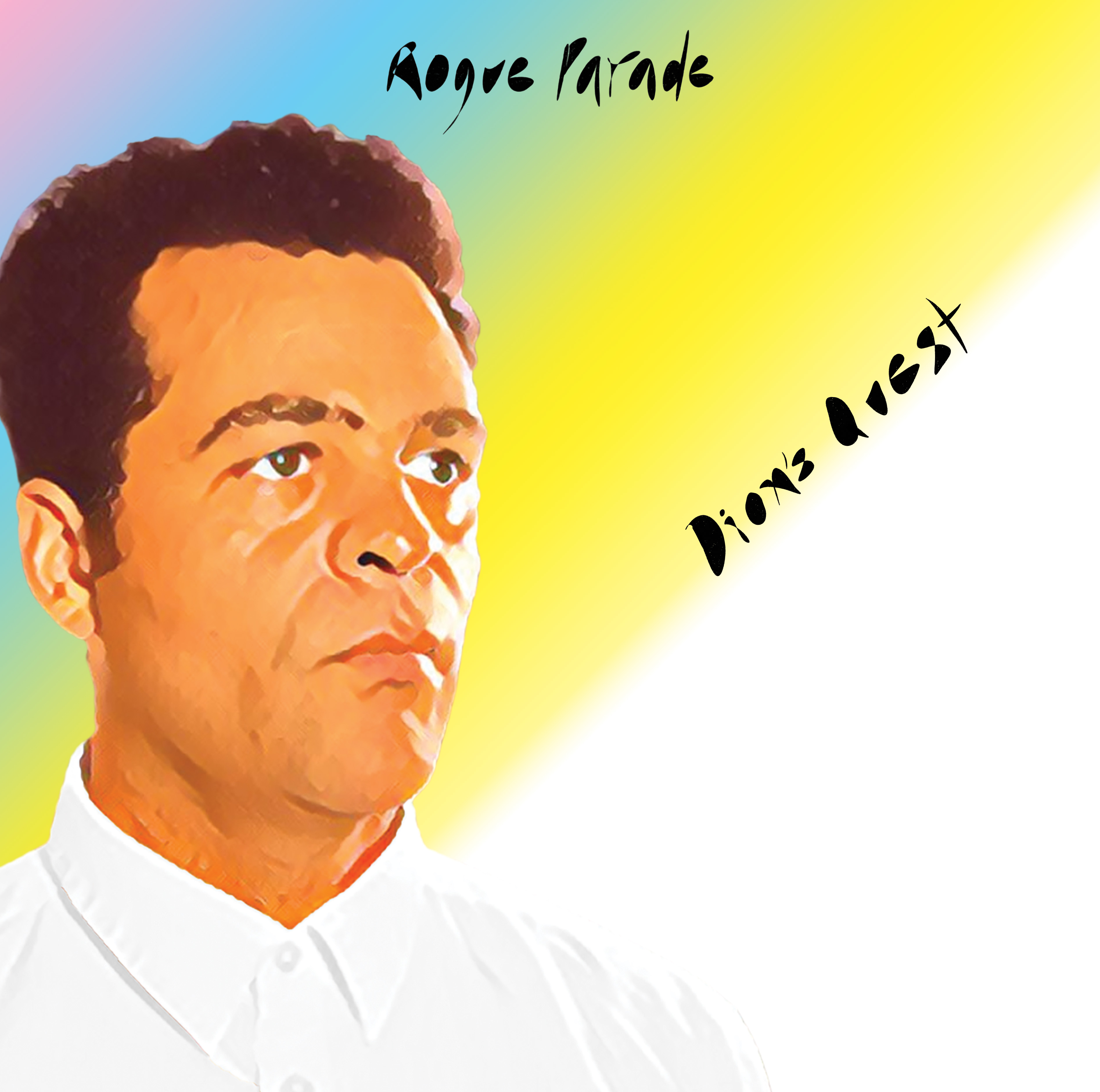
CD Review: Greg Ward's Rogue Parade - Dion's Quest


Greg Ward's Rogue Parade
Dion's Quest

Some of the tracks on Dion's Quest, the second release by Greg Ward's Rogue Parade, were inspired by dark subject matter, like the COVID-19 pandemic, the murder of George Floyd and the 2020 elections. But before he gets to that, the alto saxophonist begins in an upbeat mood inspired by people he met on a visit to South Africa, whose kindness left an impression on him long after he returned home. "Crimson Clay" is a 6/4 jaunt with Ward and guitarist Matt Gold  in unison while guitarist Dave Miller plays a rhythmic countermelody before taking the first solo. The complexity of Ward's solo, put against the chord pattern different from the first half of the song, begins by sounding like a detailed, written part. But as he liberates himself from the rhythm section, it becomes clear that this is a spontaneous statement.

The mood that Rogue Parade establishes with that track, and the use of two guitars along with the alto, give the group a signature sound. It seems to gather elements from the trebly twang of spaghetti western guitars and intricate post-fusion picking. The former style comes into focus on "Noir Neauveux," where bassist Matt Ulery alternates bars of 5/8 and 6/8 and still keeps it catchy, while Gold and Miller create a high lonesome feel. Ward's long high notes and unison with Gold help set the sun-drenched scene. The bluesy coda wraps things up in a slinky feeling. (Anyone who remembers Wayne Horvitz's Bring Yr Camera album with the group The President will devour this mesh of styles.)

Ward is no stranger to intense subject matter, having been part of Mike Reed's excellent and underrecognized Flesh and Bone, inspired by Reed being trapped in the middle of a European white power rally while on tour. That being said, "Blues of the Earth" offers a musical statement on the Floyd murder and the 2020 elections that might not address either issue directly but it presents some barbed statements, from Ward's opening growls and pops to Miller's manic guitar solo. At the end, it goes into a "Mannish Boy" riff, so it does earn its blues moniker too.

After a few more thoughtful tracks (the harmonically-driven "Bravo Constatine" and "Porthole Dreams," a brief rumination inspired by isolation during the pandemic), "Beware of the Oh EEEs" begins with some guitar clatter that eventually straddles detailed post-rock picking with some wailing from the leader. After hearing the way James Brandon Lewis fit in so well with the Messthetics, this tracks proves Ward's Rogue Parade might be forging an equally righteous path, where visceral attack and sprawling melody lines converge. 

Drummer Quin Kirchner, who can often be heard playing in freer settings, exerts his authority here, playing a little more laidback but definitely driving the music along. At first, it sounds like he and Ulery sat out the closing "Ocean of Faith," leaving Ward, Gold and Miller to explore the rubato melody. But it becomes clear after awhile that bass and drums are there, gently but effectively pushing things along. Maybe its my ears always hearing a connection to some remote song, but a chord change toward the end of each "Ocean of Faith" chorus hints at the hook of Louis Armstrong's "What A Wonderful World," giving it a deeper connection to a message of hope that Ward had in mind. 

With that, Ward has created an album that ought to end up high on the Year End lists. 

Wednesday, May 03, 2023

A Little Bit of Me, A Lot of John Vanderslice

The second part of this blog post should have been written sometime last week, preferably at the start of the week. That was not to be, because of what I'm going to talk about first. 

This past Saturday was the double record release show for an album by my band the Harry Von Zells, and a split single by Creedmoors and Pink Gin Marimbas. The days leading up to the show were filled with rehearsals, when I wasn't working the closing shift. The latter two bands also made their performance debuts that night, since the songs on the single were the work of solo artists in their basement. Now they are real bands. 

The Harry Von Zells haven't played a show since October 2021, which is right around the time I started recording tracks for the album. As I've mentioned in a few previous posts, I was sort of at the end of my rope around that time, feeling like maybe it was time to stop trying to get band practices together and to stop booking shows, two things that didn't always reach their potential, with or without the looming pandemic. But I was determined to get some songs recorded so even if I never performed live again, the songs wouldn't just evaporate into the ether.

Turns out the songs sounded really strong. Further, when you make a record, it's a good idea to stage a release show so people will know about it. and maybe buy it. The Harry Von Zells got resurrected with a lineup that is still solidifying. But the original four of us also played together on Saturday too, and it felt good. 


Before we played, Creedmoors opened the show. The center stage guitarist, Joe Tarowsky, is the one responsible for the single, "Rosie Jean," and a few other cool songs that can be found on Bandcamp. Mike Athey is on bass. Erin Dawes (who played with me in the Love Letters) is on drums and Tammy Wallace is on guitar. (A link to the music is below.) They sounded really tight, and when all four of them sang it once, it felt like a choir. Beautiful stuff. The surprising thing is the band came together really quickly, in a space of about two months. 


Pink Gin Marimbas played next. I don't have an action shot because I'm part of the live version of the band. (In case you don't know, I'm the second from the left). I play drums for them, though it's not my usual instrument. Rob Rayshich (far right, guitar) did the recording and his adult kids Max (far left, guitar) and Charlie (keyboards, main vocals, second to right) round out the band in person. I too was wearing a pink shirt during our set, but switched out for the Harry Von Zells set. This photo was one of our candid, outtake shots, outside Government Center, the record store/live space/coffee shop/bar where we played. 


Creedmoors and Pink Gin Marimbas can be found here. Please give both of them a listen and maybe take a piece of us home with you.

I don't particularly feel like reporting on the Harry Von Zells set because it's my band. What I do feel comfortable saying is that the turnout at the show on Saturday really blew me away. Government Center isn't a huge place but it's not tiny either, and the place was packed, even before things started. It was so great to have so many people come out for the show, especially folks I didn't really know who were friends with the other bands and who hung around the whole night. That really felt good. 

While I don't want to talk get indulgent about the band itself, there is one song of ours that could use a little explanation and will act as a good segue into the second part of this post. Back in the early 2000s, John Vanderslice released his album Cellar Door and I listened to it constantly. Several years earlier, my band the Pundits opened for John's band MK Ultra, who I really liked. I had heard some of John's solo albums and thought they were good, but Cellar Door really blew me away. It was full of stories about people who were just on the brink or weren't tightly wound and the blend of lyrical plots and music was great. I still think it's one of his best albums. 

Somewhere around that time I decided to write a song about a guy who's obsessed with a musician, and I wanted it to sound like a John Vanderslice song. As I wrote it, I created something like a story arc in my lyric book. The first verse came pretty easily but I had to figure where it would go from there. And I also had a chorus ready, with the first line: "But now I'm cold/so cold from crying..." 

Nothing creepy happens in the song. It's more about building up expectations way too high about how things will go, only to see them fall apart. 

But, to be clever (at least in my mind), I titled it "Dear John." Even though the musician in the song could be anyone.

When John Vanderslice played a show in Pittsburgh recently, I pondered telling him about the song. I didn't have the records in hand yet, or else I would have given him one. But I couldn't do it. He was so warm and friendly to everyone that night, very appreciative that we were all there, so I couldn't jeopardize that good feeling. I mean, he told me loves me. And he wrote that on an album I bought from him. 


When Vanderslice tours, he doesn't play clubs anymore. Instead, he's part of a network of acts that play house shows. The last time he came to Pittsburgh, he played a house in Greenfield, a really residential 'hood very close to where I grew up, which is funny because the dudes in that area would've beaten up guys like John or me (we're the same age) if we looked at them. 

On April 22, he played at the Bantha Tea House which sometimes hosts shows, but the aura felt similar to a house show: a small (maybe 30 people) but attentive audience, who all seemed to know his songs. (It really sounded like people were singing along at various times.)

Storytelling was as much a part of the show as the songs. In fact there might have been more talk than rock. Before the set started, he asked the audience to submit questions on slips of paper, which he would answer throughout the night. But John is a great talker anyway so the heavy talk ratio didn't really matter. I would have preferred that he didn't ask the management to turn off the ceiling fan about 20 minutes into the set, because it got a bit stuffy after awhile. But not stifling. 

Bantha has a piano that is reasonably in tune, so the evening started with "Farewell Transmission," a tender ballad from the Pixel Revolt album. From there, he stuck to his acoustic guitar for the rest of the night, never needing a microphone. The set list spanned a wide gamut of songs, which makes sense because he's released a lot of albums (counting live albums and remixes, the number is around 13). 


Vanderslice only played one song from his newest album, Crystals 3.0 because, presumably, it's the only one that can be recreated with just an acoustic guitar. A lot of his work over the past 10 years has veered away from indie rock (if you can use that label for Vanderslice's songs) toward more electronica. Some of the stories he told between songs tackled that subject, pointing out how hip hop and electronica acts often release several things in the space of a year while indie bands take forever to make decisions and obsess over how much effect to put on their guitar in the studio. "Bands are in a stylistic prison," he said. He admitted that in 2013 when he was trying to work on a new album, he couldn't come up with anything when approaching the music as more straightahead rock (my term, not his). When he started using more electronics, things took shape. 

He also talked about being interviewed on the TrueAnon, a politics podcast, with a left-wing analysis, or as its creators put it, "a show about your enemies made by your friends." Vanderslice explained how, when being interviewed, it's easy to put your own spin on a story to keep it interesting, which gets spun even a little more when a producer shapes that interview into a story. 

Throughout the evening, Vanderslice came off as a guy who still gets excited about things on a regular basis. About a week before the show, someone broke into Tiny Telephone, the recording studio he runs in Oakland, California, and a lot of equipment was stolen. As he talked about it, Vanderslice focused less on the shock of the robbery and more on how touched he was that so many people rallied their support online to help the studio recover or try to find the equipment. That support seemed to give him the motivation to continue the tour and not go home to try and deal with the loss right away. (In the week since that show, Jack White alone donated $15,000 to a gofundme campaign for Tiny Telephone.) 

Vanderslice also seemed eternally grateful that we were there for his show. (Things were supposed to end after 75 minutes, but when he finally called it quits, he had been going for nearly two hours.) He tried to pass on his positive disposition too, espousing things like the pleasure of packing a peanut butter sandwich and a thermos of coffee and going on a 10-mile hike. 

And then there were the songs. "Exodus Damage," his first person tale about a fragile character who is caught up in 9/11 conspiracies and devoted to another such believer; "When It Hits My Blood," a tale of someone with bad habits; "Too Much Time," which always seemed like his closest shot at a pop hit. 

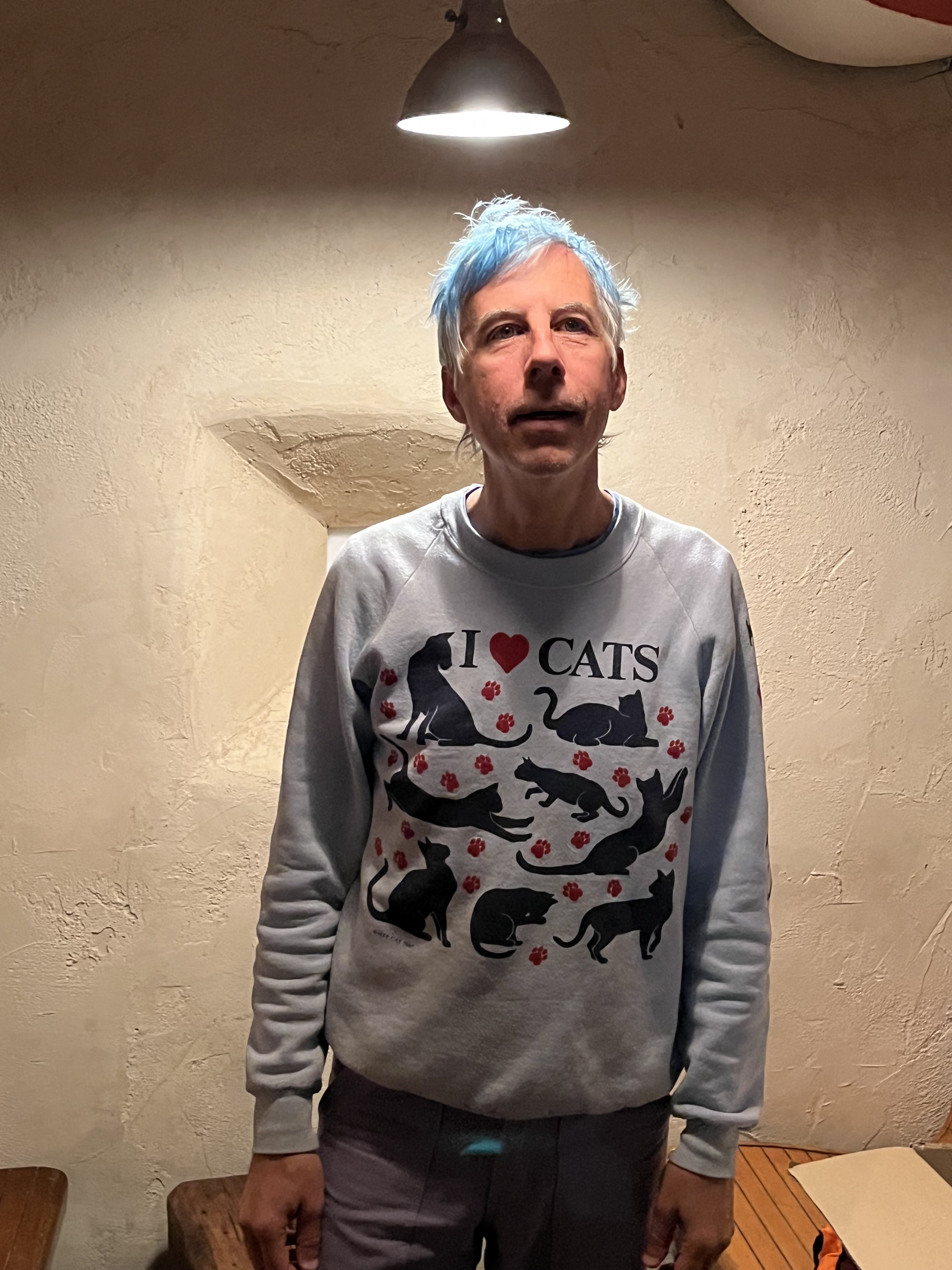
After the set, he worked the merch table, giving everyone time for chatting and pictures. I took two because I wanted make sure "I Love Cats" was legible in one of the pictures. 


Thursday, April 20, 2023

Out Of Town Music Visitors (And One Birthday)

I don't particularly like the phrase "photo dump." Aside from the scatological connotations of one of those words (despite not having used that phrase in several decades, it still haunts me), there's the notion that a bunch of photos are just being discarded, like they don't mean anything; you figure it out. So there is no dumping going on here. Instead, I give to you some rather overdue photos from a couple of live shows from the past couple weeks.


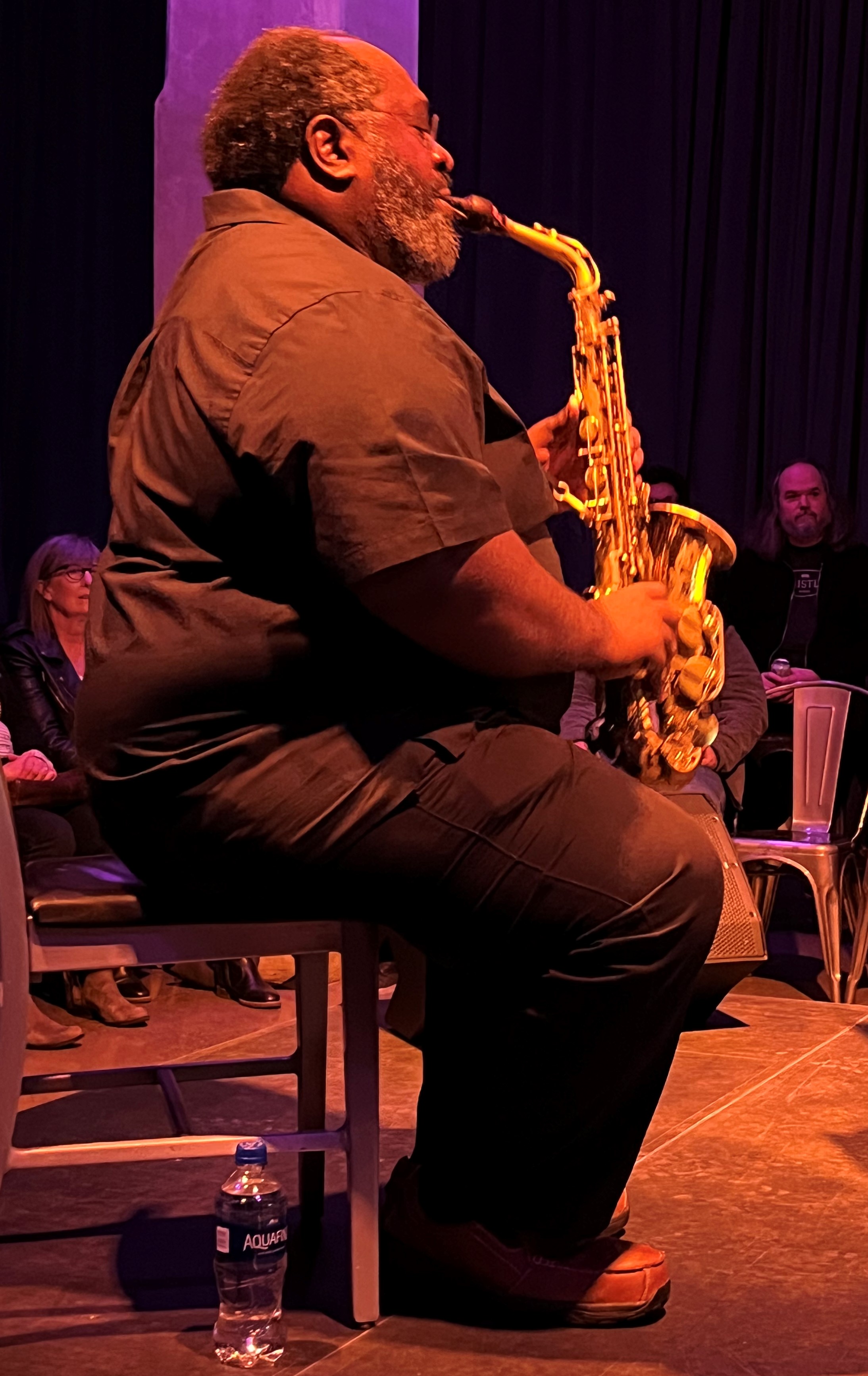
Darius Jones (alto saxophone) and Amirtha Kidambi (vocals) performed in the lobby of the Andy Warhol Museum on Thursday, April 6. Despite having a theater with excellent acoustics, the open space in the entrance has been reformulated, acoustically, for live performances and has hosted several, dating back to pre-pandemic days. The sound in the high-ceiling room can accommodate both electric and acoustic performers (and probably more audience members).

Jones and Kidambi performed a set of pieces that incorporated the writings of Sun Ra, in this case the literary works of the philosophical bandleader/composer. With just the two of them onstage, face to face, the set was of course a bit sparse but they filled the room with sound. Jones is one of the most unique alto saxophonists around, with a strong tone and a mind that can shift rapidly from extended technique to rich, flowing tones. Kidambi uses her voice like an instrument, often singing percussively, or toying with words and phrases. This was clear at the start of the set, as both players held long tones, starting things off in a bit of suspense about what was to come.


The duo really dug into the work, with Jones adding heft to Kidambi's recitation of Ra's words. The saxophonist, who has released solo albums of his own, sounded exciting during his solo flights and fit perfectly with his partner's performance. I'm rather particular about improvising vocalists, or those who sometimes approximate with their voice what free improvisors often do on their instruments. Kidambi is a skilled artist, who has done strong work with her own group Elder Ones and Mary Halvorson's Code Girl. But sometimes the repetition of key phrases, delivered in various dynamic ways or in occasionally shrill blasts, didn't stick, feeling instead just a little abrasive. 

Between that show and what follows, Pittsburgh saxophonist Ben Opie celebrated his 60th birthday on Friday, April 14 at Con Alma Downtown. I arrived later in the evening, coming straight from work, but caught a little bit of Ben's Thoth Trio + a few friends. I was too far from the stage to get a decent photo (though a friend sitting next to me had the smarts to take a photo of the mirror behind us, to get some good, reversed images). 

After Ben finally took a set break (he had been playing all night), Bombici got up to play. In a lineup that apparently that reunited their original personnel, the group played an exciting blend of Balkan ethno-fusion and Romani music that featured some strong improvisations over grooves in time signatures that were too loopy to count, and that are best enjoyed purely for their sound. Not to mention the tight delivery of the band. Happy belated birthday, Ben. 


This past Sunday, Chicago saxophonist Ken Vandermark finally made it back to Pittsburgh. (He was supposed to visit back in March 2020 and I even wrote a preview piece for that show.) His return also marked the performance debut of  Edition Redux, a group of what he described as "pretty fucking good musicians."  Along with Vandermark (tenor, baritone saxophones, clarinet), it featured Lily Finnegan (drums), Erez Dessel (keyboards) and Beth McDonald (tuba, electronics).   


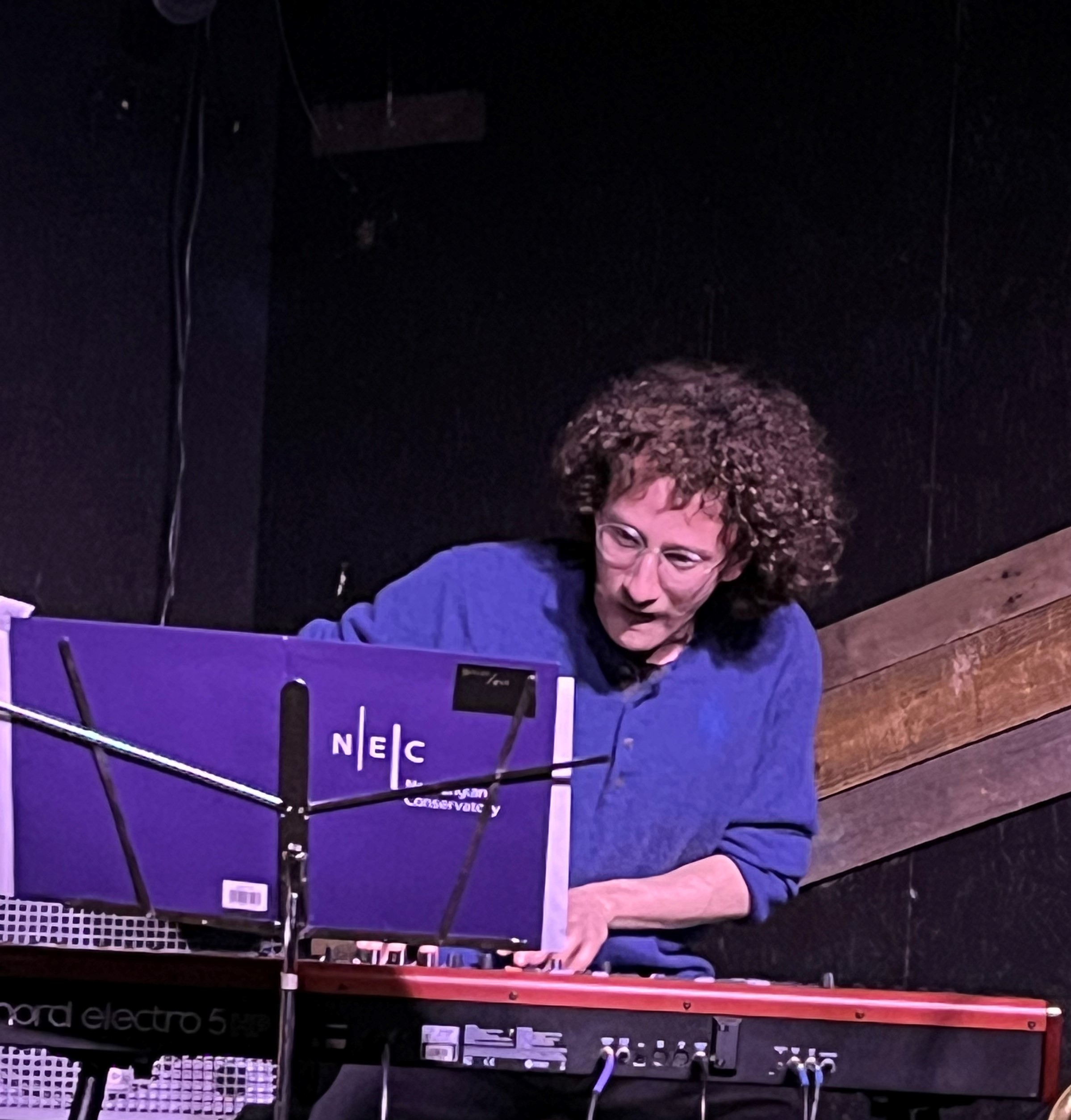
The quartet's two sets combined spastic free improvisation with marches, 7/8 ostinatos and a little bit of uncertainty with an ending or two , which gave it more charm. Dessel could barely contain himself in his set, hulking over his keyboard, hammering on it aggressively but also getting some cool Fender Rhodes sounds, which thickened up the sound.


McDonald used her tuba to commingle with Dessel's low-end grooves but it also worked as a second voice, closely with Vandermark. In set opener, "Go Back To Your Jacket," she proved she was no ordinary tubaist by striking her mouthpiece with the palm of her hand, creating a sound that got looped and rolled around on the stage as the piece took shape. Later in "Aperto," a piece by Julius Hemphill, her solo sounded both funky and vocal.

Vandermark sounded a little understated in the first tune, but when the time came, his tenor playing breathed fire. Many times, he switched between saxes and B-flat clarinet, to the point where it was hard to tell if a piece had evolved into a new section or the group was playing a new composition. (It was always the former.) It was great hearing him on baritone again, and "Summer Sweater" delivered some great slap-tongue pop and growls.


While everyone in the band sounded top-notch, drummer Lily Finnegan nearly stole the show, to use a tired cliché that feels true in this case. Her moments of free playing had the kind of forward momentum that makes this music really exciting, with percussion grabbed mid-play and used on the drum heads. But she could also hold down a groove that felt fierce. When she and Dessel broke off into a free duet in "...Jacket," they looked like total opposites, him going wild and her remaining calm and collected. Yet, they still worked together to start a fire. Finnegan has no releases yet under her name, but it's best to keep her in mind and look forward to the day that she does. 

This show took place on a Sunday night and started at 9 pm, which was probably a deal breaker for some people. That might explain the small turnout, which of course didn't deter the enthusiasm of the performers. For this listener, the start time was ideal. Plus, Ken didn't keep us out to all hours of the morning. 

Wednesday, April 12, 2023

Tomas Fujiwara's Triple Double - March On


Tomas Fujiwara's Triple Double
March On

A set of outtakes from a previously released album often connotes alternate versions of what appeared on the previous release or music that, for any number of reasons, didn’t make the cut the first time around. March On, a digital-only follow-up to Triple Double’s March, has a little of both of those qualities, but they’re executed in a different way. 

Lead by drummer Tomas Fujiwara, Triple Double lives up to its name with three instruments played two musicians each: drums (Fujiwara, Gerald Cleaver), guitar (Mary Halvorson, Brandon Seabrook) and trumpet/cornet (Ralph Alessi, Taylor Ho Bynum). Three tracks consist of brief improvisations edited from alternate takes of two different March tracks. “Smoke” and “Silhouettes” lift fragments (one lasts 45 seconds, the other 1:13) of guitarists Mary Halvorson and Brandon Seabrook playing duets in “Silhouettes In Smoke” and uses them to bookend this EP. “Smoke,” the opener, builds from a single note and feels prettier, while “Silhouettes” closes the disc in a foreboding mood, coming across with the tight brevity of a film cue. “Docile Fury Duet” (from “Docile Fury Ballad”) features Seabrook skronking all over his axe while Bynum wails and growls in the background. 

The title track comes acts as the centerpiece of the release. The group recorded this extended track of free improvisation, which Fujiwara planned to cut into interludes between the proper tunes on March. The results of the 31-minute performance convinced the drummer to keep it intact. His feeling is understandable because it presents a good example of how group improvisation can work. No one steps on their bandmates’ feet. One horn executes a low growl, while the other wails high. The drums stir up a brew together. After Seabrook bangs out a rough chord, Halvorson does the same, with a clean tone for contrast. Even when things get chaotic, a sense of fun carries it. Things even settle down for a gentle moment halfway through, giving everyone a chance to listen to the space before proceeding. And the energy continues.