Monday, January 28, 2019

What I Heard at Winter Jazz Fest 2019


Yes, I was really there. I spent a whole week in New York, arriving Sunday evening January 6 and coming back to town the following Sunday. At the beginning of the week, Jazz Congress took place for two days at Jazz at Lincoln Center. Winter Jazz Fest had kicked off during the previous weekend, with a few stand-alone shows happening, eventually leading to the two-day blitz of performances at a dozen venues around the Village, all accessible on Friday and Saturday (January 11 & 12) to those who purchased a two-day pass.

Pittsburgh Current published my report on Jazz Congress and the background of Winter Jazz Fest on their website, which can be found here. This blog post will focus on the events that I attended during the week, getting into a little more detail about the performances. 


First, a report from Jazz Congress 2019. Jazz, Swing, Race and Culture proved to be a pretty thought-provoking panel with (left to right), pianist Myra Melford, bassist Christian McBride, panel moderator Andre Guess, trumpeter Wynton Marsalis, drummer Terri Lyne Carrington and trumpeter Nicholas Payton.
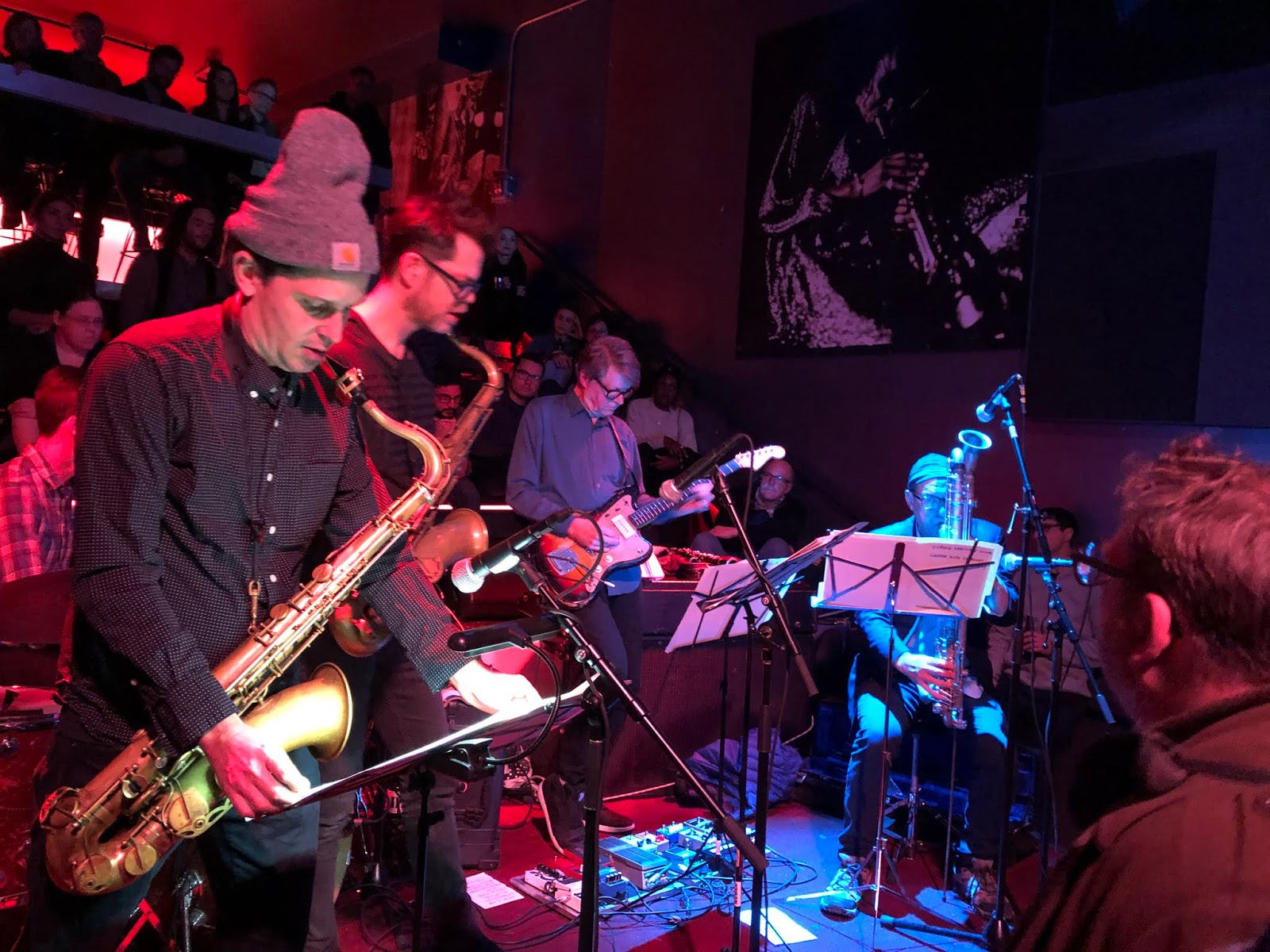

That night at Nublu 151, clarinetist Ben Goldberg lead a quintet through music that came predominantly from his album Unfold Ordinary Mind. Guitarist Nels Cline and drummer Ches Smith both appeared on the album and at the show. The lanky, bespectacled guy on tenor sax looked kind of familiar but I couldn't place him at first. Then Goldberg announced him as his longtime friend Donny McCaslin, who has become well-known over the last year for his performance on David Bowie's swan song Blackstar. John Ellis was the other tenor player, seen here in the foreground.

Like Unfold Ordinary Mind, this group had no bassist, with the low end coming, rather ingeniously, from Goldberg's contra-alto clarinet. The set had a lot of sonic adventure moving playing out over some strong rhythmic foundation. There were canons of drones, and moments where Cline seemed to question the 4/4 beat of the tune and attempted to rip it apart. In my notes, one scribble described a dirty 6/8 descending line as the Beatles' 'I Want You (She's So Heavy)' at church."

Tuesday night, following the final panel talks at JALC, the lobby of the fifth floor auditorium was mobbed with people there to hear a tribute to the last trumpeter Roy Hargrove. This show was free to the public so everyone in town was there. I quickly gave up on the attempts to find the end of the line, which curled around a corner and reversed at another auditorium door. It was a wise choice since the whole concert was broadcast over the jumbo-trons in the lobby with very high fidelity. And the whole thing went on for about four hours. Emcee Christian McBride said there were about 200 people backstage, ready to honor Hargrove's memory and talent. Being able to move around made it more relaxing. (Plus, there was a Whole Foods beneath the building, so that Team Member discount came in handy.)

Wednesday night was an adventure, traveling out into Brooklyn to a venue called Brooklyn Steel to check out Medeski, Martin & Wood, who were performing with Alarm Will Sound, the 18-piece ensemble (one might say "orchestra" since they have a lot of strings). The first few nights I'm in New York, it usually takes me a while to figure out which direction to take when I'm traveling. That was the case on this evening, when I headed south instead of north, only discovering that after about 15 minutes of walking and umpteen checks of the map on my phone. Duh. 

Pittsburghers will understand this comparison: Brooklyn Steel is comparable to Mr. Small's Funhouse - if it were multiplied about three times. This cavernous venue was once a steel manufacturing plant and now boasts a capacity of 1800 and lot of open space - which you can't really see when you arrive at the end of the first set, when the room is dark and there are hordes of people clustered right inside the performance space. The only perk of getting there as the first set concluded was being able to stake out a spot before the music started up again. Of course I ended up sitting to the left of Dude who texted the whole evening, just a few feet behind a gaggle of music geeks who yelled encouragement to the band all night. 

MM&W started set two by themselves. John Medeski hit a funky, dirty groove that drove the crowd wild. I was yearning for an extra chord or two in there, but about ten minutes into the groove, the trio took it out into free territory, which made up for the repetition. With Alarm Will Sound, they played music from their collaboration album Omnisphere. Some of it lumbered a little, getting a little too locked into a 7/4 riff in some points, but the voicings were often pretty compelling, setting things like strings, bassoon and tuba against Medeski's keys. 


On Thursday, alto saxophonist Gary Bartz celebrated the 50th anniversary of his album Another Earth by playing it in its entirety at Le Poisson Rouge. Beginning the set auspiciously with a reading of the "Star Trek" theme (which wasn't part of the original album) Bartz lead a quartet of guitarist Bruce Edwards, bassist James King and drummer Nasheet Waits (whose father, Freddie, played on the original album) through some brawny, two chord vamps that had the room in a frenzy.

Things really picked up though when the group was joined by tenor saxophonist Pharoah Sanders and trumpeter Charles Tolliver, who both appeared on the original album. Sanders moved slowly around the stage and sat when he wasn't playing, but he was in excellent form, unleashing some of his signature wails. As great as he sounded, Tolliver nearly stole the show, playing with fire and imagination that makes me wish that we'd hear from him more often.


Wristbands were available for pick-up Friday afternoon, so after getting mine at SubCulture, it was time to head back to LPR for the start of ECM Records night. First on the bill was Michael Formanek's Very Practical Trio. The sound fits the group as the bassist's bandmates are guitarist Mary Halvorson and alto saxophonist Tim Berne. The trio, which was leaving for a European tour the next day, didn't announce more than one song title but some of the early ones sounded like Berne compositions: long flowing melodies with some intervallic leaps. Formanek started one piece with long line, while guitar and alto played together on top of him. Then Berne added another counter melody that had the delicacy of a flute, if but for a moment. Can't wait for the album.


Following a quick dash for dinner, I made it back in time to see trumpeter Ralph Alessi and This Against That. I just reviewed their new ECM disc so I was familiar with the set. Still seeing it live was great. Alessi can play anything from warm and lush to shrill and vicious. Ravi Coltrane has a great rapport with him on the album and onstage, but the whole group (bassist Drew Gress, pianist Andy Milne, drummer Mark Ferber) all moved together. When Coltrane switched to sopranino for the closer "Melee," he began with short phrases, extending them gradually and even getting a sound out of that sounded like a backwards recording. He and I talked a bit about this instrument when he was scheduled to come to the Pitt Jazz Seminar in 2017. Any reluctance he felt for that tiny horn seems to be a thing of the past.


You can't see everything at Winter Jazz Fest. Over at the Soho Theater, the Messthetics - guitarist Anthony Pirog & the Fugazi rhythm section of Brendan Canty and Joe Lally - had just wrapped up. But up next was guitarist Miles Okazaki. In the wake of releasing his album Work: The Complete Compositions of Thelonious Monk, Vols. 1-6, he played a set that a friend called "Monk In a Blender." Beginning with "Crepescule with Nellie," Okazaki stitched together numerous Monk tunes, many of which made sense next to each other, with similar twists or patterns, while others digressed. "Well You Needn't" (sounding taut and accusatory), "Skippy," "Four In One," "'Round Midnight." It wasn't a mere show of his Monk knowledge either. This extended piece, which frequently returned to "Crepescule" as a touchstone, was put together thoughtfully, in a way that proves that not only does Okazaki know the tunes, he's gotten inside them.

Crystal Palace is gin that I discovered as poor college student in the '90s. A liquor store employee could tell I wanted something cheap so he handed the $5.99 bottle to me. As of this evening, 28 years later, it's still the same price at the store. I mention this because Zinc Bar poured that brand of rotgut into my gin & club soda (my drink of choice). And they charged $11 for it. However it was damn strong, so down the hatch it went.

Zinc Bar is an intimate space with a narrow bar along the left side of the room, with the stage at the far end, and tables lined up in front of it. If you get a seat, there's a one-drink minimum. Since I already ordered my usual libation at the bar, I opted to stand back by the line separating the spaces while Avram Fefer's Calling All Spirits Trio started to play.

If Ben Goldberg's set had been the one to reinforce the feeling that I was in a new city at a festival and that the magic had started, Fefer's set was just what I needed as Friday evening started to wind down. His tenor and alto playing were both energetic, with playful melodies and wild solos. Bassist Michael Bisio and drummer Michael Wimberly helped him lift the bandstand, ready to fly off at any point, though they waited, boiling under, for the right moment.

Tomas Fujiwara's Triple Double was up next, starting a tad later than the 1:20 a.m. slot listed in the schedule. Many people my age would lament that a show would continue at such a gawdawful late time, but this added to the fun of the evening. However, the second drink was catching up to me and I thankfully didn't go for #3. Two drummers (Fujiwara and Gerald Cleaver), two guitars (Brandon Seabrook and Mary Halvorson, in her third show of the night) and two trumpeters (Taylor Ho Bynum and Adam O'Farrill) put on a great set that got loose but never lost its focus.


Seeing either Vijay Iyer or Craig Taborn perform solo would make an amazing set but the two of them together can really make your brain melt. That was how Saturday started with Night 2 at the ECM showcase at Le Poisson Rouge. The duo, who played together in Roscoe Mitchell's Note Factory and probably other times as well, moved like one brain. While Iyer crossed hands over the keyboard, Taborn played countermelodies several octaves apart. When one locked into an ostinato, the other took a solo and then - with little time for a formal transition - they switched roles. One movement, if their performance could be described as a set of movements, flowed into the next. The picture above was taken during the final quarter of their set, after they switched pianos. Up close, Taborn appeared to take a more visceral approach to his instrument, leaping all over the keys - and he kept that up even when he had his legs crossed.

One good thing about Winter Jazz Fest is their website kept an accurate account of what venues were at capacity and which still had room. Sadly, Nellie McKay's show at the Greenwich House Music School was filled a couple hours before her set. Much as I wanted to see it, my friend Erica suggested SOB's where Anteloper was playing. It was a solid consolation - and the loudest set I had seen all week. (MM&W had nothing on this duo.) 

Anteloper consists of Jaimie Branch (trumpet) and Jason Nazary (drums). Both also dabble in electronics. In fact, Nazary spent a good portion of the set playing his trap kit with one hand and twiddling knobs with the other. Branch also had some sort of keyboard and bank of electronics too. Their sound nearly made Miles Davis albums like Agarta sound tame by comparison. Sped up samples crackled through the p.a., accompanied by seizure-inducing strobes, with Branch adding some rich long tones on top. Occasionally, those trumpet sounds returned in loops. A set like this might be labeled non-jazz by some people, but it certainly set the brain throbbing.

Over at Sheen Center, which was near capacity, the audience was getting seated for a set called "Impressions of Pepper Round Robin," inspired by a new compilation on Impulse! called A Day in the Life: Impressions of Pepper and round-robin turns at improvisation. My tolerance for tributes like this, and really anything involving the Beatles and jazz, is limited but I thought I'd check it out. Liberty Ellman's variations on "With a Little Help From My Friends" sounded nice, as did David Virelles' piano spot, on which trumpeter Keyon Harrold joined in. But it wasn't clear everyone was going through the album, song by song, which turned it into a distraction. Besides, my heart was into another show at another venue, with another fairly lengthy walk coming before it.


Jon Irabagon's album Dr. Quixotic's Traveling Exotics made it onto my Top 10 list of 2018 so the chance to hear this group live pulled me back to the Soho Theater. Instead of an acoustic piano, Luis Perdomo played a Fender Rhodes, which made things funky but fiery. He and bassist Chris Lightcap held the music together while Irabagon and trumpeter Tim Hagans went off. Drummer Rudy Royston gave the music a solid swing but he played like he wanted to add another level of complexity to the music. It only made Irabagon play more furiously, even when he was ripping into the changes of "All the Things You Are," which is retitled "The Things" on the album and combined with his own "Emotional Physics" a term which epitomizes the fire this group started.

Upon meeting Lightcap after the set, I found out that he grew up in Latrobe, PA and knew all about Pittsburghese, which we bantered about back and forth for a bit. Irabagon convinced me that I should indeed try to get into SubCulture to see JD Allen and David Murray, despite the WJF site saying it was filled to capacity. I took his advice, made the walk and got in...just in time to hear them leave the stage.

Much as I wanted the excitement to continue, I had a bus to catch the next day and since the subway I needed was right outside of SubCulture, I took it as a hint to get to bed. So it felt appropriate that Winter Jazz Fest 2019 ended for me in a flood of Pittsburghese and a discussion of Donnie Iris' "Ah! Leah!" As I said in the Pittsburgh Current article, the further you get from Pittsburgh the closer it seems.


(I waited until I got home to cut off my wristband.)

Friday, January 11, 2019

Breakfast Near a Beatle or How I Met Sir Paul in a New York Diner

Everything does NOT happen for a reason, but being at a certain place at a certain time can have an impact on a person. Sometimes it's good to just roll with things. I found that out yesterday.

I've been in New York since Sunday night. Monda and Tuesday were the two days that the conference known as Jazz Congress took place. Winter Jazz Fest officially started last weekend and there have been a few days of shows already that I've seen. The big, multiple shows/venues night kicks off tonight. I'll be writing about that for Pittsburgh Current so stay tuned. For now, there's another story to tell.

Wednesday, my wife and son came up to meet me. During the days, we're checking out museums and at night, they're whooping it up in a hotel while I go to hear music. Yesterday, we decided to check out a diner called the Lexington Candy Shop, because we liked the name. As we were leaving, I looked it up on a map. We're at 56th and Lexington. It was at the corner of Lexington and 83rd Street. That's a walk, I thought, but why not. Towards the end of the journey I realized there was a subway that we could've taken, which would've gotten us within a few blocks of it. But we got to check out the storefronts and the general populace of the Upper East Side, an area I knew even less than the area with the clubs that I frequent during the festival.

Everyone was a good sport and by that I mean my 11-year old son. In fact, when the thought came up of stopping somewhere else, Donovan said no, that we should keep going.

Finally we got to the Candy Shop which is a tiny, narrow diner with booths going down one side and around the corner. It's a diner from a bygone area, apparently one that's been around since 1925. The nice but no-nonsense waitress seated us and as she said down, my wife Jennie gave me a look. At first I thought it meant, "We finally made it." But she said, "Do you see who that is?" Then she gestured toward the booth behind us, which was kind of wedged into a corner, away from everyone.

And there was Paul McCartney talking on the phone as he ate.

We took all this time to walk up to this place and not only was it as cool and as quaint as I would've hoped, but Sir Paul is sitting behind us. I know anything's possible but that's not something I would've expected on a trip to New York for a jazz festival.

I'm the type of guy who will say hi to artists I like but Jennie is not. But I wasn't about to say anything to this guy, especially while he was in the middle of a phone call. So we just remained calm (outwardly), taking in the whole idea. Plus it was 11:00 and I really needed to eat. I tried to make out a bit of what he was saying on the phone, but it was impossible. Not because he was talking in a thick accent, but just because. It didn't sound all that enticing to the average tourist anyway. Perhaps some dry business stuff.

I have to say that Paul was extremely polite and gracious to the waitress, who was a professional. It was amusing when she came back to the table, telling him the credit card that he had given her needed a PIN to go through. He had to go up to the counter to type it in.

As Paul and the people with him, including I later found out a new wife, were putting their coats on, he turned towards us and I said hi. He asked how we were doing and I said something like, "Great," and little more. Then I went on to tell him we were visiting from Pittsburgh and wanted to stop in. He replied, "We're kind of like the local celebrities here." It felt more like a joke than a serious statement and I felt like I saw the everyday Paul, which I was something I always hoped I would see. With that, he put on his knit hat and they were on their way. No photos, other than one Jennie took of me and Donovan, where you can see a tuft of gray hair popping up behind us. But it felt better that way.

"Who was that," Donovan asked. I told him and he didn't seem exactly blown away by the fact that he had met one of the biggest names in music. Which is fine. We didn't tell him while Paul was there because I didn't know how he would react. As the day wore on, it seemed to have more of an impact.

The waitress asked if we had noticed Paul back there in the corner. She said he's been something of a regular there for years, having started to come in when he was with Linda, who lived across the street.

I've always felt that a meal would be the way to meet "legendary" musicians. If I wanted to get a good interview with, say, John Cale, maybe he would be put at ease if we talked over food instead of talking over the phone or in some office. My breakfast a few feet from Sir Paul isn't exactly the way I imagined that we would meet, but I'll take it.

Monday, January 07, 2019

Getting Back on Track/ Remembering Bart Wise/ Where Am I?

There should have been a 2018 wrap-up here, not to mention a few more album reviews and stories about shows. But...the holidays kept me busy. At the time, I thought they were driving me crazy, but they weren't. It was just business as usual in the retail world. Now that it's over, I'm in New York, getting ready for the Jazz Congress conference which starts in the morning. Winter Jazz Fest is already underway and there's stuff that I'm going to check out, beginning tomorrow night. This post is coming to you courtesy of my friend Sharon's apartment in Astoria. I rode up here on the Megabus this afternoon.

While I missed adding my two cents to JazzTimes' Albums of the Year list, I did get to sound off in the NPR Music Jazz Critics Poll, which was organized by the venerable Francis Davis. The results can be read here. 

But before I move forward with the events of this trip, I start with bad news. My former Bone of Contention bandmate Bart Wise passed away on December 30, after a battle with pancreatic cancer. I was lucky to see Bart back in 2016 when the Bone got back together to play at RePunk 3. It was a momentous occasion not only because I never thought it would happen, but also because both he and Sean Lally were playing in the band. That was the first and only time they were onstage together, Bart having joined the band after Sean left in 1990.

The Bone's first album, 48 Points of View (recorded when Sean was in the band), might still be the most magical one to me, since it fulfilled my lifelong dream of putting out an actual record. But the lineup with Bart (1990-1993) might have been a more creative, fertile period. It's hard to say definitively. We recorded both a single and a CD (Stay Calm), wrote a lot of songs (the ones I wrote were some of the ones for which I'm most proud) and we played the Knitting Factory, one of just a few out of town trips we made.

The thing to remember in all of this was the band was pretty egalitarian. There was no front person. We all wrote and sang. Well, Bart's token song contribution was an instrumental, and he only did a little back-up singing, but he definitely had a hand in the arrangements. But he brought energy and enthusiasm to the band. If Lila, Barb or I had the song ideas, Bart was the one to say, "Okay, let's do it." And that often meant he wanted to run through a song one more time at practice to make sure we were where we needed to be.

After a certain point, we were getting tired of "Barbie Likes to Die," a song from 48 POV that was the closest thing we had to a hit. By the time the record came out, we had been playing it for two years. But Bart had an idea. Rather than adding the occasional guitar skronk to the riff (like Sean had), Bart offered to get out his trumpet, something he knew how to play just enough to add some well-placed blats to the song. Perfect.

There comes a certain time in a band's life when they reach the limit of what they can accomplish without taking a huge leap of faith to take it to the next level. Some bands don't want to do that, preferring to quit while they're ahead or while it's still fun. Sometimes reality sets you straight about things like this. Bart left the Bone when his doctorate studies at CMU began to take up more time and the shows weren't quite as exciting as they once were. I, of course, felt like we needed to ramp things up if Stay Calm was going to go anywhere, but deep down I knew Bart was right. I couldn't fault him for throwing in the towel when you've got all that work coming up for you. Clearly he was on a track because he later did post-doc work and got courted to go for a law degree.

His wife Nancy went to high school with me and we were in marching band together. Funny thing is, she didn't meet Bart until they were out in San Francisco together. They have two kids, a son and daughter. Lila and Barb are probably going to the funeral this weekend. If I wasn't here I'd be there too. The guy were a mere 54 years old. I hope he's looking down at me and helping me follow the right path. Maybe he and Pop Shanley are hanging out. I can only hope. Even when you don't see someone very often, just knowing that they're walking the same earth as you can keep you on track. When they're gone, you can feel the loss.


Saturday, December 15, 2018

Record I Couldn't Live Without: The Rugbys - Hot Cargo; Remembering Pete Shelley

Pittsburgh Record Fest 20 took place last Sunday, December 8. It opened at noon and ran through the afternoon, rather than being an evening event. Since I had to be at work at 2:30, I had just enough time to run in, take a look around and buy a few things.

I've noticed over the past year how the price of used vinyl has gone up, at least in Pittsburgh. Maybe I got spoiled by the low prices that I'd see at Jerry's Records throughout the years that it was owned by its namesake. And I understand the reason for inflation. Running a record store isn't a sure-fire way to make money so if one wants to keep the doors open, the price tag will help with that. But that means the days of finding that the Five dollar blind buy album are long gone. Earlier this year, when I went on my '80s kick, I thought I'd be able to find Submarine by the Catheads in a used bin. Time was when I saw it constantly. (Time was when I owned it too, but wasn't enthused with the whole thing, so I sold it. But that's another story.) Now it's MIA. At least in a brick and mortar place.

With that in mind, events like this one make me go in thinking that I should look for records that I can't live without. I know my listening time is limited, as are the finances, so whatever I buy, make it count.

So when I came across this album, I stopped in my tracks.

I was given a copy of the Rugbys' Hot Cargo when I was in either kindergarten or first grade. In fact, I still have it. It's really scratched but I've pulled it out a few times and tried to ignore the loud pops made by the those scratches that can be felt on the vinyl surface.

The Rugbys initially showed up on my little radar around that same time when I got a box of 45s, also as a gift, probably around Christmas time. They were in a thin box, probably boxed up as a cut-out, designed to make a quick buck. Several of them had the SSS logo from Shelby Singleton Records. The Rugbys were on Amazon Records (with a label design that included a nude woman with long hair covering her chest) but that label was also run by Singleton. The single was "You, I" b/w "Stay With Me" and I loved it. Not only did "You, I" rock, with a nervy stop-start riff, it had some great wah-wah guitar. The final seconds have some of the nastiest fuzz this side of Big Brother and the Holding Company's "Ball and Chain." "Stay With Me" was more of a pop song, but it also had an urgency to it, with drum fills after each chorus that, in retrospect, remind of Moby Grape's "Omaha."

When I got both records, I couldn't read too well yet, because I remember asking someone in the family what the band name was and the song titles. I committed them to memory, but also used the shapes of the letters to help. (Thanks, Sesame Street.)

Sometime later, my mom came home from Downtown Pittsburgh, probably after a visit to the 5&10, with Hot Cargo, a whole album by the Rugbys! (The other time she did this, she brought me the debut of the Hassles, long after they had broken up but before their keyboardist went on to super-stardom as Billy Joel.)  Now I knew their names, who sang and wrote each song and what they looked like. However, I never knew which guy was bassist Mike Hoerni and which was drummer Glenn Howerton since neither of them are photographed playing instruments. They just look on while Steve McNicol plays guitar and Ed Vernon sits at the B3.

That record spent a lot of time on my Mickey Mouse phonograph. I knew it inside and out. I learned that "Stay With Me" wasn't listed on the back cover, but it did appear on the label and on Side one. Though in a reverse of the normal standard, the album version faded out before the roaring climax at the end of the single.

The copy of Hot Cargo at the Record Fair was sealed, and only $12, so I knew I couldn't live without it. Since I brought it home that Sunday, I think I've played at least a little of it every day. Part of this is probably the nostalgia factor, but the band sounds really good. They could fit in on any Nuggets compilation (and they might be on one, for all I know), but they're more than a typical garage rock band. For one thing, McNichol and Vernon, who split most of the songwriting duties, came up with some great music, moving well beyond the confines of three-chord rock. Their lyrics left a bit to be desired but "You, I" is a tense little number. "The Light" sounds slightly Doors-ish, but it uses some sly 4/4-to-6/8 time changes in the verse. During the bridge it makes a change that really takes it from catchy to intense. It's hard to tell if Vernon was going for a soul feeling on "Juditha Gina" but his delivery captures that. The nearly seven-minute "Wendegahl the Warlock" used to scare me a little as a kid, with the eerie organ intro and Vernon's opening shriek, but this could have been a showpiece in their live sets.

Which brings me to the band itself. Presumably they played everything and didn't get subbed out by the Singleton Wrecking Crew. That being the case, these guys are tight. Finally hearing the whole thing on sound system with good speakers and minimal surface noise, Horeni's basslines jump out a little more on "You, I." Throughout the album, he really locks in with Howerton, who sounds like he might have some jazz roots in his playing. McNicol's guitar solos are constructed really well, building up in melody and intensity in a song like "Juditha Gina," leading into Vernon's yell that brings things back down.

So the question lingers - how did these guys sound live? "Wendegahl" could be a long jam out song that got the teenyboppers in Louisville screaming. Maybe they danced wildly to "You, I." And maybe the purists thought they were okay when Hornei stepped up to sing the boogie rock of "Rockin' All Over Again."

A few years ago, I found a video of "You, I" on youtube where Steve McNicol had left a comment. It made me think that maybe I could track him down and do an interview that I'd post here. As I went looking for that video this week, I came across another one with some grainy footage of them lip-synching "You, I" on some TV show. Scrolling through the comments, there  was one that was posted eight months ago: "The guitar player just died last night." Sigh. RIP Steve. Somewhere along that search someone also mentioned that Ed Vernon, who seemed to go by "Eddie" everywhere except on the Hot Cargo cover, had also passed. Maybe Mike Hoerni or Glenn Howerton are out there somewhere.

When I think about how my ears were shaped by music, and what I listen for - harmonies, rhythm, noise, et al - Hot Cargo probably played a big role. I got it at a time when I was really impressionable and I played it enough times to keep it lodged in my brain over 40 years later. Some of the nuances of it could have been second nature ideas that I'd think of when writing my own songs.

                                                                 *

In a similar vein, Pete Shelley's death last week was a pretty big downer, another addition to list that's become too damn long this year. I can remember seeing the cover of Buzzcocks' Another Music in a Different Kitchen in my brother's room when it first came out. (His copied came in the mylar sleeve.) It would be another five years or so before I really heard them, after locking my radio dial to the left side and soaking up music on WRCT and WYEP. The number of Buzzcocks songs seemed endless, and usually pretty high quality. Even the songs that beat a good idea to death (the end of "I Believe," "Why Can't I Touch It," "Hollow Inside") still got me pumped up.

I remember buying a used US pressing of A Different Kind of Tension and trading it for the UK version because I had to have the lyric sheet. Understanding all those contrasts in the title track's lyrics were important. But even without it, the crunch of those guitars was amazing. I used to imagine Shelley and Steve Diggle putting their whole forearms into it as they banged away on the strings. When the guitar solo reaches the high notes in "Raison D'etre," I was slayed every time. The way Pete whined the title of "I Don't Know What To Do With My Life" might you think that even a wordy title like that can sound breezy if delivered the right way.

Shelley's death seemed to effect a lot of far-flung people, if tributes on Facebook mean anything. They were a pop band but they were also a punk band, combining both qualities in a way that didn't water down either of them. When Shelley went solo, he dove into synth heavy music, but "Homosapien" and even moreso on the later, somewhat overlooked "Telephone Operator" and "Many A Time," the quality never waned.

I regret not getting into Buzzcocks' revamped music, as everything I've heard from people say it's also high caliber. Plus the one time they came to Pittsburgh was, according to many friends, one of the loudest shows they had ever heard. Someday, I'll dig into the part of their discography. For now, I raise my coffee mug to Pete and thank him for all the music and the conversations it has sparked over the years. You knew how to bring us together, Pete.

Sunday, December 09, 2018

CD Review: Josh Sinton Predicate Trio - making bones, taking draughts, bearing unstable millstones pridefully, idiotically, prosaically


Josh Sinton's Predicate Trio
making bones, taking draughts, bearing unstable millstones pridefully, idiotically, prosaically
(Iluso) ilusorecords.com

Josh Sinton just came to Pittsburgh recently, as part of Adam Hopkins' Crickets project. Like everyone else in that band, he has a number of his own musical irons in the fire. Earlier this year he released Krasa, an album of vicious solos on an amplified contra-bass clarinet. He has also lead Ideal Bread, the quartet that plays the music of Steve Lacy. The hook, so to speak, with that band is that no one plays Lacy's instrument, the soprano saxophone. Sinton plays baritone, as well as bass clarinet. Both are utilized on this session, recorded with cellist Christopher Hoffman (also a member of Henry Threadgill's groups) and drummer Tom Rainey.

The album has an open feeling while it simultaneously maintains a strong sense of direction. This happens in "Bell-ell-ell-ell-ells." Rainey charts a loose course underneath Sinton's ruminations which initially have a tonal quality that feels like a ballad. For a brief moment he delivers some upper register notes that sound like a trumpet. Hoffman enters and Sinton steps back to give him room, only to reemerge mid-way through the nine-minute track with a riff that sounds like a theme. As it turns out, it functions more as a cue that leads to more interesting transitions.

Sinton has written music for dance and theater and that experience can be felt in the thoughtful "A Dance." Hoffman begins playing plucked cello, crisply getting harmonics to ring in a few spots. When the trio comes together, the cellist alternates between bowing and plucking. Their work nods to Julius Hemphill's trio with cellist Abdul Wadud, but the subdued, probing quality of the work evokes a looser version of Chico Hamilton's early groups. They work in a freer direction without leaving the melodic framework behind.

With the next track,"Blockblockblock," they shift gears. Sinton and Hoffman volley some stop-start blasts between baritone and cello. The action continues into "Unreliable Mirrors," this time with bass clarinet. Again, freedom kicks it off, and the trio presents some fine reasons that this style. With that in mind, the session also includes a couple spontaneous improvs. Rainey, who has recorded numerous albums on his own and with people like Tim Berne and Ingrid Laubrock, plays all over his kit and always seems to have the perfect accents to help the group take flight.

The album's mouthful of a title came about when Sinton created an anagram with the titles of the nine tracks. It shows a devotion to his work that reverberates after the album is done, leaving these inventive performances in mind.


Thursday, December 06, 2018

CD Review: Mars Williams Presents An Ayler Xmas Volume 2


Mars Williams
Mars Williams Presents An Ayler Xmas Volume 2
(ESP/Soul What) www.espdisk.com

A few weeks ago I was thinking about the upcoming Christmas holiday season and getting a feeling of anxiety. For the first time ever, I wasn't looking forward to Christmas. The holiday season, starting with Thanksgiving, has started to become a reminder of family members who have passed away around this time, some in the past, some more recently. Add in the usual stress that the holidays put on everyone - fighting crowds, worrying about getting the right gift or any gift for people, getting everything together for holiday visits - and the whole thing started to become too much to handle.

When this CD showed up on my doorstep, I felt skeptical. Sure, Albert Ayler's music has been placed in different contexts. Saxophonist Jeff Lederer has combined it, to good effect, with sea shanties (on 2016's Brooklyn Blowhards) and fused Ayler's controversial New Grass album with shaker hymns early this year on the not quite as successful Heart Love. But Christmas music and Ayler seemed like a bit close to a gimmick. (Somehow I missed the first installment of saxophonist Mars Williams' fusion of Yuletide carols and tenor shrieks.)

All that changed while listening to it on the way to work. The shift came during the second track, a live performance in Vienna with Williams and a quartet (with trumpet, bass and drums). Vocalist Christof Kurzmann joins them to sing "O Tannenbaum," in a gentle, calm voice. The music begins to take on a deeper significance when Kurzmann goes into two verses of "Red Flag," the anthem of the British Labour Party, which was written on the same melody. (Robert Wyatt recorded in the '80s.) Now the message has moved beyond parties and beautiful trimmings. By adding that extra song, the music also includes the hopes for a better future, something that's been weighing heavily on my mind all year.

Right as that feeling sets in, the group barrels into Ayler's "Spirits" rapidly digging into the folk quality of it and accelerating it. Before long they're seguing into "The Twelve Days of Christmas," which still sounds like an Ayler theme, especially when Williams gets to "five golden rings."

It was at that point that I realized that taking the joie de vivre of rollicking free jazz and smashing it up against Christmas music really makes me happy. It was a nostalgic feeling but one that threw all the sad thoughts and the stress out the window. They are actually playing music that's indeed the healing force of the universe. Or at least in my personal orbit.

One other track comes from that Vienna performance, in a medley that starts with Ayler's "Universal Indians" and concludes with Kurzmann singing "We Wish You a Merry Xmas." The remaining three tracks were recorded in Chicago with Witches & Devils, Williams' Albert Ayler tribute band. This octet gets even more anarchic in the 15-minute "Xmas Medley," like a band of revelers at the holiday party who have had too much spiked eggnog but still maintain their charm. Another of their tracks includes Ayler's "Bells" in between "Carol of the Drum" (aka "Little Drummer Boy"), "O Come Emmanuel" and "Joy to the World." Williams also makes a personal reference, throwing in a quote of the Waitresses' "Christmas Wrapping," on which he played the original sax riff.

Williams himself played a big part in blowing away my personal holiday malaise. He recreates the Ayler sound beautifully, with the raspy tone, heavy vibrato and an energy that his horn can barely contain. And, though some might consider this a minus, the recording quality of An Ayler Xmas gets just a little ragged during the loud, free sections - bringing to mind some of Albert's original ESP records.

An Ayler Xmas Volume 2 , co-released by ESP and Williams' Soul What imprint, is mandatory holiday listening. (Presumably the first installment is as well.) It might not be the best thing to play at the office party but it'll cheer up any free jazz fan who might not be looking forward to holiday festivities. My copy will occupy a special place, right next to my Beatles Christmas record compilation and The American Song-Poem Christmas compilation, which can be read about here.

Tuesday, December 04, 2018

Seeing Adam Hopkins, Pittsburgh Banjo Club, talking about town


The last week got away from me. It began with two features for Pittsburgh Current, which is just hitting the street as I type. This coming Saturday, saxophonist James Carter hits town for a tribute to Rahsaan Roland Kirk. While I'm often skeptical of tribute shows, the subject of this one and Carter, who is really steeped in both the history of music and is dedicated to pushing it forward, is someone who can pull this one off.

I also interviewed Danielle de Picciotto of the duo hackedepicciotto. The other half of that duo is Alexander Hacke, who has been in Einsturzende Neubauten since almost the beginning. Their music is both heavy and beautiful.

You can find both of those stories at pittsburghcurrent.com/category/music/ If you're reading this in town, look for a physical copy at your closest coffee shop or watering hole.

Interviewing, transcribing and writing those articles, along recording my spot for WYEP-FM, happened in the early part of the week. Then last Wednesday, bassist Adam Hopkins came to Alphabet City with his sextet which I suppose has been dubbed Crickets, since that's the name of their CD. (For a link to a story on them, check the last post.)

Someone once said that to find out more about jazz musicians from the '50s and '60s, Miles Davis' Kind of Blue offers a great starting point. By investigating that album and then exploring the careers of the six other musicians on that record, a whole goldmine of jazz history will open up before you. I'm not being hyperbolic by saying this, nor do I wish to compare the Crickets group to the Kind of Blue group, but the same could be said about Hopkins and crew in the context of modern music. It consists of musicians who are all leaders themselves doing creative music: saxophonists Anna Webber, Ed Rosenberg and Josh Sinton; guitarist Jonathan Goldberger; and drummer Devin Gray.

The group pretty much played the Crickets album all the way through. Having listened to it a lot, it took on more depth hearing it come to life just a few feet away. The interplay between the tenors of Webber and Rosenberg stood out more, providing tension through occasionally dissonant blends.  Hopkins, since he had a microphone at his disposal, took the opportunity to build a greater rapport with the audience between songs. Since few small groups feature two tenors, he also joked about using the evening to decide which player would stay in the band based on their solos. Of course both killed in very different ways, Webber during the more aggressive "Mudball" and Rosenberg on "Haven of Bliss," which is exactly how the latter felt, topped off with some fiery tenor wails. Sinton was amazing on both baritone sax and bass clarinet.

Goldenberger seemed right at home with the indie rock foundation of the songs, drawing on a bank of pedals and a small violin bow to add extra clarity to his playing. Gray held things together until the closing "Scissorhands" when he really cut loose, as the horns slowly built up the melody of the song. Hopkins, hidden behind the tall drinks of water in the horn section, worked as the anchor to all of this. Another 75 minutes would have been cool too but for a weeknight show starting at 7 p.m., Crickets gave us plenty.

In an interesting observation, Hopkins told the audience that it would take them a year to find an audience of the size we had here. It sounds crazy because, while it wasn't a dead night at Alphabet City (which charges no cover and only requires advance reservations), it was nowhere near as crowded as it often gets during their Jazz Poetry series in September. As a city resident who has been involved in several pockets of the music scene, it made me wonder that maybe we have it better here than we think.

Or at least, we have a good spot for touring groups that play freer, less traditional versions of jazz. I overheard talk from a few people afterwards about how hard it is to maintain an audience in New York anymore because no one goes out, including musicians who used to be seen regularly at their peers' shows, hanging out, swapping stories and making connections. Here they were in Pittsburgh, doing just that with - get this - a bunch of musicians that moved HERE from New York! Granted they didn't move here because of the greener musical pastures but they certainly had a fresher look of our scene than some others do.

And where do out-of-town jazz folks go after blowing out minds with their music? To the Allegheny Elks Lodge, where the Pittsburgh Banjo Club has their weekly gig! By the time we arrived there, the Club was getting ready for their second set and the shuttle of senior citizens had departed with their patrons. (I'm not making that up. I saw it driving away I parked.) Still it was a good time, even if the banjos were a little under-miked. Incidentally, the Lodge is cash only.

I went home still needing to write an album review for Pittsburgh Current, but  also having an early workday the next morning. That, combined with a PC-sponsored happy hour on Thursday at the dive bar located about 50 feet from my house, ensured that the review didn't get written until Friday morning. Which brings us up to now.

Saturday, November 24, 2018

Upcoming in PIttsburgh

Earlier this week I appeared on 91.3 WYEP-FM, talking about upcoming shows in Pittsburgh. It's a regular thing I'm doing every other Tuesday morning, in connection with my writing for Pittsburgh Current. I finally remembered to give this blog a plug at the end of the bit. So if you are reading this after hearing about it on the radio, thanks for stopping by. Please let me know if you do that by leaving a comment.

If you wound up here by some other reason, here is a link to a story I have in the current issue of PC, about bassist Adam Hopkins, who's coming to town this week. It's an early (7 p.m.) FREE show, so you should come. Here it is.

And here's a picture because visuals always help.


Friday, November 23, 2018

CD Review: Wendy Einsenberg - Its Shape is in Your Touch; The Machinic Unconscious


Wendy Eisenberg
Its Shape Is In Your Touch
(VDSQ) www.vdsqrecords.com

Wendy Eisenberg
The Machinic Unconscious
(Tzadik) www.tzadik.com

Wendy Eisenberg might be the most liberating guitarist since Derek Bailey. Few players coax such a vast array of sounds from those six strings, all of it coming in a torrent that has no regard for whether the lines connect easily or not. They come rapidly, leaving the listener to wonder what the hell just happened and to find out more by exploring it further. Which leads to more details coming to light. When considering the background inspirations for some of the music, even greater dimensions start to arise.

Based in Western Massachusetts, Eisenberg has played with an array of adventurous musicians and was part of the "brainy noisy punk" (NPR) band Birthing Hips. As a poet, their writing has been turned into large scale works and they have also written extensively about music and theory. These two albums present two different sides of Eisenberg's guitar playing: Its Shape is In Your Touch is a series of solo acoustic improvisations; The Machinic Unconscious presents them in an electric trio with bassist Trevor Dunn and drummer Ches Smith.

In the opening seconds of Its Shape Is In Your Touch, as a stark tritone hangs in the air, the clarity of Eisenberg's playing already presents itself. Even in a spare setting their crisp tone can be felt. Soon they're hitting harmonics, and bending notes and getting sustained rings where they normally wouldn't exist. Until the final seconds, Eisenberg moves at a slow, thoughtful pace that isn't afraid of pregnant pauses.

This contemplative feeling continues through the album, which gets its name from a Richard Brautigan poem and an idea from novelist William Gaddis that "you can change a line without touching it." Eisenberg plays with an uninhibited quality that allows things to move at a relaxed pace, without ever getting lost in the exploration of the thought process. Sometimes a delicate line gets slashed by the introduction of a dissonant interval, but the mood is never disturbed. A track like "Early November" sounds at times like acoustic folk of someone like John Fahey, but that might say more about the music they have absorbed because the final creation comes across as something highly original. Even "All Saints" - a somewhat unsettling six-minute track of string scrapes and plinks where nearly all of the playing happens beneath the bridge  - fits right in since it serves as the final statement of the album.

In direct contrast to that album's opening sound, The Machinic Unconscious opens with the explosion of an effects pedal. It takes a moment to realize that it comes not from Eisenberg but from Trevor Dunn, who plays a lot of fuzz bass throughout the album. Eisenberg uses similar effects at various points but they never alters the clarity of their tone.

In some free music, the musicians move together in parallel lines, making it feel like they're playing as a unit even if they're not following bar lines or chord changes. At times on The Machinic Unconscious the trio feels like three separate elements pulling away from one another. "Frayed, Knotted and Unshorn" could be the preamble to a soundcheck where the fuzz bass noodles, guitar skronk and drum fills were played to test levels. "Foresworn" begins like a fading transmission, plagued by bad guitar cables.

But if all the attention is focused on Eisenberg while listening, the perspective changes. Suddenly, their melodic choices and what they plays on top of their bandmates reveal themselves. After two tracks of pure freedom, they provide a funky backbeat in "Parataxis," and Eisenberg chews it up, locking into an ascending/descending riff towards the end. In "Kiln," the melodic quality of the guitarist's work approximates the best raw moments of fusion while "Dangerous Red" sounds like a distant cousin to the guitars on Trout Mask Replica.

The inspiration behind the music adds some more perspective to it as well. Commissioned by John Zorn for the Tzadik label, the title comes from a critical theory by Gilles Deleuze that poses the idea that the unconscious can release an expansive, radical imagination process on the poetic landscape. The track that opens the album with a blast, "The Descent of Alette," takes its name from an Alice Notley poem which is marked by "formal disruptions," like the excessive use of quotes. Eisenberg presumably is transferring this process to the music.

Two release shows coming up for both albums for those in a couple lucky cities. On November 30, a performance at the State House in New Haven, CT celebrates the release of Its Shape Is In Your Touch. The show for The Machinic Unconscious takes place on December 11 at Nublu in New York City. If only I could travel to both of them, I'd get to see this music unfold in front of me, getting an even deeper grasp of this guitarist's work.


Saturday, November 10, 2018

CD Review: Four from Out Now Recordings

Yoni Kretzmer's New Dilemma
Months, Weeks and Days

Thomas Heberer/Yoni Kretzmer/Christian Weber
BIG

Shay Hazan Quintet
Domestic Peace

Eric Plaks
Chrysalis

(Out Now) www.outnowrecordings.com

Out Now, the imprint spearheaded by saxophonist Yoni Kretzmer, released these four albums throughout 2018. Although several months have gone by since the music hit the streets, it's still worth talking about them, as they continue the label's track record of challenging, but quite impressive jazz.

Kretzmer brings a heightened level of intensity to a performance any time he picks up his tenor saxophone. During one solo of Months, Weeks and Days he yells in between sax wails, in the place where lesser players would simply take a breath. 

His New Dilemma project expands the scope of his work by adding cellist Christopher Hoffman and violist Frantz Loriot to the ensemble. Strings in free jazz can often result in shrill dissonance or metallic scrapes, but Loriot and Hoffman add some strong color to the music. "June 14th" starts with free frenzy but evolves like a Tim Berne piece, with cello, viola and bass (Pascal Niggenkemper) uniting in a powerful riff beneath Kretzmer and Josh Sinton, whose bass clarinet is a strong foil to the leader's tenor. This opens the second of two CDs in the set, while the previous disc ended with "June 20th," where the horns provide the drone and the strings play the melody. The music might feel dense and unrelentless but bright moments (the relatively soulful changes in "Jan 19th 2015") do exist in tandem with the heaving blowing. The cohesion of the group, rounded out by drummer Flin Van Hemmen, is astounding too.


Kretzmer is right at home on Big, which presumably was a freely improvised set, since all six tracks are credited to him, trumpeter Thomas Heberer and bassist Christian Weber. In this setting the saxophonist shows off the great range of his playing. While he can peel off some intense altissimo lines, he also contributes some smoky mid-range work, as evidenced in "Spine."

All three players are attentive listeners, creating in the moment something that sounds pre-determined ("Bait and Tackle") pushing each other towards upper levels of intensity or keeping it understated when required. The only minus with the set comes from Heberer's occasional vocalizations which probably attempt to imitate his horn but sound closer to insipid babytalk. Luckily once he stops, "Everybody in the Cemetery is Dead" becomes another spiritied three-way conversation.


Domestic Peace is the only disc of these four that wasn't recorded in the US. Bassist Shay Hazan took his group into a studio in Tel Aviv, which is also Yoni Kretzmer's birthplace. The quintet's music is a blend of tradition and free blowing, each track revealing a different approach. 

"New Year's Eve" opens the set with a slow, rubato melody. The only soloist is drummer Haim E. Peskoff who moves freely across his kit, marking a solo with dynamic pauses and thunder, thanks in part to a production that make him sound like a rock drummer. "Cycles" begins very much in the vein of Crescent-era John Coltrane before Tal Avraham takes it somewhere else entirely but reaching to the bottom of her trumpet's register for some grit.  "Hybrus," which comes in two consecutive parts begins with a free Cecil Taylor-esque romp before moving into a pedal point drone and finally a 7/4 groove, which again is driven by Peskoff's fire. Hazan doesn't put his own playing on much display here, but his compositions, solid accompaniment and, therefore, his leadership do all of that for him. 


Pianist Eric Plaks decided a few years ago to create a book of 100 themes that could be used as material for improvisations. Ideas would range from free flights to more structured approaches. At the time of Chrysalis was being assembled, he had worked out 34 such themes. Six of them appear on the disc, along with three improvisations. He is joined by Andrew Hadro (baritone saxophone, bass clarinet, B-flat clarinet), Leonid Galaganov (drums) and on three tracks Evan Crane (bass). 

Without looking at the titles, it can be hard to discern the improvised tracks from the ones built on the Themes. Plaks and his crew do a good job blending the two approaches. "Ashes to Ashes" opens with a mutant boogie woogie riff, and features Hadro playing all three of his reeds. "Theme 1," based on a transcription of a Plaks solo, comes off like a thoughtful meditation, with linear changes built into it, as well a feeling that evokes ragtime. Dedicated to the late David S. Ware, "Theme 18" almost feels like a tango,, while a dedication to Cecil Taylor, "Theme 11," incorporates some of the embellishment techniques that pianist used in his '60s recordings. This Book of Themes concept is off to a strong start.

Wednesday, November 07, 2018

CD Review: Aram Shelton & HÃ¥kon Berre - Dormancy/ Aram Shelton & Ole Mofjell - Uncovered


Aram Shelton & HÃ¥kon Berre
Dormancy
(Self-released) aramshelton.bandcamp.com/album/dormancy

Aram Shelton & Ole Mofjell
Uncovered
(Self-released) singlespeedmusic.bandcamp.com/album/uncovered

Aram Shelton was becoming a significant part of the Chicago jazz scene in the early 2000s. Then he moved to San Francisco. He continued to perform at a brisk pace there, playing with several different projects and running his Single Speed label. Then he moved to Copenhagen. Even then, the alto saxophonist hasn't slowed down, recording two discs with two different drummers that he met while living there.

The alto/drum set-up is nothing new to Shelton, who released a set of improvisations with drummer Kjell Nordeson in 2012. In this context, he is just as likely to revel in the sonic possibilities of his instrument as he is to blow some choice, fragmented melodies. Shelton's co-conspirators on both albums incite different ideas from him, helping him choose how to utilize his horn.

Dormancy, recorded in last January in Copenhagen with Norwegian drummer HÃ¥kon Berre might be the more visceral album of the two. Shelton draws on techniques such as multiphonics - creating two saxophone notes simultaneously -  slapping the saxophone pads, making his horn growl like guitar feedback and creating a strong drone of overtones which he holds through circular breathing. Berre is a responsive player, sometimes holding back and clattering on metal and cymbals, and other times lighting a fire that gets the duo moving toward an intense climax. This sense of adventure can sometimes wear thin during a whole session but Shelton and Berre never get lost in their technique. The album features more than free squonk as well. "New Growth" opens with the saxophonist blowing pensive lines that add up to a great thought, while Berre calmly moves across his kit.

In contrast to Berre, Ole Mofjell's moves at a much faster pace even when he plays freely. His rapid rolls and movement across his kit don't relent for the first four minutes of Uncovered's opening title track. Shelton's contribution here comes in a line that he delivers with an equal amounts of speed and definition. Another lengthy track, the 12-minute "Aspect," builds like a piece with different sections built into it due to the way Shelton's phrases take different shapes. "Frame" has a bluesy quality that could be a reference to Ornette Coleman, while Mofjell's steady groove on "Bomba" recalls Ed Blackwell's tom-heavy work with that saxophonist. The connection between these two players makes this disc the stronger of the two, although Dormancy still has a strong blast of energy music.

Around the time that Shelton released these discs earlier this year, he was moving yet again, this time to Hungary. Hopefully he's found some like-minded collaborators there too.

Sunday, November 04, 2018

Thoughts About Pittsburgh

I try to avoid starting a post with "It's been awhile since I've written." In the early days of the blog I did that a lot and it just comes across as overly apologetic in a way. I don't really think there is anyone coming here on a regular basis (i.e. not after seeing a link on social media) who is saying, "Aw, man!" when I haven't added anything in a couple weeks. 

But the events of the past week or so have sort of thrown me for a loop and put me in a frame of mind where I didn't feel ready to delve into an analysis of a new album, or talk about shows that have happened.

Pittsburgh made the national headlines last week when a gunman went into the Tree of Life synagogue and killed 11 people and wounded several others. This happened in Squirrel Hill, the neighborhood where I grew up. My childhood home is a little more than a mile down the hill from Tree of Life. The late Fred Rogers lived about two blocks from the scene of the crime. When the incident happened, my wife was at work, at the cemetery that's a couple blocks from Tree of Life. Our son was with her too. They were on lockdown for most of the afternoon. Of the people that died, one was the partner of my personal doctor. The father of a good friend of mine was badly injured and is still in the hospital. My friend has always been an easy living musician-type of guy. From the posts I've seen of his online, he's suddenly hit with a reality that he never dreamed of, having someone precious hanging in limbo. It's really changed his perception on the world around him.

How do you even begin to deal with that? How do you unpack the thought of someone going into a place of worship and killing people simply because they are there? What do you tell your kid? "Kid, the world is fucked up." And once you get beyond that, what can you say? Even before this happened, I often tell him to make the world a better place.

That night there was a vigil in Squirrel Hill. I didn't go because among other things I had a show that night. The wife and kid had gotten home and were a little exhausted so we all needed downtime. Then I felt guilty for not going to the vigil, like I wasn't doing my part, whatever little part that could be. I sat down and wrote a letter to the editor of the Post-Gazette. In it, I pointed out how, during the campaign trail, our current president encouraged supporters to "beat the hell" out of protesters. That attitude is more than prevalent these days: Don't like someone? Just kick their ass. Get rid of them. And that's how we got to where we are now. 

I didn't sent the letter. After doing so much internet research to make sure I wasn't misquoting the president, I was getting weary. And you know the old saying: you should never send an angry letter. It should be noted that I used the word "malarkey," so if it had run, maybe readers would think an old man wrote it. 

That night (Saturday), I got onstage for the first time since February. It wasn't with the Love Letters but with a pick-up group that played REM songs in a night of tribute bands doing whole sets by other groups. Everyone in the room had a heavy heart because, on top of the Tree of Life shooting, the word had gotten around that two nights earlier, there was another loss in music community. Jess Flati, who made up one half of the Lopez, had died suddenly from a heart attack. He was 40. 

I didn't know Jesse too well. The Lopez once played a show with the Love Letters a few years ago. His bandmate/wife Steph Wolf and I often ran into each other at shows and talked. But I interviewed Jesse for my first assignment at Pittsburgh Current over the summer. He was a sweet guy, gregarious, ambitious and really down to earth. The type of person we need more of in this world. 

At the show, people were hugging each other, crying a little (me included) but we were there for each other and the music lifted us. During the band Benefits' set of songs by the Cure (which was fabulous and made me think even more about burying my age-old resentment for that band), singer/show organizer Michael Baltzer asked us to look at the people around us and - only if we felt comfortable doing it - saying hi and, if appropriate, give each other a hug. I hugged my friend Greg Cislon, who was close to me. Oh yeah, and then the band played "Close to Me."

Our REM set went well. I got into this band because I was in the right place at the right time on the right night. Baltzer saw me at Howlers one night and said some friends of his needed a bass player to do the set. I said, sure why not. The next morning, he connected the four of us via Messenger. I have heard Joe Melba's name for a long time and saw him years ago in a band, but I never officially met him until I stepped onto his porch for the first practice. He was Bill Berry. Anthony Schiappa was Peter Buck and was great at figuring out all the guitar nuances of the songs. And he was patient while I caught up. Justin Cimba was our Michael Stipe. In a wild act of boldness, he flew up from New Orleans to do the show, arriving Thursday night before the show. We had time for one practice, which, thanks to my work schedule happened at 9:30 on Friday morning. During that practice, Joe got a call about Jesse Flati.

Tuesday morning was Jesse's funeral. There had been a viewing the day before. Since it was in Aliquippa, which is out past the airport, I was hesitant to go then, because I wanted to be home when my son got back from school and I knew traffic would be awful at rush hour. Still, I wrestled with myself over this, feeling like I making excuses when I should be showing some kind of support. So I made plans to go to the funeral, which was held in the funeral home itself. RIP Jesse. You drew an SRO crowd that day. 

In closing, I want to post a couple pics from shows that happened several weeks ago that I upoloaded but never got around to posting. The first comes from the CD release show Paddy the Wanderer's new album. I got there in time to hear the last song and a half (Grrrrrrrrr). But I love the expression on Chet Vincent's face as he looks at singer Joey Troupe. (Chet joined them for the last song.) 


And then there was the great show by Hearts & Minds, the trio of (left to right) Paul Giallorenzo, Jason Stein and Chad Taylor, one of my favorite nights of the year.


Tuesday, October 23, 2018

CD Review: Cuong Vu 4tet - Change In the Air


Cuong Vu 4tet
Change in the Air
(RareNoise) www.rarenoiserecords.com

While listening to Change in the Air through earbuds recently, the sound of Cuong Vu's trumpet took on an amazing quality. In the ballad "All That's Left of Me Is You," he sounded like Bobby Hackett, whose dreamy trumpet floated off in the distance on those classic Jackie Gleason albums on Capitol. Bathed in echo, Vu, like Hackett, conjured wistful thoughts that elevated the lyrics of romantic standards. Instead of a fleet of violins, "All That's Left..." had Bill Frisell doing similar things on the guitar, both accompanying and adding extra melody.

One song later, I realized that this sonic experience came about through carelessness. I wasn't hearing the full stereo recording because the earbuds weren't plugged in all the way. Once the jack was fully in place, there was Vu front and center. Not the same aural encounter, but still a great song.

For Change in the Air, Vu had everyone in the 4tet bring in original compositions. Drummer Ted Poor composed the first two tracks, each vastly different. "All That's Left of Me Is You" was written to sound like a ballad from the era in which Hackett was famous, and it contains some familiar harmonic turns. (This could be my ears, but the deep cut Neal Hefti ballad "Falling In Love All Over Again" comes to mind.) Rather than sounding derivative it creates a comfort level, aided a great deal by Frisell's warm sound and Vu's rich tone.

Poor also contributed "Alive" which feels like a waltz with a couple extra beats added every few measures. Bassist Luke Bergman holds it down with Frisell while the drummer and trumpet dig into the nuances of it. The loping feeling, and the way Poor plays off of that, add to the excitement which sets high expectations for what might come next.

Bergman's "Must Concentrate" begins with some folky guitar strumming and, following some bright tones from Vu, it gets heavier after Poor cues in some power chords. The trumpeter's "Round and Round" and its partner "Round and Round (Back Around)" feature Vu and Frisell locked into a deep rubato conversation that gets more dramatic as melodic phrases repeatedly come back around. Frisell's three pieces also have simple folk-like melodies which benefit from Vu's strong tone and the rhythm section's flexibility. The closing "Far From Here" is a gentle free ballad, combining a high lonesome (or "wistful," perhaps) quality with the open, free feel of Paul Motian, the latter due in large part to the guitar and drums.

Albums released under a leader's name typically build on one musician's vision, which is developed by a full band. When all the musicians in a band write for a session, the results can be diverse but a little too eclectic. Change in the Air lands at the ideal spot in between those poles. These 10 tracks offer a varied set that show each player's individuality and the compatibility within the group.

Saturday, October 20, 2018

CD Review -Tyshawn Sorey - Pillars


Tyshawn Sorey
Pillars
(Firehouse 12) www.firehouse12records.com

For someone who is both prolific as a composer and in-demand as a sideman (click here for just a sample of proof) Tyshawn Sorey does not rush anything with his own music. This becomes clear in the opening section of Pillars, a single composition spread over three discs. The work begins with a drum roll that lasts nearly four minutes. The roll has no significant shifts in dynamics. Sorey may be toying with phase shifting a little as he plays it, although that could be my ears listening for variations. It's tempting to say this segment sets the tone for what will come over the three discs, each lasting about 75 minutes on average. But that's an easy cliche and it's not an accurate description either.

Sorey, who plays drums, percussion, trombone and dungchen (a Tibetan long horn) and conducts, is joined by four bassists - Joe Morris, Carl Testa, Mark Helias and Zach Rowden. Testa doubles on electronics. Morris also plays guitar, as does Todd Neufeld. Stephen Haynes (trumpet, flugelhorn, cornet, alto horn and small percussion) and Ben Gerstein (trombone and melodica) complete the octet.

Pillars has a great deal of open space in the music. Things develop slowly, giving it plenty of room to breathe. When Neufeld plays acoustic guitar in Part I, he doesn't attack the strings fast and furiously. He sounds more methodical, like he's thinking deeply about what to play, as he casually vocalizes along with his instrument and Sorey adds some loose commentary from his trap kit. Throughout the entire piece, there are some moments when the volume knob might be cranked to fully grasp the work of the basses, for instance, only to have a brass blast make you jump five feet. A high frequency squeal comes about 50 minutes into Part II, threatening to spoil the whole thing for anyone who can't handle the high pitch. (A similar one comes in Part I, but Testa lowers its range quickly.)

The unsettling moments aren't limited to the shrill pitches either. Part III begins with a repetitive passage, where the basses bow a dissonant tone cluster and an answer comes from a quick guitar plink. This continues for four tense minutes before a trombone enters the fray for a solo that adds some haunting beauty to the scene. On the surface, this section can get under one's skin, but since Sorey takes his time, it encourages close scrutiny to figure out why he did it this way. Only then do you notice how the basses slowly move out of sync with one another, with one beginning to pluck instead of bow. When the trombonist (it could be either Sorey or Gerstein) is left alone, the slow transition makes it feel more dramatic.

It's kind of surprising that Pillars doesn't include any notes from the composer. Neufeld plays both acoustic and electric guitars, so it can hard to distinguish the latter from him or Morris. Same goes for the 'bone players, not to mention the bassists, who are panned across the speakers. Besides, a piece like this with so many sections begs from some guidance.

Sorey has said the work was inspired by Zen meditation, which explains the deliberate movement of the work. Low notes drone slowly, not creating a melody but setting a mood. They might happen in close proximity to three- or four-way bass passages or they might lead to the tolls of gongs and bells, which always sound rich and enthralling in Sorey's work. In other people's sessions, Sorey has made complex time signature swing as hard as an Art Blakey 4/4 groove. Here, he often reduces his trap work to simple pounds and crashes. But that's really all the music needs at that point.

While the subdued movement of the set does evoke the act of meditation, it also recalls work by Roscoe Mitchell (Sorey played on Bells for the South Side) and Bill Dixon. The Part III opening also invites comparisons to Morton Feldman. Ultimately, name dropping all of these composers in one paragraph indicates that Sorey is actually creating a new stream of music which might not have its own category as of yet.

Sorey explains that the flowing quality of Pillars means that shouldn't be considered "goal-oriented music...Actually I see the experience as meditative, akin to how it works with ambient music, so that you're almost 'listening without listening' - a Zen way of experiencing music," he says in the album's press release. In a really surprising turn, Pillars IV, the vinyl counterpart to the three-CD Pillars presents a different version of the piece which surely impacts the way it can come across to listeners. After listening to the discs several times, there is a temptation to find out how it comes across edited down and delivered on vinyl. After all, Sorey has declared, "To me, the recording is the piece."

Tuesday, October 16, 2018

Guitars of All Sorts Invade Pittsburgh


Lately, the writing assignments for Pittsburgh Current have been coming at such a rate, it almost feels like an actual full-time job. That's not a complaint in the least, but with the real job too, that doesn't leave much focus for things like blog entries. Then when I do have the time, I spent most of wondering if there's something else I should be doing. 

I turned 51 last weekend (October 7, for anyone who's keeping track) and while I didn't get the full day off from work, at least I didn't have to work the closing shift. After dinner with Mum and the family, I made it to Brillobox to catch the Major Stars, as well as local openers Terry & the Cops. (Dinner precluded getting to see the other opener, Ancient Skvlls [not a typo]). Major Stars are led by guitarists Wayne Rogers and Kate Village. For more background on the band, click here to see my preview on the show. 

Most bands have their personalities shaped by their singer. Not necessarily the case with Major Stars. Originally Rogers handled the vocals. But once he decided to devote all his attention to his guitar, three women have filled the slot, each bringing a dynamic set of pipes to the band. Noell Dorsey has been the vocalist for a couple years now and she has a voice that can hold its own when combined with the three-guitar onslaught of Rogers, Village and Tom Leonard. When the guitar solos were going - which was a major chunk of the set - she spent a good deal of time doing some impressionistic dancing/swaying to the music or, towards the end of the set, banging on a tambourine. She didn't seem to mind playing second fiddle to the guitars.


Some people might run screaming at the idea of three guitars, beaucoup solos and excessive volume. On paper it may seem like a dude thing, in the worst way possible. But Major Stars poked holes in that idea. For obvious starters, there's Village, who came off as the most physical player of the three. Armed with a hollowbody guitar, she ravaged it during the set, leaping offstage (almost colliding into several audience members) and working the feedback through it, with amazing and taste. Rogers also jumped towards us several times, in addition to stalking around the stage like a man with a mission. But he played with a sense of lifting the bandstand, not merely showing off. Leonard, who stayed back comparatively, had the tough task of maintaining himself between these two, and complementing Rogers' lines at times. He pulled that off in spades too. As far as volume, well, you can't have three guitars up there and expect to be polite and quiet.


Guitar music of a very different type was happening at Club Cafe this past Saturday. Bill MacKay grew up in Pittsburgh but moved away and calls Chicago his home. A couple years ago I wrote about an album he released with his band Darts and Arrows. More info about his recent work can be found here, in a piece I did for Pittsburgh Current. 

MacKay took the stage at a show that could have used at least a couple dozen more people. It was just him and an Epiphone, plus a few pedals and a glass slide. Something really peaceful and spellbinding happens when people play music this pure and honest. It's rich in melody, and filled with technique, which probably adds to the quality of it. But MacKay made it look easy to squeeze these harmonic fragments together with a little bit of fret noodling and a lot of focus. The show was so uplifting that the next morning, I took to social media in hopes of getting some friends out to see him play a free show at the Carnegie Library in Oakland. I'm not sure if anyone took me up on the idea of the 2 p.m. show, but one good friend bought some music online based on my tip, so I was glad to hear that.

I got there towards the end of a set by the local duo Pairdown, but liked what I heard. Most compelling was "70s Bert," a song inspired by guitarist Bert Jansch and another story about mystery and intrigue (I think), which they delivered with some gorgeous picking that was a direct link to Bert.


On the previous night, I was back at Brillobox for the album release by locals Mariage Blanc. (Read all about them here. See, I told you PC has become like a part-time job, rather than just freelance stuff here and there.) I realize I throw the word "dreamy" around quite a bit when talking about pop music, but the way guitarists Matt Ceraso and Josh Kretzmer play together, picking out complementing melodies, did sound pretty dreamy. Having listened intensively to Mirror Phrase, their new album, it was exciting to hear the music coming to life onstage. Not that the album lacks any humanity. But it is produced to sound like a complete work, whereas on Friday, I was watching four guys playing that music.

The only frustrating thing was the large contingent of people talking at loud volumes during the set. Unlike Major Stars, Mariage Blanc's music doesn't mow you down so much as pull you in. If you want to talk, people, go downstairs to that bar. You're not doing the band any favors. And you're missing out.

Mariage Blanc took what I like to call "the coveted second slot," between openers Andre Costello and the Cool Minors and headliners delicious pastries. I got there late (it was my first night not closing in several days, so I had family time) and I only caught the tail end of Costello's set. By the time delicious pastries went on, I was beat, bur I couldn't leave. These guys hardly ever play out and when they do, they make it Happening, combining the best of vintage psychedelic pop of the past and of the newer strain that comes from bands like Olivia Tremor Control. I caught myself nodding off while standing on my feet, and I still couldn't leave until they were done.

Saturday, October 13, 2018

CD Review: Geof Bradfield- Yes, and... Music for Nine Improvisers


Geof Bradfield
Yes, and... Music for Nine Improvisers
(Delmark) www.delmark.com

Considering this album comes from Delmark, which for decades has championed generations of free improvisers in Chicago, the title of Geof Bradfield's debut on the label gave the impression that this was going to be a session that might get pretty rowdy. Nine improvisers together can create a good ruckus. The opening "Prelude,"where Bradfield's tenor blows over a jerky vamp provided by bassist Clark Sommers and drummer Dana Hall, didn't dispel the preconception either. Things never boil over but Bradfield takes some great intervallic leaps and the rhythm section gradually gets freer.

But the ensemble passages in "In Flux," which immediately follows "Prelude," take a different turn. They feature an airy, colorful blend of flute, bass clarinet, trumpets and trombone. Scott Hesse's guitar solos might toy with bar lines, but there isn't a trace of skronk to what he does. Then, if things seem too light, alto saxophonist Greg Ward changes all that in his all-too-brief solo, before one of the trumpets brings it back down. Something else is afoot here.

The Yes, and... part of the title is derived from an improvisational game used by the Compass Players. This theater group that originated in 1950s Chicago and has connections to comedy legend Shelley Berman (a personal hero), Second City (a successor) and Sun Ra (who was hired once to improvise behind the actors). In the "Yes...and" game, an actor would improvise a bit and the actor that followed them would use this phrase as a springboard to what they would then say, much like improvisation.

Bradfield used this concept for the whole album, which he wrote as a suite. "Prelude" and other short tracks like "Chorale" and "Ostinato" serve as quick breakout pieces for trios of the group. The remaining pieces present the whole group working together. The 14-minute "Anamneses" is the most successful of the longer ones. The ensemble moves in and out, sounding like they're agreeing with the soloists' thoughts. Hall's recurring woodblock hits act like a bonding agent to the setting. Anna Webber's bass flute gives the first section some rich color, followed by bigger dynamics and squawks from Russ Johnson's trumpet. Bradfield wraps it up with a solo marked by some gruff vibrato.

Games of "Yes...and" probably went in directions that the players never expected. It was built on that sense of the unknown. In that same way, this album has a bit of a random quality that can be both engaging and disjointed. "Impossible Charms" leans closer to modern big band swing, with solos from trombonist Joel Adams and trumpeter Marquis Hill. The album concludes with "Forro Hermeto," a salute to the festive music of Hermeto Pascoal. It's a worthy ending, especially in the final minutes where the rhythm shifts into a highly-charged dance party. But on the basic listening level, it almost seems out of place considering all that has preceded it.

At this point, jazz music is open to all manner of composition approaches. Geof Bradfield has drawn on one from another artform that lends itself to the music. Although the results might be a bit far flung this time around, there are plenty of moments where the soloists and the ensemble passages bring it to life.

Monday, October 01, 2018

John Vanderslice Returned to Pittsburgh!


As a scrawny kid growing up in the part of Squirrel Hill, a Pittsburgh neighborhood, that bordered the Greenfield neighborhood, there were certain things you watched out for. Well, one thing in particular. If you made eye contact with certain types of dudes from Greenfield, you were likely to get a chest pumped in your face and accusations of "being bad." All because of eye contact. I was once accused of trying to be bad by a tough dude who stole a hat I was wearing. The threat came because I had the audacity to try and grab it back from him. And that didn't even happened on the streets of Greenfield. It was right before a CCD class at church.

But that was long ago. Greenfield is a different place now. Not only are those kinds of threats (hopefully) gone, but now there's a chance that a house on Greenfield Avenue might host one of your favorite singers when he plays an intimate set for about 35 people. That's just what happened this past Wednesday, when John Vanderslice set up shop for an evening.

I have to admit I had some apprehensions about the set-up. Vanderslice's songs of conspiracy theorists, dark threats, strange love and generally unwound narrators seem to draw people who really like his music a lot. (I fall into that category but my obsession has been in remission as of late.) These Vanderslice fans could be the type of people that consider an intimate living room concert the place where they can have one-on-one conversations with him between songs. These kinds of things happen at indie rock shows, so why not here.

Wrong. Wrong. Wrong. The night was nothing like that. Clark, the host of the evening, was a gracious, enthusiastic host, as was his wife, whose name escapes me. (Sorry.) Their daughter Ada had a concession stand on the front porch, which several visitors patronized too.

And then there was John. He was in the midst of a living room tour because in 2014 he decided he was through with playing rock clubs. His song "Dear Sarah Shu," he said, is a metaphorical announcement that he was over with touring and was leaving an elaborate set of warnings for future acts that want to engage in this foolish task. (We'll overlook for a minute that the song came out in 2005 on Pixel Revolt.)


The Living Room Tour solved every problem Vanderslice had with the typical tour grind that can drive indie rock performers crazy. The audience, in exchange, got to get up close and personal with him for a more time than one normally gets at a club show too. For two solid hours, he played 20 songs and told us stories between them. He even opened with "The Dream is Over," a song by his old band MK Ultra, which Clark requested.

At first the stories between songs went on as long as the actual songs, with Vanderslice's sharp wit and warmth making them worthwhile. Anyone who thinks that his lyrics are all a reflection of himself as an anxious, paranoid theorist would be relieved to discover how together he actually is. "I'm crazy, but a good crazy," he said. The guitarist continually asked if everyone was comfortable, or if they needed to get a drink. He also plugged Ada's concession stand as well. He even invited questions, which were politely asked about some of the lyrics.

After a few songs, John seemed really comfortable with the scene and didn't always stop to talk after every song. "My song-to-story ratio is high," he later said, and he was right. He struck a good balance between songs and talk. So when he needed help remembering the lyrics to "Fiend in a Cloud," it didn't upset the flow of the evening. "Exodus Damage," with lyrics that read like a letter from a co-dependent narrator to either a lover or role model, became even more suspenseful when Vanderslice stopped strumming the guitar and sang most of it a capella. It was even more impressive since he started the song lightheartedly by trying to get Clark's wife (who requested it) to sing it along with him.

Vanderslice sang so many songs that night, with vivid tales populated by all sorts of characters, that I felt like I needed to go home and listen to all of his albums, and all the MK Ultra albums, again and remember all the words and song titles. The whole performance got me that excited about it.

Afterwards, he urged everyone to hang around for a dance party. "Well, if you have to go, that's okay," he assured us. The party never really took off but after working the merch tables and bestowing genuine thanks to everyone who came, he expounded to us hangers-on about the creativity and production in modern hip hop music, cranking up his Spotify playlist to offer examples. He laid out a whole elaborate set of reasons, but that's better suited for another blog post some other time.