Wednesday, August 28, 2024

CD Review: Miles Okazaki - Miniature America


Miles Okazaki
Miniature America

"In the context of the road trip, it seems that Miniature America could be a roadside attraction, just beyond that hill in the distance. It's announced on a billboard that promises something you've never seen before, a one-of-a-kind curiosity." 

These words come from Miles Okazaki's liner notes to his newest album, a thought that adds a cinematic element to the 22 tracks. If the music herein was a roadside attraction, the experience might play tricks on the mind, blurring the line between reality and bleary-eyed hallucinations that come after long hours on the interstate. The brief tracks (11 of them don't even last two minutes) exit as quickly as they enter, making them feel like fleeting dreams, or something seen from the corner of the eye.

Okazaki has assembled a group of seven musicians and three vocalists to help create this exquisite work. The instrumentation includes no bass, drums or any type of percussion. Along with Okazaki's guitars come three saxophones (Caroline Davis, Anna Webber, Jon Irabagon), trombone (Jacob Garchik), vibraphone (Patricia Brennan) and piano (Matt Mitchell). The voices of Fay Victor, Jen Shyu and Ganavya do everything from create angelic choirs to repeat selected lines of poetry or excerpted phrases from Immanuel Kant. The latter occurs in "The Cocktail Party" which evokes its name as Mitchell plays the album's languid theme while disembodied voices chatter in the background. Or maybe the foreground.

The brevity of the pieces works in their favor since they provide passing glimpses into varied and detailed scenes. "Chutes and Ladders" presents 61 seconds of group improv, most of it bathed in reverb. In "Deep River" Victor savors one line of poetry while Okazaki flows around her. The combination of guitar, vibes and piano in "Follow That Car" has a fine layer of distortion floating on top of it, which isn't easy to detect at first. 

When things go on longer, the album feels like a suite that's reaching a finale. "In The Fullness of Time" lasts over six minutes, as Ganavya takes liberties with the melody that first entered in "The Cocktail Party" while Irabagon plays wildly off in the distance. A few tracks earlier, all three of the vocalists turned that same melody into a hymn in "The Firmament."

Throughout the album, Okazaki acts more like a bandleader committed to the sound of the group rather than acting as a major soloist, though his rapid picking does get ample room in tracks like "The Funicular" and "Zodiacal Sign." Along with his standard electric and acoustic guitars, he utilizes a quarter-tone and fretless guitars to toy with the sound through channel-crossing slides and plinks.

When the album concludes, the voices of everyone involved repeat more final lines of poems, and what could be unsettling actually comes off sounding warm and a tad humorous. And it feels like the parting words of those unusual roadside folks - who might not be there if you turn around to look back at them.

Monday, August 19, 2024

LP Review: Harold Land - The Fox


Harold Land
The Fox

The Acoustic Sounds vinyl reissue of Harold Land's The Fox fulfills an important task not only because it shines a bright, crisp light on a great album but also because it helps to elevate the profile of three criminally overlooked jazz musicians. 

First on that list is, of course, tenor saxophonist Harold Land. Even during his fruitful years, albums like Harold In the Land of Jazz and West Coast Blues seemed to lament how recognition and great attention seemed to evade the man who once played in a band that was poised (legitimately) to be the one of the most revered acts in jazz - the Clifford Brown-Max Roach Quintet. Land left the group to take care of his family, and Sonny Rollins held the tenor chair until Brown and Richie Powell died in a car accident. While some of Land's later recordings helped elevate his name, he still could use more props.

Trumpeter Dupree Bolton, Land's foil on The Fox, also had the cards stacked against him. Leonard Feather's liner notes of this album emphasized the mysterious background of the gifted trumpet player by citing a quote that Bolton gave to a downbeat editor about running away from home at the age of 14. (He offered no other information about himself.) In 2009, a somewhat lackluster collection of performances offered some background in the notes about Bolton's life, much of which was spent behind bars. The info could be found in my writeup at this link. Suffice to say, Bolton's incredible technique and improvisation ideas were inversely related to his personal life. More on that in a minute.

Finally, there's pianist Elmo Hope. The one time close associate of Thelonious Monk, who was judicious in his choice of piano playing friends, Hope died in 1967 at age 43, leaving behind too few recordings of some really advanced compositions. He also recorded a few blowing sessions that featured John Coltrane on his way up, thereby capturing both players in their young and ambitious phase. The Fox was recorded in 1959, when Hope was living on the West Coast, and he wrote four of the six tracks, so this album really does him right. 

Bassist Herbie Lewis and drummer Frank Butler complete the lineup. Not to downplay their efforts but both were pretty well-documented players throughout their lives. And they also elevate the music here. 

The quintet barrels out of the gate immediately in the Land-penned title track. In some ways, it's built like a standard bop theme that's played at a rapid tempo. But on closer examination, the harmonic direction sounds like Ornette Coleman's version of bebop. You're expecting a return to the A part after Land tears it up for a few bars. But no, the theme is over and Land has jumped into the solo. 

While some greenhorns have trouble maintaining a bebop tempo, the tune seems to have trouble keeping up with the band; they play like they want to break away. Land has to blow a long note in his second chorus to catch his breath. Bolton matches his speed and ingenuity. Following the Hope ballad "Mirror-Hand Rose" they bring the energy back up with another tune by the pianist, "One Second, Please." 

The pianist gets the first solo on his "Sims A-Plenty" which goes to great lengths in support of the staying power of his work. Delivered with a catchy shout from the horns at the start and finish, this one should be a hard bop standard. "Little Chris" also proves that the right combination of West Coast players could write and blow with as much fire as their East Coast cousins.

It might come as a surprise that when Contemporary Records released The Fox, it was already a reissue. The small Hi-Fi Jazz imprint released the first edition in 1960, a full nine years before Lester Koenig had the smarts to give this ace session a second chance. This new edition might not have the Saul White painting of the original, but the cover profile of Land is enough to capture the gravity of the music in these grooves, and invites everyone to reexamine this overlooked classic. As far as the reissue goes, the pressing captures the fire of the quintet. Among other things, it can make a listener lament that Dupree Bolton - who sounds somewhere between the groundbreaking of Dizzy Gillespie and the forward vision of Booker Little - had so few chances to pursue his muse.

Thursday, August 15, 2024

CD Reviews: Luke Stewart Silt Trio - Unknown Rivers / Kim Cass - Levs

Pi Recordings recently released two albums under the leadership of two different bassists. Both meet the level of expectation and adventure that usually come from this cutting edge imprint and neither one sounds a bit like the other.


Luke Stewart Silt Trio
Unknown Rivers

Luke Stewart might be the kind of player that would be considered a bassist's bassist. A member of Irreversible Entanglements and a regular presenter of jazz concerts in the D.C. area, he has also performed with a wealth of musicians such as David Murray, Wadada Leo Smith and jaimie branch. As a leader, he knows how to not only sustain a groove but to build on it without letting the direction get lost.

Unknown Rivers presents him in two trios. Both feature tenor saxophonist Brian Settles. The first four tracks have Trae Crudup on drums while the remaining three come from a live set with Chad Taylor behind the kit. Both lineups have plenty going for them, and hearing them back-to-back makes this a strong album.

"Seek Whence" opens the set with a melody that recalls the jagged, clipped theme of Thelonious Monk's "Evidence," with a harmonic framework that puts the focus on the 7/4 groove (with a measure of 4/4 tacked on to the end to keep the listener's attention). "Baba Doo Way" also has an infectious melody based on the phrasing of the title, which Steward and Settles play in unison before going off. Crudup sets up some free rolls and cymbal splashes in "You See?," which motivates his comrades to explore the free possibilities of the mood. Stewart slides up and down the neck and Crudup keeps a low level fire going, eventually inspiring Settles to move from a more subdued stayed into more ecstatic mood. "The Slip" has another vamp in 7/4, with a groove that would still make a great sample. 

The three tracks with Chad Taylor come from a live performance which flows together like an multi-section suite. It begins with the energy at a high level, thanks to a two-minute drum showcase at the start of "Amilcar" before Stewart digs into a rich descending bass line. The nearly 13-minute "Dudu" is something of an epic within itself, starting with a bowed bass line and featuring a pensive tenor line that flows through. 

The sparks created by the performances on Unknown Rivers make it the kind of album that feels very of-the-moment, yet this music also has a very timeless energy that recalls classic artists who straddled vamps and pure freedom. 

Kim Cass
Levs

By contrast Kim Cass' Levs fits in the Pi discography with other demanding albums that fly past the ears so quickly that it can be a challenge to untangle what is going on. The bassist has appeared on a few albums that fit that description, including two by pianist Matt Mitchell (A Pouting Grimace and Phalanx Ambassadors), drummer Kate Gentile's Find Letter X and Snark Horse (the group helmed by Mitchell and Gentile) on their six-disc album. 

The pianist returns the favor, playing through Levs, along with drummer Tyshawn Sorey. Most of the 13 tracks also include Laura Cocks (flutes) and Adam Dotson (euphonium), though both function mainly as coloring to the sound, rather than soloists. Sometimes they blend so well with Mitchell's Prophet-6, that a unique, different sound is created; at other times they sound like a vintage mellotron. 

Cass composes in relatively short segments. All but one of the tracks last barely more than three minutes, and nearly all of them end suddenly, some with no fanfare after the final chord, others sounding like the tape was cut. Within the confines of each piece, plenty happens, though. Mitchell and Cass play some thoughtful parallel lines in "Gs." "Time" starts with a press roll that launches Mitchell into something that starts off like twisted piano boogie, which flow without a break for two minutes until that quick cut-off arrives. Even when things seem to be moving rapidly, with Sorey jousting in a three-way match with piano and bass, tracks like "Slag" and "Rumple" have stops in the composition, which offers a sense of clarity to the performance. 

The entire album could be considered a showcase for Cass' technique but certain moments stand out in relief. At the end of the droning "Fog Face," he seems to deftly incorporate the entire range of his instrument in a mere 20 seconds. "Ripley" is built on a bass harmonic that is one of the few moments on the album that feels like a ballad. "Body" also beings with a thoughtful bass solo, with flutes and euphonium girding it. If you're not expecting the stone cold cut at the end, you might think your sound system has malfunctioned.

"Trench" ends the album like an epic, albeit a dark one. Cass has saved the longest piece (six minutes) for his final statement. After spinning so many twisted lines earlier, Mitchell sticks to minor chords. Eventually the bass starts walking underneath while Cocks and Dotson float on the surface and Sorey skitters around. After an intentional lack of climaxes, "Trench" is built on trick endings. It also might be the darkest piece of instrumental music Pi has released since that first Starebaby album. But that isn't a criticism.

Monday, August 12, 2024

Talkin' Velvet Monkeys On Another Blog

Velvet Monkeys. Back: Elaine Barnes.
Front: Charles Steck, Don Fleming, Jay "The Rummager" Spiegel


In addition to this space, I contribute about once a month (or two) to my friend Will Simmons' blog The Gullible Ear. The idea behind each entry requires the writer to pick one song and discuss it. Usually they subjects are off the beaten track but even the popular ones are not the ones that you've read about endlessly. In the past I expounded about songs by the 5th Dimension, Little Richard and Herbie Mann, digging into what they really mean to me, as well as unsung bands like Boston's Christmas.

Early this month, I chose "World Of," a song by the Velvet Monkeys, the early '80s DC quasi-garage pop band that included Don Fleming and Jay Spiegel (both later of B.A.L.L. and Gumball and charter members of Half Japanese). The band's Future album has just been remastered for its 40th anniversary and is available on Bandcamp as Future 20/40. 

When I bought the album, I didn't download all the bonus tracks at first because I was on deadline. Nor did I notice the plethora of photos that came along with them, including radio playlists, in all their typewritten glory. There were also a bunch of promo photos of the band. One of the least flattering ones appeared on the back of a Velvet Monkeys compilation that Shimmy-Disc released in 1989. I figured it was time to spotlight how fetching this band, so here we have two photos of them.  


The album itself can be found here. I suggest checking out both. 


Wednesday, August 07, 2024

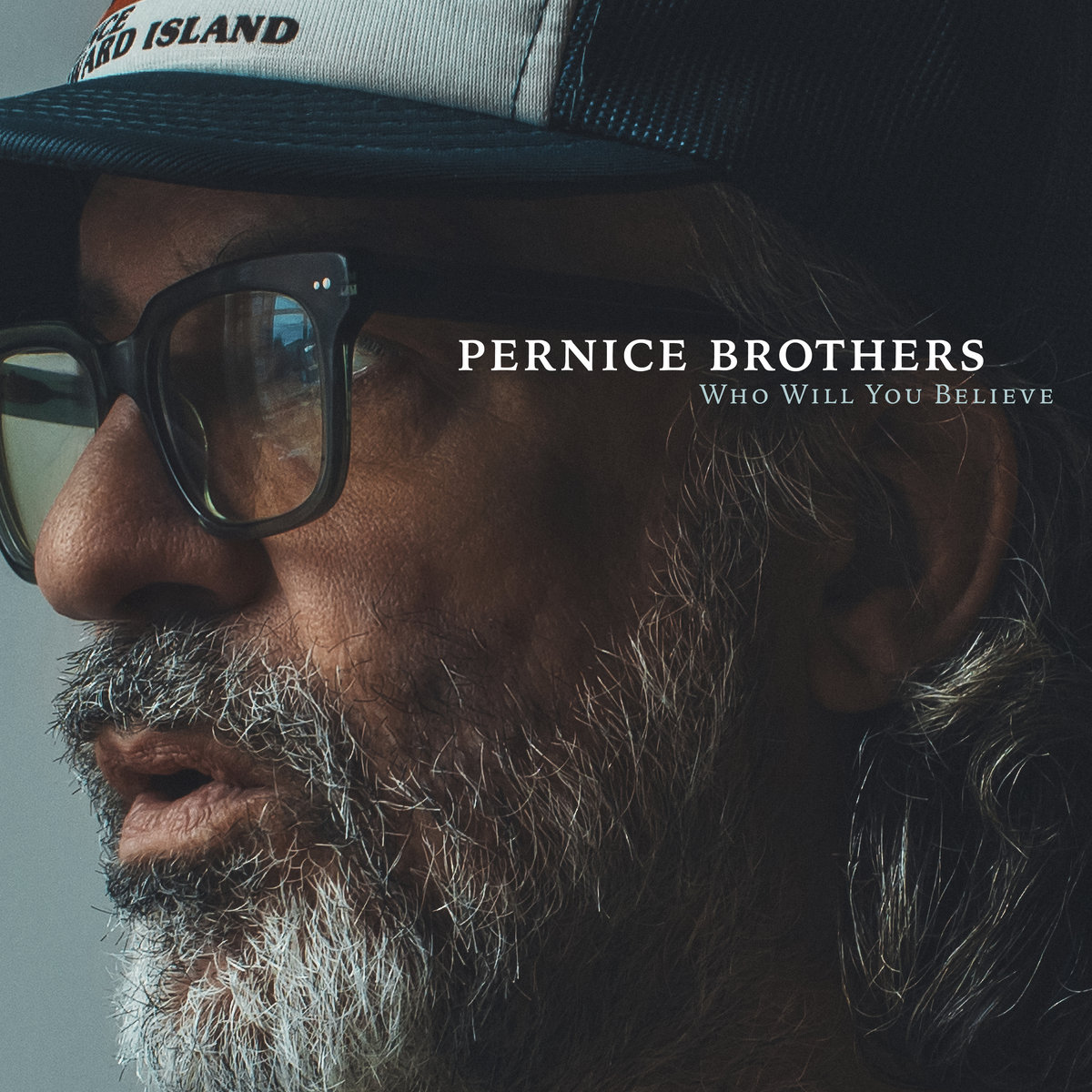
LP Review: Pernice Brothers - Who Will You Believe


Pernice Brothers
Who Will You Believe

During frequent listens to Pernice Brothers albums like Yours, Mine and Ours, Discover a Lovelier You and Goodbye, Killer, it sometimes feels as if Joe Pernice is rewriting the same couple songs with different lyrics. But it doesn't matter because they sound like some of the greatest songs ever written. If Pernice - the main driver behind the band that includes just one of siblings - isn't coming up with heart-rendering chord progressions built in layers, he's crooning over them in a voice that could be alternately soothing, weary or hopeful, often reaching into an upper register for the right amount of pathos. 

Pernice has always been a master at delivering sharp imagery in a line or two. To list just a few personal favorites: "Won't you come away with me and begin some thing we can't understand"; "If I was the only one and you were the last alive/ would we sit there like the amateurs and watch our days go by/ waiting for the universe to die"; "Scratched your farewell couplet in my window frost." Then there's his skill at merging high brow and low brow, as in the song about being obsessed with someone reading both Ford Maddox Ford and Jacqueline Susann. (I believe the latter inspired a song of mine, at least as a starting point.)

In an interview included with the live Nobody's Watching CD, the singer confesses a fondness for the Best of Bread 8-track tape that belonged to his mom. Part of me nearly died, wondering how this literate tunesmith took inspiration from David Gates' limpid music. Then I heard a few of Bread's hits again. While I'm still not fond of "Baby I'm-A Want You" or "It Don't Matter to Me," the power of their pop structures and the falsetto middle eights can't be denied.

Who Will You Believe includes a song that checks off all the boxes required for a strong country song about good loving that has died. For starters, it's called "I Don't Need That Anymore." He doesn't have to elaborate on what "that," is, because the rest of the song spells it out. Playing Dolly to his Porter is no less than Neko Case, who brightens up the second verse. There are plenty of ways to say it's over, but among the images used here, the best might be "I don't feel the pull of sirens singing anymore." Nashville needs that song.

The only thing absent from the track is a third verse, in which Pernice and Case could have harmonized together. Sure, that might override the point of the song but it could have driven it home, musically. That missing lyrical element also affects songs during the first half of the album. A number of them throw out a few good lines but their storylines get blunted by refrains that pop up too frequently. None are bad songs, but it feels like they could have done more.

"December In Our Eyes" really nails the '70s soft rock arrangement, with electric piano, congas and mellow trumpet. Here, Pernice's storytelling skills get a workout, but the song's instrumental coda, complete with strings, could have faded sooner. On the other hand, the six-string solo in "Hey, Guitar" threatens to turn the scene into Mott the Hoople's "Rock and Roll Queen," a touchstone that feels accurate what with the song's trick ending, which evokes Mott's early album studio tricks.

Seven different guitarists are credited on the album, including Pernice and brother Bob, though personnel is listed collectively. When our hero goes it alone with just his acoustic guitar on the last three tracks, at least at the start of each one, these songs have the most dramatic impact. "Ordinary Goldmine" follows "I Don't Need That Anymore" and feels like it picks up where the other left off.

"The Purple Rain" could be another break-up song but sources have indicated it might be for friends that have passed. In keeping with the feeling, strings and a brass ensemble ease into the arrangement before a literal choir chimes in for the final chorus. Rather than rise to a dramatic crescendo, however, the song doesn't overplay the feeling and ends calmly. If "The Purple Rain" is about friends that have gone, it might be the most poignant song of Pernice's career. If not, it still hits hard. 

Between both of those tracks, "How Will We Sleep" includes another telling line: "Growing old seemed like death to me when I was young/ Now I want to grow old/ And I want to belong." Playing indie music isn't just for kids, as well all know. But composing it, and ruminating about the passage of time can be a challenge. As Who Will You Believe fades, it's clear that Pernice has a handle on both. 

Tuesday, July 30, 2024

A Talk With Micky Dolenz

Monkees enthusiasts can likely recall a scene from the episode of the show called "The Monstrous Monkee Mash." While Mike Nesmith, Micky Dolenz and Peter Tork are searching for Davy Jones in a haunted house, Peter disappears. The realization inspires Mike and Micky to break the fourth wall, yelling at the camera in unison, "HE'S GONE!" (It was a recurring joke on the show.)

"Maybe we make it a duet," Micky asks Mike. "If you leave, I'll be a single."

Without missing a beat, Mike imitates the opening thump of their theme song, and Micky sings in a mock-hysterical voice, "Here I come/walking down the street/I get the funniest looks from/ all the people I meet/ Hey, hey, I'm a Monkee!" 

The sequence of that hilarious scene probably unfolds quicker than it takes to read about it. But it's become strangely true. With the passing of Mike Nesmith in late December 2021, Micky Dolenz is now the last surviving member of  the Monkees. (Davy died in 2012; Peter in 2019.) What started as a television show that brought the zeitgeist of  A Hard Day's Night into the living rooms of Middle America became much more than that. Some top shelf composers and the Wrecking Crew session players of Los Angeles helped to launch these four disparate lads into pop stardom. (They proved they could play the instruments and take control of the studio process along the way, but that's another story.) Most of the band's biggest singles had Micky Dolenz singing lead. And damn, could that kid sing! 

At 79, he shows no sign of slowing down. Though he could rest on some extremely catchy laurels, Dolenz has continued to be a productive performer with a scope that goes beyond his heyday. 

Before his guitar-slinging pal passed away, Micky recorded Dolenz Sings Nesmith, an homage to his longtime pal which took some deep cut Monkees tunes as well as some of his solo material and, with the help of Christian Nesmith (Mike's son), helped to reimagine them in some bold new arrangements. (Incidentally, the original inspiration for the album came from Nilsson Sings Newman, in which singer Harry paid tribute songwriting singer pal Randy.)


Earlier this year, Micky - who had previously done a full-length salute to Carole King -  paid tribute again, this time to a band that took some jangly inspiration from him years before. Dolenz Sings REM might only be an EP, but it proves that Micky still pays attention to the modern cats. There's something exhilarating about hearing him sing "Radio Free Europe." Even those of us who might not be too keen on the original "Shiny Happy People" can be won over by his version (thanks in part to the soaring back-up singing of Micky's sister Coco.) With a front cover shot depicting our hero in a car in front of Wuxtry Records (the Athens, GA record store where REM members Michael Stipe and Peter Buck first met), it betrays a genuine love and hat tip to the band. (Hopefully a sequel will follow someday.) 

Throughout all of these modern projects, one fact becomes clear: Micky still has a strong set of pipes. When he comes to South Park Amphitheatre this Friday, August 2, the performance has been titled "Micky Dolenz: Songs and Stories." No mere nostalgia trip for the almost octogenarian, he calls the evening "a flat-out rock concert." 

Micky and I spoke by phone for 20 minutes about a week ago. For a fellow of his stature and a fellow of my Monkees devotion, that time is a mere drop in the bucket, but any time with this charming guy is worth it. Plus having spoken with each Monkee except Davy Jones, the opportunity was not something I wanted to miss. 

When we finally got past some phone issues, I wanted to avoid the tired stories that we all know and kept it to a few leading questions. Micky proved himself to be plenty loquacious, sharp as a tack and a bit humble to boot. He started off talking about his connection to Pittsburgh from the start of his performance career. 

Micky: Before we start, I’ve got a little bit of trivia for you. 

Lay it on me.  

Guess where the first public performance I ever had was as a singer. And I was also playing guitar. It was in 1955. I was 10 or 11 years old. It was my first performance onstage in front on an audience singing a song and playing a guitar.

I think I remember you telling this once at a concert. 

Uh oh!

Was it at Kennywood Park?

Yes it was!

Did it involve an elephant?

I was on a promo press junket for this series that I was doing called Circus Boy. I had a pet elephant called Bimbo. We came out, cross country by train because, obviously, they couldn’t put the elephant on a plane! That was my pet elephant in the show, We were on a press junket doing personal appearances: Kennywood Park; in Chicago there was something, I think the Pump Room. In New York, Grand Central Station. And then in New York, up onstage with the Rockettes at Radio City Music Hall.
But that was my first performance. And I have it on tape! I came out with a little local three-piece band and sang a few songs. Then the elephant came out and did a bunch of tricks with the elephant’s trainer, of course. Basically, in my first performance as a professional, I opened for an elephant! I love telling that story.
I love Pittsburgh. I think it’s so beautiful. All those beautiful houses overlooking the rivers. Fantastic!

I also have little bit of Pittsburgh trivia related to you. My uncle used to be in radio here and he went out to California in the '60s and became a bit-part actor and was on two episodes of
The Monkees.

Wow! What was his name?

Rege Cordic. He was the Town Cryer in [the episode] A Fairy Tale and the doctor in the Christmas episode.

[Sounding genuinely excited] Wow, how cool! Is he still with us?

No, he passed about 20 years ago. But he had a really rich baritone voice. And that actually leads into what I wanted to ask you too. How do you preserve your vocal pipes after all these years?

Funny you should bring that up. I’ll tell you what I’ve done it over the years. But first I have to tell you, I had a bit of laryngitis for four months. I still have a little bit of a croak, nothing as bad as it was. But I had to cancel a couple of shows, it got so bad. We tried to figure out what it was. My EMT specializes in voice. It’s been a real challenge for me. I don’t know where it came from. I don’t know why. It just hit me. I couldn’t talk, I certainly couldn’t sing. For months it’s been going on. I just saw him again yesterday and it was a lot better. I was focusing on the shows this weekend. And it’s going to be fine. They figured it out and it’s gotten incredibly better.
I’ve been asked this question a few times. You know your vocal chords are muscles, right? So if you think of it almost like a sport. In my case, my mother and father were both singers, actors and performers. So part of it is inherited. Part of it is the luck of the draw, inheriting the right musculatures, as we call it. Then of course there’s the training. If they hadn’t been in the business, I might never have utilized my voice. But they were, so over the years, as a child I learned to sing very young. My mom taught my sister and I how to sing. How to sing harmonies. And then, it’s a little bit nature and a little bit nature.
During the Monkees, boy, I was singing a lot. I never had a coach. But I had people, and a bit of advice here and there. I got very, very lucky after the Monkees. Well - luck or design. I never ended up going through that period, post-Monkees, in the '70s and '80s, going around to sing in smoky, dingy nightclubs with no monitors. That wiped out a lot of people, as you can imagine.

I moved to England and I didn’t sing a note, hardly, for 10 to 12 years. I was directing and producing television and movies. I went through, again, a bit of the luck of the draw. It was by design. I wanted to be a director at the time, after the Monkees. So I missed that 10 or 15 years where all of my contemporaries were singing in smoky [bars]. It was horrible in clubs, in concert, everywhere. We didn’t have monitors. Not in those early, early days. You were singing over the band. and you only heard yourself bouncing off the back wall. So it was brutal on people’s voices. It also kind of saved my tubes, as it were, for 10 or 12 years. 
The biggest thing that happened, I would say – I don’t know how much you want me to go into this – was when I got a Broadway musical. It was Aida, the Elton John/Tim Rice musical. I was going to do it on the national tour and then on Broadway for about a year. And my manager said, “You should really take some vocal lessons.” And I said, “What are you talking about? I’ve been singing for 30 years!” And she said, “Trust me. Eight shows a week on Broadway, doing those kind of songs.” I said alright. And I’m so glad I did. 
It wasn’t about learning to sing, or reading music. It was about breathing. It had to do with how you save your vocal chords by breathing, and breathing exercises. And by warming up. That’s the next thing. I warm up before a show. I warm up before a tour. I warm up every day, doing exercises. Like you would for a sport. You wouldn’t go out and play Wimbledon without having warmed up or played a game in weeks.
Anyhow, sorry to ramble on.

That’s okay. The only other person I’ve asked about their voice is Johnny Mathis. And you gave a much more nuanced answer than him.

Johnny Mathis, one of my favorites, ever. He’s the first album I ever bought as a kid. I told him that when I met him.

I don’t know if this is totally accurate but I read that before the Monkees, you had considered going to college for architecture.

I did go. Oh yeah. I was in college, studying to be an architect. I had a couple of semesters under my belt. I was doing little day jobs, because I had done that series [Circus Boy], in the summer, on school break. Mainly just to make money. And I would get little bit parts. There was a show called Mr. Novak. Peyton Place. You know, guest star things.
My plan was to be an architect. And if I couldn’t make it as an architect, I could fall back on show business! I’m serious. 
I was in school when the Monkees audition came along. Obviously I took a couple of days, I went to the audition, then there were mini-auditions. I would just take off a day here and there to do the auditions. When my agent said, “You’ve got the pilot,"  I didn’t even quit school because I knew - back then to this day - most pilots don’t sell. I didn’t even quit school. I took a week off to film the pilot and then I went back to school! Then when we got the order for the first 26, that’s when I quit school.

Do you ever get existential and think about where we’d all be if you’d blown off that audition?

Oh boy. [Laughs] A lot. Or if they had chosen not to cast me. But I wouldn’t have blown off the audition. Not blown it off, my agent would have said you’ve got an audition for a pilot. I was up for three different pilots that year, all music shows. Because [music] was in the air. Yeah, I often wonder, or if they had chosen to go with someone else. Which would’ve happened, of course.

At what point did you realize, wow this thing is really freaking huge?

Yesterday! (Laughs) No, it constantly amazes me. A number of times in my life, like when I came back from England. It happened to be around the time of the MTV thing [in 1986, when the station reran the original episodes, eventually leading to a reunion tour]. That was a huge surprise.
No, I remember specifically when that [first] happened. It was in December of ’66. The show went on the air in September. We were in production, 24-7: filming the show eight to ten hours a day. Then, since I was doing most of the lead singing on the songs, I would have to go into the studio until midnight and record [songs]. Back then, of course, without social media and all that other stuff, you really didn’t get a sense of anything. There weren’t fans. There wasn’t paparazzi. There wasn’t anything like that. Because they couldn’t find you if they wanted to, people would try but…
So that Christmas came along and we got a hiatus from filming the show. I was planning to go up to the family home up in San Jose for Christmas. So I made my Christmas shopping list and I jumped into my car and I drove to the neighborhood mall. I was born and raised in LA, so I drove to neighborhood mail.
I just got out of my car to go in and get all my Christmas presents for the family. So I go through the big glass doors at the mall. All of a sudden a bunch people start running at me. I thought it was a fire. So I’m holding the doors opening going, “Don’t run! Don’t run! Don’t panic. Walk carefully!” And then all of a sudden, I realize, “Shit, they’re running at me!” And I was pissed off because I couldn’t do my shopping. I had to send one of the roadies to do my friggin’ shopping!
And that’s when I went, “Oh shit, something’s going on here.”

It looks like I’m at the 20-minute point with you and that’s my limit.

Only because there’s another [interview call] coming up. Do you want to ask about the show? 

Yes. I want to ask about the set list for the show. What can we expect?

What you can expect is of course, all the big Monkee hits. That goes without saying. I always do them in their entirety because I know a lot of people and a lot of the fans there may not be familiar with all the other Monkees stuff, I know that they want those big hits. So I made a vow years ago that I would make sure that everybody got those hits. But then I discovered over the years of playing, as long as they know they’re going to get the hits, you can go off and do different things. You can do deep album cuts, which I have, or you can even do non-Monkees material because they know they’re going to get those hits.
In this latest iteration, it again still all the big hits, with a nice seven-piece band. Then not long ago, I started telling stories. I would ask the audience, do you want to hear stories. And they were like, “YEAH!” So I start telling stories about the day and about the Monkees and about my experiences and specifically about people I knew. Like specifically, I tell a story about Stephen Stills. I’m not going to tell the story now because you have to come to the show! (Laughs) And then sing a particular song. I tell a story about Jimi Hendrix opening for the Monkees. A lot of people don’t know that. Then I sing an appropriate song. And other examples: I tell about meeting the Beatles and going to Abbey Road Studios when they were recording Sgt. Pepper. And I sing a song. I remember them recording when I was there. And people seem to love it.

I’m really looking forward to it.

I hope you can come.
 
Oh, hell yeah, man! Me and some friends of mine from work are already looking forward to it.

Friday, August 2. 7:30 pm. South Park Amphitheater, 100 Farmshow Rd., South Park Twp, PA 15129

Saturday, July 20, 2024

CD Review: Jason Stein/Marilyn Crispell/Damon Smith/Adam Shead - spi-ralling horn

Jason Stein/Marilyn Crispell/ Damon Smith/ Adam Shead
spi-ralling horn
(Balance Point Acoustics/ Irritable Mystic) irritablemysticrecords.bandcamp.com/album/spi-raling-horn

In person, the trio of Jason Stein (bass clarinet), Damon Smith (bass) and Adam Shead (drums) combine integrated three-way free improvisation with somewhat theatrical, surreal elements. Their visit to town in 2022  included moments when Smith had several bows wedged between the strings of his instrument; Shead dismantled his drum it, leaving pieces spread around the performance space, with electric toothbrushes vibrating inside the shells. Their Hum CD (2023) captured the energy of those trio performances.

spi-ralling horn ups the ante a bit, with the great pianist Marilyn Crispell joining the trio in the studio. Whereas Hum features two 20-plus minute performances, this session bands a 63-minute set into seven tracks. Each one has distinct qualities, yet the whole album is best appreciated in one sitting, since it provides a deep look at the imaginations of these players and how they work together.

Maybe it's pure coincidence, but Crispell waits 50 seconds to join Stein, Smith and Shead on "a song paid by singing." She begins tentatively, but fits right in immediately, straddling the space between the bass clarinet's lengthy threads of melody - which ran across the instrument's whole range - and the ever-shifting rhythm section.

In that opening piece and the following "a universe of otherwise," the quartet moves on pure energy. Crispell, whose more recent albums as a leader have been more delicate than her work with Anthony Braxton or her own trios in the '90s, can still get aggressive and she moves in waves full of dynamics. As Stein winds down on this track, without fully stopping, some noises float to the surface, keeping the source (Smith's bows, Shead's percussives?) a secret that still enthralls.

The group could probably could have kept moving freely and maintained focus but things branch off in the next few tracks. "the ground laid open" begins with piano and bass clarinet in a duet (almost playing counterpoint in a few moments) before turning the focus to Smith and Shead. "saturant moon water" is a hypnotic tone poem with cascades of quiet chords, bowed harmonics and sustained high pitches. From there, the group shows how delicate they can get without sacrificing depth in "so close it cut my ribs," a title that contradicts the ballad-like pedal point movement of the piece. 

If Smith's bass was overshadowed during the early part of the album, he opens "a rusted bell's clank" out front of Shead's hi-hat, making his whole instrument resonate deeply without resorting to any extended techniques, not even a bow. Brevity is good but he leaves us wanting more. Free improvisation can often end ambiguously but the album's last track does with definitive exclamation points. After Crispell joins Shead for a brief duet that recalls the best moments of Cecil Taylor and Andrew Cyrille, the drummer brings the set to a climax with some loud snare crashes, signalling that they've reached an ideal spot in the performance. That kind of thunder brings an audience to their feet.

The meeting of Crispell and the Stein/Smith/Shead trio came together due to the pianist and bassist's mutual admiration of visual artist Cy Twombly. The album's cover art, and presumably the track titles, originate from the artist's work. 

Monday, July 08, 2024

CD Review: Travis Reuter - Quintet Music


Travis Reuter
Quintet Music (self-released)

Birds of Fire was the first Mahavishnu Orchestra album I ever heard. Two-thirds of the way through, I turned it off. That was close to two decades ago, so details are a little fuzzy. But I think I gave up around "Sanctuary" in large part because it felt like four out of the five musicians were playing the equivalent of 1-2, 1-2-3-4, 1-2-3, 1-2-3-4-5, 1-2-3, 1-2 in tandem and it just felt too rigid. And hyper.  John McLaughlin fans will cut me some slack, I hope. My assessment is more metaphorical than literal. Besides I'm telling you that story to tell another one.

The fuzzy memory of Birds of Fire came back to me while listening to Quintet Music, the second album by Travis Reuter.  No one, including this writer, will mistake the guitarist for a McLaughlin apostle, but he does write some particularly knotty compositions that divide his quintet into various sections, with bass and drums playing together in a choppy but taut manner, while tenor saxophonist Mark Shim, vibraphonist Peter Schlamb and Reuter himself play melodies or improvisations (or both, maybe) in front of them. There are times when the guitar and vibes shift to foundational support too. Shim frequently plays in the lower range, adapting his tone to the point where he almost sounds like he's playing a baritone. 

Bassist Haris Raghavan has the herculean task of bouncing between the front line and locking in with drummer Tyshawn Sorey. A striking example of this comes in "Same Song," when he and Schlamb ever so briefly join forces and create a cluster that sounds like an old school pinball bumper being hit by the ball. Sorey, who often takes other composers' convoluted tempos and helps our ears make sense of them, almost does the opposite on this session. His parts sound busy, pushing hard against the rest of the group and often making it hard to latch onto the music.

There's no sin in writing or playing that way, of course. Tension can be fun. In "#13 F34," Schlamb begins by soloing over Reuter's ringing chords; by the end, they switch roles. "#9 Low/High 1" starts with a clear guitar line, which Raghavan echoes, while Sorey goes wild over. The piece, one of only two that go beyond the seven-minute mark, switches to a different setting after two-and-a-half minutes but returns to the initial part at the end.

Most of the pieces stay below five minutes; Reuter, Shim and Schlamb each also get an interlude with the rhythm section, all of them coming in under two minutes. The brevity proves Reuter doesn't try to overpower his band with too many ideas. "#8 D@z" keeps it single length (3:18) yet still manages to have Shim and Schlamb trade solos back and forth. 

But "Fast Louis," which comes next, begins with little variation in terms of dynamics. It could be the same track. Granted, the whole piece (the other extended track) ultimately has more space instead of cramming it with caffeinated ostinatos and lines. Yet, the 10 tracks on Quintet Music starts to run together after awhile. Finding the subtleties between them requires a deep dive. Sorey's drums occasionally sound as if the depth of his parts isn't captured as clearly as it could have been, which might take away from the group. There were times when I wanted to see this band in person, to see how they bring this music together. That setting could bring out nuances that the speakers only hint at. It also makes me curious to hear Reuter's 2012 debut Rotational Templates, which utilized electric piano instead of vibes.


Friday, June 21, 2024

Dish It Out: Remembering James Chance

The Contortions, on the No New York compilation.
Chance is pictured top left.

Before John Zorn, before Eric Dolphy, before even Charlie Parker, the alto saxophonist that fascinated me was James Chance. I took up the alto in tenth grade and while I was starting to get into jazz, I hadn't bought much jazz other than Bitches Brew and Albert Ayler's Vibrations (which I bought within about a week of each other). Most of my record purchases were punk rock. James Chance bridged the gap between that style and jazz. In fact, he kind of bridged the gap between Bitches Brew and Vibrations. 

It all comes rushing through the speakers in opening seconds of "Dish It Out," the opening track by the Contortions on the No New York compilation. Jody Harris bangs out a trebly guitar chord, which gets answered by George Scott's rubbery bass. Then Chance starts wailing in the upper register of his horn. Forget melody or harmony. It almost sounds like James chooses certain fingerings on the horn, rather than the pitch it produces. He certainly feels the groove his band is playing, which eventually includes Pat Place's yowling slide guitar and Adele Bertei's organ, which to my ears has always been a beautiful evocation of thunder and lightening. While Chance's horn sounds "wrong" on purpose, Bertei's keys seem to do something more deliberately against the grain.

Chance's vocals on the track might have been inspired by James Brown but his execution seems more like a pissed off dad. It'd be a few years before Ian MacKaye would front Minor Threat and make this level of hostility into a common vocal style. In 1978, no one sounded this rabid. 

Speaking of James Brown, the Contortions final track on No New York was a cover of the Godfather's "I Can't Stand Myself." According to Bertei (I think it's in her memoir but I definitely read it online), the group had never played the song before and ran through it as a soundcheck in the studio. It chugs along on one chord, bolstered by a Harris guitar solo that tries to force a chord change (doesn't happen), climaxing with an abrasive wail from the singer that cues an equally shrill sax solo. 

Could he really play, my innocent mind wondered. The only way to find out was to check out everything. Buy by Contortions. Sax Maniac by his later group, James White and the Blacks. Off-White by the same group. Some of them were pretty good. Some felt a little jokey in a dry sort of way. ("Stained Sheets" in which Lydia Lunch moaned over the phone to an incredulous, hostile James.) But what  was impressive was the way his band, which at times included trombonist Joseph Bowie (brother of Lester, of the Art Ensemble of Chicago), would sound like they were just riffing away but all of a sudden they'd reach a stop-time like clockwork. 

Chance put together a new version of the Contortions in the early '90s, following the re-release of Buy on Henry Rollins' Infinite Zero label. He came to Pittsburgh, playing at Luciano's Coffeehouse, which once existed down the street from Duquesne University. The backing band seemed just a tad slick (the bassist had a six-string bass) but Chance was his usual self, blowing the high F on his horn, shooting down to the low B-flat and then flopping around in the middle. It might have sounded raw or primitive but this was his thing, his sound. Notorious for picking fights with audience members in New York, he claimed at the time he had sworn off that, after one incident damaged his suit. However, a friend who was at that show claimed on Facebook this week that Chance slugged him when he got too close to the stage.

Only today did I discover, through an obit, that the saxophonist studied with the World Saxophone Quartet's David Murray prior to forming the Contortions. Chance spoke to me when I was writing a feature on Joseph Bowie for JazzTimes in 2016, an interview that had been about three decades in the making. Hailing from Milwaukee, Wisconsin, he had a love of both the Stooges and jazz of all stripes and had wanted to combine the two.

Upon arriving in New York in 1975, he immersed himself in the loft scene, playing with the Bowie brothers and drummer Charles "Bobo" Shaw. "One thing I liked about those guys is they had an obvious information of rhythm and blues in their playing," he said in our phone conversation. "Even though they were mostly playing free, a lotta times it would go into funk rhythms, even though… at the La MaMa [Theater, in the East Village], they didn’t even have a bass player usually. Or even any rhythm besides drums." He went on to talk about saxophonist Henry Threadgill and trumpeter Ted Daniel playing in James White and the Blacks. 

During the conversation, it started to become clear that Chance's sound on the alto, as raw as it seemed, was a conscious choice to make him distinct in a scene of players. He might not have been playing straight - or even avant garde - jazz, but he knew it was important to have his own sound to set him apart. 

Chance's last performance seems to have been pre-pandemic, according to the obit linked in his Instagram page,  March 2019 in Utrecht. More recently, a gofundme campaign was started to help him deal with medical bills. When he and I talked in 2016, he mentioned that someone in Pittsburgh had expressed interest in bringing him back to town, but unfortunately it didn't happen. Chance (who was born James Siegfried) died on June 18, 2024, though cause of death was not disclosed at the time. 

Thanks, James. 


Sunday, May 26, 2024

CD Reviews: Matthew Shipp Trio - New Concepts in Piano Trio Jazz, Rich Halley - Fire Within


Some time last year, I hatched a plan to write a piece about ESP-Disk's reissue of Matthew Shipp's 1990 debut album, Circular Temple, in tandem with his then-new solo piano disc The Intrinsic Nature of Matthew Shipp (Mahakala). The blog post was also going to discuss music journalist Clifford Allen's book Singularity Codex - Matthew Shipp on RogueArt, which covered his subject's extensive releases on that French imprint and offered insight into the pianist's work through interviews with people who have played with him, recorded him and released his work. For whatever reason - procrastination, malaise over the state of jazz journalism in early 2023, worry that I couldn't find a way to talk about Shipp's work - the piece never materialized. 

The good thing about Matthew Shipp is that, despite any talk that he might retire, his studio output has yet to slow down. Here we are with two examples.

Before we get to that, a few words about Allen's book, which is still as relevant today as it was in 2023. At just over 200 pages, with slightly less than half of it devoted to examinations of Shipp's RogueArt albums, Singularity Codex still delivers a good look at the pianist as a whole. Discussions with bassist William Parker, saxophonist Rob Brown and guitarist/bassist Joe Morris come in strict Q&A layouts, which can sometimes make assumptions about the readers' background knowledge and skip on details. But Allen makes sure details are covered. 

Some of the conversations might get into minutiae, but presumably, the people picking up the book are Shipp fans who enjoy that. Considering how Shipp can be a little reticent in interviews (his voice only appears in the back cover endorsement), the words of his peers  make up for it. The third section, on the albums themselves, might even make the reader want to find a particular session that is not already on their personal shelf. 


Matthew Shipp Trio
New Concepts in Piano Trio Jazz
(ESP-Disk') www.espdisk.com

If the title of the latest disc by Shipp's piano trio seems a little bold, it follows a trajectory of some of his previous ones, like the aforementioned Intrinsic Nature of Matthew Shipp or The Conduct of Jazz (2015) and a track called "When the Curtain Falls on the Jazz Theatre" (from 2009's Harmonic Disorder). But it also holds true in describing the eight performances on the album. 

One of the new concepts seems to be the approach drummer Newman Taylor Baker takes on in the band. On this session, he comes off as a master of restrain and someone who fills in the background cautiously and freely. In a few tracks, his contributions seem limited to a few cymbal crashes or washes. There have been numerous drummers who have played freely behind the piano and drums, but Baker's performance often sounds closer to a third voice, rather than a rhythmic instrument.

"Sea Song" begins with 34 seconds of brushes on drum heads, nearly impossible to hear at first. When Shipp and bassist Michael Bisio join him, Baker continues to act as the waves drifting in the background, only getting a bit more animated in the last couple minutes.. Bisio, playing below his instrument's usual range, comes off like a rugged on hull on the high seas. Shipp doesn't stick to a set of changes, but flows with a continuous set of ideas that also evoke the openness of the sea. 

A steady walking bass in "The Function" gives Shipp and Baker room to spin whatever ideas strike them. The pianist casually throws in some Monk-like filigrees and accents and some of his signature low-end, sustained strikes, all of them usually lasting a few brief bars. Meanwhile Baker seems to tinker with his kit, tapping out ideas and leaving space wide open between them. 

To be clear, none of these qualities detract from the power of the album. If anything, they add a level of intrigue. The upper strata of this intrigue is of course Shipp, who continues on a musical path that becomes more idiosyncratic as he goes. He and Bisio have worked together so closely that the sparse movement of "Tone IQ" sounds full. "Brain Work" is a detailed solo piano piece, beginning with notes collapsing onto one another without any feeling of clutter. It actually feels like one large idea that requires three minutes to play. 

"Coherent System" is the album's closing epic, at 11 minutes significantly longer than the 10 preceding tracks. It constantly morphs into different shapes, with tempos rising and falling naturally. Baker takes a cue from the low end of the piano and plays on the snare almost like a march. Without much transition, Shipp into waltz time, before returning to the march, stopping at some point to add a classical flourish.

If it all sounds a little hard to imagine, that is because a piano trio has never come off this way before.


Rich Halley
Fire Within

Tenor saxophonist Rich Halley resides in Portland, Oregon where he has worked extensively as a band leader (releasing 25 albums) and founder of the state's Creative Music Guild. He has also played Vinny Golia, Nels Cline and Andrew Hill, to name a few. Fire Within is his third album with all three members of the Matthew Shipp Trio (following 2020's The Shape Of Things). All five tracks are credited to each player, which implies that this was a spontaneous session, although there are moments where Halley hits on a line that could be a pre-determined theme.

He opens the title track with a lick that acts as a fanfare and when the group joins him, there's no doubt that Shipp is the pianist, performing his familiar staccato dance on the keys, as Bisio and Baker roll behind him. This is no session where the trio bends to the wishes of the leader. Baker, quiet on the previous album, comes alive with a solo on this track that relies on drama and dynamics and builds to a crescendo. 

While things definitely feel free and unwound at times, these moments are balanced by tracks like "Angular Logic" where Shipp's chordal vamp moves in tandem with Halley, whose rich tone builds to frantic levels. "Through Still Air," where Bisio's high bowing meets Halley on an even level, almost feels like a ballad, but something unsuspecting is in the water. There might be an old standard quote courtesy of Halley, and the whole piece ultimately brings Andrew Hill to mind. 

The quartet excels best in the longer pieces where they take time to work through ideas. "Inferred" is one of the best, beginning with a bass solo that starts in a contemplative mood, working into a mournful tune before Shipp creates a tornado and lifts Halley up, going through different shapes before returning to the pensive feeling from early in the track. 

Fire Within has a different set up than New Concepts In Piano Trio Jazz but Shipp's unique approach is still recognizable. It's also nice to hear him in the company of a strong tenor saxophonist like Halley again.

Sunday, May 12, 2024

Messthetics & James Brandon Lewis Lift the Bandstand; Thoughts on Steve Albini

The past week was filled with some sad music news, not to mention a personal deadline to write about a particular jazz box set. But the week began with some really uplifting music, so our story is going to begin there. 

The Messthetics and James Brandon Lewis album on Impulse! has been in heavy rotation at home since it came out in March so the anticipation for the group's return to Pittsburgh was pretty high. When they came to Club Café last year, Lewis played a set with his trio and then joined the Messthetics for the end of theirs. But on Monday, May 6, the quartet was onstage the whole time.  


Punk rock and jazz have come together before several times. Saccharine Trust began as an arty punk band who went on to meld beat poetry and jazz riffs, before members of that band went on to form Universal Congress Of, who went even more in a mostly instrumental, improvisational direction. But both of those bands were heavy on feeling, which made up for a more primal approach to improvisation.

The Messthetics feature Joe Lally (bass) and Brandon Canty (drums), the rhythm section of one of the best known punk bands of all time - Fugazi. It's not an exaggeration to say that, since the band set a gold standard for honesty and integrity with their music, which inspired legions of musicians. Guitarist Anthony Pirog straddles all kinds of styles of jazz and rock. James Brandon Lewis is, quite simply, one of the most inventive tenor saxophonists around right now. 

With all four of these guys together, it's like a confluence of punk rock and jazz. That's obvious, but when they hit on Monday, suddenly there were no musical boundaries, no need to put a label on what they do, no chance to boil it down into easy to digest categories. If you have to ask, you'll never understand.


Sure, that's not exactly true. But the excitement that these guys delivered was on par with what Fugazi gave us, combined with the rich harmonic ideas that Lewis' Red Lily Quintet plays. There were times when Lewis was honking at the low end of his tenor, but it wasn't like the bar walking tenor players of bygone days, who were simply honking to get a reaction out of inebriated listeners. "The Time Is the Place" had urgency in the tenor solo, like Lewis had a message or an emotion he wanted to unleash. He knew what we needed. 

"That Thang," as the name might imply, had a hearty funk groove, backed up by some equally heavy chord work. Pirog's harmonic approach was also a quality that gave things an extra kick, with chords or melodies that expanded the sound. Canty's trademark bell, mounted on a cymbal stand, sat quiet for much of the set but when it was struck, you felt it. 

Lally was not a flashy player ,but he was solid, keeping it together with Canty, who rocked more than swung, which served the music well. As they were barreling through "Fourth Wall," which is built largely on a repeating figure that kind of stretches a triple meter over a backbeat, it occurred to me that this was probably what the MC5 was trying to do years ago, after listening to Coltrane and Sun Ra and hoping to incorporate their ideas into their music. Only this time, there were more than good intentions going on here. These cats have the vision and the skill to really pull it off and write the next chapter. 

Canty was the voice of the group, offering introductions and general info between songs. When one fellow in a corner of Club Café kept yelling out enthusiastic compliments, the drummer kept the mood positive and asked his name. "Steve," Canty told him upon learning it, "we love you." No lectures, no shushing, just love. It added to the camaraderie of the show and we all felt a little more connected to Steve. 

The local trio Else Collective opened the evening. Their guitar/bass/drums set up started off minimal and tense, with counter grooves making it a challenge to find a downbeat, if there really was a proper one. Parts of it sounded a little too rigid, but most of their pieces tended to open up as they continued, and that's when they created some heat. 

*
When a friend texted me that Steve Albini had died this week, I almost hit the floor. It wasn't that I was the hugest Albini fan or that I had some wild encounter with him somewhere along the way. I actually had mixed feelings about him as a person. He knew a lot about the music industry and wasn't afraid to call people out who he knew were shysters. 

He didn't suffer fools, but he didn't suffer the uninformed either. I still remember him getting prickly with a local writer who dared to use the word "producer" in relation to his work on an album. And Steverino ripped into him. He loathed being called a producer, believing that producers are the people who take over recording sessions and try to change a band's sound to fit someone else's needs. (I"m paraphrasing here.) I could see what he meant, but having dealt with so many indie rock folks that fly off the handle due to semantics, the response made me eyes roll a little.

Of course, I made sure other people knew how he felt about it too, if there were times that the p-word came up in relation to him. 

But there was that sound Albini created. It had the immediacy of a band playing in a basement party (to me, the ideal setting), with added clarity. Everything was alive and leaped out at you. Whether you wanted it coming at you was your choice.  The first artist that comes to mind is not Nirvana. It's PJ Harvey. I was both terrified and intrigued by "Rid of Me," which ends with her singing a capella, like she's gasping for breath after being held under water. 

When it comes to the whole "producing" thing, Shimmy-Disc founder/musician Kramer had the best take on it, posted on Instagram this week: "Steve was always right, about everything......with one very important exception: all that nonsense he loved to spout about not being a record producer. What a complete load of horse shit. Any debate over the evidence supporting that statement would just seem like comedy, to me. Artists trusted him, and he returned their trust by protecting them from harm in the studio. He did so simply by making sure that their recordings sounded like who they actually were. Sure, maybe it begins with "engineering", but...THAT, is 'producing.'"

The idea behind that is what breaks my heart. Albini, might have seemed like a self-righteous, smug little pud, but he cared. He really cared. He was committed to protecting artists from becoming what they weren't. Sometimes when you care about something, it might seem like you're on a mission, which not everyone understands, and it gets frustrating, so you lash out. And Albini realized that he was a jagoff, confessing to it in a now famous article from The Guardian last year. You rarely see that kind of honesty anymore.

But what's really sobering is that the guy was a mere 61 years old and died of a heart attack. That is too damn close to where I am now. It could happen to any of us tomorrow. I hope it doesn't. The world needs us.

Now go start your own band. And go to other people's gigs too.

Wednesday, May 01, 2024

GBV in Pittsburgh, April 27

GBV vocalist Robert Pollard, with drummer Kevin March and guitarist Doug Gillard
 
While waiting to get through the security check point at Mr. Small's on Saturday, my friend Tim and I met a couple of polite gents from Ottawa who had traveled to our fair town to see Guided By Voices. One of them asked how many times we'd seen them. I rolled my eyes and tried to think of an answer, and one of our new friends took that to mean "too many times to get an accurate number." But that wasn't the case. I just couldn't recall how long it's been since I last saw them. 

Checking past blog entries, the only show mentioned is the 2014 appearance, where Death of Samantha opened for them. I know I saw them at least once more before the pandemic. There was the one night I was milling through the crowd, scoop pad in my hand, writing down song titles, and two people asked me, "Are you [Post-Gazette writer] Scott Mervis?" At least they recognized my line of work.

Whenever the last show was, I recall GBV figurehead Robert Pollard seeming really snockered (more so than usual) but being impressed that the set ended after exactly 90 minutes, as he predicted. It was a good night of music, but his rambling between-song patter, coupled with the wall-to-wall GBV bros, made me wonder if I needed to see them again. The last GBV album I bought was....good. But I haven't been compelled to pull it off the shelf for a couple years.

Last Saturday, April 27, peer pressure started to weigh on me. (Though the peers that talked about going are actually much younger than me.) Besides, live shows give you something that you don't get sitting at home, listening while doing something else or nodding off in your easy chair. 

Mr. Pollard and the band delivered too. By the time the houselights and the p.a. music came on, approximately 135 minutes had passed since their set began. Pollard definitely had a few in him before he hit the stage (and speaking of hitting, he also took a drag off a joint that was passed to him by an audience member, after talking about the good old days of doing drugs at shows), but the desire to rock hard overpowered the desire to fall into his cups and perform that way. If you're going to sing for that long, even with breaks, it's important to maintain stamina and pace oneself, and Pollard did.

The set, naturally, cut a wide path through the band's songbook. Several Bee Thousand songs were pulled up, along with a few others from their days on Matador Records. If I was a good journalist, I might have kept count of how many songs they played, but it was hard enough maintain a spot in the crowd, amidst all the dudes raising index fingers and beer cans in the air when recognizing a song. (They'd kill me for saying this, but the way the diehard fans reacted to lyrics reminded me of the time I saw the Indigo Girls and members of the audience were acting out the words to songs.) 

But I shouldn't disparage some guys who were merely having the time of their lives. No one was slamming into innocent bystanders. And, thankfully, no dudes were groping ladies during the set, at least not what I saw. (I heard reports of that at prevous shows.)

Parts of the set took me back to seeing GBV in late 1993 at the CMJ Music Marathon, just prior to the release of Bee Thousand. There was a lot buzz surrounding the band and hoi polloi like Kim Gordon and Thurston Moore were in the audience. Onstage the music made me think of an indie rock take of A Hard Day's Night. Everything was short, concise and amazing. Last week, it was fascinating to hear so many songs all in a row, all sounding tight and well-written, all of them sequenced in the set so they didn't blend together or sound like "just another GBV song." Running order is crucial in these cases, and GBV takes that seriously.

The evening also reminded me of seeing GBV mainstay Doug Gillard's band Gem a few years later at CMJ, but for another reason. That band's set made me rue the choice to forego earplugs, as Gillard and Tim Tobias played some loud guitar with a healthy dose of high end. Gillard was equally loud last Saturday and as the evening wore on, these ears got a little more sensitive to all those power chords, as well as the roars of the crowd. In my defense, it had been a long day that started early that morning, included a full day of work, dinner with Mum and little less caffeine that I would have preferred prior to getting to the show.  

But it was a good time.

Due to the security line, openers the Gotobeds were, quite literally, playing the final chord of their set as I walked in the door. When Eli Kasan, their singer, asked me how that final chord sounded, I couldn't lie: it rocked. 

Tuesday, April 30, 2024

Recap of the African Rhythms Alumni Quintet + Memories of Randy Weston


Anyone who had the good fortune to hear Randy Weston play live, like the time he came to Pittsburgh in 2013, understood the musical lineage to which the pianist was connected. From the voicings he chose at the piano to the way he struck the keys, shaped the chords and phrased a melody - all the way up to the compositions themselves, the command of his playing felt like the direct link to the legends of his instrument that preceded him.

Saturday, April 20, Kente Arts Alliance, who brought Weston to town almost 11 years ago, presented the African Rhythms Alumni Quintet, a group of skilled musicians who all either played with the pianist or studied under him. In fact, three of them appeared at the 2013 show.

The evening's two-set performance paid tribute through a number of Weston compositions. Among the selections, "Hi Fly" is the one that has become something of a classic, having been recorded by numerous musicians, including Cannonball Adderley and Eric Dolphy. Many of the other tunes are not as well known, but the band played them with a passion that nearly forces you to dig out and rediscover more Weston music.


The whole quintet was top notch but I could have listened to pianist Sharp Radway play solo all night. He provided plenty of support for the other players but his solos made it clear that he sees his role as keeper of the Weston flame going. "Berkshire Blues" presented a great example of this, with the unique chord voicings that Radway chose. The song isn't a traditional blues, which only made it better. "The Shrine" began with a tritone vamp on the piano before going into a slow dirge that evoked Charles Mingus' "Meditations on Integration."

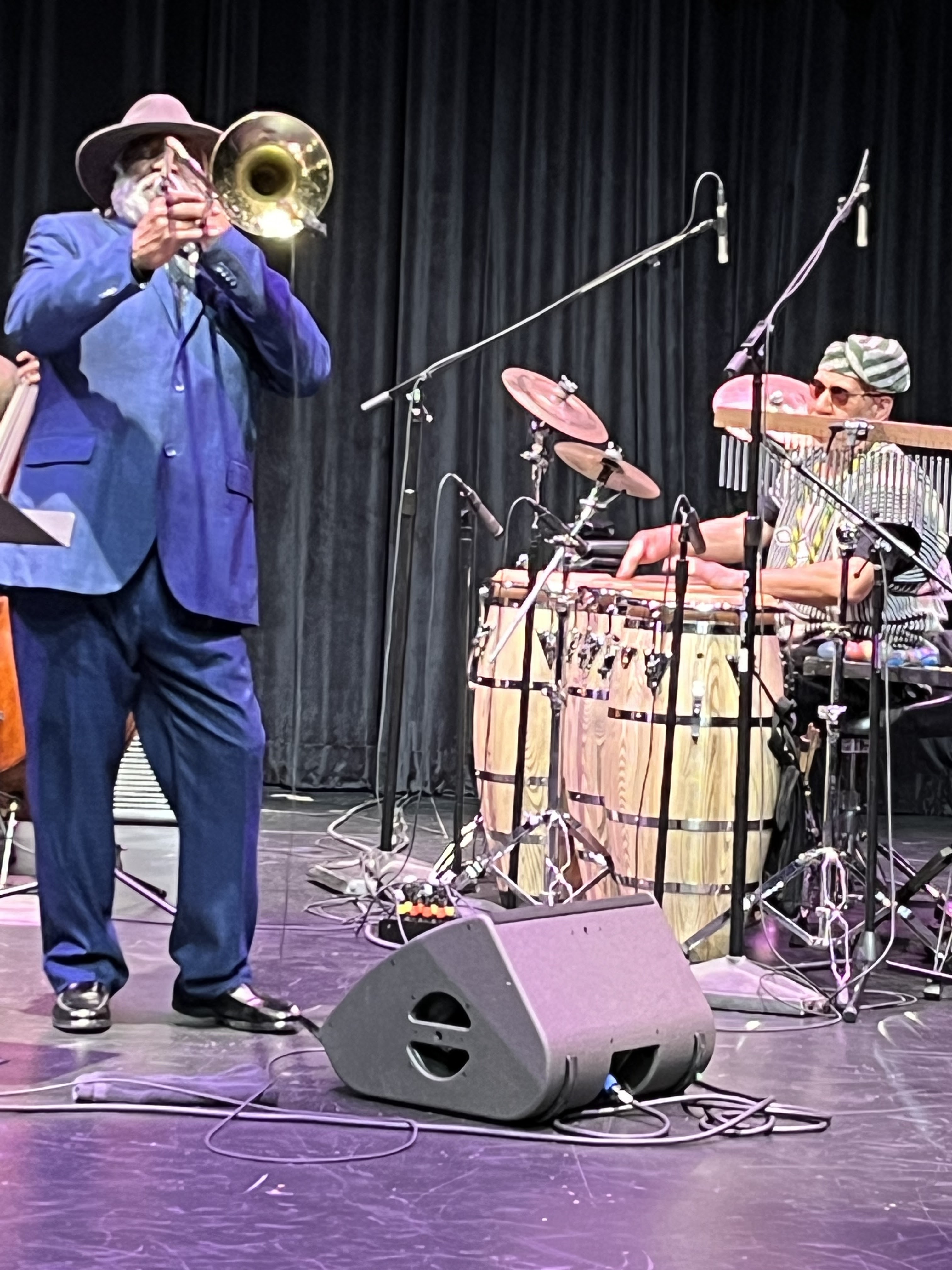
Alto saxophonist/flutist TK Blue served as the announcer for the band, engaging the audience with tales of Weston and adding bright and fiery solos to "Hi-Fly" and some vocal flute playing in "The Shrine." But if Blue was the m.c., bassist Alex Blake might have been the fire driving the whole group. As he did the last time he came to town, Blake sat down with his upright bass leaning towards him. Throughout the night, he walked, plucked and slapped it as was needed. He even did a variation on the Slam Stewart method of soloing, since he sang along with his lines, although there were times that it seemed like he might have been testifying. 


Trombonist Frank Lacy was the one musician, besides Radway, who didn't come to town in '13. His gritty 'bone playing has been a crucial part of the Mingus Tribute bands in New York (he also recorded his own album of Mingus tunes) and he also tears it up in the free wheeling trio 1032K. From the beginning of the night, he was flying high, bringing a heavy swing to "African Village Bedford-Stuyvesant" and making his horn yell. 

Finally, Chief Baba Neil Clarke kept the music driving, with three congas, a series of cymbals and nothing resembling a traditional trap kit. Considering Weston's vast knowledge of different musics from Africa and around the world, Clarke's set-up made perfect sense. His performance in "Little Niles" felt manic in the best possible way, highlighting a tune that has a long, flowing form, the likes of which are rarely heard in this kind of music. 

Speaking of this music, after seeing this show and unpacking it for a few days, I went back to my interview with Weston that preceded his visit. (He passed away in 2018.) One thing I recalled before looking at it was that he didn't use the word "jazz." "I never heard a musician say to another musician, 'We’re going to go play some jazz,'" he said. "Interesting, huh? Instead, [they’ll say], “We’re going to play Duke’s music or Billie Holiday’s music or Benny Goodman’s music.” We never use the word."

What I had forgotten was that Weston saw himself less as a musician and more like a storyteller. "Music is spiritual. It’s taken me from Bed-Stuy growing up, to the black church, the blues, big band and all over Asia and Africa," he said. "So I tell stories about my experiences, about African-American culture, African culture and the spirituality in music itself." 

It's good to know those stories are continuing to be told.